
The Mexico City Policy: An Explainer
Understanding the Trump Administration’s “Promoting Human Flourishing in Foreign Assistance” Policy
Editorial Note: Originally published in Jan. 2017, this resource is updated as needed, most recently on Feb. 17, 2026, to reflect the latest developments.
Key Points
- On January 27, 2026, the Trump administration released details of the latest iteration of the Mexico City Policy (MCP), now part of a broader umbrella called “Promoting Human Flourishing in Foreign Assistance (PHFFA),” significantly expanding the policy to encompass more funding, more organizations, and new policy areas.
- First announced in 1984 by the Reagan administration, the Mexico City Policy has been rescinded and reinstated by subsequent administrations along party lines and has been in effect for 23 of the past 42 years.
- Historically, when in effect, the policy had required foreign non-governmental organizations (NGOs) to certify that they would not “perform or actively promote abortion as a method of family planning” using funds from any source (including non-U.S. funds) as a condition of receiving U.S. government global family planning funding. This was expanded by President Trump in 2017 to encompass the vast majority of U.S. bilateral global health assistance (including PEPFAR, maternal and child health, malaria, nutrition, and other U.S. global health programs). The latest expansion now includes most non-military foreign assistance and applies to U.S. NGOs, international organizations, and foreign governments, as well as foreign NGOs. In addition to abortion, it prohibits the promotion of “discriminatory equity ideology” and “gender ideology.”
- KFF estimates have found that almost $40 billion could now be subject to the policy restrictions, billions more than during the first Trump administration ($7.3 billion).
- While the full reach of this latest expansion will be shaped by broader changes to the U.S. foreign aid portfolio, potential legal challenges, and additional applications to other agencies and funding streams, it already extends well beyond the reach of what was in place during the first Trump administration.
What is the Mexico City Policy?
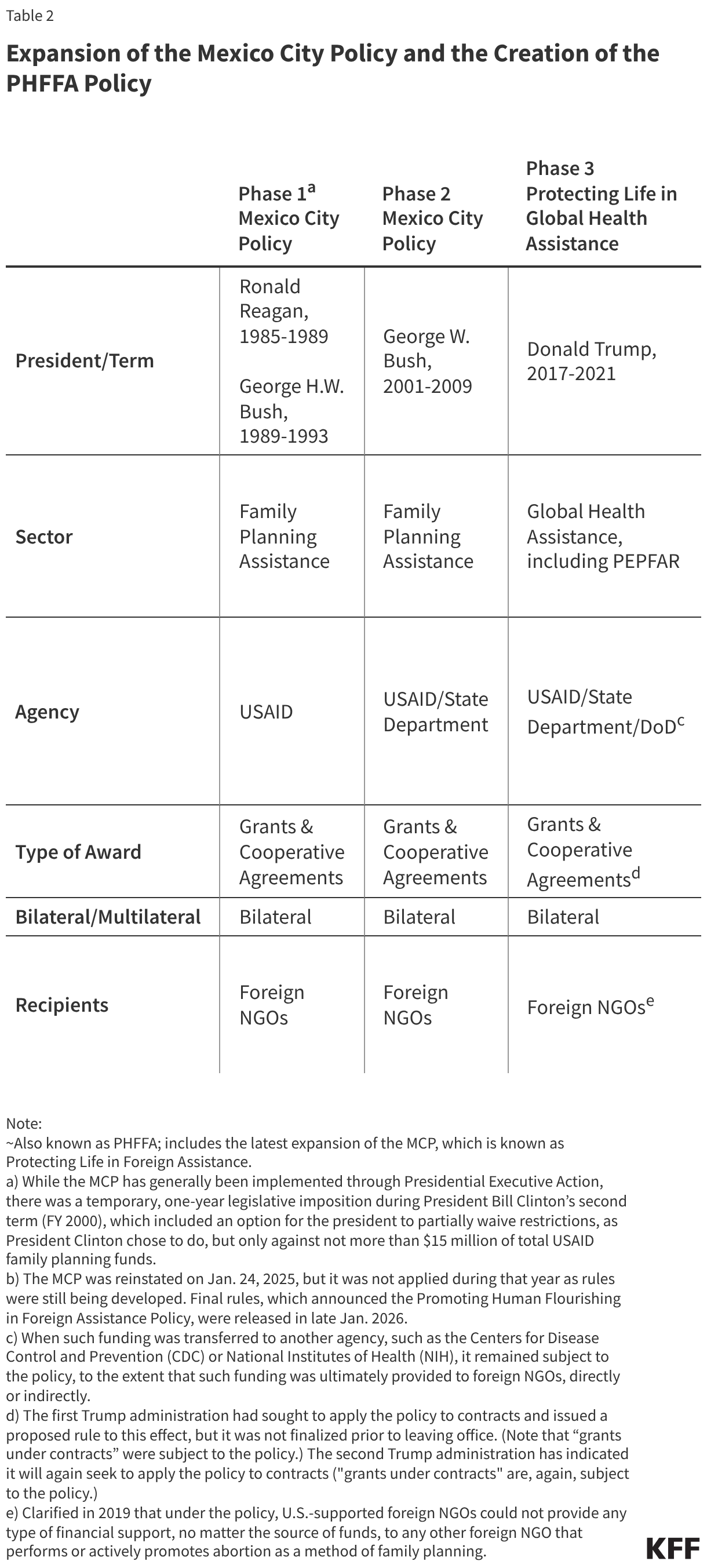
The Mexico City Policy is a U.S. government policy that – when in effect – has required foreign NGOs to certify that they will not “perform or actively promote abortion as a method of family planning” using funds from any source (including non-U.S. funds) as a condition of receiving U.S. global family planning assistance and, as expanded by the first Trump administration, most other U.S. global health assistance. The latest expansion, by the second Trump administration, applies to significantly more funding (most non-military foreign assistance), many more organizations (beyond foreign NGOs), and new services and activities (beyond abortion).The policy was first announced by the Reagan administration at the 2nd International Conference on Population, which was held in Mexico City, Mexico, on August 6-14, 1984 (hence its name; see Box 1).1 It was renamed “Protecting Life in Global Health Assistance” (PLGHA) in 2017, and now “Protecting Life in Foreign Assistance” (PLFA) as part of the broader “Promoting Human Flourishing in Foreign Assistance (PHFFA)” Policy umbrella. Among opponents, it is also known as the “Global Gag Rule,” because, in addition to prohibiting service delivery, it also prohibits the promotion of restricted activities, including through lobbying, referrals, and public information campaigns.
Box 1: The Original Language of the Mexico City Policy, 1984
“[T]he United States does not consider abortion an acceptable element of family planning programs and will no longer contribute to those of which it is a part. …[T]he United States will no longer contribute to separate nongovernmental organizations which perform or actively promote abortion as a method of family planning in other nations.”2
When first instituted in 1984, the Mexico City Policy marked an expansion of existing legislative restrictions that already prohibited U.S. funding for abortion internationally. Prior to the policy, foreign NGOs could use non-U.S. funds to engage in certain voluntary abortion-related activities as long as they maintained segregated accounts for any U.S. money received, but after the Mexico City Policy, they were no longer permitted to do so if they wanted to receive U.S. family planning assistance. During those years, U.S. funding for family planning ranged from approximately $300-$600 million annually.
When the policy was expanded by President Trump in 2017 to include the vast majority of U.S. bilateral global health assistance, including funding for HIV under the U.S. President’s Emergency Plan for AIDS Relief (PEPFAR), maternal and child health, malaria, nutrition, and other programs, it increased the funding that could be subject to restrictions to more than $7 billion.3 At that time, the Trump administration also moved to further tighten restrictions in how it defined “financial support,” reaching other areas of U.S. development assistance beyond global health and other non-U.S. funding streams. See “What is the definition of ‘financial support’?” below.4
Although President Biden rescinded the policy, President Trump reinstated the MCP through a presidential memorandum on January 24, 2025, directing the Secretary of State to “to implement a plan to extend the requirements of the reinstated Memorandum to global health assistance furnished by all departments or agencies,” which would reach beyond the 2017 expansion. Some organizations and members of Congress had also called for the policy to be expanded to apply to all foreign assistance, and last year, it was reported that the administration intended to include new areas of restrictions related to DEI and gender.
On January 27, 2026, the policy details were released under three separate, but inter-related final rules (interim final rules were first posted on January 23) as part of the PHFFA umbrella (see Box 2). The rules cite the presidential memorandum on the MCP and eight other presidential actions issued in January and February of 2025 that addressed foreign aid, DEI, and gender issues to “ensure that foreign aid is aligned with administration policy and promotes human flourishing.” As such, the PHFFA applies to most non-military foreign assistance and most recipients of foreign aid (not just foreign NGOs). In addition to abortion, it prohibits promoting “discriminatory equity ideology,” including activities related to diversity, equity, and inclusion (DEI), and promoting “gender ideology,” including providing gender affirming care, seeking legal protections based on gender identity, and other related services and activities. The rules indicate that the State Department will work with other agencies that administer foreign assistance to expand the policy further.
Box 2: Promoting Human Flourishing in Foreign Assistance (PHFFA) Policy
The Trump administration released details of its new Promoting Human Flourishing in Foreign Assistance (PHFFA) Policy, which includes the latest expansion of the Mexico City Policy, via three separate, but related, final rules on January 27, 2026. Each rule applies to the same funding streams, types of organizations, and award mechanisms but restricts different activities and services:
- Protecting Life in Foreign Assistance (PLFA): prohibits recipients from providing or promoting abortion as a method of family planning.
- Combating Discriminatory Equity Ideology in Foreign Assistance: prohibits recipients from promoting or engaging in diversity, equity, and inclusion-related (DEI-related) policies and activities.
- Combating Gender Ideology in Foreign Assistance: prohibits recipients from providing or promoting gender affirming care, legal protections based on gender identity, and other related activities; defines sex as “person’s immutable biological classification as either male or female.”
With the latest expansion, KFF estimates have found that as much as $39.8 billion in U.S. foreign aid and almost 2,600 prime recipient organizations may be affected (this number should be considered a floor since the policy requirements are passed down when funding is sub-awarded to another organization).
When Has the Mexico City Policy Been in Effect?
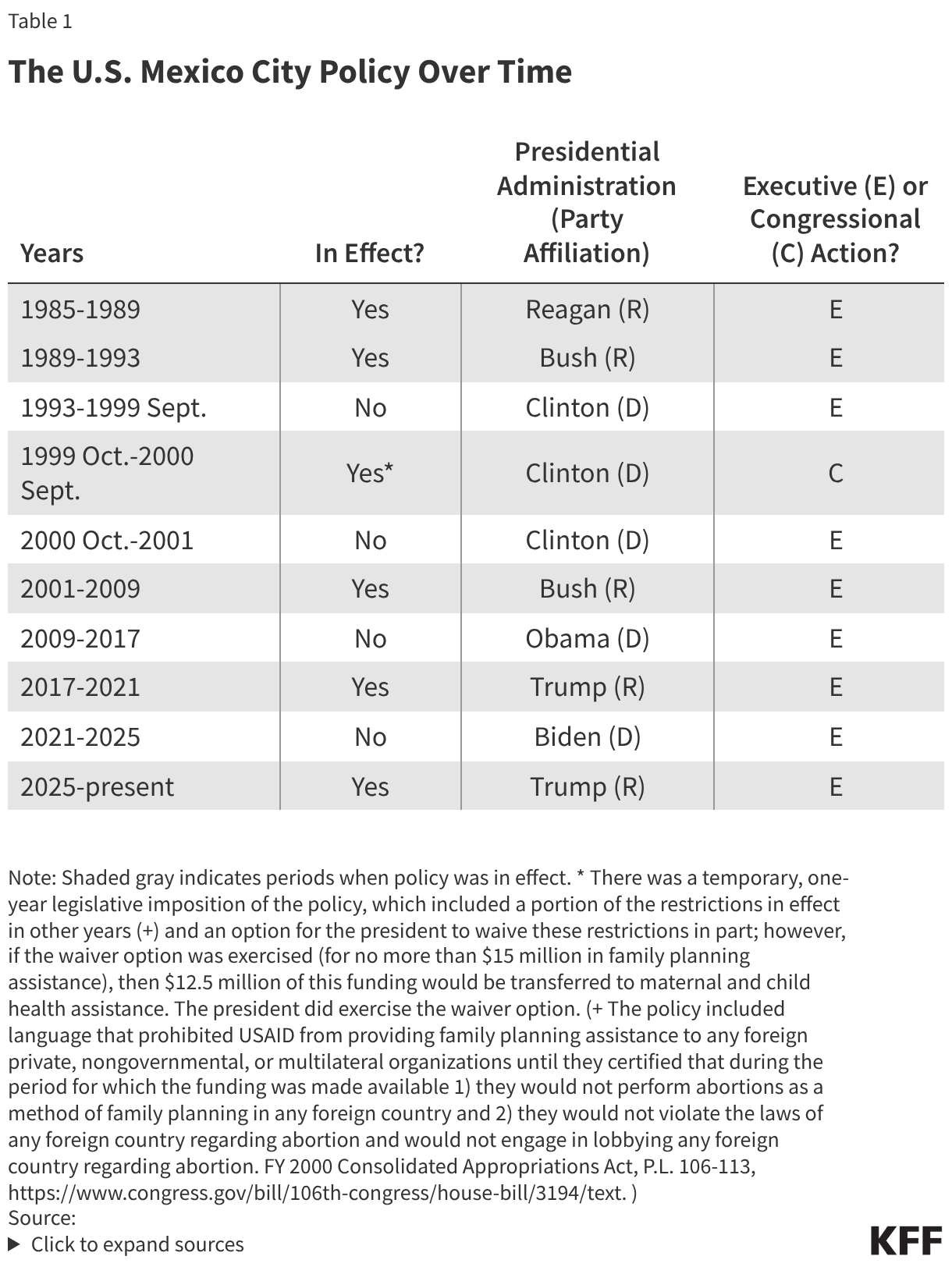
The Mexico City Policy has been in effect for 23 of the past 42 years, primarily through executive action, and has been instated, rescinded, and reinstated by presidential administrations along party lines (see Table 1).
The policy was first instituted in 1984 (taking effect in 1985) by President Ronald Reagan and continued to be in effect through President George H.W. Bush’s administration. It was rescinded by President Bill Clinton in 1993 (although it was reinstated legislatively for one year during his second term;5 see below).6 The policy was reinstated by President George W. Bush in 2001,7 rescinded by President Barack Obama in 2009,8 and reinstated and expanded by President Trump in 2017.9 It was rescinded by President Biden in 2021.10 President Trump then reinstated the policy from his first term in January 2025, noting an intention to expand it further, with final rules released in January 2026.11
How Has the Mexico City Policy Been Instituted (and Rescinded)?
The Mexico City Policy has, for the most part, been instituted or rescinded through executive branch action (typically via presidential memoranda12). While Congress has the ability to institute the policy through legislation, this has happened only once in the past when a modified version of the policy was briefly applied by Congress during President Clinton’s last year in office as part of a broader arrangement to pay the U.S. debt to the United Nations.13 (At that time, President Clinton was able to partially waive the policy’s restrictions.14)Other attempts to institute the policy through legislation have not been enacted into law,15 nor have legislative attempts to overturn the policy.16 See Table 1.
To What Entities Does the PHFFA Policy Apply?
Under the PHFFA, the types of organizations now subject to the policy, albeit with different applications, include:
- Foreign NGOs,17 which include:
- international NGOs that are based outside the U.S.,
- regional NGOs that are based outside the U.S., and
- local NGOs in assisted countries.
- U.S. NGOs,18
- Foreign governments19 and parastatals20 (note: the State Department will assess whether or not to apply the policy based on foreign policy considerations), and
- International organizations (note: applies to voluntary contributions; international organizations who are recipients of only U.S. assessed contributions are not subject to the policy).21
A waiver of the policy or its elements in specific cases is allowed if, in the Secretary of State’s judgment, such a waiver is necessary for national security or foreign policy purposes; see “Are waivers or exemptions allowed?”.
When in place, the policy applies to these organizations as a condition of receiving most non-military U.S. foreign assistance, either directly (as the main – or prime – recipient of U.S. funding) or, for foreign NGOs, U.S. NGOs, and international organizations, indirectly (as a recipient of U.S. funding through an agreement with the prime recipient; referred to as a sub-recipient); see “To what assistance does the PHFFA apply?” below.
Importantly, some aspects of the policy are applied differently based on organization type:
- The strongest restrictions apply to foreign NGOs and international organizations, which are required to agree that outside the U.S. they will not provide or promote abortion as a method of family planning, promote gender ideology, promote discriminatory equity ideology, or engage in unlawful DEI-related discrimination with any funding, from any source; they also must agree not to provide financial support to any other foreign NGO or international organization that engages in such activities. See “What is the definition of ‘financial support’?” below.
- A U.S. NGO is required to agree that it will not provide abortion as a method of family planning outside the U.S. (including with non-Federal funds) and that it will not, “within the scope of any program, project, or activity funded by foreign assistance,” provide or promote abortion as a method of family planning, promote gender ideology, promote discriminatory equity ideology, or engage in unlawful DEI-related discrimination. It is also required to “ensure the physical and financial separation of their foreign assistance-funded programs, projects, and activities from the provision or promotion of” prohibited activities; if such separation is made, a U.S. NGO may carry out prohibited “promotion” activities (such as conducting public information campaigns, or using or teaching education materials) with non-Federal funds but still may not “provide” prohibited activities (such as providing abortion, providing “sex-rejecting procedures,”22 or engaging in unlawful DEI-related discrimination) with any funds. In addition, U.S. NGOs “are not subject to an additional requirement not to provide financial support using non-Federal funds to other organizations that provide or promote abortions outside the United States.”
- A foreign government or parastatal is subject to the policy if the State Department decides to apply the policy – in whole or in part – to an award based on foreign policy considerations; specifically, foreign governments and parastatals may have to agree to not use U.S. foreign assistance award funds to provide or promote abortion as a method of family planning, promote gender ideology, promote discriminatory equity ideology, or engage in unlawful DEI-related discrimination. If it is applied, foreign governments and parastatals “will be required to place any foreign assistance funds under the award in a segregated account to ensure that such funds may not be used to support such activity to the extent the foreign government conducts or supports such activity.” Thus, a foreign government may carry out prohibited activities with non-Federal funds, and they are not subject to the financial support requirement.
To What Assistance Does the PHFFA Apply?
The PHFFA policy applies to most non-military foreign assistance, beyond U.S. global health assistance or U.S. family planning assistance alone (see Table 2).23 Specifically, it applies to foreign assistance administered by the State Department under title III of the annual Department of State, Foreign Operations, and Related Programs (SFOPS) Appropriations Act as well as four other headings within the SFOPS appropriations act: International Narcotics Control and Law Enforcement; Nonproliferation, Anti-Terrorism, Demining and Related Programs; Peacekeeping Operations; and International Organizations and Programs.24 This extends its reach to other sectors, beyond global health, to include humanitarian assistance; economic development, democracy, human rights, and governance; peace and security; education and social services; and environment.25 Within these accounts, the policy currently applies to two main types of funding instruments used for foreign assistance – grants and cooperative agreements – and also to grants provided under contracts. The administration has stated its intention to apply the policy to contracts, subject to future rule-making.26 This was also sought during President Trump’s first term when a proposed rule to this effect was issued, but it was never finalized.27 The rules also indicate that the State Department will work with other agencies that administer foreign assistance to apply the restrictions to their funding streams.
What Does It Mean to “Flow Down” the Policy?
Foreign NGOs, international organizations, U.S. NGOs, foreign governments, and parastatals must pass down (or “flow down”) the policy requirements under the award terms, as applicable, to sub-recipients of foreign assistance, which would then require the sub-recipients to agree to the policy’s restrictions and then flow down the requirements to other organizations, as applicable, if they sub-award the funding further.
What is the Definition of “Financial Support”?
The financial support28 requirement governs any funding, no matter the source of funds, provided by foreign NGOs and international organizations to a foreign NGO or international organization for any purpose, if that foreign NGO or international organization happened to provide or promote prohibited activities (there are some differences based on type of organization; see “To what entities does the PHFFA Policy apply?” above). This approach codifies how the financial support requirement was expanded during the first Trump administration.29
Accordingly, this approach to “financial support” may affect funding provided by other donors (such as other governments and foundations) and non-foreign assistance funding provided by the U.S. government for a wide range of purposes. For example, if this funding is first provided to a foreign NGO or international organization that has accepted the policy (as a recipient of U.S. global health or other non-military foreign assistance), the organization then could not, using another donor’s funding for any purpose, provide support to a foreign NGO that provides or promotes prohibited activities.
What Activities Are Prohibited Related to Abortion?
Under the expanded Protecting Life in Foreign Assistance (PLFA) policy under PHFFA, foreign NGOs and international organizations “agree that, during the period of the award, [they] will not, outside the United States, provide or promote abortion as a method of family planning, or provide financial support to any other foreign NGO or [international organization] that engages in such activities” (there are some differences based on type of organization; see “To what entities does the PHFFA Policy apply?” above. Restricted activities include (also see Box 3):
- providing abortion as a method of family planning,30
- providing advice and information about and offering referral for abortion – where legal – as part of the full range of family planning options,
- promoting changes in a country’s laws or policies related to abortion as a method of family planning (i.e., engaging in lobbying), and
- conducting public information campaigns about abortion as a method of family planning.31
The prohibition of these activities is why the policy has been referred to by its critics as the “Global Gag Rule.”
The policy also provides information and clarification about other abortion-related matters:
- Allows for exceptions in cases of rape, incest, risk to life of mother: The policy does not prohibit, where consistent with local law, organizations from providing advice and information about, performing, or offering referral for abortion in cases where the pregnancy has either posed a risk to the life of the mother or resulted from incest or rape.32 The policy also states that “treatment of an ectopic pregnancy or spontaneous loss of pregnancy (a miscarriage) is not an abortion.”
- Allows for post-abortion care: The policy states that “treatment of injuries or illnesses caused by legal or illegal abortions,” which is known as post-abortion care, is not restricted.
- Prohibits passive referral: The policy now prohibits responding to a question about where a safe, legal abortion may be obtained when a woman who is already pregnant clearly states that she has already decided to have a legal abortion (passively providing information, versus actively providing medically-appropriate information). The policy does permit an exemption to be sought from the State Department where this, or another term, is in conflict with local law. This is an expansion compared to the prior policy where passive referral was permitted and the policy requirements did not apply when healthcare providers had an affirmative duty required under local law to provide counseling about and referrals for abortion as a method of family planning.
Box 3: Other U.S. Legal and Policy Restrictions on Abortion and Foreign Assistance
U.S. funding for abortion overseas using certain U.S. foreign assistance was already restricted and remains restricted under several provisions of the law. This includes a prohibition on using U.S. funding to pay for an abortion as a method of family planning (and, in actual policy practice, it was not allowed in any case, even in cases of risk to life, rape, or incest33), nor was using funds to conduct certain abortion-related activities.34 Specifically, before the Mexico City Policy was first announced in 1984, U.S. law already prohibited the use of U.S. aid:
- to pay for the performance of abortion as a method of family planning or to motivate or coerce any person to practice abortion (the Helms Amendment, 1973, to the Foreign Assistance Act);
- for biomedical research related to methods of or the performance of abortion as a means of family planning (the Biden Amendment, 1981, to the Foreign Assistance Act); and
- to lobby for or against abortion35 (the Siljander Amendment, first included in annual appropriations in 1981 and included each year thereafter).
Shortly after the policy was announced in 1984, the Kemp-Kasten Amendment was passed in 1985, prohibiting the use of U.S. aid to fund any organization or program, as determined by the president, that supports or participates in the management of a program of coercive abortion or involuntary sterilization (it is now included in annual appropriations).
The Leahy Amendment (first passed in 1994 and now included in annual appropriations) clarified that the Helms Amendment use of the term “motivate” should not be construed to prohibit, where legal under local law, the provision of information or counseling about all pregnancy options.
What Activities Are Prohibited Under “Gender Ideology”?
Under the new Combating Gender Ideology in Foreign Assistance policy of the PHFFA, foreign NGOs and international organizations “agree that, during the period of the award, [they] will not, outside the United States, promote gender ideology, or provide financial support to any other foreign NGO or [international organization] that promotes gender ideology” (there are some differences based on type of organization; see “To what entities does the PHFFA Policy apply?” above). Gender ideology is defined in the policy as “an ideology that replaces the biological category of sex with an ever-shifting concept of self-assessed gender identity.”36 Restricted activities include:
- providing or promoting gender-affirming care;
- lobbying for legal protections based on gender identity, legalization or availability of gender-affirming care, and lobbying for the continued legality of such activities or to change policies;
- conducting a public information campaign in foreign countries regarding acceptance of “gender ideology” or the benefits and/or availability of gender-affirming care;
- using or teaching sex education materials that include gender ideology; and
- conducting drag queen workshops, performances.
The policy also defines sex as “person's immutable biological classification as either male or female,” which will have likely implications for vulnerable populations served by U.S. foreign assistance programs, including transgender persons.
The policy allows procedures done to “to treat a person with a medically verifiable disorder of sexual development,” “for purposes other than attempting to align an individual’s physical appearance or body with an asserted identity that differs from the individual’s sex,” or “to treat complications of, including any infection, injury, disease, or disorder that has been caused by or exacerbated by, the performance of” gender-affirming care.
What Activities Are Prohibited Under “Discriminatory Equity Ideology”?
Under the new Combating Discriminatory Equity Ideology in Foreign Assistance policy of the PHFFA, foreign NGOs and international organizations “agree that, during the period of the award, [they] will not, outside the United States, promote discriminatory equity ideology, engage in unlawful [diversity, equity, and inclusion-related, or] DEI-related discrimination, or provide financial support to any other foreign NGO or [international organization] that conducts such activities” (there are some differences based on type of organization; see “To what entities does the PHFFA Policy apply?” above). Discriminatory equity ideology is defined in the policy as “an ideology that treats individuals as members of preferred or disfavored groups, rather than as individuals, and minimizes agency, merit, and capability in favor of generalizations,”37 such as that “an individual, by virtue of the individual's race, color, religion, sex, or national origin, should be discriminated against or receive adverse treatment to achieve diversity, equity, or inclusion.” Restricted activities include:
- promoting discriminatory equity ideology, which includes using or teaching education materials (including books, curricula, and media) that advance such ideology; and
- unlawful DEI-related discrimination, which the policy defines as “discrimination on the basis of race, color, religion, or national origin if such discrimination violates U.S. federal antidiscrimination law or would violate U.S. federal antidiscrimination law if it occurred inside the United States, including the use of those characteristics as a selection criterion or preference for, or basis for exclusion from, employment, contracting, program participation, resource allocation, or similar activities, opportunities, or benefits.”38
The policy does not “address discrimination on the basis of disability or other protected classes, nor does it address … grounds other than race, color, religion, or national origin.”
Are Waivers or Exemptions Allowed?
The rules allow for waivers or exemptions in certain cases as follows:
- Waiver: A waiver of the policy or its elements in specific cases is allowed if, in the Secretary of State’s judgment, such a waiver is necessary for national security or foreign policy purposes. A waiver can be issued either by the Secretary of State or the Under Secretary of State for Foreign Assistance, Humanitarian Affairs, and Religious Freedom, and according to the rules, the State Department will issue guidance on the waiver process.
- Foreign governments/parastatals: The State Department is allowed to exercise discretion, based on foreign policy considerations, in determining whether, and how (in full or in part), to apply the policy terms to the awards of foreign governments and parastatals.
- Local law: The policy permits an exemption to be sought from the State Department where a specific PHFFA award term is in conflict with local law (see, for example, “Prohibits passive referral” above).
What Has Been the Impact of the Mexico City Policy?
A KFF literature review of studies examining the policy, from 2001 to 2024, identified a range of impacts associated with the policy, when in effect, including: increases in abortion rates and reductions in contraceptive prevalence (among other health outcomes); disruption and gaps in services; reduction in service integration; over-implementation and chilling effects; confusion about the policy; loss of civil society/NGO coordination and partnerships; and increased administrative burden (see Box 4). In addition, several studies sought to calculate or estimate the reach of the policy, as measured by amount of funding, countries, and/or NGOs affected.
Box 4: Impacts Associated with the Mexico City Policy in the Literature
- Increased abortion rates
- Increased pregnancy
- Decreased contraceptive prevalence
- Disruption in family planning and other services
- Gaps in family planning and other services
- Reduced service integration
- Over-implementation and chilling effect
- Confusion
- Loss of civil society/NGO coordination and partnerships
- Increased administrative burden
During the first Trump administration, two official assessments by the State Department were released:
- Initial six-month review of implementation of the policy: released in February 2018, it directed agencies to provide greater support for improving understanding of implementation among affected organizations and provided guidance to clarify terms included in standard provisions of grants and cooperative agreements.
- Second review of the policy, covering the first 18 months of implementation: released in August 2020, it found the awards declined spanned a variety of program areas,39 in addition to cross-cutting awards; spanned geographic areas, but many were for activities in sub-Saharan Africa; and led to gaps or disruptions in service delivery sometimes being reported, despite U.S. efforts to transition projects to another implementer in order to minimize disruption.
Additionally, a report by the U.S. Government Accountability Office (GAO), released in March 2020, found that from May 2017 through FY 2018, the policy had been applied to over 1,300 global health projects, with the vast majority of these through USAID and CDC, and NGOs declined to accept the expanded policy during the first Trump administration in 54 instances, totaling $153 million in declined funding40 across USAID and CDC. The State Department and DoD did not identify any instances where NGOs declined to accept the policy conditions.
- “Policy Statement of the United States of America at the United Nations International Conference on Population (Second Session), Mexico City, Mexico, August 6-14, 1984,” undated, https://www.jstor.org/stable/1973537?seq=1; United Nations Division of Economic and Social Affairs/Population Division, “United Nations Conferences on Population,” webpage, undated, https://www.un.org/en/conferences/population. ↩︎
- “Policy Statement of the United States of America at the United Nations International Conference on Population (Second Session), Mexico City, Mexico, August 6-14, 1984,” undated, https://www.jstor.org/stable/1973537?seq=1. ↩︎
- KFF analysis of Trump Administration/Department of State: “Protecting Life in Global Health Assistance,” fact sheet, May 15, 2017, https://2017-2021.state.gov/protecting-life-in-global-health-assistance-2/index.html; “Background Statement: Announcement of ‘Protecting Life in Global Health Assistance,’” background opening statement, May 15, 2017; “Implementation of Protecting Life in Global Health Assistance (Formerly known as the ‘Mexico City Policy’),” PRM press guidance, May 15, 2017; “Background Briefing: Senior Administration Officials on Protecting Life in Global Health Assistance,” press release of special briefing by senior Department of State officials via teleconference, May 15, 2017, https://2017-2021.state.gov/background-briefing-senior-administration-officials-on-protecting-life-in-global-health-assistance/index.html; “Subject: Protecting Life in Global Health Assistance,” Federal Assistance Management Advisory Number 2017-01; “Protecting Life in Global Health Assistance (May 2019),” MCP-related portion of standard provisions for cooperative agreements and grants to U.S. NGOs (May 2020) and foreign NGOs (Aug. 2020)); and KFF analysis of data from: Congressional Appropriations Bills, Press Releases, and Conference Reports; Federal Agency Budget and Congressional Justification documents and Operating Plans; ForeignAssistance.gov; Office of Management and Budget, personal communication. ↩︎
- USAID, “Protecting Life in Global Health Assistance Frequently Asked Questions and Answers,” Oct. 2019, https://web.archive.org/web/20210125230730/https://www.usaid.gov/sites/default/files/documents/1864/FINAL_Protecting_Life_in_Global_Health_Assistance_FAQs_Oct_2019_USAID.pdf. ↩︎
- The temporary, one-year legislative imposition of the policy occurred as part of a broader deal related to paying the U.S. debt to the United Nations. See FY 2000 Consolidated Appropriations Act, P.L. 106-113, https://www.congress.gov/bill/106th-congress/house-bill/3194/text; PAI, Global Gag Rule Timeline, July 12, 2011; and Richard Cincotta and Barbara Crane, “The Mexico City Policy and U.S. Family Planning Assistance,” Science, Oct. 19, 2001, Vol. 294: pp. 525-526, https://science.sciencemag.org/content/294/5542/525. ↩︎
- Bill Clinton Administration, “Subject: AID Family Planning Grants/Mexico City Policy,” Memorandum for the Acting Administrator of the Agency for International Development, January 22, 1993, Clinton White House Archives, https://clintonwhitehouse6.archives.gov/1993/01/1993-01-22-aid-family-planning-grants-mexico-city-policy.html. ↩︎
- George W. Bush Administration, “Subject: Restoration of the Mexico City Policy,” Memorandum for the Administrator of the United States Agency for International Development, January 22, 2001, Bush Administration White House Archives, https://georgewbush-whitehouse.archives.gov/news/releases/20010123-5.html; “Subject: Restoration of the Mexico City Policy,” Memorandum for the Administrator of the United States Agency for International Development, March 28, 2001, Federal Register, https://www.federalregister.gov/documents/2001/03/29/01-8011/restoration-of-the-mexico-city-policy; George W. Bush Administration, “Subject: Assistance for Voluntary Population Planning,” Memorandum for the Secretary of State, August 29, 2003, Bush Administration White House Archives, http://georgewbush-whitehouse.archives.gov/news/releases/2003/08/20030829-3.html. ↩︎
- Barack Obama Administration, “Mexico City Policy and Assistance for Voluntary Population Planning,” Memorandum for the Secretary of State, the Administrator of the United States Agency for International Development, January 23, 2009, Obama White House Archives, https://obamawhitehouse.archives.gov/the-press-office/mexico-city-policy-and-assistance-voluntary-population-planning. ↩︎
- Donald J. Trump Administration, “The Mexico City Policy,” Memorandum for the Secretary of State, the Secretary of Health and Human Services, the Administrator of the Agency for International Development, Jan. 23, 2017, Trump Administration White House Archives, https://trumpwhitehouse.archives.gov/presidential-actions/presidential-memorandum-regarding-mexico-city-policy/. ↩︎
- Joe Biden Administration, “Memorandum on Protecting Women’s Health at Home and Abroad,” presidential actions, Jan. 28, 2021, https://bidenwhitehouse.archives.gov/briefing-room/presidential-actions/2021/01/28/memorandum-on-protecting-womens-health-at-home-and-abroad/; White House, “FACT SHEET: President Biden to Sign Executive Orders Strengthening Americans’ Access to Quality, Affordable Health Care,” statements and releases, Jan. 28, 2021, https://bidenwhitehouse.archives.gov/briefing-room/statements-releases/2021/01/28/fact-sheet-president-biden-to-sign-executive-orders-strengthening-americans-access-to-quality-affordable-health-care/. ↩︎
- White House/Donald J. Trump Administration (second), “The Mexico City Policy,” Memorandum for the Secretary of State, Secretary of Defense, the Secretary of Health and Human Services, the Administrator of the Agency for International Development, Jan. 24, 2025, https://www.whitehouse.gov/presidential-actions/2025/01/memorandum-for-the-secretary-of-state-the-secretary-of-defense-the-secretary-of-health-and-human-services-the-administrator-of-the-united-states-for-international-development/; White House/Donald J. Trump Administration (second), “FACT SHEET: President Donald J. Trump Enforces Overwhelmingly Popular Demand to Stop Taxpayer Funding of Abortion,” fact sheets, Jan. 25, 2025, https://www.whitehouse.gov/fact-sheets/2025/01/fact-sheet-president-donald-j-trump-enforces-overwhelmingly-popular-demand-to-stop-taxpayer-funding-of-abortion/; Protecting Life in Foreign Assistance, 91 Fed. Reg. 3319 (Jan. 27, 2026) (amending 2 C.F.R. §602), final rule, https://www.federalregister.gov/documents/2026/01/27/2026-01519/protecting-life-in-foreign-assistance. ↩︎
- Presidential memoranda “are often used to carry out routine executive decisions and determinations, or to direct agencies to perform duties consistent with the law or implement laws that are presidential priorities” and are not required to be published in the Federal Register (although those pertaining to the Mexico City Policy sometimes have been). These presidential instruments or directives “may have the force and effect of law only if the presidential action is based on power vested in the President by the U.S. Constitution or delegated to the President by Congress.” Memoranda have the same legal authority as executive orders, although the latter is always required to be published in the Federal Register. Quotes as stated in Congressional Research Service (CRS), Executive Orders: Issuance, Modification, and Revocation, April 16, 2014, RS20846, https://www.congress.gov/crs-product/RS20846. ↩︎
- The legislative application of the policy – applying to FY 2000, which was from Oct. 1, 1999, until Sept. 30, 2000 – included language that prohibited USAID from providing family planning assistance to any foreign private, nongovernmental, or multilateral organizations until they certified that during the period for which the funding was made available 1) they would not perform abortions as a method of family planning in any foreign country and 2) they would not violate the laws of any foreign country regarding abortion and would not engage in lobbying any foreign country regarding abortion. FY 2000 Consolidated Appropriations Act, P.L. 106-113, https://www.congress.gov/bill/106th-congress/house-bill/3194/text; PAI, Global Gag Rule Timeline, July 12, 2011; and Richard Cincotta and Barbara Crane, “The Mexico City Policy and U.S. Family Planning Assistance,” Science, Oct. 19, 2001, Vol. 294: pp. 525-526, https://science.sciencemag.org/content/294/5542/525. ↩︎
- The legislation included an option for the president to waive these restrictions; however, if he exercised the waiver option (for no more than $15 million in family planning assistance), then $12.5 million of this funding would be transferred to maternal and child health assistance. The president did exercise the waiver option. FY 2000 Consolidated Appropriations Act, P.L. 106-113, https://www.congress.gov/bill/106th-congress/house-bill/3194/text. ↩︎
- CRS, Abortion and Family Planning-Related Provisions in U.S. Foreign Assistance Law and Policy, May 17, 2016, R41360, https://digital.library.unt.edu/ark:/67531/metadc855791/. ↩︎
- CRS, Appropriations for FY2000: Foreign Operations, Export Financing, and Related Programs, updated August 4, 1999, RL30211, https://digital.library.unt.edu/ark:/67531/metadc814156/; CRS, International Family Planning: The “Mexico City” Policy, updated April 2, 2001, RL30830, https://digital.library.unt.edu/ark:/67531/metacrs1906/; CRS, Abortion and Family Planning-Related Provisions in U.S. Foreign Assistance Law and Policy, May 17, 2016, R41360, https://digital.library.unt.edu/ark:/67531/metadc855791/; PAI, Global Gag Rule Timeline, July 12, 2011. ↩︎
- Under PHFFA, an NGO is a for-profit or not-for-profit organization that is not part of the U.S. government, a foreign government, or a international organization; includes private sector organizations, non-profit organizations, and educational institutions. A foreign NGO is formally defined in the rules as “any non-governmental organization or entity, whether non-profit or profit-making (including any commercial firm and educational institution), not organized or existing under the laws of the United States, any State of the United States, the District of Columbia, the Commonwealth of Puerto Rico, or any other territory or possession of the United States.” ↩︎
- Under PHFFA, an NGO is a for-profit or not-for-profit organization that is not part of the U.S. government, a foreign government, or a international organization. A U.S. NGO is formally defined in the rules as “any non-governmental organization or entity, whether non-profit or profit-making (including any commercial firm and educational institution), organized or existing under the laws of the United States, any State of the United States, the District of Columbia, the Commonwealth of Puerto Rico, or any other territory or possession of the United States.” Prior to the latest expansion, U.S. NGOs had not been directly subject to the Mexico City Policy but had to agree to ensure that they did not provide funding to any foreign NGO sub-recipients unless those sub-recipients had first certified adherence to the policy. ↩︎
- Under PHFFA, a foreign government is “any department, agency, independent establishment, or other entity of the government of a foreign country.” ↩︎
- Under PHFFA, a parastatal is a “foreign-government-owned organization operated as a commercial company or other organization, including non-profits, or enterprises in which foreign governments or foreign government agencies have a controlling interest.” ↩︎
- An international organization (also referred to as a multilateral organization) is an organization that is jointly supported by multiple governments and, often, other partners (versus bilateral efforts, which are carried out on a country-to-country basis); includes specialty agencies of the United Nations (U.N.) and international financing mechanisms that pool and direct resources from multiple public and private donors for specific causes. Furthermore, each rule of PHFFA defines an international organization as “(A) Any organization designated as being entitled to enjoy the privileges, exemptions, and immunities under the International Organizations Immunities Act; (B) Any organization treated as a public international organization pursuant to the regulations or policies of the Department of State; (C) Any organization established by international agreement and whose governing body is composed principally of representatives of national governments; or (D) Any other multilateral entity in which sovereign nations participate.” ↩︎
- According to the rule, to “provide a sex-rejecting procedure means any act of performing any procedure, or prescribing, dispensing, or utilizing any drug or device, for a sex-rejecting procedure, and any act of paying for, assisting in carrying out, or operating a facility that carries out, any such activities.” It also defines a “sex-rejecting procedure” as “any pharmaceutical or surgical intervention that is provided for the purpose of attempting to align an individual's physical appearance or body with an asserted identity that differs from the individual's sex either by: (I) intentionally disrupting or suppressing the normal development of natural biological functions, including primary or secondary sex-based traits; or (II) intentionally altering an individual's physical appearance or body, including amputating, minimizing or destroying primary or secondary sex-based traits such as the sexual and reproductive organs.” ↩︎
- In the past, foreign NGOs had been required to adhere to the Mexico City Policy – when in effect – as a condition of receiving support through certain U.S. international funding streams: family planning assistance through the U.S. Agency for International Development (USAID) and, beginning in 2003, family planning assistance through the U.S. Department of State. In the 2003 memorandum announcing the policy’s expansion to include the Department of State, President Bush stated that the policy did not apply to funding for global HIV/AIDS programs and that international organizations that are associations of governments are not included among “foreign NGOs.” The first Trump administration expanded the policy to apply to the vast majority of U.S. bilateral global health assistance furnished by all agencies and departments, including: family planning and reproductive health; maternal and child health (including household-level water, sanitation, and hygiene (WASH)); nutrition; HIV under PEPFAR; tuberculosis; malaria under the President’s Malaria Initiative (PMI); neglected tropical diseases; global health security; and certain types of research activities (see: George W. Bush Administration, “Subject: Assistance for Voluntary Population Planning,” Memorandum for the Secretary of State, August 29, 2003, Bush Administration White House Archives, http://georgewbush-whitehouse.archives.gov/news/releases/2003/08/20030829-3.html. Department of State: “Protecting Life in Global Health Assistance,” fact sheet, May 15, 2017, https://2017-2021.state.gov/protecting-life-in-global-health-assistance-2/index.html; “Background Statement: Announcement of ‘Protecting Life in Global Health Assistance,’” background opening statement, May 15, 2017; “Implementation of Protecting Life in Global Health Assistance (Formerly known as the ‘Mexico City Policy’),” PRM press guidance, May 15, 2017; “Background Briefing: Senior Administration Officials on Protecting Life in Global Health Assistance,” press release of special briefing by senior Department of State officials via teleconference, May 15, 2017, https://2017-2021.state.gov/background-briefing-senior-administration-officials-on-protecting-life-in-global-health-assistance/index.html; “Subject: Protecting Life in Global Health Assistance,” Federal Assistance Management Advisory Number 2017-01; “Protecting Life in Global Health Assistance (May 2017),” MCP-related portion of standard provisions for cooperative agreements and grants to NGOs, May 11, 2017; USAID: USAID: “Standard Provisions for U.S. Nongovernmental Organizations: A Mandatory Reference for ADS Chapter 303,” ADS Reference 303maa, partial revision May 18, 2020, http://web.archive.org/web/20200916043917/https://www.usaid.gov/ads/policy/300/303maa; “Standard Provisions for Non-U.S. Nongovernmental Organizations: A Mandatory Reference for ADS Chapter 303,” ADS Reference 303mab, partial revision Aug. 18, 2020, https://web.archive.org/web/20200916055738/https://www.usaid.gov/ads/policy/300/303mab ; CDC, “Additional Requirement – 35: Protecting Life in Global Health Assistance,” webpage, https://web.archive.org/web/20201028113231/https://www.cdc.gov/grants/additional-requirements/ar-35.html?CDC_AA_refVal=https%3A%2F%2Fwww.cdc.gov%2Fgrants%2Fadditionalrequirements%2Far-35.html; NIH, “Protecting Life in Global Health Assistance,” webpage, https://web.archive.org/web/20201217194950/https://grants.nih.gov/policy/protecting-life-global-health-assistance.htm. ↩︎
- This includes voluntary contributions to international organizations from foreign assistance. ↩︎
- This includes stabilization assistance and migration and refugee assistance. ↩︎
- As of Feb. 26, 2026, the policy will be effective and apply to all new grants and cooperative agreement awards that provide covered non-military foreign assistance, as well as to all existing grants and cooperative agreement awards when amended to add new funding. ↩︎
- The exception to this is “grants under contracts,” which were previously subject to the policy; they are essentially grants made to sub-awardees by recipients of contracts. ↩︎
- The rules state “to provide financial support means to provide funds from any source and for any purpose to a foreign NGO or [international organization] through an award, sub-award, contract, sub-contract, grant under contract, or other written agreement or donation of funds.” ↩︎
- In June 2019, USAID provided additional information to reflect this broader interpretation of the standard provisions. USAID, “Protecting Life in Global Health Assistance Frequently Asked Questions and Answers,” Oct. 2019, https://web.archive.org/web/20210125230730/https://www.usaid.gov/sites/default/files/documents/1864/FINAL_Protecting_Life_in_Global_Health_Assistance_FAQs_Oct_2019_USAID.pdf. ↩︎
- The PLFA of the PHFFA defines “to provide abortions as a method of family planning means any of the following activities: (A) any act of performing or inducing an abortion as a method of family planning; (B) any act of prescribing, dispensing, utilizing, selling, manufacturing, or distributing drugs, devices, or equipment for the purpose of performing or inducing abortion as a method of family planning; or (C) any act of paying for, assisting in carrying out, or operating a facility that carries out, any of the activities described above.” ↩︎
- The PLFA of the PHFFA defines “to promote abortion as a method of family planning includes any of the following activities: (A) Committing resources, financial or otherwise, to increase the availability, or use, of abortion as a method of family planning; (B) Operating a service-delivery site that provides counseling, including advice and information, regarding the benefits and/or availability of abortion as a method of family planning (unless, in the case of a United States nongovernmental organization, the physical and financial separation requirements under this paragraph with respect to foreign assistance are satisfied); (C) Providing advice that abortion as a method of family planning is an available option, or referring for, or encouraging women to consider, abortion as a method of family planning[;] (D) Lobbying, pressuring, or encouraging a foreign government to legalize or make available abortion as a method of family planning, or lobbying, pressuring, or encouraging such a government to continue the legality of abortion as a method of family planning;(E) Conducting a public-information campaign in a foreign country regarding the benefits and/or availability of abortion as a method of family planning; and, (F) Using or teaching sex education materials (including books, curricula, media, etc.) that promote abortion as a method of family planning.” ↩︎
- While the policy allows exceptions for organizations that perform abortions with non-U.S. funds in the cases of a pregnancy that threatens the life of the woman or was a result of rape or incest, long-standing USAID interpretation of the Helms Amendment to the Foreign Assistance Act had not permitted U.S. funding to support the performance of abortions in these exceptional cases. ↩︎
- While the policy allows exceptions for organizations that perform abortions with non-U.S. funds in the cases of a pregnancy that threatens the life of the woman or was a result of rape or incest, long-standing USAID interpretation of the Helms Amendment to the Foreign Assistance Act had not permitted U.S. funding to support the performance of abortions in these exceptional cases. ↩︎
- For information about other U.S. government requirements and policies related to family planning and reproductive health, see: KFF, The U.S. Government and International Family Planning & Reproductive Health: Statutory Requirements and Policies; KFF, Statutory Requirements & Policies Governing U.S. Global Family Planning and Reproductive Health Efforts, 2012; CRS, Abortion and Family Planning-Related Provisions in U.S. Foreign Assistance Law and Policy, R41360, https://www.congress.gov/crs-product/R41360/. ↩︎
- When initially introduced, the amendment prohibited only lobbying for abortion, but in subsequent years Congress modified the language to include lobbying against abortion as well. ↩︎
- The rule defines gender identity as “an individual’s fully internal and subjective sense of self, disconnected from biological reality and sex and existing on an infinite continuum. Gender identity does not provide a meaningful basis for identification and cannot be recognized as a replacement for sex.” ↩︎
- According to the policy, generalizations include the following: (I) Members of one race, color, religion, sex, or national origin are morally or inherently superior to members of another race, color, religion, sex, or national origin; (II) An individual, by virtue of the individual's race, color, religion, sex, or national origin, is inherently racist, sexist, or oppressive, whether consciously or unconsciously; (III) An individual's moral character or status as privileged, oppressing, or oppressed is primarily determined by the individual's race, color, religion, sex, or national origin; (IV) Members of one race, color, religion, sex, or national origin cannot and should not attempt to treat others without respect to their race, color, religion, sex, or national origin; (V) An individual, by virtue of the individual's race, color, religion, sex, or national origin, bears responsibility for, should feel guilt, anguish, or other forms of psychological distress because of, should be discriminated against, blamed, or stereotyped for, or should receive adverse treatment because of actions committed in the past by other members of the same race, color, religion, sex, or national origin, in which the individual played no part; (VI) An individual, by virtue of the individual's race, color, religion, sex, or national origin, should be discriminated against or receive adverse treatment to achieve diversity, equity, or inclusion; (VII) Virtues such as merit, excellence, hard work, fairness, neutrality, objectivity, and racial colorblindness are racist or sexist or were created by members of a particular race, color, religion, sex, or national origin to oppress members of another race, color, religion, sex, or national origin; or (VIII) the United States is fundamentally racist, sexist, or otherwise discriminatory.” ↩︎
- The policy cites “examples of unlawful practices such as race-based training sessions, race-based segregation in facilities or resources, implicit segregation through program eligibility, race-based “diverse slate” policies in hiring, race-based program participation (including when framed as addressing underrepresentation), DEI training programs that promote discrimination based on protected characteristics, such as by stereotyping, excluding or disadvantaging individuals based on their race, color, religion, or national origin, or creating a hostile environment.” ↩︎
- Including family planning and reproductive health (FP/RH), HIV and AIDS (HIV/AIDS), maternal and child health (MCH), tuberculosis (TB), and nutrition. ↩︎
- Specifically, seven prime awards amounting to $102 million and 47 sub-awards amounting to $51 million (more than two-thirds of sub-awards were intended for Africa). ↩︎