Medicare

NEW AND NOTEWORTHY

What to Know About Medicare Coverage of Telehealth

Congress has repeatedly extended pandemic-era flexibilities around Medicare coverage of telehealth, but most such flexibilities remain temporary. This brief answers key questions about the current scope of Medicare telehealth coverage, including both temporary and permanent changes adopted through legislation and regulation, and future policy considerations.

Changes to the Medicare Advantage Program Enhance Some Consumer Protections But Roll Back Others

CMS recently finalized policies as part of the 2027 Medicare Advantage final rule that both enhance consumer protections and roll back changes to the Medicare Advantage program that were intended to protect consumers. These changes have gotten less attention than payment issues and changes to the star ratings system, which also affect plan payments, but could have implications for Medicare beneficiaries.

Examining the Potential Impact of Medicare’s New WISeR Model

A federal initiative to establish new prior authorization requirements in traditional Medicare, called the Wasteful and Inappropriate Service Reduction (WISeR) model, is likely to have only modest impact in its first year.

State Profiles for Dual-Eligible Individuals

This data collection draws on Medicare and Medicaid administrative data to present national and state-level information on people who are covered by both Medicare and Medicaid, referred to as dual-eligible individuals (also known as dually-enrolled beneficiaries).

Data Visualization

The Facts About Medicare Spending

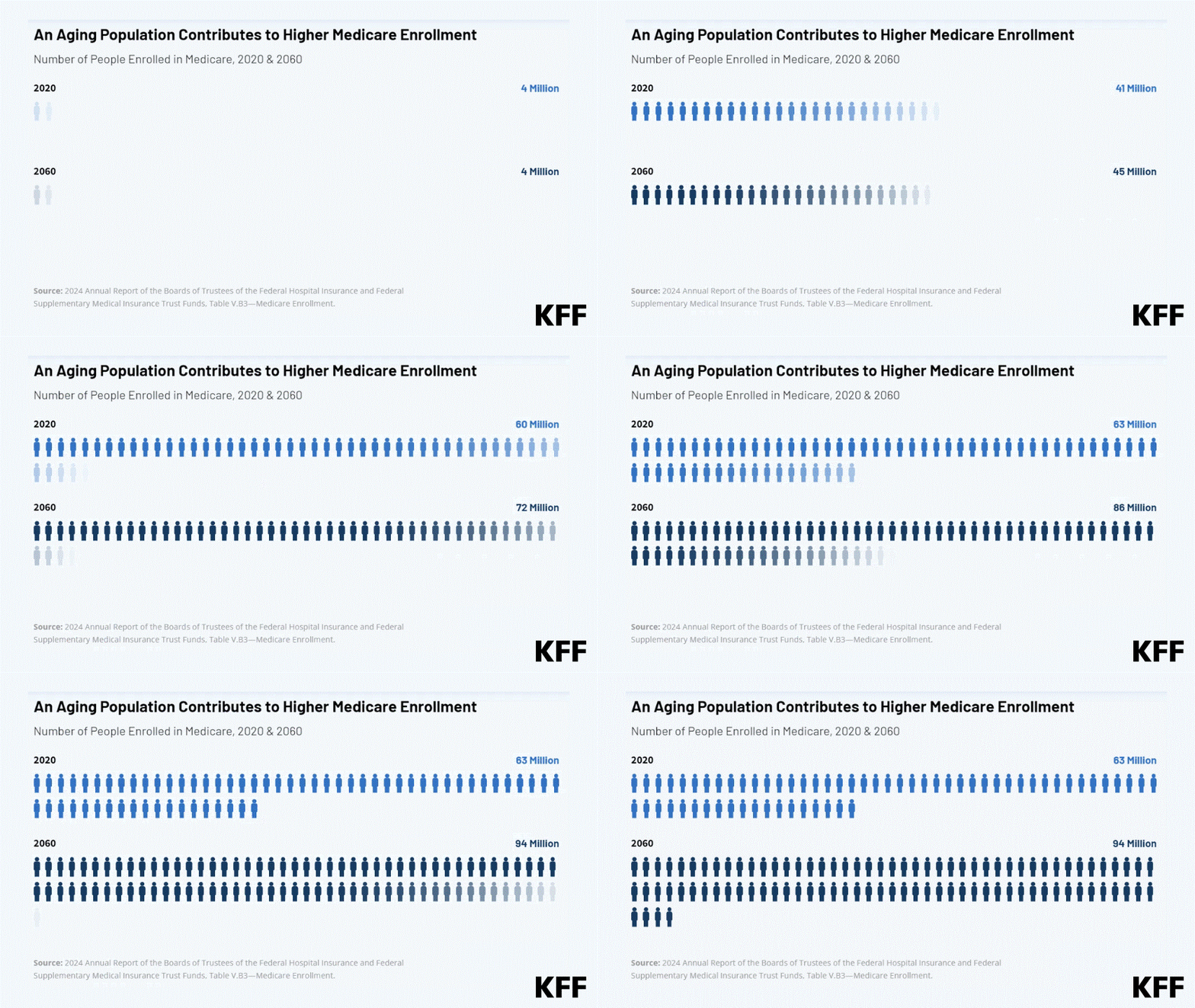
This interactive provides the facts on Medicare spending. Medicare, which serves 67 million people and accounts for 12 percent of the federal budget and 21 percent of national health spending, is often the focus of discussions about health expenditures, health care affordability and the sustainability of federal health programs. u003cbru003eu003cbru003eExplore data on enrollment growth, Medicare spending trends overall and per person, growth in Medicare spending relative to private insurance, spending on benefits and Medicare Advantage, Part A trust fund solvency challenges, and growth in out-of-pocket spending by beneficiaries.u003cbru003eu003cbru003eu003ca href=u0022https://www.kff.org/medicare/issue-brief/faqs-on-medicare-financing-and-trust-fund-solvency/u0022 data-type=u0022linku0022 data-id=u0022https://www.kff.org/medicare/issue-brief/faqs-on-medicare-financing-and-trust-fund-solvency/u0022u003eRelated:u003ca href=u0022https://www.kff.org/medicare/issue-brief/faqs-on-medicare-financing-and-trust-fund-solvency/u0022u003e FAQs on Medicare Financing and Trust Fund Solvencyu003c/au003eu003c/au003e

Read More

Subscribe to KFF Emails

Choose which emails are best for you.
Sign up here

Filter

731 - 740 of 1,598 Results

  • Turning Medicare Into a Premium Support System: Frequently Asked Questions

    Issue Brief

    Premium support is a general term used to describe an approach to reform Medicare that aims to reduce the growth in Medicare spending. These FAQs raise and discuss basic questions about the possible effects of a premium support system for Medicare beneficiaries, the federal budget, health care providers, and private health plans.

  • Questions and Answers about Turning Medicare into a Premium Support System

    News Release

    With its inclusion in the House GOP health plan released last month, the idea of converting Medicare into a premium support system once again features prominently in Capitol Hill policy discussions about the future of Medicare, the federal health insurance program that covers 57 million seniors and people with disabilities. A new brief from the Kaiser Family Foundation helps inform the debate by examining some frequently asked questions about premium support. This approach, generally speaking,…

  • Analysis Finds End-of-Life Medicare Spending Declines With Age Among Seniors

    News Release

    Among beneficiaries who died in 2014, Medicare spent significantly more per person on medical services for seniors in their late sixties and early seventies than on older beneficiaries, according to a new data note from the Kaiser Family Foundation. The analysis comes at a time when physicians can now be reimbursed by Medicare for end-of-life care discussions with their patients. The analysis of Medicare claims data through 2014 finds that among those who died in…

  • Modifying Traditional Medicare’s Benefit Design Could Reduce Federal Spending But With Cost Tradeoffs Between Beneficiaries and The Federal Government

    News Release

    Revamping traditional Medicare’s benefit design and restricting “first-dollar” supplemental coverage could reduce federal spending, simplify cost sharing, protect against high medical costs, decrease out-of-pocket spending for many beneficiaries, and provide more help to those with low incomes -- but would be unlikely to achieve all of these goals simultaneously.

  • Modifying Medicare’s Benefit Design: What’s the Impact on Beneficiaries and Spending?

    Report

    This report examines an approach to reforming Medicare that has been a focus of Congressional hearings and featured in several broader debt reduction and entitlement reform proposals, and was included in the June 2016 House Republican health plan. The analysis models four different options for modifying Medicare's benefit design, all of which include a single deductible, modified cost-sharing requirements, a new cost-sharing limit, and a prohibition on first-dollar Medigap coverage. The analysis models the expected…

  • Independent Payment Advisory Board (IPAB) Process: A Timeline

    Feature

    IPAB Timeline Download Source Kaiser Family Foundation, “The Independent Payment Advisory Board: A New Approach to Controlling Medicare Spending,” 2011, https://www.kff.org/health-reform/issue-brief/the-independent-payment-advisory-board-a-new/.

  • A Study of Medicare Advantage Plan Networks in 20 Counties Finds That Plans Include About Half of All Hospitals in Their Area 

    News Release

    A Kaiser Family Foundation analysis of private Medicare plan networks finds that Medicare Advantage plans include about  half of area hospitals in their network, on average, while one in five plans have no  Academic Medical Center in-network.  Among plans in an area with a National Cancer Institute-designated cancer center, more than two in five did not include the cancer center in their network. The new study of the hospital networks of Medicare Advantage plans, which…

  • Medicare Advantage Hospital Networks: How Much Do They Vary?

    Report

    This report takes an in-depth look at Medicare Advantage plans’ hospital networks. The analysis draws upon data from 409 Medicare Advantage plans serving beneficiaries in 20 diverse counties that together accounted for about one in seven (14%) Medicare Advantage enrollees nationwide in 2015. The report examines the size and composition of plans’ hospital networks, the variation across counties, the inclusion of Academic Medical Centers and NCI-Designated Cancer Centers, and the relationship between network size and…