Medicare

NEW AND NOTEWORTHY

Examining the Potential Impact of Medicare’s New WISeR Model

A federal initiative to establish new prior authorization requirements in traditional Medicare, called the Wasteful and Inappropriate Service Reduction (WISeR) model, is likely to have only modest impact in its first year.

State Profiles for Dual-Eligible Individuals

This data collection draws on Medicare and Medicaid administrative data to present national and state-level information on people who are covered by both Medicare and Medicaid, referred to as dual-eligible individuals (also known as dually-enrolled beneficiaries).

Data Visualization

The Facts About Medicare Spending

This interactive provides the facts on Medicare spending. Medicare, which serves 67 million people and accounts for 12 percent of the federal budget and 21 percent of national health spending, is often the focus of discussions about health expenditures, health care affordability and the sustainability of federal health programs. Explore data on enrollment growth, Medicare spending trends overall and per person, growth in Medicare spending relative to private insurance, spending on benefits and Medicare Advantage, Part A trust fund solvency challenges, and growth in out-of-pocket spending by beneficiaries.

Read More

Stay informed.

Stay informed.

Filter

371 - 380 of 1,602 Results

  • Key Facts About Medicare Part D Enrollment and Costs in 2023

    Issue Brief

    The Medicare Part D program provides an outpatient prescription drug benefit to older adults and people with long-term disabilities in Medicare who enroll in private plans. This brief analyzes Medicare Part D enrollment and costs in 2023 and trends over time. The analysis highlights the substantial growth of Medicare Advantage drug plans in the marketplace for Part D drug coverage, where enrollment overall is concentrated in a handful of large plan sponsors.

  • 10 Prescription Drugs Accounted for $48 Billion in Medicare Part D Spending in 2021, or More Than One-Fifth of Part D Spending That Year  

    News Release

    A new KFF analysis finds that the 10 top-selling prescription drugs under Medicare Part D comprised less than 1 percent of all covered drugs in 2021, but accounted for 22 percent, or $48 billion, of gross Medicare Part D drug spending that year. The analysis provides context for understanding the federal government’s new authority under the Inflation Reduction Act to negotiate prices for some high-spending drugs covered by Part D, Medicare’s outpatient prescription drug benefit…

  • A Small Number of Drugs Account for a Large Share of Medicare Part D Spending

    Issue Brief

    The Inflation Reduction Act requires the federal government to negotiate the price of certain high-spending drugs covered by Medicare. This analysis provides context for understanding the potential impact of negotiating prices for a limited number of Medicare-covered drugs by identifying the 10 top-selling Part D drugs in 2021, measuring the share of total Part D drug spending accounted for by top-selling drugs that year, and examining changes in spending and use of these drugs since…

  • New Alzheimer’s Drugs Spark Hope for Patients and Cost Concerns for Medicare

    Policy Watch

    The Food and Drug Administration granted full approval to Leqembi, a new Alzheimer's drug, on July 6, 2023. This updated policy watch focuses on the implications of Medicare coverage of the drug for program spending as well as equity and affordability issues for beneficiaries, and the potential for the Inflation Reduction Act to address the spending impacts. It also covers additional details from the Centers for Medicare and Medicaid Services about patient registries.

  • KFF Survey of Consumer Experiences with Health Insurance

    Poll Finding

    The survey finds nearly six in 10 people with health insurance experienced a problem using their insurance in the past year, with even larger shares reporting problems among people who are sick or who have mental health needs. It includes data for people with different types of coverage, including employer, Marketplace, Medicare and Medicaid, and also examines affordability issues and mental health access.

  • KFF Survey Shows Complexity, Red Tape, Denials, Confusion Rivals Affordability as a Problem for Insured Consumers, With Some Saying It Caused Them to Go Without or Delay Care

    News Release

    Most (58%) people with health insurance say they encountered at least one problem using their coverage in the past year, with even larger shares of people with the greatest health care needs reporting such problems, finds a new KFF survey of consumer experiences with health insurance. Such problems vary across types of insurance but include such things as denied claims for care they thought was covered, difficulty finding an in-network doctor or other provider, and…

  • What is the Potential Impact of New Drugs for Obesity and Alzheimer’s Disease on Medicare Costs, Coverage and Beneficiaries? 

    News Release

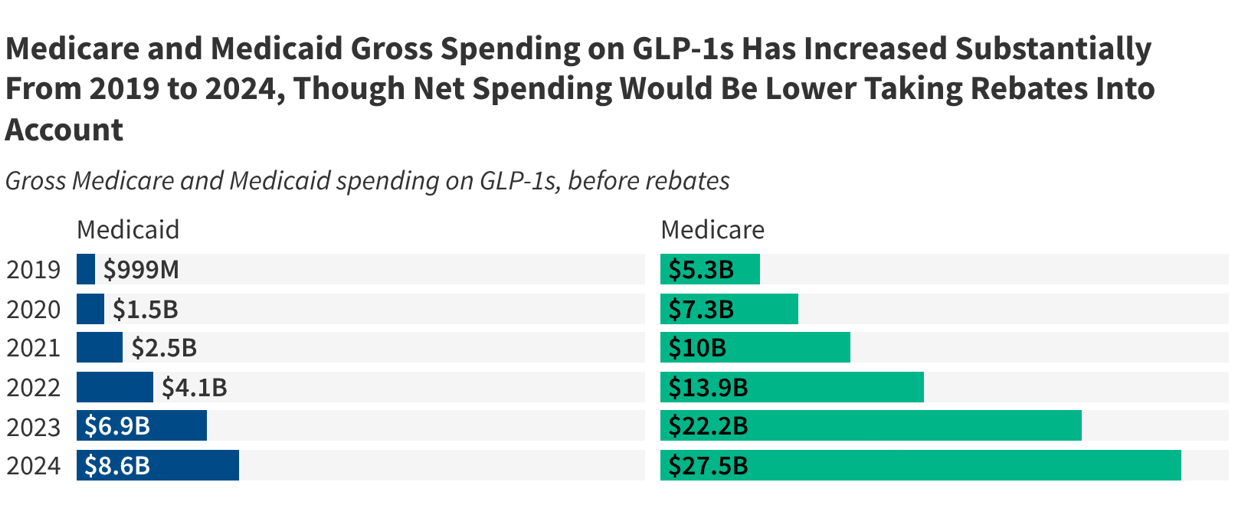
    Two new KFF analyses examine the potential impact of Medicare coverage of new prescription drugs for obesity and Alzheimer’s disease on program spending and beneficiary out-of-pocket costs, as well as the role that the Inflation Reduction Act could play in mitigating these effects. Manufacturers of both types of drugs are lobbying for broad Medicare coverage of them, though they face different challenges. The availability of effective weight-loss drugs, including Novo Nordisk’s Ozempic and Wegovy (semaglutide)…

  • What Could New Anti-Obesity Drugs Mean for Medicare?

    Policy Watch

    In this piece, we discuss Medicare coverage of obesity treatments, the potential cost implications if Medicare covers anti-obesity drugs, and how the Inflation Reduction Act could potentially address these cost concerns.

  • Testimony: Prior Authorization in Medicare Advantage

    Issue Brief

    Jeannie Fuglesten Biniek, an Associate Director for the Program on Medicare Policy at KFF, testified before the Senate Homeland Security and Government Affairs Committee Permanent Subcommittee on Investigations on May 17, 2023 as part of a hearing on Examining Health Care Denials and Delays in Medicare Advantage.