Medicare

NEW AND NOTEWORTHY

What to Know About Medicare Coverage of Telehealth

Congress has repeatedly extended pandemic-era flexibilities around Medicare coverage of telehealth, but most such flexibilities remain temporary. This brief answers key questions about the current scope of Medicare telehealth coverage, including both temporary and permanent changes adopted through legislation and regulation, and future policy considerations.

Changes to the Medicare Advantage Program Enhance Some Consumer Protections But Roll Back Others

CMS recently finalized policies as part of the 2027 Medicare Advantage final rule that both enhance consumer protections and roll back changes to the Medicare Advantage program that were intended to protect consumers. These changes have gotten less attention than payment issues and changes to the star ratings system, which also affect plan payments, but could have implications for Medicare beneficiaries.

Examining the Potential Impact of Medicare’s New WISeR Model

A federal initiative to establish new prior authorization requirements in traditional Medicare, called the Wasteful and Inappropriate Service Reduction (WISeR) model, is likely to have only modest impact in its first year.

State Profiles for Dual-Eligible Individuals

This data collection draws on Medicare and Medicaid administrative data to present national and state-level information on people who are covered by both Medicare and Medicaid, referred to as dual-eligible individuals (also known as dually-enrolled beneficiaries).

Data Visualization

The Facts About Medicare Spending

This interactive provides the facts on Medicare spending. Medicare, which serves 67 million people and accounts for 12 percent of the federal budget and 21 percent of national health spending, is often the focus of discussions about health expenditures, health care affordability and the sustainability of federal health programs. u003cbru003eu003cbru003eExplore data on enrollment growth, Medicare spending trends overall and per person, growth in Medicare spending relative to private insurance, spending on benefits and Medicare Advantage, Part A trust fund solvency challenges, and growth in out-of-pocket spending by beneficiaries.u003cbru003eu003cbru003eu003ca href=u0022https://www.kff.org/medicare/issue-brief/faqs-on-medicare-financing-and-trust-fund-solvency/u0022 data-type=u0022linku0022 data-id=u0022https://www.kff.org/medicare/issue-brief/faqs-on-medicare-financing-and-trust-fund-solvency/u0022u003eRelated:u003ca href=u0022https://www.kff.org/medicare/issue-brief/faqs-on-medicare-financing-and-trust-fund-solvency/u0022u003e FAQs on Medicare Financing and Trust Fund Solvencyu003c/au003eu003c/au003e

Read More

Subscribe to KFF Emails

Choose which emails are best for you.
Sign up here

Filter

341 - 350 of 1,598 Results

  • The CBO Report That Didn’t Roar

    From Drew Altman

    In his latest column, KFF President and CEO Drew Altman discusses a recent Congressional Budget Office (CBO) estimate that the Centers for Medicare and Medicaid Innovation (CMMI)'s payment and delivery demonstrations have cost Medicare money, and what it means for the future of value-based payment.

  • What is the Centers for Medicare and Medicaid Services’ New AHEAD Model?

    Issue Brief

    In September 2023, the Centers for Medicare and Medicaid Services (CMS) announced a new opportunity for states to leverage federal funding on health care: the Advancing All-Payer Health Equity Approaches and Development (AHEAD) model. With this model, CMS – under the auspices of the CMS Innovation Center, also known as CMMI -- aims to reduce the rate of growth in health care spending, improve people's health, and reduce disparities in health outcomes. This issue brief…

  • Year in Review: 10 Health Policy Issues for 2023

    Fact Sheet

    This fact sheet offers a look back at 10 issues that KFF tracked closely during 2023 in its polling, policy analysis and journalism, including summaries of major findings and news stories.

  • Medicare Advantage 2024 Spotlight: First Look

    Issue Brief

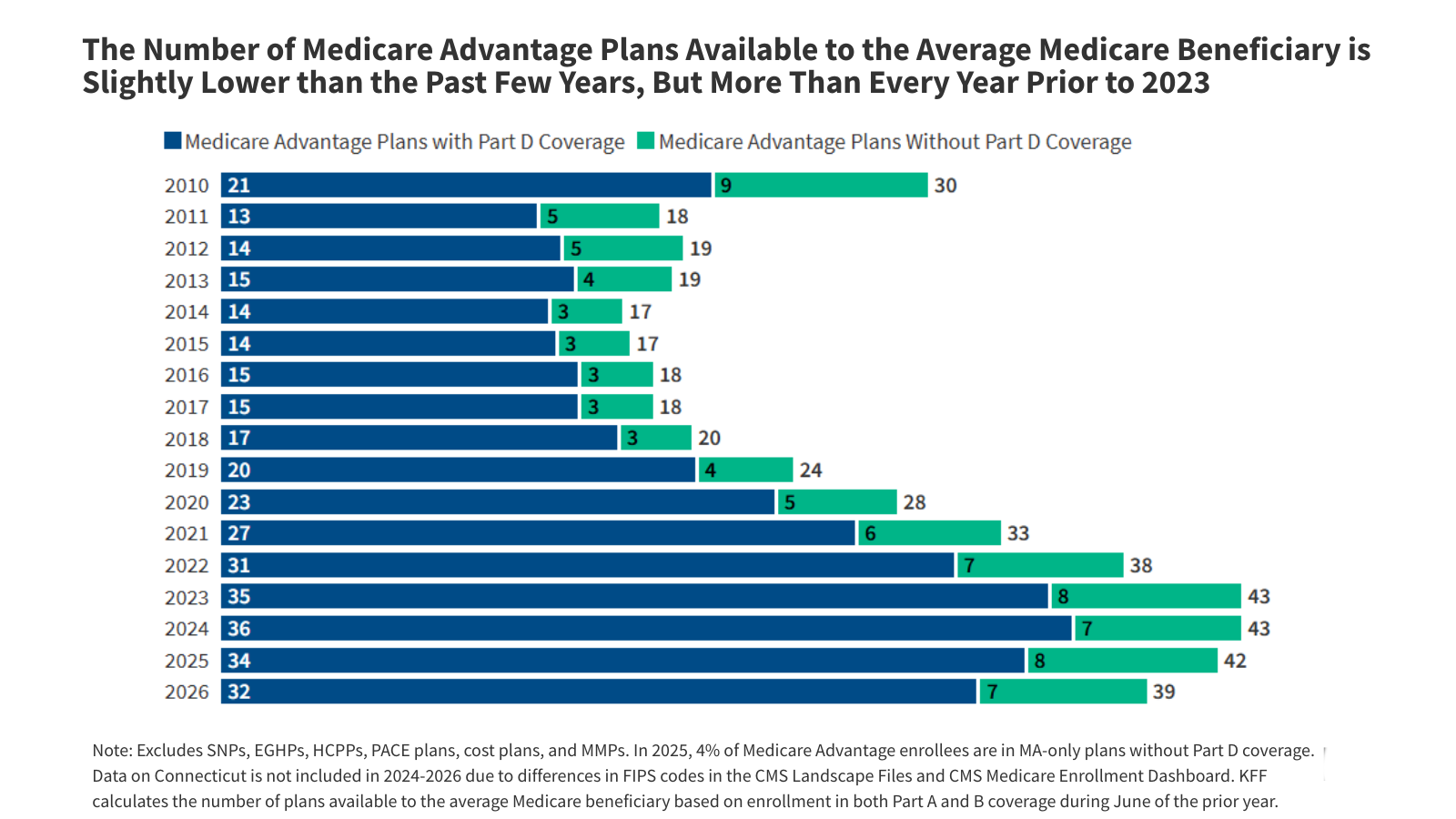
    For 2024, the average Medicare beneficiary has access to 43 Medicare Advantage plans and can choose from plans offered by 8 firms. Among the majority of Medicare Advantage plans that cover prescription drugs, 66 percent will charge no premium in addition to the monthly Medicare Part B premium. As in previous years, the vast majority of Medicare Advantage plans will offer supplemental benefits, including fitness, dental, vision, and hearing benefits.

  • With Medicare Open Enrollment Underway, Beneficiaries Typically Will Have a Choice of 43 Medicare Advantage Plans for 2024, Consistent with 2023 But More than Double The Number From 2018

    News Release

    With open enrollment underway, Medicare beneficiaries have until December 7th to review and select their coverage for 2024. They also have a lot of options to choose from, as two new KFF analyses show. For many beneficiaries, the first decision is whether to enroll in traditional Medicare (often with supplemental coverage and a stand-alone prescription drug plan) or Medicare Advantage, the private plans sponsored by insurance companies that now cover more than half of all…

  • Medicare Part D in 2024: A First Look at Prescription Drug Plan Availability, Premiums, and Cost Sharing

    Issue Brief

    Medicare Part D prescription drug coverage is available for people with Medicare who enroll in private plans, either a stand-alone prescription drug plan (PDP) for people in traditional Medicare, or a Medicare Advantage plan that covers all Medicare benefits, including prescription drugs (MA-PD). This issue brief provides an overview of Part D plan availability and premiums in 2024 and key trends over time.

  • Overall Satisfaction with Medicare is High, But Beneficiaries Under Age 65 With Disabilities Experience More Insurance Problems Than Older Beneficiaries

    Issue Brief

    This brief analyzes data from the 2023 KFF Survey of Consumer Experiences with Health Insurance to get a current understanding of how Medicare is working for older adults and younger people with disabilities. The analysis shows that people with Medicare who are under 65 with disabilities experience more problems using their Medicare coverage, including access and cost-related problems, than beneficiaries who are 65 and older.