Medicare

New & Noteworthy
Examining the Potential Impact of Medicare’s New WISeR Model

A federal initiative to establish new prior authorization requirements in traditional Medicare, called the Wasteful and Inappropriate Service Reduction (WISeR) model, is likely to have only modest impact in its first year.

State Profiles for Dual-Eligible Individuals

This data collection draws on Medicare and Medicaid administrative data to present national and state-level information on people who are covered by both Medicare and Medicaid, referred to as dual-eligible individuals (also known as dually-enrolled beneficiaries).

Data Visualization

The Facts About Medicare Spending

This interactive provides the facts on Medicare spending. Medicare, which serves 67 million people and accounts for 12 percent of the federal budget and 21 percent of national health spending, is often the focus of discussions about health expenditures, health care affordability and the sustainability of federal health programs.

Explore data on enrollment growth, Medicare spending trends overall and per person, growth in Medicare spending relative to private insurance, spending on benefits and Medicare Advantage, Part A trust fund solvency challenges, and growth in out-of-pocket spending by beneficiaries.

Related: FAQs on Medicare Financing and Trust Fund Solvency

Read More

Subscribe to KFF Emails

Choose which emails are best for you.
Sign up here

Filter

221 - 230 of 1,593 Results

  • Medicare Advantage 2026 Spotlight: A First Look at Plan Offerings

    Issue Brief

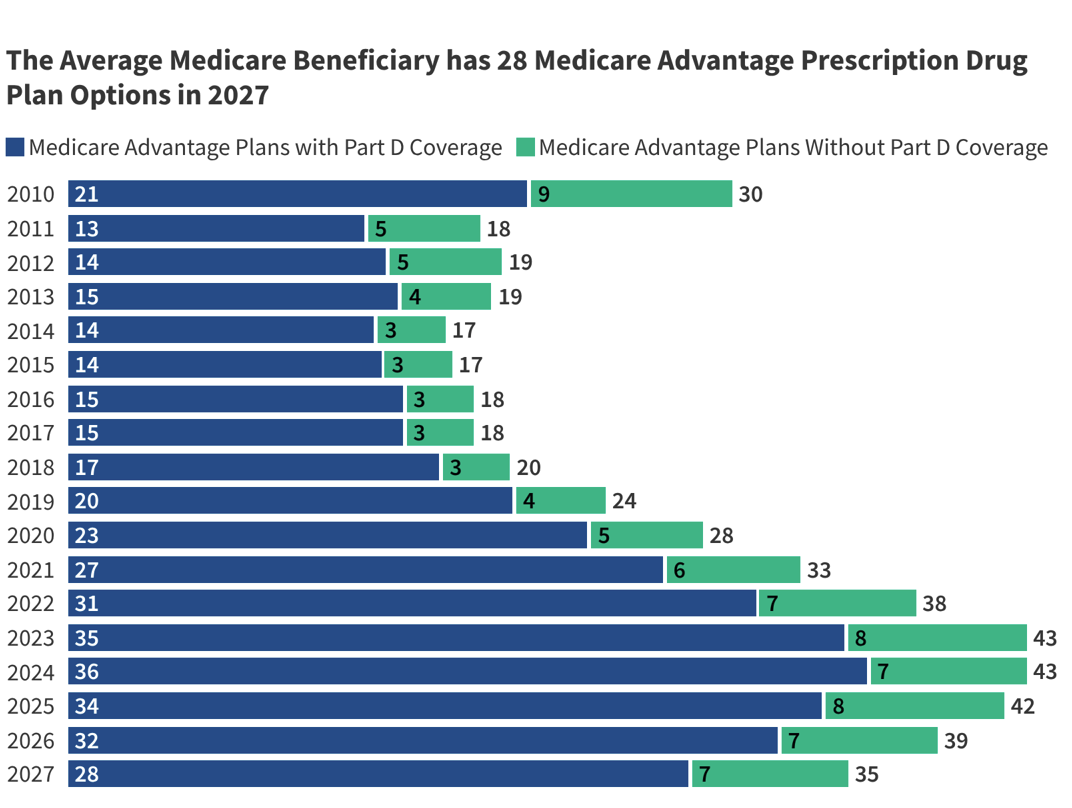
    This brief provides an overview of the Medicare Advantage plans that are available for 2026 and key trends over time. In 2026, the average Medicare beneficiary has a choice of 32 Medicare Advantage prescription drug (MA-PD) plans, two fewer than the 34 in 2025. Virtually all Medicare Advantage plans for 2026 provide multiple extra benefits like vision, hearing, and dental benefits, similar to last year.

  • Implementation Dates for 2025 Budget Reconciliation Law

    Feature

    This searchable timeline shows the implementation dates for the health care provisions included in the 2025 federal budget reconciliation law, previously known as "One Big Beautiful Bill Act." It includes provisions related to Medicaid, the Affordable Care Act, Medicare and Health Savings Accounts (HSAs).

  • The Connection Between Social Security Disability Benefits and Health Coverage Through Medicaid and Medicare

    Issue Brief

    This analysis examines who was eligible for Medicare and/or Medicaid between 2002 and 2022 because they received disability benefits from one of the country's Social Security disability programs, Social Security Disability Insurance (SSDI) or Supplemental Security Income (SSI). Many who receive SSDI and SSI qualify for both Medicare and Medicaid, known as dual-eligible individuals.

  • Health Provisions in the 2025 Federal Budget Reconciliation Law

    Issue Brief

    On July 4, President Trump signed the budget reconciliation bill, previously known as the “One Big Beautiful Bill Act,” into law. This summary provides background, description, budgetary impact and related information on the health care provisions of the law in four categories: Medicaid, the Affordable Care Act, Medicare and Health Savings Accounts (HSAs).

  • Enrollment and Spending Patterns Among Medicare-Medicaid Enrollees (Dual Eligibles)

    Issue Brief

    This brief examines national and state-level data on enrollment and spending for Medicare-Medicaid enrollees using the 2019 and 2020 Medicare Beneficiary Summary Files and the 2019 Transformed Medicaid Statistical Information System (T-MSIS). Spending data for Medicare includes beneficiaries in traditional Medicare only, since spending data for beneficiaries enrolled in Medicare Advantage plans are unavailable. State-level data on Medicare-Medicaid enrollment and spending are available through KFF’s State Health Facts.

  • What to Know about Medicare Spending and Financing

    Issue Brief

    This brief provides an overview of Medicare spending and financing, based on the most recent historical and projected data from the Medicare Trustees and the Congressional Budget Office (CBO). The brief highlights trends in Medicare spending and key drivers of spending growth, including higher enrollment, growth in health care costs, and increases in payments to Medicare Advantage plans.