Medicare

NEW AND NOTEWORTHY

What to Know About Medicare Coverage of Telehealth

Congress has repeatedly extended pandemic-era flexibilities around Medicare coverage of telehealth, but most such flexibilities remain temporary. This brief answers key questions about the current scope of Medicare telehealth coverage, including both temporary and permanent changes adopted through legislation and regulation, and future policy considerations.

Examining the Potential Impact of Medicare’s New WISeR Model

A federal initiative to establish new prior authorization requirements in traditional Medicare, called the Wasteful and Inappropriate Service Reduction (WISeR) model, is likely to have only modest impact in its first year.

State Profiles for Dual-Eligible Individuals

This data collection draws on Medicare and Medicaid administrative data to present national and state-level information on people who are covered by both Medicare and Medicaid, referred to as dual-eligible individuals (also known as dually-enrolled beneficiaries).

Data Visualization

The Facts About Medicare Spending

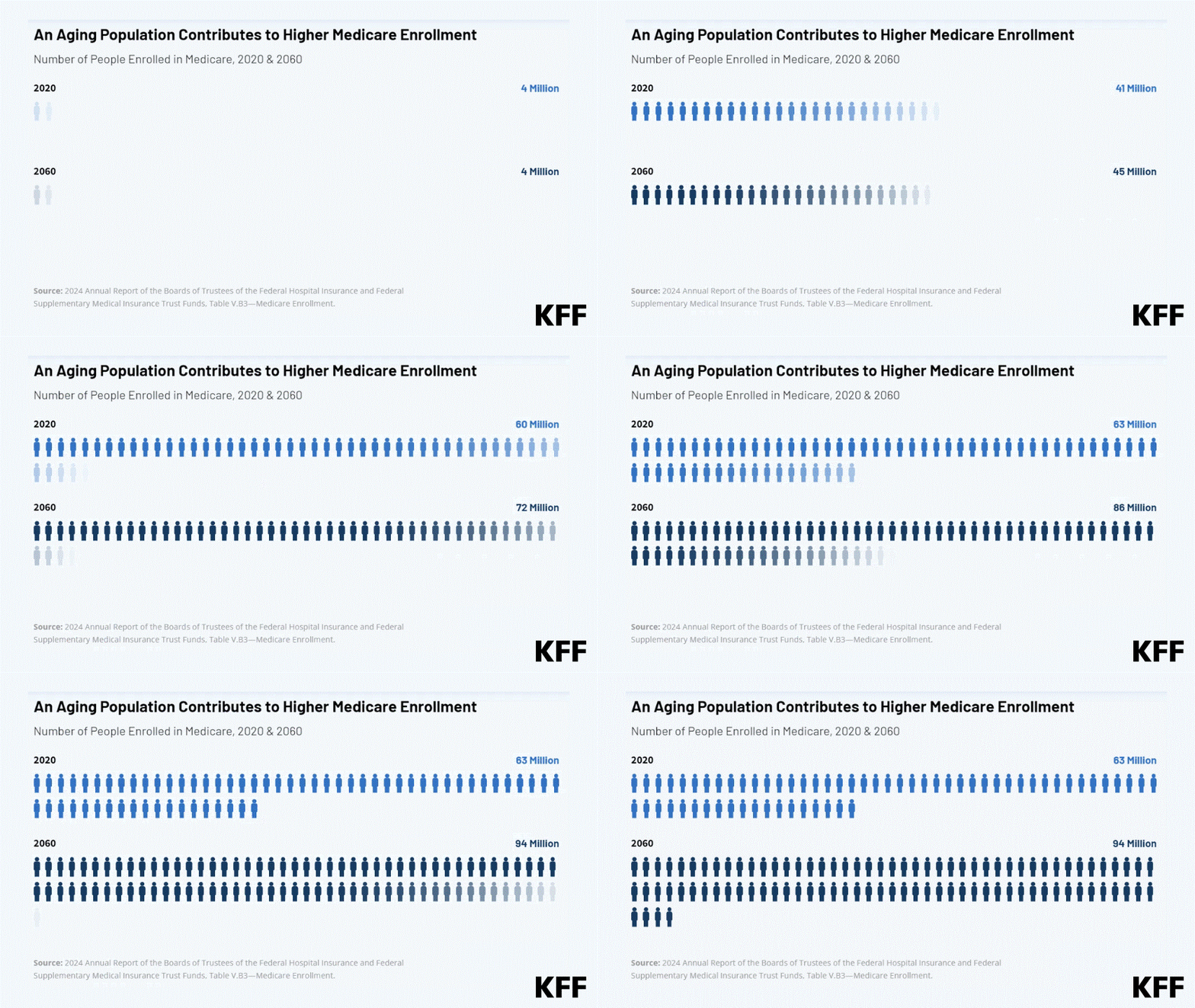
This interactive provides the facts on Medicare spending. Medicare, which serves 67 million people and accounts for 12 percent of the federal budget and 21 percent of national health spending, is often the focus of discussions about health expenditures, health care affordability and the sustainability of federal health programs. u003cbru003eu003cbru003eExplore data on enrollment growth, Medicare spending trends overall and per person, growth in Medicare spending relative to private insurance, spending on benefits and Medicare Advantage, Part A trust fund solvency challenges, and growth in out-of-pocket spending by beneficiaries.u003cbru003eu003cbru003eu003ca href=u0022https://www.kff.org/medicare/issue-brief/faqs-on-medicare-financing-and-trust-fund-solvency/u0022 data-type=u0022linku0022 data-id=u0022https://www.kff.org/medicare/issue-brief/faqs-on-medicare-financing-and-trust-fund-solvency/u0022u003eRelated:u003ca href=u0022https://www.kff.org/medicare/issue-brief/faqs-on-medicare-financing-and-trust-fund-solvency/u0022u003e FAQs on Medicare Financing and Trust Fund Solvencyu003c/au003eu003c/au003e

Read More

Stay informed.

Stay informed.

Filter

1,431 - 1,440 of 1,601 Results

  • Health Care and the 2004 Elections: Medicare Coverage and Financing

    Issue Brief

    Medicare Coverage and Financing Download a printable .pdf of Health Care and the 2004 Elections: Medicare Coverage and Financing. IssueBackgroundPolicy Challenges Facing MedicareAssessing Candidate PositionsIssue The Medicare program is a valuable source of health insurance coverage for more than 41 million Americans. Medicare enjoys broad public support, but the program faces a number of challenges in the years ahead, including the implementation of the new Medicare drug benefit beginning in 2006. Another issue pertains to…

  • The Effect of Formularies and Other Cost Management Tools on Access to Medications: An Analysis of the MMA and Proposed Regulations

    Issue Brief

    This paper, by John F. Hoadley, Ph.D., of the Health Policy Institute at Georgetown University, examines how formulary designs and other cost-management tools may affect Medicare beneficiaries’ access to medications through their Medicare Part D prescription drug plans. It is one in a series commissioned by the Kaiser Family Foundation that analyzes issues surrounding the implementation of the Medicare Prescription Drug, Improvement, and Modernization Act of 2003 (MMA) and the proposed regulations. Issue Brief (.pdf)

  • Medicare Health and Prescription Drug Plans Report

    Other Post

    Medicare Health and Prescription Drug Plans Monthly Tracking Reports These briefs present monthly data on Medicare Advantage participation, enrollment and penetration. They also summarize recent activities by the Centers for Medicare and Medicaid Services (CMS), participating health plans, and the research community pertaining to the Medicare Advantage program and prescription drug plans that began serving the Medicare population in January 2006. The reports were prepared by researchers at Mathematica Policy Research Inc. April 2010 Report…

  • Dual Eligible Home and Community-Based Waiver Program Participants and the New Medicare Drug Benefit

    Issue Brief

    Dual eligible beneficiaries who participate in Medicaid home and community-based waiver programs usually do not have a centralized care provider to manage their health care benefits and services. For the new Medicare prescription drug benefit, no individual is designated to assist participants with their prescription drug plan selection, comparison of formularies, and if necessary, management of their exceptions and appeals should a medication be denied by their plan. This paper offers state and federal policymakers…

  • Medicare Prescription Drug Coverage for Residents of Nursing Homes and Assisted Living Facilities: Special Problems and Concerns

    Issue Brief

    This issue brief describes Medicare drug benefit policy issues for residents of nursing homes and other long-term care settings, such as assisted living facilities and board and care facilities. The brief addresses differing rules for nursing home and non-nursing home settings, as well as for dual eligibles residing in long-term care facilities. Issue Brief (.pdf)

  • Medicare+Choice Withdrawals: Understanding Key Factors

    Report

    To help understand why M+C plans have exited or limited their participation in the M+C program in recent years, this report presents an empirical analysis of the factors associated with plan withdrawals between 1999 and 2001. This analysis explores factors such as M+C payment levels, local market characteristics, and individual health plan characteristics to help predict plan withdrawals and draw inferences about the types of plans and markets that have been most adversely affected. Report

  • Selected Findings on Knowledge and Understanding of the New Medicare Rx Drug Program — January/February 2004 Kaiser Health Poll Report Survey

    Poll Finding

    Seniors are confused about the Medicare prescription drug law. Selected findings from the January/February 2004 Kaiser Health Poll Report survey show that while about two-thirds of seniors report following the debate closely, just 15% say they understand the new prescription drug law very well and seven in 10 don’t know that it passed and was signed into law. Survey Toplines Chartpack News Release Statement by Drew Altman, President and CEO, Kaiser Family Foundation on the…

  • Kaiser Family Foundation/ Harvard School of Public Health Medicare Prescription Drug Survey

    Report

    A new survey by the Kaiser Family Foundation and Harvard School of Public Health examines public opinion on the current Medicare prescription drug debate. The survey, a follow-up to a broader, more comprehensive survey released in June 2003 about the Medicare program and proposed changes, finds that a majority of seniors want Congress to pass Medicare prescription drug legislation this year, but most worry that they will still pay too much for drugs even if…

  • Medicaid Matters For Low Income Medicare Beneficiaries: A Video

    Event Date:
    Event

    In this video, Mildred Benham, a 68 year-old dual enrollee who lives in Bloomington, Illinois, describes the role Medicaid plays in providing services that Medicare does not, such as prescription drugs and personal care. Mildred is a typical dual enrollee in that she has multiple conditions, such as fibrosis of the lungs, rheumatoid arthritis, high blood pressure, and cataracts. To control her conditions, she takes 12 prescriptions a day. Because of her physical limitations, Medicaid…

  • The Role of Health Coverage for People with Disabilities: Findings from 12 Focus Groups with People with Disabilities

    Report

    This report presents findings from focus groups conducted with people with a range of disabilities in an effort to understand the challenges they face and their experiences in the health-care system. To capture variations in experiences by source of health insurance, the groups include people covered under Medicare, Medicaid, and private insurance, as well as those no health insurance at all. The report highlights the ways in which various sources of insurance are working for…