Medicare

NEW AND NOTEWORTHY

What to Know About Medicare Coverage of Telehealth

Congress has repeatedly extended pandemic-era flexibilities around Medicare coverage of telehealth, but most such flexibilities remain temporary. This brief answers key questions about the current scope of Medicare telehealth coverage, including both temporary and permanent changes adopted through legislation and regulation, and future policy considerations.

Examining the Potential Impact of Medicare’s New WISeR Model

A federal initiative to establish new prior authorization requirements in traditional Medicare, called the Wasteful and Inappropriate Service Reduction (WISeR) model, is likely to have only modest impact in its first year.

State Profiles for Dual-Eligible Individuals

This data collection draws on Medicare and Medicaid administrative data to present national and state-level information on people who are covered by both Medicare and Medicaid, referred to as dual-eligible individuals (also known as dually-enrolled beneficiaries).

Data Visualization

The Facts About Medicare Spending

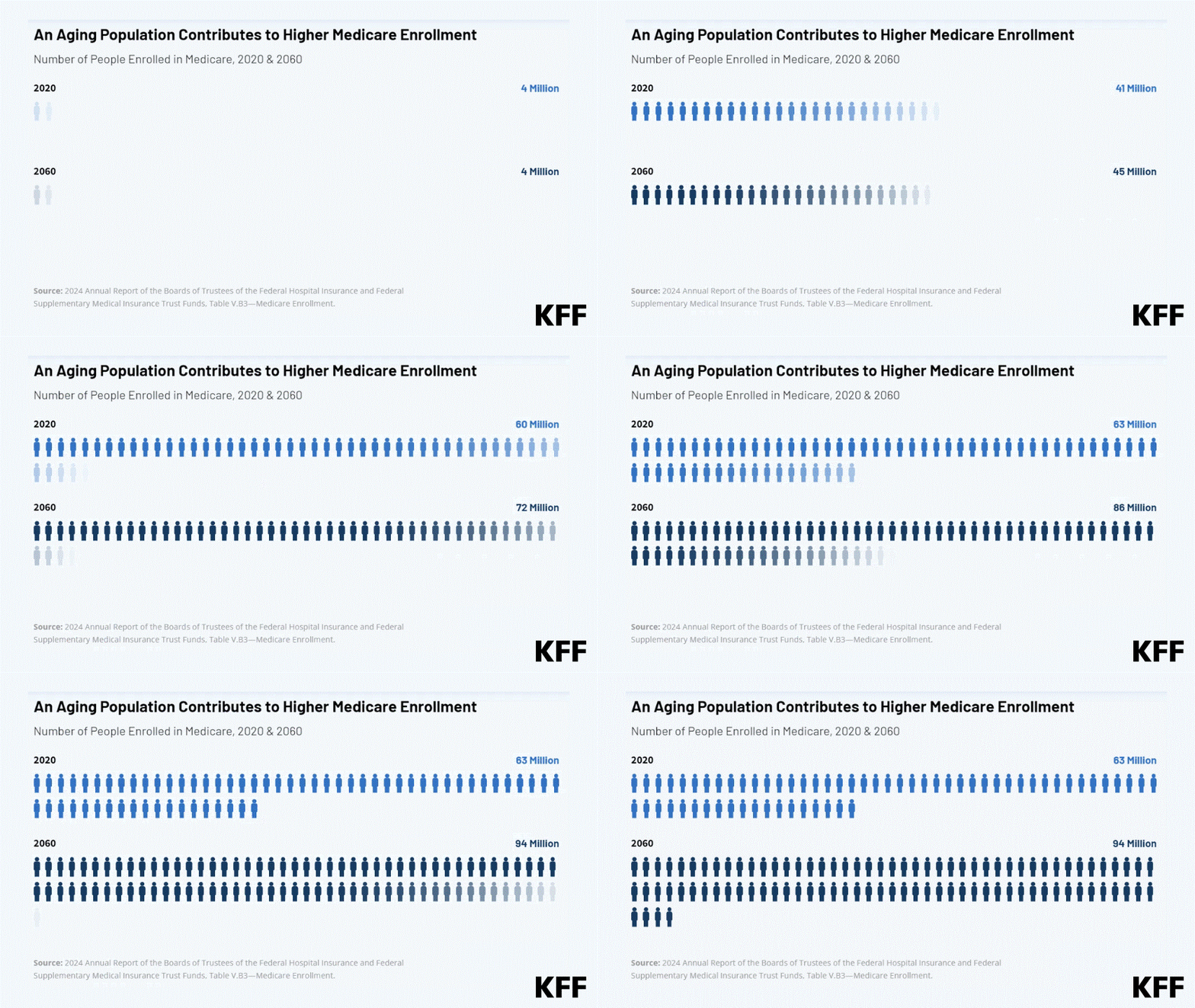
This interactive provides the facts on Medicare spending. Medicare, which serves 67 million people and accounts for 12 percent of the federal budget and 21 percent of national health spending, is often the focus of discussions about health expenditures, health care affordability and the sustainability of federal health programs. u003cbru003eu003cbru003eExplore data on enrollment growth, Medicare spending trends overall and per person, growth in Medicare spending relative to private insurance, spending on benefits and Medicare Advantage, Part A trust fund solvency challenges, and growth in out-of-pocket spending by beneficiaries.u003cbru003eu003cbru003eu003ca href=u0022https://www.kff.org/medicare/issue-brief/faqs-on-medicare-financing-and-trust-fund-solvency/u0022 data-type=u0022linku0022 data-id=u0022https://www.kff.org/medicare/issue-brief/faqs-on-medicare-financing-and-trust-fund-solvency/u0022u003eRelated:u003ca href=u0022https://www.kff.org/medicare/issue-brief/faqs-on-medicare-financing-and-trust-fund-solvency/u0022u003e FAQs on Medicare Financing and Trust Fund Solvencyu003c/au003eu003c/au003e

Read More

Stay informed.

Stay informed.

Filter

1,281 - 1,290 of 1,601 Results

  • Raising Medicare’s Age of Eligibility to 67 Would Achieve Significant Savings, But Shift Costs To 65- and 66-Year-Olds, Other Individuals, Employers and Medicaid, New Analysis Shows

    News Release

    Study Estimates Two in Three People Ages 65 and 66 Would Pay $2,200 More On Average For Health Care in 2014 Than They Would If They Remained in Medicare MENLO PARK, Calif. -- Raising Medicare’s eligibility age from 65 to 67 in 2014 would generate an estimated $5.7 billion in net savings to the federal government, but also result in an estimated net increase of $3.7 billion in out-of-pocket costs for 65- and 66-year-olds, and…

  • Medicare Part D 2011 Data Spotlights

    Report

    The Kaiser Family Foundation has issued a collection of analyses related to the Medicare Part D stand-alone drug plan options available to seniors for calendar year 2011. These spotlights focuses on key aspects of the drug plan choices available and relevant trends since the Medicare drug benefit took effect in 2006. They were prepared by a team of researchers at Georgetown University, NORC and the Kaiser Family Foundation. 2012 Part D Data Spotlights Now Available…

  • Medicare: The Basics, A Public Dialogue on Health Care: The Future of Medicare

    Report

    A public education brochure describing basic facts about the current Medicare program and how it works. This fact sheet is included in a full packet of information as part of a joint public information project between Kaiser Family Foundation and League of Women Voters of public meetings held across the United States in October 1998 (#1427 - available in print). Report Report

  • Medicare Restructuring: The FEHBP Model

    Other Post

    Executive Summary Part 2 How Well Does FEHBP work? FEHBP has been somewhat more successful than Medicare in controlling costs. However, recent trends indicate that FEHBP's competitive structure alone cannot guarantee cost control over the long term. Until recently, FEHBP experienced slightly lower growth in spending per enrollee than Medicare. Over the period 1987 to 1997, Medicare spending per beneficiary grew at an annual rate of 8.1 percent. FEHBP spending per enrollee grew at 7.1…

  • Selected Findings on the New Medicare Rx Drug Law – Chartpack

    Poll Finding

    Selected Survey Findings on the New Medicare Rx Drug Law - Chartpack Seniors are confused about the Medicare prescription drug law. Below is a series of chart illustrating selected findings from the January/February 2004 Kaiser Health Poll Report survey. The findings show that while about two-thirds of seniors report following the debate closely, just 15% say they understand the new prescription drug law very well and seven in 10 don’t know that it passed and…

  • The New Medicare Drug Benefit:  Potential Effects of Pharmacy Management Tools on Access to Medications

    Issue Brief

    The New Medicare Drug Benefit: Potential Effects of Pharmacy Management Tools on Access to Medications This report describes the pharmacy benefit management tools that will be available to private plans administering the new Medicare drug benefit, including formularies, the definition of categories and classes, and cost sharing requirements. The authors conclude that substantial flexibility given to plans to design management tools could have significant implications for beneficiaries’ access to needed medications and out-of-pocket spending. Issue…

  • Medicare Part D Prescription Drug Plan Availability in 2013

    Fact Sheet

    This fact sheet contains 2013 state-specific summary data about available Medicare drug benefit options, including premium ranges and the number of plans available at no cost to qualifying beneficiaries. Fact Sheet (.pdf)