Medicare

NEW AND NOTEWORTHY

Examining the Potential Impact of Medicare’s New WISeR Model

A federal initiative to establish new prior authorization requirements in traditional Medicare, called the Wasteful and Inappropriate Service Reduction (WISeR) model, is likely to have only modest impact in its first year.

State Profiles for Dual-Eligible Individuals

This data collection draws on Medicare and Medicaid administrative data to present national and state-level information on people who are covered by both Medicare and Medicaid, referred to as dual-eligible individuals (also known as dually-enrolled beneficiaries).

Data Visualization

The Facts About Medicare Spending

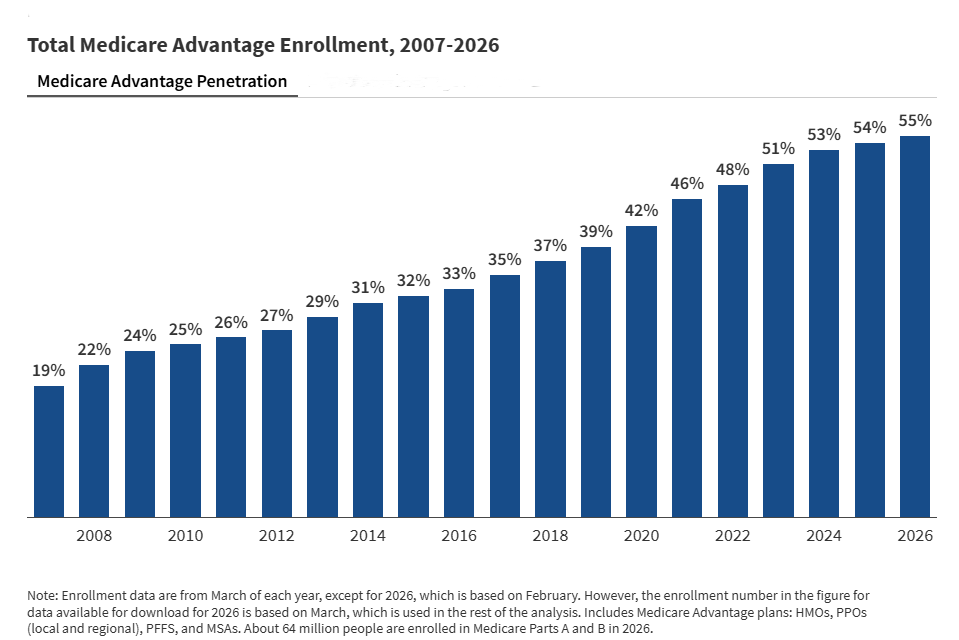
This interactive provides the facts on Medicare spending. Medicare, which serves 67 million people and accounts for 12 percent of the federal budget and 21 percent of national health spending, is often the focus of discussions about health expenditures, health care affordability and the sustainability of federal health programs. Explore data on enrollment growth, Medicare spending trends overall and per person, growth in Medicare spending relative to private insurance, spending on benefits and Medicare Advantage, Part A trust fund solvency challenges, and growth in out-of-pocket spending by beneficiaries.

Read More

Stay informed.

https://js.hsforms.net/forms/embed/292449.js

Stay informed.

https://js.hsforms.net/forms/embed/292449.js

Filter

1,181 - 1,190 of 1,602 Results

  • Medicare Now and in the Future

    Issue Brief

    Download PDF Issue Medicare is a valuable source of health insurance for nearly 45 million Americans – mainly seniors ages 65 and older, but also 7 million younger adults with permanent disabilities.  Before Medicare was signed into law in 1965, about half of all seniors lacked hospital insurance.  Today, virtually all people ages 65 and over are covered by Medicare.  Medicare is a popular program, but faces a number of issues and challenges in the…

  • The Federal Government’s Authority To Regulate Advertising in Medicare

    Issue Brief

    This policy brief, prepared for the Kaiser Family Foundation by Vicky Gottlich at the Center for Medicare Advocacy, explains the Centers for Medicare & Medicaid Services’ legal authority to regulate advertising and other information issued by the private companies that contract with the government to provide Medicare benefits. The brief also suggests additional steps the agency could take to enhance consumer protections with respect to advertising and marketing practices under its current authority. Issue Brief…

  • Study Finds Advertising By Insurers Favors Medicare Advantage Over Stand-Alone Drug Plans

    Issue Brief

    As the marketing period for 2009 Medicare plans nears, the Kaiser Family Foundation Kaiser Family Foundation issued a report analyzing the content and frequency of television, print and radio advertisement for private Medicare plans that ran nationally or in one of three local media markets (Miami/Fort Lauderdale, Fla.; Phoenix, Ariz.; and Greensboro, N.C) during the marketing and enrollment period for 2008 plan offerings. The study finds that insurers last year placed three times more advertisements…

  • Pitching Private Medicare Plans: An Analysis of Medicare Advantage and Prescription Drug Plan Advertising

    Other Post

    This Kaiser Family Foundation report analyzes the content and frequency of television, print and radio advertisement for private Medicare plans that ran nationally or in one of three local media markets (Miami/Fort Lauderdale, Fla.; Phoenix, Ariz.; and Greensboro, N.C.) during the marketing and enrollment period for 2008 plan offerings. All ads were identified by VMS, a media monitoring service. The study finds that insurers last year placed three times more advertisements to promote Medicare Advantage…

  • The Medicare Part D Coverage Gap: Costs and Consequences in 2007

    Report

    This study quantifies the number of Medicare Part D plan enrollees in 2007 who reached a gap in their prescription drug coverage known as the “doughnut hole,” as well as the changes in beneficiaries’ use of medications and out-of-pocket spending after they reached that gap.

  • Medicare Advantage in 2008

    Issue Brief

    Medicare Advantage plans enrolled a record 9.8 million beneficiaries, more than one in five of the nation’s 44 million people on Medicare as of April 2008. That represents an increase of more than 800,000 beneficiaries in just four months, continuing a period of unprecedented growth for private plans in Medicare since 2003. This issue brief, prepared for the Kaiser Family Foundation by Marsha Gold of Mathematica Policy Research, Inc., analyzes recent developments in the Medicare…

  • Medicare 2008 Benefits Table

    Report

    2008 Medicare Benefits Table Summary of Traditional Medicare, 2008 PART A Financing: 1.45% for both workers and employers No premiums* Benefits: Inpatient hospital - Days 1-60 - Days 61-90 - Days 91-150 - After 150 days Deductible of $1,024 per benefit period** No coinsurance $256 a day $512 a day No benefits Skilled nursing facility - Days 1-20 - Days 21-100 - After 100 days No coinsurance $128 a day No benefits Home health No…

  • Medicare Prescription Drug Plans in 2008 and Key Changes Since 2006: Summary of Findings

    Issue Brief

    This synthesis of key findings from analysis presented in a series of eight Medicare Part D 2008 Data Spotlights describes key features of stand-alone prescription drug plans offered in 2008 and trends since 2006. The synthesis covers a range of topics, including premiums, the coverage gap, benefit design, cost sharing, specialty tiers, formularies, utilization management, the top 10 brand-name prescription drugs, and the availability of low-income subsidy plans. The analysis was conducted jointed by Jack…

  • Medicare Part D 2008 Data Spotlight: Ten Most Common Brand-Name Drugs

    Issue Brief

    This Medicare Part D Data Spotlight examines the variation in 2008 Part D plan coverage, cost sharing and utilization management tools for the 10 prescriptions most commonly used by Medicare beneficiaries, including treatments for cholesterol, cardiovascular health, osteoporosis, dementia, gastrointestinal reflux and ulcers. It looks at data from the 47 stand-alone prescription drug plans available nationwide in 2008. This data spotlight is one in a series analyzing key aspects of the 2008 Medicare Part D…

  • Medicare Part D 2008 Data Spotlight: Low-Income Subsidy Plan Availability

    Issue Brief

    This Medicare Part D Data Spotlight focuses on the availability of drug plans for beneficiaries receiving the Part D low-income subsidy in 2008 and changes since 2006. It looks at data from the 47 stand-alone prescription drug plans available nationwide in 2008. This is one in a series analyzing key aspects of the 2008 Medicare Part D prescription drug plan choices. The analysis was conducted jointed by Jack Hoadley of Georgetown University, Elizabeth Hargrave of NORC…