Medicaid

Work Requirements

Challenges with Implementing Work Requirements

Many states are anticipating a variety of implementation challenges, including the need for complex system changes, a compressed implementation timeline, and limited staff capacity.

What is the Medicaid Hardship Exception?

The number of Medicaid expansion enrollees who ultimately qualify for the high unemployment hardship exception will depend on how the exception is implemented and how unemployment rates changes.

Tracking Implementation of the 2025 Reconciliation Law: Medicaid Work Requirements

KFF’s interactive tracks key data and policies that will affect how states implement Medicaid work requirements, which are required under the 2025 budget reconciliation law starting in January 2027. The tracker includes state-level data on Medicaid enrollment and renewal outcomes as well as current state enrollment and renewal policies.

2025-2026 Medicaid Budget Survey

2025 Medicaid Home Care survey

Payment Rates Ahead of 2025 Reconciliation Law

This issue brief describes Medicaid payment rates for home care and other workforce supports that are in place in 2025, before the majority of the 2025 reconciliation law provisions start taking effect.

Home Care Support for Family Caregivers in 2025
number of responding states, including DC, that allow payments for family caregivers by type of home care program and type of caregiver.

This issue brief describes the availability of self-directed services and supports for family caregivers in Medicaid home care in 2025, before most provisions in the reconciliation law take effect.

States’ Management of Home Care Spending

This issue brief describes the mechanisms states are currently using to limit Medicaid spending on home care and their plans for adopting new mechanisms in state fiscal year (FY) 2026.

Waiting Lists for Medicaid Home Care, 2016 to 2025
A Look at Waiting Lists for Medicaid Home- and Community-Based Services from 2016 to 2025

This data note provides new information about waiting lists in Medicaid home care before many of the provisions in the 2025 reconciliation law go into effect.

Eligibility and coverage
  • Eligibility, Enrollment, and Renewal Policies
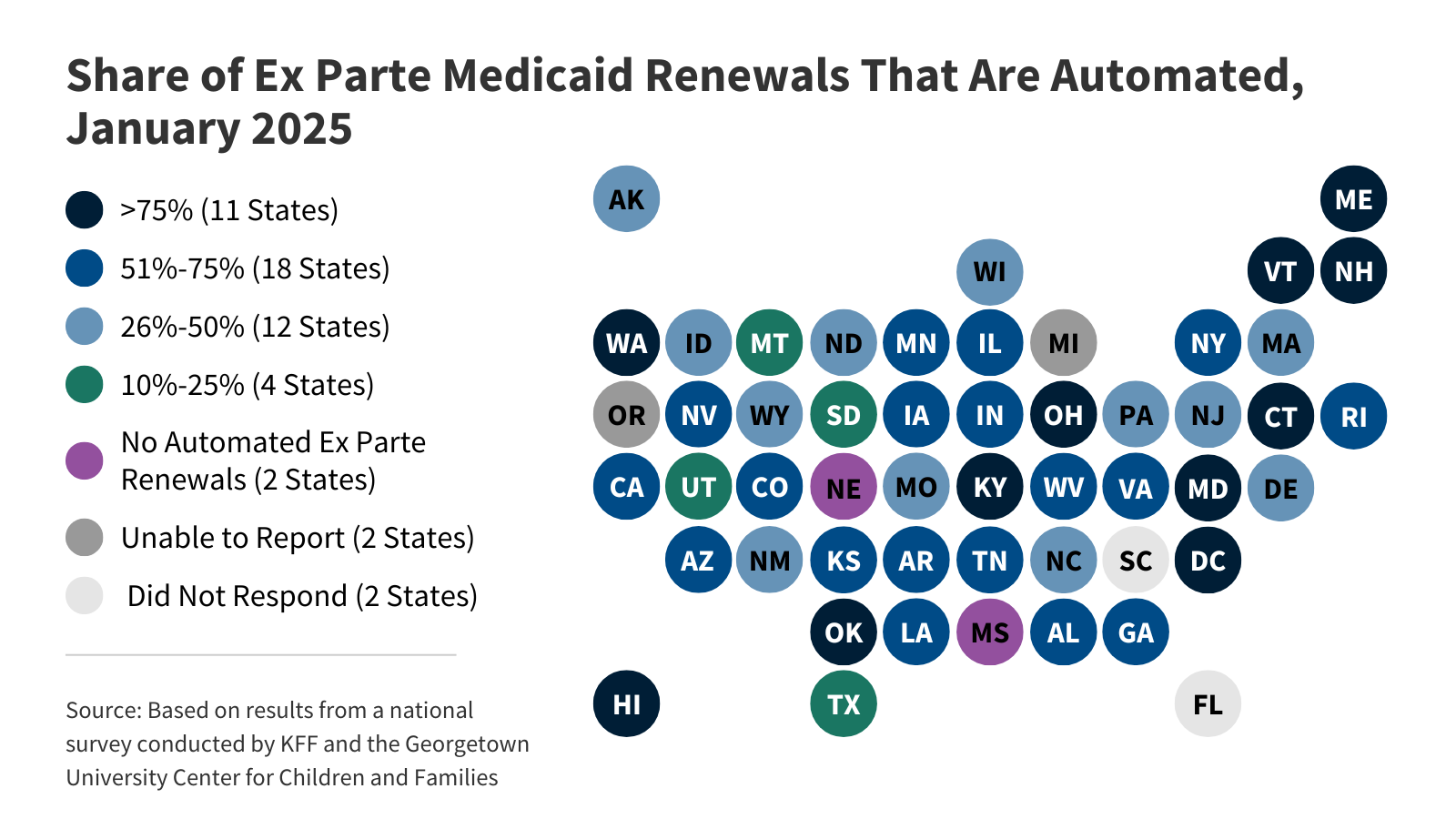
    KFF's survey findings capture state actions that seek to improve the accuracy and efficiency of Medicaid and CHIP enrollment and renewal processes, as of January 2025.
  • Seniors and People with Disabilities

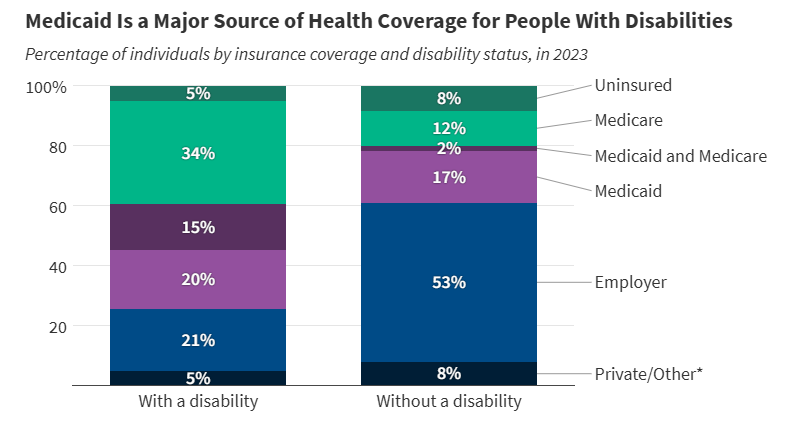
    More than 1 in 3 people with disabilities (15 million) have Medicaid (35%). In comparison, only 19% of people without disabilities have Medicaid.
  • Children with Special Needs

    Amid debates about proposed cuts to federal Medicaid spending, this brief analyzes key characteristics of children with special health care needs and explores how Medicaid provides them with coverage.
  • People With Intellectual and Developmental Disabilities
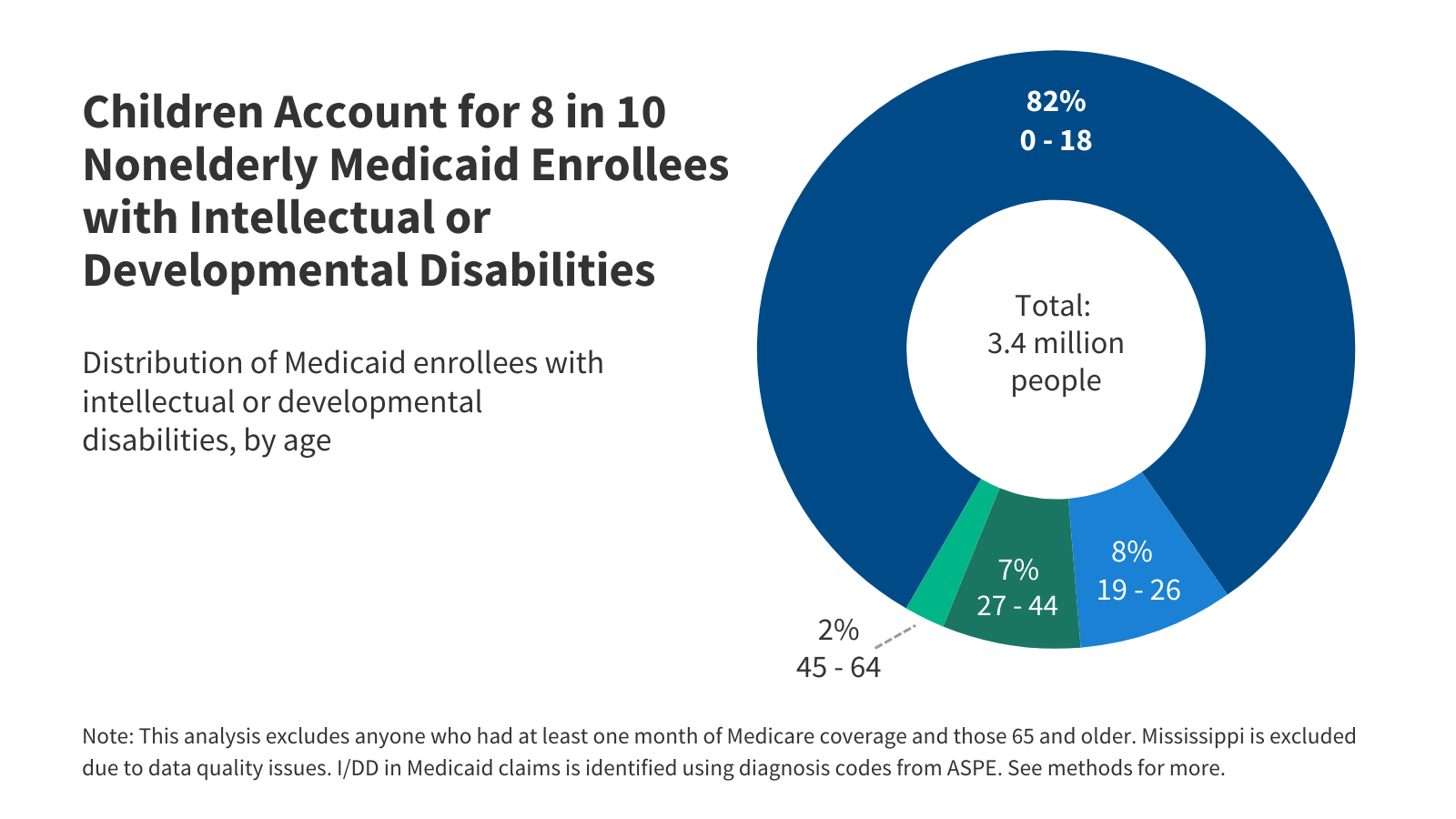
    Among the estimated 8 million people with intellectual and developmental disabilities (I/DD), over three million have Medicaid coverage.
  • Adults with Chronic Conditions

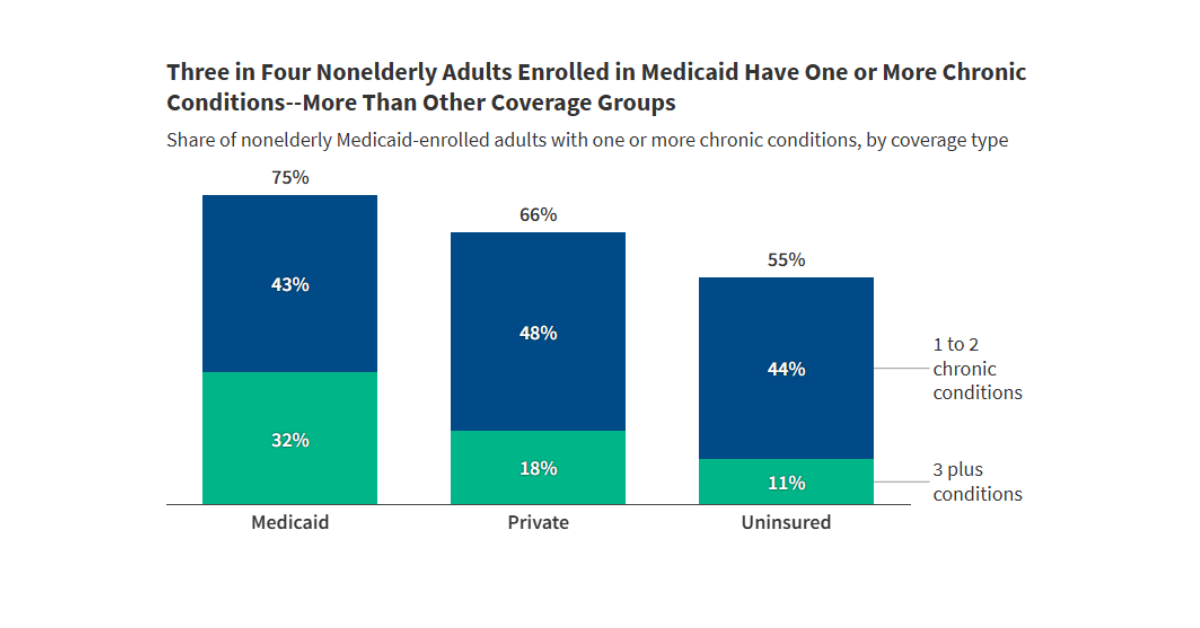
    Among working age adults enrolled in Medicaid, approximately three quarters have one or more chronic conditions, and nearly one-third have three or more.

The Essentials
  • 5 Facts: Immigrants and Medicaid

    This brief provides five key facts on Medicaid and immigrants as context for understanding the potential impacts of policy changes under the Trump administration.
  • 5 Facts: Medicaid and Hospitals

    This brief explains the role of Medicaid for hospitals, including how much spending on hospital care comes from Medicaid, the share of births covered by the program, and how Medicaid expansion has impacted hospital finances.
  • Medicaid Financing: The Basics

    Medicaid is a major source of financing for states to provide health coverage and long-term services and supports for low-income residents. This brief examines key questions about Medicaid financing and how it works.
  • 5 Facts: Medicaid’s Share of National Health Spending

    This brief explores how Medicaid spending contributes to national health spending and how different service areas contribute to Medicaid costs.
  • 5 Facts: Medicaid and Nursing Facilities

    The substantial Medicaid savings in the reconciliation bill could have major implications for nearly 15,000 federally certified nursing facilities and the 1.2 million people living in them.

Subscribe to KFF Emails

Choose which emails are best for you.
Sign up here

Filter

701 - 710 of 2,679 Results

  • Community Health Centers’ Role in Delivering Care to the Nation’s Underserved Populations During the Coronavirus Pandemic

    Issue Brief

    In the midst of the coronavirus pandemic, community health centers are serving as public health responders, especially for medically underserved populations. Health centers are a national network of safety net primary care providers who provided care to nearly 30 million patients in 2019, and disproportionately serve patients who are low-income, persons of color, uninsured, or publicly insured – groups that have been especially hard hit by the pandemic. This brief examines how health centers have adapted their service delivery models during the pandemic response and the current challenges they face continuing to meet patients’ needs.

  • Medicaid Maintenance of Eligibility (MOE) Requirements: Issues to Watch

    Issue Brief

    Federal legislation provides a temporary increase in federal Medicaid matching rates to states conditioned on states providing continuous eligibility for existing enrollees and meeting certain other eligibility requirements. This brief provides an overview of these maintenance of eligibility (MOE) requirements, examines what happens when the MOE expires, and discusses key issues to consider looking ahead.

  • Health Insurer Financial Performance Through September 2020

    Issue Brief

    In this brief, we analyze third quarter data from 2018 to 2020 to examine how insurance markets performed financially through the end of September. Average margins remained relatively high compared to the same point in recent years, suggesting many insurers remained profitable even as non-COVID-related care returned in the summer and fall.

  • How Has the Pandemic Affected Health Coverage in the U.S.?

    Policy Watch

    Findings from administrative data suggest that the decline in enrollment among employer-sponsored insurance was far less than overall declines in employment as of September, and that many who did lose their job-based coverage likely found a safety net in coverage through Medicaid or the ACA marketplaces.

  • Options to Make Medicare More Affordable For Beneficiaries Amid the COVID-19 Pandemic and Beyond

    Report

    Medicare provides significant health and financial protections to more than 60 million Americans, but there are gaps in coverage and high cost-sharing requirements that can make health care difficult to afford. This report analyzes several policy options that could help make health care more affordable for people covered by Medicare, especially beneficiaries with relatively low incomes: adding an out-of-pocket limit to traditional Medicare, adding a hard out-of-pocket cap to Part D, expanding financial assistance through the Medicare Savings Programs, and expanding financial assistance through the Part D low-income subsidy program.

  • COVID-19 Has Claimed the Lives of 100,000 Long-Term Care Residents and Staff

    Policy Watch

    More than 100,000 residents and staff have died in long-term care facilities since the start of the pandemic. This post discusses the implications of the likely rise in cases due to holiday gatherings and the share of total COVID-19 deaths that have happened in long-term care facilities.

  • Millions of Uninsured Americans are Eligible for Free ACA Health Insurance

    Policy Watch

    Amid the ongoing pandemic and high unemployment, this poste xamines how many uninsured people would be eligible for free health insurance during in a typical year, including those who qualify for Medicaid or for tax credits that cover the full cost of an ACA Marketplace plan.

  • CMS’s 2020 Final Medicaid Managed Care Rule: A Summary of Major Changes

    Issue Brief

    On November 13, 2020, the Centers for Medicare and Medicaid Services (CMS) finalized revisions to the Medicaid managed care regulations which were proposed in November 2018. CMS previously finalized a major revision to these regulations in 2016. The November 2020 final rule is not a wholesale revision of the 2016 regulations but adopts changes in areas including network adequacy, beneficiary protections, quality oversight, and rates and payment.