What Medicare’s Temporary Program Covering GLP-1s for Obesity Means for Beneficiaries

The Centers for Medicare & Medicaid Services (CMS) has released a memo fleshing out the design of a short-term program providing Medicare coverage of GLP-1s for obesity in 2026 ahead of a multi-year demonstration program beginning in 2027. Medicare is statutorily prohibited from covering drugs used for weight loss, and these demonstration programs are designed to fill that gap.
Under the short-term program, called the “Medicare GLP-1 Bridge,” Medicare will cover GLP-1s approved for weight reduction – Wegovy and Zepbound – for eligible beneficiaries enrolled in Medicare Part D for a $50 copayment. Eligibility is based on BMI of 35 or more alone, or 27 or more plus other clinical criteria. Although beneficiaries must be enrolled in Part D to participate, the short-term program will operate outside the Part D benefit for its duration from July 1 to December 31, 2026. Instead, providers will submit GLP-1 prescriptions and prior authorization requests to a central processer managed by CMS.
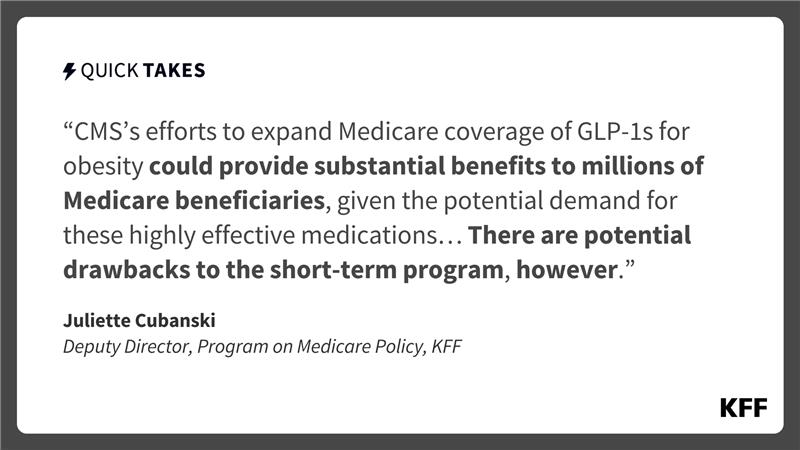
CMS’s efforts to provide Medicare coverage of GLP-1s for obesity could offer substantial benefits to millions of Medicare beneficiaries, given the high demand for these medications. The number of beneficiaries eligible for the Medicare GLP-1 Bridge is unknown, but a previous KFF analysis estimated that close to 14 million Medicare beneficiaries had a diagnosis of overweight or obesity in 2020 (BMI of 25-29.9 and 30 or more, respectively), though applying the specific criteria that determine eligibility for the Medicare GLP-1 Bridge would reduce that number.
There are potential drawbacks to the short-term program, however. Because it will operate outside the Part D benefit, the $50 copayment won’t count towards the Part D deductible or the $2,100 out-of-pocket spending cap. Part D enrollees using a GLP-1 for type 2 diabetes, sleep apnea, or other Medicare-covered uses will continue accessing the drug through their Part D plan and paying their plan’s cost-sharing requirement, even if it’s more than the $50 copayment for GLP-1s for obesity under the Medicare GLP-1 Bridge. And low-income Medicare beneficiaries who qualify for reduced cost sharing through the Part D Low-Income Subsidy can’t use those subsidies for GLP-1 prescriptions filled under the short-term program. For low- and modest-income individuals, the $50 copayment could be a barrier to participation.
Another potential issue is that beneficiaries who participate in the short-term program will need to be enrolled in a Part D plan that participates in the longer-term demonstration, called the BALANCE Model, to continue accessing Medicare coverage of GLP-1s for obesity starting in 2027. CMS is aiming for robust Part D plan participation in the BALANCE model, which is voluntary for plans, but this is still uncertain. Transitioning Medicare coverage of GLP-1s for obesity from the mandatory Medicare GLP-1 Bridge to the voluntary BALANCE model sets up the possibility that beneficiaries with coverage under the short-term program may need to switch Part D plans during the 2027 open enrollment period, with potential cost and coverage implications for other medications they use.