KFF designs, conducts and analyzes original public opinion and survey research on Americans’ attitudes, knowledge, and experiences with the health care system to help amplify the public’s voice in major national debates.
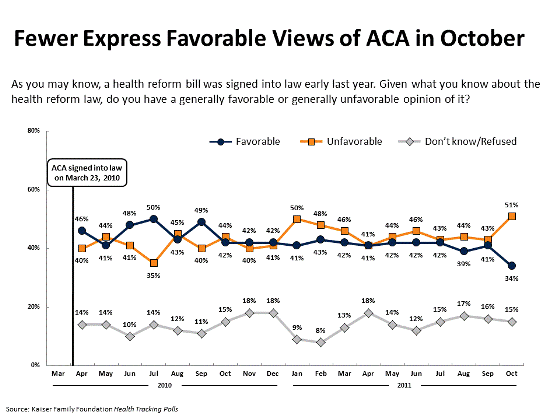
After remaining roughly evenly split for most of the last year and a half, this month’s tracking poll found a higher share of the public expressing negative views towards the health reform law. About half (51 percent) say they have an unfavorable view of the Patient Protection and Affordable Care Act (ACA), while 34 percent have a favorable view, a low point in Kaiser polls since the law was passed. While Democrats continue to be substantially more supportive of the law than independents or Republicans, the change in favorability this month was largely driven by waning enthusiasm for the law among Democrats, among whom the share with a favorable view dropped from nearly two-thirds (65 percent) in September to just over half (52 percent) in October.
With Mitt Romney among the top candidates for the GOP presidential nomination, this month’s poll also asked the public about their impressions of the Massachusetts health reform law that passed when Romney was the state’s governor. The survey finds that nearly three quarters of the public, including seven in ten likely Republican presidential primary voters, say they don’t know enough about the Massachusetts law to have either a favorable or an unfavorable opinion of it.
New 50-State Survey Finds Cuts In Provider Payments And Changes In Delivery Of Services
WASHINGTON, D.C. – Faced with the end of stimulus money and a continuing weak economy, Medicaid officials in virtually every state are enacting a variety of cost cutting measures as states’ spending for Medicaid is projected to increase 28.7 percent this fiscal year to make up for the loss of federal funds, according to a new survey by the Kaiser Family Foundation’s Commission on Medicaid and the Uninsured.
The substantial but temporary increase in the federal share of Medicaid spending under the American Recovery and Reinvestment Act (ARRA) brought about the only declines in state spending on Medicaid in the program’s history in fiscal years 2009 and 2010, even as the deep recession sharply increased Medicaid enrollment and overall Medicaid spending during that period. With that money having expired in June 2011, however, states must ramp up their own spending to replace the lost funds, even though states project total spending in the Medicaid program — which is jointly financed by the federal government and the states — to increase on average by a modest 2.2 percent this year.
The Commission’s 11th annual 50-state Medicaid budget survey captured cost containment actions ranging from restrictions on payments to providers and benefits, to new copayments for beneficiaries and additional efforts to contain the costs of prescription drugs. At the same time, states are trying to make their programs more efficient by increasing their reliance on Medicaid managed care, moving long-term care toward community-based care models, and streamlining enrollment procedures. Even with such measures, Medicaid officials in more than half the states estimate at least a 50-50 chance that they will see a budget shortfall this fiscal year as enrollment continues to grow.
“Unemployment remains high with increasing numbers of poor and uninsured keeping pressure on state budgets and Medicaid programs to meet growing needs,” said Diane Rowland, Executive Vice President of the Kaiser Family Foundation and Executive Director of the Foundation’s Commission on Medicaid and the Uninsured. “But the cumulative effect of two recessions since 2001 and a decade of constrained spending has left no cushion and many of the latest cuts will hit at the core of the Medicaid program.”
The state focus on cutting costs renews a theme seen much of the last decade. It occurs against a backdrop of deficit reduction efforts in Washington that could reduce federal support for Medicaid and shift costs to state capitols at a time when states are coping with historically difficult budget conditions and must also lay the ground work for a significant expansion of Medicaid under the health reform law.
Cost Containment Efforts A Dominant Theme
Due to maintenance of effort requirements included in the ARRA and health reform legislation, states have been prohibited from enacting new restrictions on Medicaid eligibility or enrollment procedures. Instead they have turned to other measures that in some cases build on efforts in play for the last decade, including:
Provider rate restrictions. This was the most commonly reported strategy, with 39 states restricting rates in 2011 and 46 reporting plans to do so in 2012. But a number of states also increased or imposed new provider taxes that can generate more federal matching revenue and help mitigate the effects of cuts to some providers.
Benefit reductions and restrictions. States continued to eliminate, restrict or reduce Medicaid benefits in areas such as dental, therapies, medical supplies, durable medical equipment and personal care services. Almost all states have been making substantial changes in Medicaid pharmacy programs, including preferred drugs lists, supplemental rebates and prior authorization requirements and states are now focusing on controlling costs for specialty drugs, a rising share of prescription drug spending.
New and higher copayments for beneficiaries. Five states in FY 2011 and 14 states in FY 2012 increased copayment amounts or imposed new copayments, compared to only one in FY 2010. Most copayment changes were for pharmacy and emergency room visits, although a few states are requesting federal waivers to implement broader changes that would have higher amounts and apply to populations traditionally exempt in federal law.
Changes In The Delivery of Services
Even amid strained budgets, states worked to enact reforms to better deliver care and prepare for health reform, which calls for a major expansion of Medicaid beginning in 2014. Key areas of change observed in the survey included:
Medicaid managed care. Seventeen states in FY 2011 and 24 states in FY 2012 reported expanding their managed care programs, primarily by expanding the areas and populations covered. Two-thirds of the nation’s 54 million Medicaid beneficiaries in October 2010 were enrolled in some form of managed care.
Dual eligibles. States are expanding the use of disease and care management programs and patient centered medical homes to help coordinate care for duals and other populations with chronic medical conditions. Thirty-seven states submitted letters of intent to pursue additional opportunities to coordinate care for duals based on guidance released by the federal Centers for Medicare and Medicaid Services (CMS) in July 2011.
Long-term care. States continued to shift the delivery of long-term care away from institutions and into community settings. Thirty-two states in FY 2011 and 33 in FY 2012 expanded long term care services, primarily by expanding Medicaid Home- and Community-Based Service programs (HCBS). Most states are still considering whether to adopt new options in the health reform law designed to increase community-based long-term care, but six states reported that they are moving forward with the new options.
Looking Ahead
Although Medicaid officials were focused on the here and now, they also reported moving forward to prepare for the major expansion of Medicaid under health reform. Medicaid directors say the law holds the opportunity to significantly reduce the number of uninsured, but they also cite several administrative and fiscal challenges, including tight state budgets and limited staff and resources to absorb the required new tasks. Medicaid directors said that their programs are poised for a greater role in health care delivery and they are committed to assuring access to high quality care delivered in the most effective manner possible.
The Kaiser Family Foundation, a leader in health policy analysis, health journalism and communication, is dedicated to filling the need for trusted, independent information on the major health issues facing our nation and its people. The Foundation is a non-profit private operating foundation, based in Menlo Park, California.
The Kaiser Commission on Medicaid and the Uninsured provides information and analysis on health care coverage and access for the low-income population, with a special focus on Medicaid’s role and coverage of the uninsured. Begun in 1991 and based in the Kaiser Family Foundation’s Washington, D.C. office, the Commission is the largest operating program of the Foundation. The Commission’s work is conducted by Foundation staff under the guidance of a bipartisan group of national leaders and experts in health care and public policy.
The Institute of Medicine (IOM) recently issued its long-awaited report on defining the essential health benefits under the Affordable Care Act (ACA). As expected, the committee preparing the IOM report did not recommend which specific services should be covered, but rather discussed what the process should be for defining the essential benefits, which all insurers selling coverage to individuals and small businesses will have to provide beginning in 2014. Somewhat unexpected was their recommendation to set a dollar target – reflecting the current average cost of a small business health insurance plan – as the benchmark for decisions about what to include and not include in the essential health benefits package.
The ACA gives the task of identifying the essential health benefits to the Secretary of Health and Human Services (HHS). The law specifies that the essential health benefits package must include at least 10 categories of items and services: ambulatory patient services; emergency services; hospitalization; maternity and newborn care; mental health and substance use disorder services, including behavioral health treatment; prescription drugs; rehabilitative and habilitative services and devices; laboratory services; preventive and wellness services and chronic disease management; and pediatric services, including oral and vision care. It also requires that the scope of benefits be equal to that of a “typical employer plan.” A few other criteria in the law (e.g., that the benefits reflect an appropriate balance among the categories and take into account the health needs of diverse segments of the population) guide the Secretary’s decision making.
HHS commissioned the IOM report, but it is under no obligation to follow any or all of it. The report makes a number of recommendations about the processes and criteria the Secretary should use to identify the essential health benefits, but some big and important questions are left largely unaddressed. Here are a few:
What kind of limits on covered services will be permitted?
The services categories listed in the health reform law are quite broad and inclusive, and while there may be some ambiguity around a few specific services that are not explicitly listed (such as imaging or transplants), most health care will fit pretty easily into the enumerated list. The bigger question may be about the scope of benefits within the specified categories and what limits might be allowed on otherwise covered services. For example, could a plan cover only up to 10 physical therapy visits a year, or 15 prescriptions, or 30 days in a hospital? These kinds of service-specific limits won’t matter to the vast majority of people in any given year and will reduce premiums, but they could matter a lot to a small number of individuals who in any given year come down with serious illnesses or who have chronic conditions. The IOM report gives little guidance about how limits on coverage should be handled, suggesting that they should be based on medical evidence and applied to individual circumstances (see page 5-21). However, for most types of services, it is difficult to see how explicit caps that limit coverage in all circumstances for all covered individuals can be evidence-based. Also, unlike situations where a plan denies a claim because it’s not medically necessary, caps on covered services cannot be appealed to an independent reviewer.
This is one of the more difficult issues facing the Secretary. Will the regulation from HHS specify when limits will be permitted, or will these decisions be left up to the state health insurance exchanges or even to insurers? Note that the IOM report did recommend that the regulations “should list standard benefit inclusions and exclusions at a level of specificity at least comparable to current best practice in the private and public insurance market.”
How will the essential benefits interact with the calculation of actuarial value?
The ACA defines the coverage insurers are required to provide in two different ways, separating the services covered (the essential health benefits) from the amount of cost-sharing enrollees pay (the “actuarial value”). For individual and small group plans, the ACA defines four tiers of coverage: bronze, silver, gold, and platinum. Patient cost-sharing will vary across the tiers, but all plans selling to individuals and small businesses will have to cover the essential health benefits. The different tiers of coverage in the law are not defined using specific deductibles, copays, and coinsurance. Rather, they are specified using the concept of an “actuarial value” (AV). For example, a silver plan has an actuarial value of 70%, which means that for a standard population, the plan will pay 70% of their health care expenses on average, while the enrollees themselves will pay 30% through some combination of deductibles, copays, and coinsurance. The higher the actuarial value, the less patient cost-sharing the plan will have on average. The percentage a plan pays for any given enrollee will generally be different from the actuarial value, depending upon the health care services used and the total cost of those services. And, the details of the patient cost-sharing will likely vary from plan to plan.
How the actuarial value is calculated – which has not been addressed in regulations issued so far by the federal government and was not part of the IOM’s charge – could have significant implications for what the scope of services covered might be. For example, a recent brief from the American Academy of Actuaries recently suggested that any benefit limits “that are not defined specifically in the essential benefits package presumably would be reflected in the numerator of an actuarial value calculation, but the allowed cost of the entire episode(s) would be included in the denominator.” This means that a plan imposing benefit limits – covering, say, no more than 30 days in a hospital – would lower its actuarial value and have to make up the difference somewhere else in the coverage it provides. However, different rules for calculating actuarial value might not penalize plans for limiting benefits, making such limitations more likely.
What does it mean to peg the essential benefits to a typical small employer plan?
The IOM report recommends that the ACA’s requirement that the essential benefits reflect what’s provided under a typical employer plan be interpreted to mean a small employer plan. Leaving aside whether this is a good idea or a bad idea – which reasonable people could disagree about – it’s somewhat unclear what it really means in practice. There’s little doubt that small employers offer less comprehensive coverage than large employers. For example, our recently-released annual employer survey found that half of workers with health coverage through small businesses have a deductible for single coverage of $1,000 or more, compared to 22% among those working for large employers. But, as the IOM report acknowledges (see page S-4), the differences in the overall scope of coverage between small and large firms stem more from differences in benefit design (i.e., patient cost-sharing, which is governed by the actuarial value thresholds defined in the ACA and the purchasing decisions made by employers) than in the services covered (which is governed by the definition of the essential benefits). So, attempting to distinguish between large and small employer plans is largely immaterial to the task facing HHS in specifying the essential health benefits, and may become a distraction if debate focuses on cost-sharing differences between large and small employer plans rather than the services that they offer.
Defining the essential health benefits was always going to be one of the toughest issues policymakers would face in implementing the health reform law. It determines what insurance protection people will have when they get sick or injured (with the aim of improving that protection relative to the status quo). It affects the federal budget, since a more comprehensive package means higher federal costs for subsidizing the premiums of low- and moderate-income people buying insurance on their own. And nearly every segment of the health care industry has a stake in it. The IOM report offers some guidance for resolving the inevitable tradeoffs, though it’s only one of many possible roadmaps and still leaves some big questions unaddressed.
Final update made on November 6, 2013 (no further updates will be made)
Establishing the Marketplace
On July 11, 2011, Governor Neil Abercrombie (D) signed SB 1348 into law establishing the Hawaii Health Connector, a State-based health insurance Marketplace.1 The law builds on Hawaii’s Prepaid Health Care Act of 1975 (PHCA) which required nearly all employers to provide health insurance to employees working 20 or more hours a week for four consecutive weeks.2
Structure: The legislation established the Hawaii Health Connector as a non-profit corporation.
Governance: Governance: Beginning on July 1, 2012, the Connector transitioned from an interim board to a final 15-member board appointed by the Governor and with the advice and consent of the Senate. Four non-voting ex officio members (or their designees) are the Director of Commerce and Consumer Affairs, the Director of Health, the Director of Human Services, and the Director of Labor and Industrial Relations.
Current appointed Board members are:
Sherry Menor-McNamara (Chair), Chamber of Commerce of Hawaii
Michael Gleason (Vice-Chair), The Arc of Hilo
Cliff Alakai (Treasurer), Maui Medical Group
Gwen Rulona (Secretary), UFCW Local 480
Clementina Ceria-Ulep, University of Hawaii at Manoa, School of Nursing and Dental Hygiene
Joan Danieley, Kaiser Foundation Health Plan, Inc.
Jennifer Diesman, Hawaii Medical Services Association
Robert Hirokawa, Hawaii Primary Care Association
Faye Kurren, Hawaii Dental Service
Christine Mai`i Sakuda, Hawaii Health Information Exchange
Hardy Spoehr, Papa Ola Lokahi
In December 2011, the Interim Board hired an Executive Director.
The Connector’s bylaws require the development of five standing committees: Audit and Finance, Legal Policy, Data Access and Technical Infrastructure, Community Outreach, and Community Advisory.3 The Interim Board also voted to create a standing Individual and Employer Consumer Advisory Committee in April 2012 and the permanent Board voted to create a Governance Committee in July 2012.4
In May 2012, the Connector issued conflicts of interest policies, building on those set by the Interim Board in the previous year.5 The policies require that employees and Board Members of the Connector recuse themselves from any decision or discussion in which they believe they have a conflict of interest.
Contracting with Plans: The Connector will serve “as a clearinghouse for information on all qualified plans and qualified dental plans listed or included in the Connector.” The decision to operate the Connector as a clearinghouse was reaffirmed in November 2012, though the question will be revisited if there are additional entrants to the insurance market.6 In addition, the Insurance Commissioner will retain full regulatory jurisdiction over plans and determine inclusion eligibility, provided that all qualified health plans (QHPs) that apply are included in the Connector.
In December 2011, the Interim Board recommended that insurers offering QHPs through the Connector’s small group market should be required to offer QHPs through the Connector’s individual market; however, the same plans do not need to be offered in both Marketplaces.7 The Insurance Commissioner should be empowered to grant waivers to insurers able to demonstrate that compliance with this requirement would increase the risk of insolvency or financial hardship. Insurers participating on the Connector are not required to offer coverage outside the Marketplace. In addition, insurers offering QHPs through the Connector should be required to offer the plans to all consumers in all geographic areas of the state.
The Insurance Commissioner approved 95 plans to be sold through the Connector, including about 30 dental plans. Two health insurers, Kaiser Permanente and the Hawaii Medical Service Association, will participate on the Marketplace in 2014.8 Information on plan availability and rates may be viewed by logging onto the Connector portal.
Risk Adjustment, Reinsurance, and Risk Corridors: Hawaii intends to use federal government services to administer its risk adjustment and reinsurance programs.9
Consumer Assistance and Outreach: In May 2013, the Connector released a Request for Applications (RFA) to solicit applicants for the Marketplace’s consumer assistance program, known as the Hi’i Ola Marketplace Assister Program. The Hi’i Ola Program is comprised of Navigators, In-Person Assisters, and Certified Application Counselors, collectively called “Kokua.” In August 2013, the Connector awarded grants to 34 community partners to support outreach and education efforts and facilitate enrollment through the Marketplace.10 All Kokua are trained to conduct public education activities and facilitate enrollment in QHPs, and by late October, 86 individual Kokua had been trained and certified.11 Kokua are available on every island, and the Connector website features a tool that allows consumers to search assisters by zip code. A subsidy calculator and a small business tax credit calculator are also available on the website.
In August 2013, the Connector launched a marketing campaign, including print, television, radio, and online advertising, to raise awareness of the Marketplace. The Connector has also participated in a variety of outreach events to engage stakeholders across the state. Outreach activities include presenting to over 100 business and professional organizations, establishing a presence at dozens of community events, and meeting with state legislators.12 The Hawaii Health Connector customer support center opened in late September and offers assistance in ten languages.13
In April 2013, the Board decided to allow agents/brokers to enroll individuals and small employers into health insurance coverage through the Marketplace.14 Agents/brokers must be licensed in the state and complete an online training course to become certified to sell coverage through the Connector.15
Small Business Health Options Program (SHOP) Marketplace: Employers with 50 or fewer employees will be eligible to purchase coverage through the SHOP Marketplace, and beginning on January 1, 2016, employers with up to 100 employees may purchase coverage on the Connector.16 The Connector worked with several state agencies, contractors, and the federal government to integrate current Prepaid Health Care Act requirements with the ACA, and in June 2013, the Board approved a recommendation. Employers offering QHP coverage to their employees will make available multiple QHPs from one or more issuers, select a metal level and make all plans at that level available, or allow employees to choose any plan on the Marketplace. Regardless of whether employers offer a PHCA plan or a QHP, they will select a reference plan to set their contribution limit. Employees must pay the difference in cost if they select a more expensive plan.17
Financing: In August 2013, the Board approved a sustainability plan to assess issuers a user fee of 2% of monthly premiums charged for QHPs sold through the individual Marketplace, beginning January 1, 2014. Beginning July 1, 2014 the Connector will charge issuers the same fee for QHPs sold through the SHOP Marketplace.18
Essential Health Benefits (EHB): The Affordable Care Act requires that all non-grandfathered individual and small-group plans sold in a state, including those offered through the Marketplace, cover certain defined health benefits. The Governor’s office partnered with the DCCA and DHS to examine possible EHB plans and collect feedback through two public forums. On October 1, 2012, the Governor announced that the state had selected the HMSA Preferred Provider Plan 2010 as the EHB benchmark.19
Marketplace Funding
The Hawaii DCCA received a federal Exchange Planning grant of $1 million. In November 2011, the DCCA awarded a Level One Establishment grant of $14.4 million to create a web portal for the Connector. In August 2012, the Department of Health and Human Services was awarded a second Level One Establishment grant of $61.8 million to support outreach efforts, design and develop IT architecture and engage a quality assurance.20
Next Steps
On January 3, 2013, Hawaii received conditional approval from the U.S. Department of Health and Human Services (HHS) to establish a State-based Marketplace.21The Hawaii Health Connector portal became operational on October 15 and began enrolling qualified individuals, families, and small businesses into coverage.
Hawai’i Health Connector. Strategic Decision Analysis. UPDATE: Active Purchaser versus Clearinghouse. Presented at a Consumer Advisory meeting on November 9, 2012. ↩︎
Hawaii Health Connector Interim Board of Directors. “Report to the 2012 Legislature.” December 29, 2011. ↩︎
Final update made on April 2, 2013 (no further updates will be made)
Establishing the Exchange
On November 16, 2012, Governor Paul LePage (R) wrote in a letter to federal officials that Maine would not be pursuing efforts to implement a state-based health insurance exchange.1 Legislation establishing a state-run health insurance exchange failed to pass in 2011 and 2012.
Prior to ending planning efforts, the Governor created an exchange Advisory Committee in July 2011, which included representatives from small businesses, the insurance and hospital industries, and providers, to provide recommendations and suggest exchange legislation to the Governor and the Joint Standing Committee on Insurance and Financial Services (LD 1582).2 A few months later, the Governor’s Office released a memorandum in September 2011, expressing preference for an exchange to be established within the Department of Professional and Financial Regulation, under the authority of the Director of the Department.3 Soon thereafter, the Advisory Committee released final recommendations and suggested legislation which mirrored the Governor’s memorandum.4
Contracting with Plans: On March 18, 2013, Superintendent of Insurance Eric Cioppa sent a letter to the Center for Consumer Information and Insurance Oversight (CCIIO) announcing Maine’s intent to perform plan management functions, despite not having entered into a state-federal partnership exchange. The Bureau of Insurance will license carriers, review rates, and verify carrier compliance with Exchange eligibility requirements, state law mandates, and essential health benefits. The Bureau also intends to resolve consumer complaints, provide technical assistance to carriers, and carry out market conduct and solvency analyses. Superintendent Cioppa attested that Maine has the legal authority and functional capacity to execute plan management activities, as required by the Affordable Care Act.5
Navigator Program: Despite the decision not to pursue a state-based exchange, on April 13, 2012, the Governor signed legislation creating a Navigator program for an exchange operating in the state (LD 1497).6 The program would allow brokers to act as Navigators in the exchange and would require others who want to serve as Navigators to register or obtain a limited license- with the criteria for certification to be determined by the superintendent of insurance.
Essential Health Benefits (EHB): The Affordable Care Act requires that all non-grandfathered individual and small-group plans sold in a state, including those offered through the Exchange, cover certain defined health benefits. States must decide whether to benchmark their EHB plan to one of ten plans operating in the state or default to the largest small-group plan in the state. Since Maine has not put forward a recommendation, the state’s benchmark EHB plan will default to the largest small-group plan in the state, Anthem (Blue Cross Blue Shield of Maine)- Blue Choice PPO.
Exchange Funding
In September 2010, the Governor’s Office of Health Policy and Finance received the federal Exchange Planning grant of $1 million. In addition, Maine is a member of the consortium of New England states that received a federal Early Innovator Grant of $36 million to develop, share, and leverage insurance exchange technology. The multi-state consortium also includes Connecticut, Rhode Island, Vermont, and Massachusetts with the University of Massachusetts Medical School as the grant holder.7 In November 2011, the Dirigo Health Authority was awarded a $5.8 million federal Level One Establishment grant to design and begin to build business operations and information technology systems for the Exchange and Medicaid.8 However, the Governor indicated in April 2012 the state would not spend the grant money.9
Next Steps
On March 29, 2013, Maine received approval from CCIIO to perform plan management activities. The federal government will retain control over all other Exchange functions.10
Final update made on December 11, 2012 (no further updates will be made)
Establishing the Exchange
In November 2012, Governor Jack Dalrymple (R) announced that North Dakota was not planning a state exchange.1 In the previous year, North Dakota had explored the possibility of a state-based exchange, spurred in part by enacted legislation stating North Dakota’s intent to create a health insurance exchange.2 The Insurance Department collected stakeholder feedback and identified a vendor to analyze the state’s demographics, insurance market, and policy options.3,4However, planning efforts halted after a second 2011 bill to establish an exchange failed.5
The legislative Health Care Reform Review Committee continues to receive regular updates from the Insurance Commissioner and Department of Human Services regarding the state’s planning and implementation of the Affordable Care Act.6 The Committee’s July meeting included a discussion of a state-federal partnership exchange and the possibility of the state taking over a federally-run exchange at a later date.7
Information Technology (IT): Although the state is not currently moving forward with building an exchange, it is focusing on improvements to North Dakota’s Medicaid eligibility system with the goal of ensuring a seamless connection with an exchange.8 The legislature passed HB 1475 which provides for an IT update of the Medicaid eligibility system within the Department of Human Services.9 This legislation, considered necessary for either a state- or federally-run exchange in North Dakota, was signed into law by Governor Dalyrmple on November 11, 2011.
In addition, the Health Benefit Exchange Interagency Planning Committee was formed by the Insurance Department in 2011 and includes the Department of Human Services, Information Technology Department, the Department of Human Services, the Governor’s Office, and the Office of Management and Budget.10 In 2012, the Committee shifted its focus away from exchange planning and towards upgrading the Medicaid eligibility IT system.
Essential Health Benefits (EHB): The ACA requires that all non-grandfathered individual and small-group plans sold in a state, including those offered through the Exchange, cover certain defined health benefits. The Health Care Reform Review Committee discussed EHB benchmark options after receiving a subcontractor analysis and public comments. On October 1, 2012, the North Dakota Insurance Department submitted Sanford Health Plan, an HMO plan, as the EHB benchmark.11 The state also submitted the Children’s Health Insurance Program (CHIP) as supplemental benefits for pediatric dental and vision services.
Exchange Funding
In September 2010, the North Dakota Insurance Department received a federal Exchange Planning grant of $1 million. The Department was denied the appropriation to use the funds until the legislature appropriated the funds during 2011 legislative session. The appropriation became available on July 1, 2011.
As of January 25, 2012, over three-quarters of the Planning Grant funds remained unspent.12 The Insurance Department proposed transferring the remaining funds to the Department of Human Services to allow for additional planning and development of the tools necessary to create a one-stop eligibility system for Medicaid and the exchange.
Next Steps
The federal government will assume full responsibility for running a health insurance exchange in North Dakota beginning in 2014.
Final update made on March 25, 2013 (no further updates will be made)
Establishing the Exchange
On November 16, 2012, Governor John Kasich (R) notified federal officials that Ohio would default to a federally-facilitated exchange; however, the state would maintain regulatory control over its insurance industry.1 The Governor also indicated Ohio would maintain control over Medicaid eligibility determinations.
Prior to the announcement, the Department of Insurance in collaboration with other stakeholder agencies solicited subcontractors’ assistance for the first year of exchange planning and implementation. Contractors evaluated financing options and sustainability, provided actuarial services and economic modeling, and an information technology (IT) gap analysis.2,3,4
On December 21, 2011, the Governor signed HB 79, which prohibits qualified health plans purchased through an exchange from covering abortions, except in cases of rape, incest, or to avert death of the pregnant woman.5
Contracting with Plans: On February 14, 2013, Lieutenant Governor Mary Taylor sent a letter to the Center for Consumer Information and Insurance Oversight (CCIIO) reiterating the state’s intention to perform plan management activities. The Ohio Department of Insurance (ODI) has the legal authority and operational capacity to oversee certification of Qualified Health Plans (QHPs). ODI will use the System for Electronic Rate and Form Filing (SERFF) to collect, review, and approve plan rate and benefit information. ODI will also ensure continued plan compliance, manage consumer complaints, and oversee decertification of issuers.6
Essential Health Benefits (EHB): The Affordable Care Act (ACA) requires that all non-grandfathered individual and small-group plans sold in a state, including those offered through the Exchange, cover certain defined health benefits. Since Ohio has not put forward a recommendation, the state’s benchmark EHB plan will default to the largest small-group plan in the state, Community Insurance Company (Anthem Blue Cross Blue Shield)- Blue Access PPO.
Exchange Funding
In September 2010, the Ohio Department of Insurance received a $1 million federal Exchange Planning grant.
Next Steps
On March 8, 2013, Ohio received approval from CCIIO to perform plan management activities. The federal government will retain control over all other Exchange functions.7
Final update made on October 10, 2013 (no further updates will be made)
Establishing the Marketplace
In July 2012, Governor Jack Markell (D) indicated that Delaware would begin planning for a State Partnership Marketplace.1 Delaware will retain plan management and consumer assistance functions, and defer other Marketplace management functionality to the federal government.2 In July 2013, the state announced that the Marketplace would be called Choose Health Delaware.
The Delaware Health Care Commission, housed within the Department of Health and Social Services (DHSS), led the process of planning for a Marketplace in Delaware. The Commission, originally created in 1990 with the goal of improving the provision of health care for residents of Delaware, includes ten members representing the executive and legislative branches of government and public and private sectors.3 The Commission also works with the Governance and Policy Subcommittee of the Health Care Reform Steering Committee, which was created in 2010 within the Department of Health and Social Services to implement health reform within the state.
Contracting with Plans: In April 2013, the Delaware Department of Insurance (DOI) issued a Qualified Health Plan (QHP) submission guide for issuers.4 Issuers may offer plans in the individual Marketplace, the Small Business Health Options Program (SHOP) Marketplace, or both. All issuers must offer at least one plan on each of the gold, silver, and bronze tiers, and all QHPs must be available in all three counties in the state; there will be no plans with partial service areas. Rates may vary by age, family composition, and tobacco use (by up to 1.5:1), but not geography. Issuers must also comply with Delaware’s continuity of care requirements in order to become certified. Issuers are required to establish a plan for consumers moving between QHPs and Medicaid, including a transition period of at least 60 days for prescription medications.
Issuers submitted plans to DOI beginning in May. The DOI reviewed plans for compliance with state and federal regulations and submitted recommendations to the Centers for Medicare and Medicaid Services (CMS) for certification on July 30. CMS conducted an additional review and performed final QHP certification in mid-September.5 Three issuers offer a total of 21 QHPs for individuals through Choose Health Delaware, including two multi-state plans. Two issuers provide 11 offerings through the SHOP marketplace. Information on plan rates is available on the Choose Health Delaware website.
Delaware has a number of state-specific network adequacy requirements that supplement federal guidelines. For example, issuers must ensure that a primary care provider is located within 20 miles and no further than 30 minutes driving time from a member’s place of residence. Providers must also meet the state’s Medicaid standards for timely access to care.
In addition to compliance with federal quality requirements, Delaware requires issuers to participate in state quality improvement workgroups and to submit data to the Delaware Health Information Network. Issuers who offer stand-alone dental plans only are not required to comply with these quality standards.
Risk Adjustment, Reinsurance, and Risk Corridors: Delaware anticipates that the federal government will administer the state’s reinsurance program.6
Consumer Assistance and Outreach: In July 2013, Choose Health Delaware awarded a total of over $5 million to four Marketplace Assister organizations that will hire and manage up to 68 Guides to educate consumers statewide about the Marketplace and facilitate enrollment in QHPs.7 In August 2013, HHS awarded $500,000 in Navigator grant funding to a single entity in Delaware to hire five to seven individual Navigators. Navigators in Delaware have the same training and certification requirements as Marketplace Guides and will perform the same services; the difference between the two types of assisters will be indiscernible to the consumer. Choose Health Delaware will coordinate and oversee all Guide and Navigator activities. Additionally, three Federally Qualified Health Centers (FQHCs) in Delaware received a total of $339,000 from HHS to perform outreach and enrollment assistance functions.
Choose Health Delaware’s outreach and marketing campaign is intended to target consumers (young adults, middle aged adults, the uninsured, and the underserved), small businesses, and those who influence consumers, such as social workers, community leaders, and nurses. In early September, the DOI and DHSS hosted a Marketplace kickoff event, during which they announced the launch of a marketing campaign and introduced the four Marketplace Guide organizations.8 The marketing campaign includes television, print, radio, billboard, shopping mall, and mass transit advertising. Advertisements are tailored towards specific populations, with different strategic messages for 18-29 year olds and 30-64 year olds. Choose Health Delaware bar coasters and cash jackets are also being distributed to raise awareness of the Marketplace.
The campaign includes grassroots outreach at locations like libraries, community centers, and churches and at community events, such as the Delaware State Fair. Staff and volunteers distribute informational cards and brochures to educate consumers on the Marketplace, as well as pens, grocery bags, hand sanitizer, and band aids branded with Choose Health Delaware’s logo to raise awareness.9 The Marketplace is also conducting a series of educational webinars targeting the small business community.10
Licensed agents/brokers that complete the training and registration process will be eligible to sell coverage through Choose Health Delaware. Agents/brokers will continue to be compensated by issuers; issuers are required to pay agents/brokers the same commission, regardless of whether the plan is sold on or off of the Marketplace.11 Navigators and Marketplace Guides will undergo training on handoffs to agents/brokers. The Marketplace website also includes a list of agents/brokers and contact information for each.
In July 2013, the DOI and DHSS, in partnership with the federal government, launched a consumer-facing website, including information in Spanish and a subsidy calculator. Choose Health Delaware’s consumer contact center is operated by the federal government and provides services in 150 languages.
Small Business Health Options Program (SHOP) Marketplace: Small employers with up to 50 employees are eligible to purchase coverage through the SHOP Marketplace in 2014 and 2015; the SHOP must offer coverage to employers with up to 100 employees in 2016.12 As required by federal guidance, individual and SHOP risk pools will be separate in Partnership Marketplaces. In 2014 small employers will select a plan and benefit level for employees; however, beginning in 2015 it is expected that employers will be able to choose a set of SHOP plans from which employees will be able to select the most appropriate coverage.13
Essential Health Benefits (EHB): The ACA requires that all non-grandfathered individual and small-group plans sold in a state, including those offered through the Marketplace, cover certain defined health benefits. Delaware selected the Blue Cross Blue Shield Small Group EPO as the benchmark plan.14 Delaware will supplement the benchmark plan with the Federal Employee’s Dental and Vision Insurance Program for pediatric dental and vision services.15 In addition, Delaware adopted the standard requiring habilitative services to be offered at parity with rehabilitative services.
Marketplace Funding
The Delaware Department of Health and Social Services received a federal Exchange Planning grant of $1 million in 2010. In November 2011, Delaware was awarded a Level One Establishment grant for $3.4 million to ready business and information technology systems for an exchange. Delaware received a second Level One Establishment grant for $8.5 million in January 2013 to support the review of qualified health plan (QHP) applications, to implement a consumer assistance program, and to fund an outreach and education campaign.16
Next Steps
On December 20, 2012, Delaware received conditional approval from the U.S. Department of Health and Human Services (HHS) to establish a Partnership Marketplace.17 The Choose Health Delaware Marketplace portal became operational on October 1; consumers may download a paper application from the website but cannot apply for Marketplace or Medicaid coverage directly through Delaware’s site. The federal government is operating the online eligibility and enrollment system and consumers must use the federal portal to apply for coverage online.
Final update made on November 1, 2013 (no further updates will be made)
Establishing the Marketplace
On June 18, 2012, Governor John Lynch (D) signed HB 1297 into law, which prohibits the state from participating in or enabling a state-based health insurance Marketplace. However, HB 1297 allows for state agencies or departments to “operate specific functions of a federally-facilitated exchange.”1 Given this authority, newly-elected Governor Maggie Hassan (D) informed federal officials on February 13, 2013 that New Hampshire would pursue a state-federal partnership exchange. The state will retain control over plan management and consumer assistance functions.2
In 2011, Governor Lynch allowed two bills opposing the implementation of federal health reform to become law without his signature.34 SB 148 prohibited the enforcement of the individual mandate in the Affordable Care Act and HB 601 established the Joint Health Care Reform Oversight Committee to oversee all recommendations for legislation implementing federal health reform and required the Insurance Commissioner to obtain approval from the Committee before implementing any provisions.
While Governor Lynch was initially favorable to the creation of a State-based Marketplace, opposition in the state substantially limited his ability to move forward.5 In April 2011 the Insurance Department withdrew a contract for work on Marketplace governance, eligibility, and health plan participation, because of a unanimous rejection by the Executive Council, a body of five elected members who advise and provide a check on the Governor’s power in the state.6
Contracting with Plans: The New Hampshire Insurance Department (NHID) has legislative authority to certify Qualified Health Plans (QHPs); however, standards and rules relating to QHPs are subject to approval by the Joint Health Care Reform Oversight Committee. NHID released guidelines for QHP Certification on April 10, 2013.7 Anthem Blue Cross and Blue Shield is the only insurer offering coverage in the Marketplace in 2014.8 Anthem will offer 11 health plans across three metal levels, one dental plan, and one catastrophic plan. Anthem has contracted with 16 out of 26 hospitals in New Hampshire and one hospital in Massachusetts in accordance with Network Adequacy requirements. Rates in the Marketplace are higher than other states, in part due to New Hampshire containing only one rating area and one insurer within the Marketplace.9
Risk Adjustment, Reinsurance, and Risk Corridors: In December 2012, Governor Lynch indicated that New Hampshire was interested in administering its reinsurance program; however, Governor Hassan intends to use federal services to run the state’s program.10
Consumer Assistance and Outreach: HB 1297 authorized the creation of a 12-member Health Exchange Advisory Board, for which the Governor, Insurance Commissioner, and Health and Human Services Commissioner each nominated four individuals who were all confirmed by the Executive Council. The Advisory Board, which began meeting in November 2012, is tasked with representing the interests of businesses and consumers in the Marketplace.11
Due to opposition from Republicans in the state and the failure of the legislature to appropriate funding, NHID is not able to directly oversee the implementation of consumer assistance programs, and responsibilities have been shifted to the New Hampshire Health Plan (NHHP), the state’s high risk pool. NHHP was awarded $5.3 million to fund a Marketplace Assister program and to develop and implement an outreach and education campaign.
On September 5, 2013, NHHP released a Request for Proposals (RFP) for the Marketplace Assister program. Marketplace Assisters (MPAs) will provide outreach and direct assistance to consumers seeking to enroll in coverage through the federal Marketplace, healthcare.gov. MPA proposals were due September 20, 2013 and on October 1st, NHHP announced six organizations had received funding to serve as Marketplace Assisters.12 The Marketplace Assister program will be run alongside the federal Navigator program. On August 15, 2013 CMS awarded nearly $580,000 to Planned Parenthood of Northern New England and Bi-State Primary Care Association to serve as Navigators in New Hampshire.13 NHID developed the in-person assister training curriculum and NHHP will provide program oversight. Per New Hampshire state law, Navigators and MPAs as well as other assisters may not recommend one plan over another. Insurance brokers and Agents will also play an important role in signing people up for coverage. Brokers, agents, and MPAs are required to register with CMS and the State of New Hampshire.14
Also on September 5, 2013, NHHP released an RFP for the development and implementation of an outreach and education campaign to raise awareness about the coverage opportunities under the ACA and to create a brand identity for the New Hampshire Marketplace. Components of this campaign include the development of a state-based website and a communications strategy involving television, radio, print, and online advertising; social media platforms; grassroots and small business outreach; and partnerships with community entities such as libraries, schools, and faith-based organizations. NHHP expects to award the contract in early November.15
Essential Health Benefits (EHB): The Affordable Care Act requires that all non-grandfathered individual and small-group plans sold in a state, including those offered through the Marketplace, cover certain defined health benefits. States must decide whether to benchmark their EHB plan to one of ten plans operating in the state or default to the largest small-group plan in the state. New Hampshire compared potential plans and the legislative Joint Health Care Reform Oversight Committee recommended Matthew Thornton Blue (Anthem BCBS) as the benchmark plan.9 The state will use the Federal Employee Dental and Vision Plan (FEDVIP) for the pediatric dental and vision supplements.
Marketplace Funding
While the State of New Hampshire Insurance Department received a $1 million federal Exchange Planning grant, little of the money was spent. The passage of HB 601 ordered the return of $666,000 in unused funds effective July 2011 and directed the Insurance Commissioner to decline certain Marketplace planning grant funds in the future. The Department has since requested permission to use the remaining funds; however, the Executive Council declined to authorize the spending in December 2011.16In February 2013, the state was awarded a Level One Establishment grant for $894,406 to hire consultants to support plan management operations, including activity management and technical assistance, and to perform preliminary research for consumer assistance functions. In April 2013, New Hampshire received a second Level One Establishment grant totaling $5.3 million to support further planning, development, and design of a Consumer Partnership Marketplace.17 Despite being awarded this federal funding, the state of New Hampshire rejected the second level one grant funding. Instead, CMS awarded the funds to the New Hampshire Health Plan (NHHP), a quasi-government organization originally created to oversee the high risk pool. NHHP will oversee the consumer outreach and education efforts in the state.
In February 2011, New Hampshire applied for an Early Innovator grant as part of the multi-state New England consortium; however, the state itself was not included as a recipient when the award was granted.18
Next Steps
On March 7, 2013, New Hampshire received conditional approval from the U.S. Department of Health and Human Services (HHS) to establish a Partnership Marketplace.19 Enrollment in the Marketplace began October 1, 2013.
Final update made on September 30, 2013 (no further updates will be made)
Establishing the Marketplace
After the New York State legislature failed to pass exchange legislation, Governor Andrew Cuomo (D) signed Executive Order 42 on April 12, 2012, to establish the New York Health Benefit Exchange.1 In August 2013, the state announced that the online marketplace would be called NY State of Health.2
Structure: The Executive Order establishes the New York Health Benefit Exchange “within the Department of Health” and gives the Exchange authority to work in conjunction with the Department of Financial Services and other agencies to carry out requirements of the Affordable Care Act.
Governance: Although the Executive Order does not create an independent governing board for the Exchange, it establishes regional advisory committees, consisting of consumer advocates, small business representatives, health care providers, agents, brokers, insurers, labor organizations, and other stakeholders, to advise and provide recommendations on Exchange operations. Over 180 members have been appointed to five regional advisory committees representing Western NY, Central NY/Finger Lakes, Capital District/Mid-Hudson/Northern NY, New York City/Metro, and Long Island.3
In July 2012, Governor Cuomo named an Executive Director to head the state’s Marketplace. In October 2012, the Marketplace released an organizational chart that details leadership positions within the Marketplace and how the Marketplace will interact with other agencies.4
Contracting with Plans: Insurers may participate in the individual Marketplace, the SHOP, or both and must offer one standard product at every metal level, in every county of their service area. Insurers must offer a standard catastrophic product, but if there is more than one catastrophic plan offered in a county, QHPs may be allowed to opt out of offering the product. An insurer that offers an out-of-network product in a county’s commercial market must offer an out-of-network product through NY State of Health at the silver and platinum levels in that county (an out-of-network product offers coverage for services provided by health care providers that are not in the insurer’s network). QHPs may choose to offer up to three non-standard plans per metal level and can offer non-standard products in a portion of their service area. Child-only plans, catastrophic products, and required out-of-network products will not count towards the non-standard maximum. Standard products must cover the Essential Health Benefits; however, insurers may substitute benefits in the Preventive/Wellness/Chronic Disease Management and Rehabilitation/Habilitation categories in non-standard product offerings.5
In July 2013, the Department of Financial Services (DFS) approved rates for seventeen carriers seeking to offer coverage through the NY State of Health Marketplace.6 In August 2013, the Marketplace announced the plans that will be offered, including a map of plan availability for individuals and small businesses by county and borough.7 Plans that will be offered during calendar year 2015 must be recertified by the Department of Health (DOH) and DFS in 2014. Insurers that were not approved to sell through NY State of Health in 2014 will not have another opportunity to apply for Marketplace participation until 2015, for Plan Year 2016. 8
Insurers must maintain a provider network that is consistent with federal law and DOH managed care network adequacy standards. Each insurer’s county network must include a hospital, a choice of three primary care physicians, and a choice of two of each required specialist provider type; however, more providers may be required based on enrollment and geographic accessibility. Each county network must also fulfill provider type and ratio requirements established through the state’s Provider Network Data System (PNDS) and meet various time and distance standards. Insurers must make a good faith effort to include the essential community providers defined by the federal law in their networks and are required, at a minimum, to include a federally qualified health center and a tribal operated health center in each county network, if available. Behavioral health networks must include individual providers, outpatient facilities, and inpatient facilities that can provide detoxification and rehabilitation services. The DOH will review network adequacy quarterly, on a county-by-county basis.9
The DOH currently collects quality data for commercial products, Medicaid, and Child Health Plus through a reporting system called the Quality Assurance Reporting Requirements (QARR). All insurers selling products through NY State of Health will be required to participate in the QARR. QARR data collected will be posted on the DOH website and will be essential to determining the plan quality rankings that will be made available on the Marketplace website. Insurers participating on the Marketplace must also survey a sample of their members using the standardized Consumer Assessment of Health Care Providers and Systems (CAHPS) tool. The DOH will not require insurers to be accredited in order to participate on the NY State of Health Marketplace in 2014 and 2015; however, this requirement will be reconsidered for 2015.10
Dental and Vision Benefits: QHPs are required to offer pediatric dental benefits as a separately priced benefit for each standard and non-standard product. However, if there are adequate stand-alone dental products available, QHPs may decide not to offer a pediatric dental product. Stand-alone dental carriers must offer one standard pediatric dental product in each service area county and can elect to offer a high coverage (85% actuarial value) or low coverage (75% actuarial value) plan. Carriers may choose to offer up to two non-standard products, such as adult or family dental, in each service area county. 11 In August 2013, the Marketplace announced the dental plans that will be available for purchase through NY State of Health.12
Consumer Assistance and Outreach: New York contracted with an advertising agency to create the Marketplace name and logo and to develop a media campaign that will launch on October 1, 2013. The campaign will utilize television, radio, online, and print advertising, as well as social media, to deliver messages tailored to target populations. Marketing materials, such as brochures and fact sheets, will be provided in the nine most common languages spoken in New York. The Marketplace is also working to develop partnerships with entities such as local government agencies and advocacy organizations to build public awareness of NY State of Health, educate organizations that work with target populations, and guide potential enrollees towards enrollment.13 In August 2013, the state launched the NY State of Health website, including a tax credit and premium estimator.
Navigators and In-Person Assisters (IPAs) are a crucial component of the state’s outreach efforts. In July 2013, the DOH announced that 50 organizations were awarded a total of nearly $27 million in conditional grants to serve as Navigators/IPAs for the Marketplace. Grantees will subcontract with 96 entities to perform outreach activities and provide in-person enrollment assistance to individuals, families, and small businesses seeking coverage through NY State of Health. There will be over 430 individual assisters who will provide services in 48 languages. Navigators and IPAs will have the same responsibilities and will undergo training and certification throughout August and September.14 The NY State of Health website features a map of assister awardees and subcontractors by county and borough, as well as a site schedule with details on where and when in-person assistance will be available.
Agents and brokers must be certified by DFS in order to sell health coverage through NY State of Health, including completing a training course and passing a test. The SHOP certification course was made available in August 2013 and the individual certification course is expected to be available in the fall of 2013. After passing the test, agents and brokers then must register with DFS to sell on the Marketplace. The Marketplace hosted a series of educational webinars to help prepare agents and brokers to participate on NY State of Health.15
New York will build upon its existing call center, New York Health Options, to include Marketplace application support. NY Health Options currently provides general program information, application support, and telephone renewals for Medicaid, Family Health Plus, and Family Planning Benefits Program.16 The NY State of Health customer service center opened in September 2013.17
Small Business Health Options Program (SHOP) Marketplace: New York decided to limit the size of small employers in the SHOP Marketplace to 50 or fewer employees but is considering increasing small group size to 100, on or before 2016. The SHOP will offer both the employee choice and the employer choice models. Through the employer choice model, employers will be able to offer their employees all products within one metal level, a specific product offered by a specific insurer, multiple products from a specific insurer, or all health insurer products on all metal levels. In order for an employer to enroll in non-HMO options offered through NY State of Health, a minimum of 50% of employees must have health insurance coverage. The employer will be eligible for HMO options only if the 50% participation requirement is not met. 18
The Marketplace will partner with producers to assist employers with enrolling in NY State of Health’s SHOP Marketplace. Small group employers must sign and submit a Broker of Record letter with their application in order to authorize a broker to work on their behalf in the SHOP Marketplace.19 Producer compensation levels will be the same inside and outside the Marketplace and the Marketplace will not be involved in determining commission levels. Web-brokers will not be used in the SHOP Marketplace in 2014, but the option remains open for the future.
Essential Health Benefits (EHB): The Affordable Care Act (ACA) requires that all non-grandfathered individual and small-group plans sold in a state, including those offered through the Marketplace, cover certain defined health benefits. States must decide whether to benchmark their EHB plan to one of ten plans operating in the state or default to the largest small-group plan in the state. The NY State of Health Executive Director recommended the state use Oxford EPO as the benchmark plan and the Children’s Health Insurance Program (CHIP) as the pediatric dental and vision supplement.20
Marketplace Funding
The Department of Insurance received a federal Exchange Planning grant of $1 million in 2010. The state has since received multiple federal grants. In 2011, the Department of Health received an Early Innovator grant of $27.4 million to develop an information technology infrastructure that could be replicated by other states. The Department has also received three federal Level One Establishment grants: $10.7 million, $48.5 million, and $95 million to fund IT systems, expand consumer assistance, redesign the state’s eligibility and enrollment system, and create an all payer database, hire Marketplace executive leadership and staff, develop back-end customer support functions, and conduct consumer outreach and program integration.. In January 2013, the state received a Level Two Establishment Grant for $185.2 million to support outreach and marketing, fund IPA training and certification, purchase an accounting system, and support IT development.21
New York, along with nine other states, is receiving technical assistance from the Robert Wood Johnson Foundation through the State Health Reform Assistance Network; this assistance includes help with setting up health insurance Marketplaces, expanding Medicaid to newly eligible populations, streamlining eligibility and enrollment systems, instituting insurance market reforms and using data to drive decisions.22
Next Steps
On December 14, 2012, New York received conditional approval from the U.S. Department of Health and Human Services (HHS) to establish a State-based Marketplace.23 The NY State of Health Marketplace portal will become operational on October 1 and will begin enrolling qualified individuals, families, and small businesses into coverage.