KFF Data Note: A Snapshot of Public Opinion on the Individual Mandate

Published: Mar 27, 2012

This week, the Supreme Court hears arguments on several challenges to the Patient Protection and Affordable Care Act (ACA), including the provision that requires individuals to purchase health insurance as of 2014, known as the individual mandate. For the two years since the law’s passage, and during the debate leading up to it, this provision has been one of the most controversial aspects of the law. As the lawyers, policymakers, ACA opponents and supporters focus intently on the hearings, this Data Note looks at what the general public thinks of the mandate, explores the reasons why, and suggests that while opinion on the mandate has been fairly consistent over time, it also remains malleable, and basic factual information and messages can sway Americans’ opinion.

KFF Data Note: Americans’ Views on the Personal Impact of the ACA and the Supreme Court’s Decision

Published: Mar 26, 2012

As the Supreme Court hears cases challenging the constitutionality of parts of the Affordable Care Act, a relatively small share of the public thinks the Supreme Court’s decision will have a lot of impact on their family (28 percent). At the same time, the public is divided as to whether the law overall will leave their own families better off (26 percent), worse off (33 percent), or if it won’t make much difference (34 percent). Because certain groups of the population, such as the uninsured and those with modest incomes, stand to benefit more than others from the law’s provisions, particularly the Medicaid expansion and subsidies to purchase coverage, a new Data Note examines people’s impressions of how the law and the Court case will affect them, focusing primarily on those groups that are in the position to receive the greatest benefits.

JAMA Forum: The Stark Choices Ahead on the Future of Health Care

Published: Mar 22, 2012

Larry Levitt’s March 2012 post for the JAMA Forum is now online.

The Individual Mandate: How Sweeping?

Authors: and
Published: Mar 21, 2012

The so-called “individual mandate”  – the provision under the Affordable Care Act (ACA) that requires most individuals to carry a minimum level of insurance coverage and is now being considered by the Supreme Court – has emerged as the least popular element of the reform law and the prime target for its opponents. Yet in practice, the mandate may not be quite as far-reaching as the controversy over it suggests.

The vast majority of Americans already get insurance from their employers, Medicaid, Medicare, the individual market, or other sources of coverage, and will essentially automatically comply with the mandate once it goes into effect in 2014. The Congressional Budget Office (CBO) projects that about 80% of the 272 million non-elderly people in 2014 would be insured even in the absence of the ACA and would therefore already fulfill the mandate’s requirement.

Also, although the ACA requires people to maintain health insurance or else pay a penalty, the law allows a series of exemptions and special considerations, meaning that millions of individuals could be exempt from the requirement to maintain coverage.

The mandate’s exemptions cover a variety of people, including: members of certain religious groups and Native American tribes; undocumented immigrants (who are not eligible for health insurance subsidies under the law); incarcerated individuals; people whose incomes are so low they don’t have to file taxes (currently $9,500 for individuals and $19,000 for married couples); and people for whom health insurance is considered unaffordable (where insurance premiums after employer contributions and federal subsidies exceed 8% of family income).

In simulations prepared for Kaiser, Jonathan Gruber of the Massachusetts Institute of Technology estimates that about 40% of those who would be uninsured in the absence of the ACA would be exempt from the mandate. That means almost 9 in 10 non-elderly people would either satisfy the mandate automatically or be exempt from it. In Massachusetts – a state where an individual mandate was implemented in 2007 and has largely been effective with less controversy than greeted the ACA – about 1% of taxpayers paid a penalty in 2009, and 70% of people uninsured for any part of the year were exempt from it.

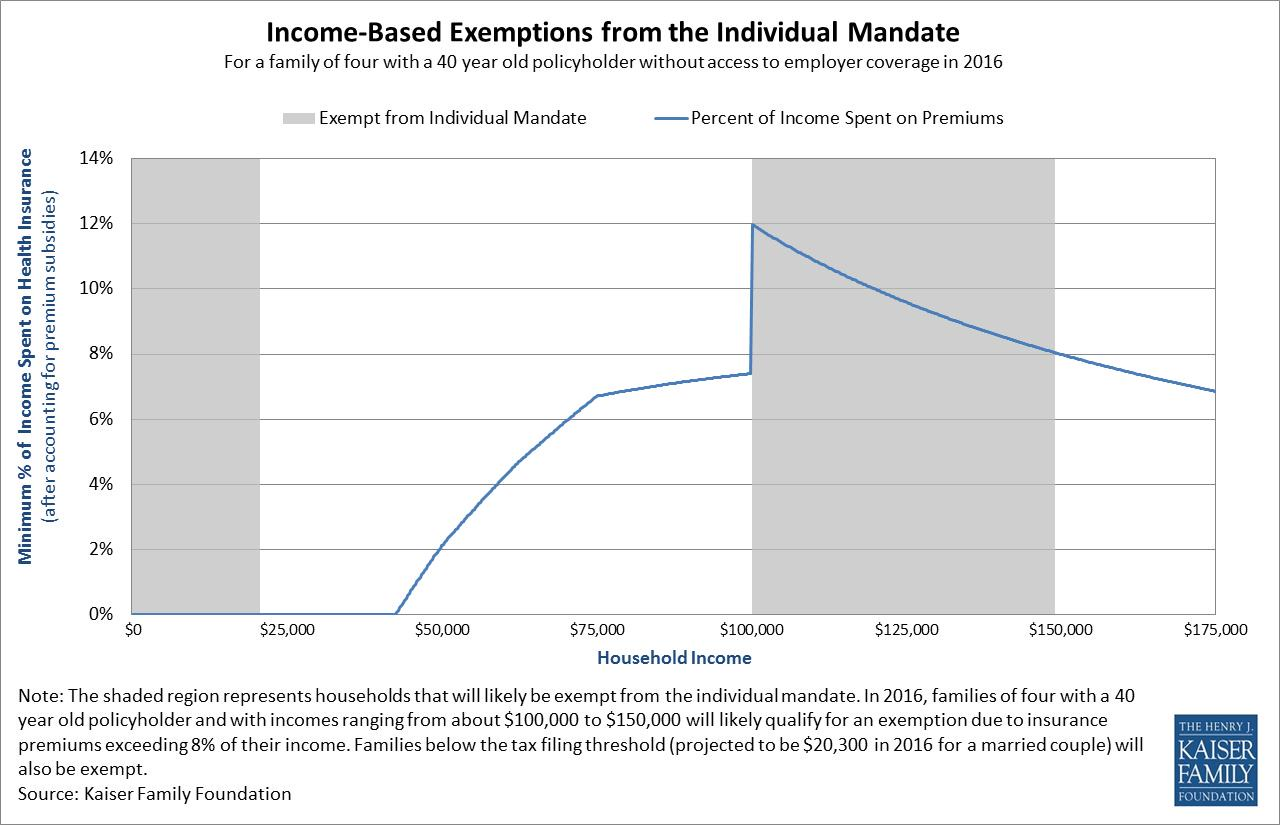
To illustrate who would be exempt from the ACA’s individual mandate, we constructed an example of a hypothetical family of four with two 40-year-old adults and two children, living in a region with average health care costs, and without access to employer coverage. This family would receive an affordability exemption from the requirement to maintain insurance if their income was below the tax filing threshold or if the cost of insurance would be more than 8% of their income. The following chart shows what percentage of income such a family would pay for health insurance at different income levels. It is based on the lower bound of CBO’s estimate that a bronze plan (the minimum coverage people would be required to buy) would cost $12,000 to $12,500 per family in 2016, and our calculator (which illustrates eligibility for subsidies to help with the cost of purchasing coverage through new health insurance exchanges).

Notes_mandate_final2

As the chart shows, families would be exempt from the mandate at the lowest income levels because they are below the filing threshold for federal income taxes. Just above this level, the mandate would apply, but families would be eligible for substantial government assistance, either through Medicaid (paying essentially nothing for coverage) or through large premium subsidies in exchanges.

Some families eligible for premium subsidies would have to pay more than 8% of income to enroll in a silver plan in an exchange even after receiving subsidies. However, they could likely apply those subsidies instead to a lower cost bronze plan and end up paying less than 8% of income, so would therefore still be subject to the mandate. If this family’s income rises above about $98,000 (estimated to be four times the poverty level in 2016, at which point they are no longer eligible for premium subsidies) they would likely have to pay more than 8% of income for a bronze insurance plan and would therefore be exempt from the mandate. Indeed, for our hypothetical family, the exemption would apply up to about $150,000 in income, at which point the family’s resources would be high enough so that the cost of a bronze insurance policy in an average cost region drops below 8% of income.

Specific dollar amounts would vary based on age, family size, and the cost of health insurance in an area, but the basic story is similar.

Of course, even with these exemptions, the individual mandate is not without controversy. Reasonable people can disagree about the mandate as a matter of policy. Opponents argue it’s an inappropriate (and unconstitutional) exercise of federal governmental power. Proponents see it as necessary and proper to make reforms of the insurance market work. Some even suggest that the exemptions are too broad and the penalties too low for it to be effective.

The requirement has perhaps become the most powerful political symbol associated with the ACA. Yet the reality of it may not be as sweeping as the symbolism.Updated June 26, 2012

News Release

SiriusXM OutQ and Greater Than AIDS Empower Gay Community to SpeakOUT

Published: Mar 16, 2012

NEWS RELEASEMarch 16, 2012

Limited-run series of live, call-in shows takes in-depth look at AIDS in Gay America— from the bedroom to the doctor’s office to the community to Capitol Hill

NEW YORK, N.Y. – SiriusXM OutQ, the nation’s first and only 24/7 LGBT radio channel, and Greater Than AIDS, a national movement to respond to AIDS in America, announced today the launch of SpeakOUT: Real Talk about AIDS in Gay America, a limited-run series of live, call-in shows that will connect listeners across the country with medical experts, people living with HIV and notable members of the LGBT community to have an honest and challenging dialogue about the current state of the HIV/AIDS epidemic in the gay community as well as the country at large.

The first installment of the series will be co-hosted by SiriusXM OutQ’s Larry Flick and Frank Spinelli, MD, Clinical Director of HIV Services at New York City’s Cabrini Medical Center and author of The Advocate Guide to Gay Men’s Health and Wellness and air live on Saturday, March 17 from 9:00 – 11:00 am ET on SiriusXM OutQ channel 108. The live, call-in show will focus on “The Politics of Mating,” tackling such issues as how to ask a partner to be tested, when your partner will not use condoms and how to disclose your status to a new partner. It will also explore the effects GrindR and other popular social networking sites have on HIV/AIDS among gay men. The panel of guests includes Greater Than AIDS representatives Marteniz Brown and Larry Hammack—gay men who will share their personal experience with HIV/AIDS—and Dr. Mary Ann Chiasson, a professor at Columbia University’s Mailman School of Public Health, who is researching the relationship between the Internet and high-risk sexual behavior among gay and bisexual men.

Future SpeakOUT: Real Talk about AIDS in Gay America shows will explore the medical aspects of HIV/AIDS, from the latest advances in research to guidance on how to communicate with doctors and health care providers, as well as the status of various initiatives related to the condition on Capitol Hill.

“Although gay men have been at the center of the epidemic since its beginning—and today are the only risk group for which rates are on the rise—the issue has moved off the radar for many men,” said Tina Hoff, Senior Vice President and Director, Health Communication & Media Partnerships, Kaiser Family Foundation, a founding partner of Greater Than AIDS. “We are thrilled to be working with SiriusXM OutQ to leverage the power of voice in opening up the conversation about AIDS in America, and encouraging more men to ‘SpeakOUT’ about this important issue.”

According to a 2011 national public opinion survey conducted by the Kaiser Family Foundation, 8 in 10 Americans say they heard little or nothing about HIV/AIDS in the last year and public concern about HIV/AIDS has fallen steadily over the years, including among those most heavily affected. According to the U.S. Centers for Disease Control and Prevention (CDC), one in five (19%) gay and bisexual men in 21 major U.S. cities today are HIV-positive — and nearly half (44%) of those who are infected don’t know it.

For more information, visit www.siriusxm.com/greaterthanaids.

About Sirius XM Radio

Sirius XM Radio is America’s satellite radio company. SiriusXM broadcasts more than 135 satellite radio channels of commercial-free music, and premier sports, news, talk, entertainment, traffic, weather, and data services to over 21 million subscribers. SiriusXM offers an array of content from many of the biggest names in entertainment, as well as from professional sports leagues, major colleges, and national news and talk providers.

SiriusXM programming is available on more than 800 devices, including pre-installed and after-market radios in cars, trucks, boats and aircraft, smartphones and mobile devices, and consumer electronics products for homes and offices. SiriusXM programming is also available at siriusxm.com, and on Apple, BlackBerry and Android-powered mobile devices.

SiriusXM has arrangements with every major automaker and its radio products are available for sale at shop.siriusxm.com as well as retail locations nationwide.

Follow SiriusXM on Twitter or like the SiriusXM page on Facebook.

About Greater Than AIDS

Greater Than AIDS is an unprecedented collaboration among a broad coalition of public and private sector partners united in response to the HIV/AIDS crisis in the United States, in particular among Black Americans and other disproportionately affected groups. Through a national media campaign and targeted community outreach, Greater Than AIDS aims to increase knowledge and understanding about HIV/AIDS and confront the stigma surrounding the disease.

The Kaiser Family Foundation — a leader in health policy and communications — provides strategic direction and day-to-day management, as well as oversees the production of the media campaign. The Black AIDS Institute — a think tank exclusively focused on AIDS in Black America — provides leadership and expert guidance and directs community engagement. Greater Than AIDS is developed in support of Act Against AIDS, an effort by the U.S. Centers for Disease Control and Prevention (CDC) to refocus attention on the domestic epidemic. Additional, financial and substantive support is provided by the Elton John AIDS Foundation, Ford Foundation and MAC AIDS Fund, among others.

http://www.greaterthan.org

Publish Date: 2012-03-16

Public Opinion on the ACA: Cruising or Turbulent Ride?

Published: Mar 15, 2012

Regular readers of the Kaiser Health Tracking poll know by now that public opinion on the Affordable Care Act (ACA) has been at a steady cruising altitude since it was signed into law on March 23, 2010, with a little over four in ten viewing the law favorably and a similar share unfavorably. But, has public opinion on the law since passage been more turbulent for different groups of Americans, for example, those with lower household incomes? Or have you ever wondered what seniors think about the health reform law and how they differ from non-seniors? What about women’s views on the ACA in the month of December 2010? Well, we have just the tool for you. Use our latest interactive chart to explore how opinion on the ACA has changed (or in some cases not changed) since the law was passed. You can compare subgroups – for instance, did you know that the insured and uninsured don’t really look that different on the law – or just look for data at a specific point in time, like the lead-up to the last Congressional election in November 2010.

The chart can be embedded on any website or blog, so make sure to share it with the whole world.

Poll Finding

Kaiser Health Tracking Poll — March 2012

Published: Mar 14, 2012

As the oral arguments on the Affordable Care Act (ACA) begin in two weeks before the Supreme Court, the March Kaiser Health Tracking Poll finds that Americans’ views on the case mirror their views on the health reform law and that they expect parts of the ACA to continue whatever the Court rules.

The poll finds that half of all Americans (51%) think the Court should rule the mandate unconstitutional and about the same number (53%) expect the justices to do so. Those views about what the Court should do reflect public opinion about the Affordable Care Act (ACA) more generally.

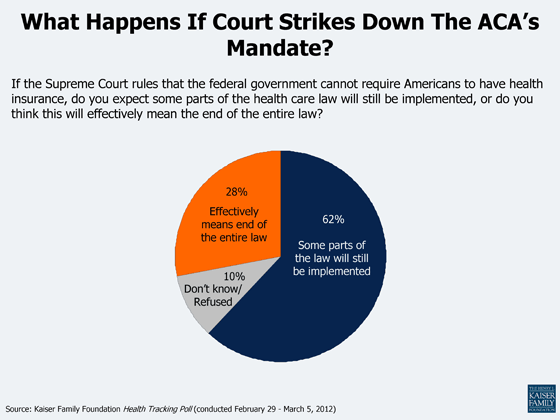
The public also does not see the mandate as the linchpin of the entire law. Sixty-two percent say other parts of the law still will be implemented if the Court rules the mandate unconstitutional, compared to 28 percent who say such a ruling will scuttle the whole effort. The poll also finds substantial public skepticism towards the Court; about as many people say the justices’ ideological views will play a major role in their decision (51%) as say their analysis and interpretation of the law (54%) will play a major role.

As the two-year anniversary of the law approaches, the public remains chronically divided. The public is almost perfectly split: 41 percent of Americans hold a favorable view of the law this month, while 40 percent hold an unfavorable one — not terribly different from the 46 percent who favored it and 40 percent who did not in April 2010. Opinions divide sharply along partisan lines, with Republicans disliking the law (75% have an unfavorable view of it this month), Democrats favoring it (66% favorable) and independents more divided (40% favorable vs. 42% unfavorable).

The March poll is the latest in a series designed and analyzed by the Foundation’s public opinion research team.

Findings (.pdf)

Chartpack (.pdf)

Toplines (.pdf)

Related Column by Drew Altman, The ACA and Fluoridation: The Power of Political Symbols

News Release

Americans’ Views on the Supreme Court Case Mirror Their Views on the Health Reform Law

Published: Mar 14, 2012
  • The Public Expects Parts Of The Affordable Care Act To Continue Whatever The Court Rules
  • Two Years After Passage The Public Is Evenly Divided On The Law, Split Sharply Along Partisan Lines

MENLO PARK, Calif. — The requirement that nearly everyone obtain health insurance or pay a fine has long been Americans’ least favorite part of the health reform law, and their views on what the Supreme Court should do about that key provision, known as the “individual mandate,” mirror that sentiment, according to a new Kaiser Family Foundation poll.

The poll finds that half of all Americans (51%) think the Court should rule the mandate unconstitutional and about the same number (53%) expect the justices to do so. Those views about what the Court should do reflect public opinion about the Affordable Care Act (ACA) more generally. Those who favor the law say two-to-one (50% to 26%) that the Court should uphold the mandate, and those who oppose the law say twelve-to-one (83% to 7%) that it should strike the mandate down. Americans have not yet tuned in to the high court case, with more than six in ten saying they are not following it closely. And many are confused — 42 percent either think the Court has overturned the law or do not know whether it has.

The public also does not see the mandate as the linchpin of the entire law. Sixty-two percent say other parts of the law still will be implemented if the Court rules the mandate unconstitutional, compared to 28 percent who say such a ruling will scuttle the whole effort. The poll also finds substantial public skepticism towards the Court; about as many people say the justices’ ideological views will play a major role in their decision (51%) as say their analysis and interpretation of the law (54%) will play a major role.

These and other findings of the March Kaiser Health Tracking Poll come just weeks before the Court is set to hear oral arguments in the legal challenges to the health reform law, which turns two years old on March 23rd and over which public opinion has been chronically divided. At the two year mark the public is almost perfectly split: 41 percent of Americans hold a favorable view of the law this month, while 40 percent hold an unfavorable one — not terribly different from the 46 percent who favored it and 40 percent who did not in April 2010. Opinions divide sharply along partisan lines, with Republicans disliking the law (75% have an unfavorable view this month), Democrats favoring it (66% favorable) and independents more divided (40% favorable vs. 42% unfavorable).

“The public’s views on the health reform law mirror the partisan and ideological divide in the country, and the public’s views on the Supreme Court case do too,” said Kaiser President and CEO Drew Altman. “People either like or do not like the ACA, but they have not weighed the legal issues before the Court,” Altman added.

The public also does not think the Court case will have a big impact on them and their families. Just under three in ten (28%) say the decision will have “a lot of impact” on them and their family, and about a third (36%) say it will have “some impact.”

So far, Americans are not focused on the legal challenges to health reform. Under ten percent (9%) say they are following it “very closely” and another 28 percent “fairly closely,” while most report following it “not too closely” (38%) or “not at all” (25%). More than four in ten either think the law has already been overturned by the Supreme Court (14%) or are unsure (28%).

Sharply divided along partisan lines, generally skeptical of the Court and focusing little on the health reform case, apparently in the belief that it will not affect them, opponents and supporters of the law alike report that the Court’s decision — whatever it is — is not likely to change their views of the ACA. Just 14 percent of supporters say they would feel more negatively about the law if the Court strikes down the individual mandate, for instance, and just 9 percent of opponents say they would feel more positively about the law if the justices uphold it.

“The public is not tuned in to the Supreme Court case yet,” said Mollyann Brodie, Senior Vice President for Executive Operations who leads the Foundation’s polling and survey research team. “When it grabs the headlines in a few weeks and again in June more people will focus on it, and there is an obvious need for public education about the issues and the stakes in this historic case.”

In other findings, confusion about the law still abounds, with six in ten (59%) Americans saying they don’t currently have enough information to understand how the law will impact them personally, almost identical to the 56 percent who said so shortly after passage in 2010. With many provisions not taking effect until 2014, two-thirds of the public say they do not feel they have been concretely affected by the law one way or the other thus far.

Finally, several misperceptions about the law endure: over half of Americans, including majorities of Republicans and independents, either believe the law allows a government panel to make decisions about end of life care for those on Medicare (36%) or are not sure whether it does (20%). Even more — seven in ten — are not aware that the ACA does not create “a new government run insurance plan to be offered along with private plans.”

The full question wording, results, charts and a brief on the poll can be viewed online. Also available is a new “Pulling It Together” analysis from Drew Altman which draws on the poll findings to examine the role the health reform law plays as a political symbol. A new interactive Kaiser chart allows users to track public opinion on the ACA, from the inception of the law to the present, for subgroups based on age, race, income, gender, party identification and insurance status. The interactive chart can be embedded on websites and blogs.

Methodology

This Kaiser Health Tracking Poll was designed and analyzed by public opinion researchers at the Kaiser Family Foundation. The survey was conducted February 29 — March 5, 2012, among a nationally representative random digit dial sample of 1,208 adults ages 18 and older, living in the United States, including Alaska and Hawaii. Interviews conducted by landline (704) and cell phone (504, including 279 who had no landline telephone) were carried out in English and Spanish by Braun Research, Inc. under the direction of Princeton Survey Research Associates International (PSRAI). The survey was weighted to balance the sample demographics to match Census estimates for the national population. The margin of sampling error is plus or minus 3 percentage points, and somewhat higher for results based on subgroups. Two questions about knowledge of the law’s provisions and status were fielded on a separate survey; see topline for full methodological details. Note that sampling error is only one of many potential sources of error in this or any other public opinion poll.
The ACA and Fluoridation: The Power of Political Symbols

Published: Mar 14, 2012

In the 1950s, water fluoridation became a public health controversy that morphed into a symbolic issue of larger proportions. For its opponents, fluoridation came to symbolize big government and even for some, a communist threat. The controversy became so odd that it was parodied in Stanley Kubrick’s 1964 film “Dr. Strangelove,” in which General Jack Ripper starts a nuclear war to stop a communist plot to “sap and impurify all of our precious bodily fluids” with, yes, fluoridated water. That was followed by the 1967 film “In Like Flint,” in which a character’s fear of fluoridation was depicted as grounds for insanity.

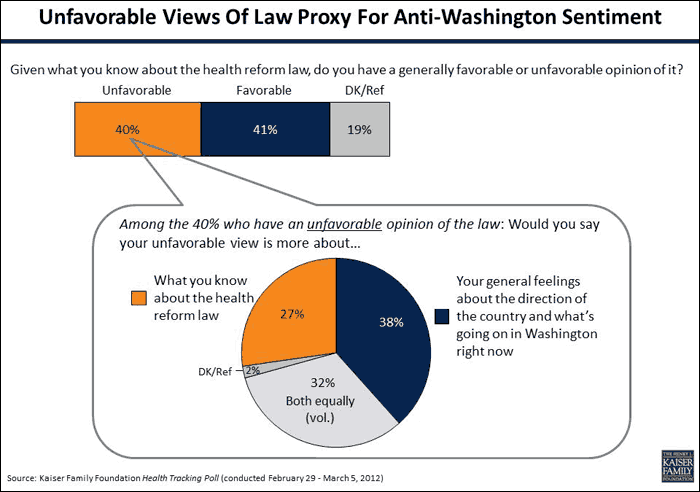
Of course there are substantive and legitimate differences over the Affordable Care Act (no comment on fluoridation). However, for many Americans, especially those who oppose the law, the ACA derives its power as an issue, like fluoridation did many years ago, because it has become a symbol of their broader fears and concerns. For example, in our latest tracking poll, we find pretty much the same split on the ACA that we have seen since the passage of the law, with 41% for it, 40% against it, and 19% unsure. Then we asked the 40% who oppose the ACA whether their opposition was based more on “what you know about the health reform law” or “more about your general feelings about the direction of the country and what’s going on in Washington right now.” The largest share of those who oppose the law (38%) say they oppose it because of what it represents to them about the direction of the country and Washington. That compares with 27% who say they oppose it because of what they actually know about the law.  Thirty-two percent (remember, this is among those who oppose the law) say “both equally.”

PIT-0314_3

When policy experts debate the ACA, they debate the substance of the law: what it will cost and save; how much it will do to reduce the number of the uninsured; and whether other policies might be more desirable.  The public, however, does not look at the ACA through the lens of a policy decision memo. A very small share of the public may follow the details of the ACA and make similar assessments to those the experts make. Others may focus on one element of the law that relates to their own lives or interests (the mandate, free prevention benefits, coverage of young adults), and make a judgment based largely on that. Many will try to figure out how it will affect them, their family, or their business, although that is a difficult calculation for most people to make, especially since the main elements of the law have yet to be implemented. But for many Americans who are opposed to the law, it has become a symbol of their broader discontent, and that has important implications.

For one thing, it helps explain why opposition to the ACA divides so sharply along traditional partisan and ideological lines; the law is a touchstone for many of their broader beliefs, especially about the role of the federal government and Washington. It also helps explain why intensity is so much greater among opponents than supporters; for opponents, the ACA is about something much bigger they fear and dislike than health reform. Supporters may greatly value the ACA’s coverage expansions and consumer protections, but they generally don’t see it as a victory for their view of government. Indeed, many see the ACA as imperfect progress to improve on, some criticize the role for private insurance plans in the ACA, and some advocates on the left would have preferred a single-payer plan.

The role the ACA plays as a political symbol also helps explain why opinion on the law is so stable. New benefits can be rolled out, proponents can try new messages, politicians can argue for and against the ACA, but the daily back-and-forth on the law and more information about its benefits can only change the views of critics at the margin, because for many, opinion is not based on the law at all, but rather on what the law symbolically has come to represent for them.

Of course, much of the power of fluoridation as a symbol was based on beliefs which were just plain wrong, and that is true of the ACA as well. There are no death panels, for example. In our latest tracking poll, 68% of Republicans say they believe the ACA creates a “government run insurance plan to be offered along with private plans” (or public option), when is does not.  And, despite the canard about a government takeover of the health care system, our system will remain a decidedly mixed public-private one after the ACA is in place. No matter, the power of the symbol remains for many.

The symbolic role the ACA plays may also mean that opinion may be hard to move even in response to seemingly game-changing events like the Supreme Court case. In our new poll, the vast majority of those with either a favorable or unfavorable view of the law say that a court decision running counter to their position would not change their views. For now at least, the public seems to be dug in and sharply split along partisan lines.

Eventually the debate about fluoridation as a symbol of the role of government died down, although the underlying debate about the role of government obviously has not. Time will tell whether the ACA follows a similar course as it moves from political and ideological symbol to reality after 2014.

March Kaiser Health Tracking Poll: The ACA at Two Years; The Individual Mandate and the Supreme Court

Published: Mar 14, 2012

As the Patient Protection and Affordable Care Act (ACA) nears its second birthday, the latest Kaiser Health Tracking Poll finds that public opinion on the law remains evenly split (41 percent favorable, 40 percent unfavorable) with sharp divisions along partisan lines, much as it has been since the law was passed.

With the Supreme Court preparing to hear challenges to the law later this month, about half the public thinks the Court should strike down the individual mandate, which has been and continues to be the law’s least popular provision. The public is not yet paying close attention to the legal proceedings, and opinions on what the Court should do about the mandate mirror views on the law overall, with most (83 percent) of those who oppose the law wanting the Court to find the mandate unconstitutional, and half of those who favor the law preferring the opposite outcome. Still, most do not see the Court’s ruling as the final word on the ACA; six in ten say that if the Court finds the mandate unconstitutional, some parts of the law will still be implemented. Underlying these beliefs is the fact that less than a quarter of the public (23 percent) expresses a lot of confidence in the Supreme Court, and about half believe national politics (50 percent) and the justices’ own ideology (51 percent) will play a major role in the Court’s decision, similar to the 54 percent who expect legal analysis to play a major role. At this point, the public says the Court’s decision is unlikely to change their overall opinion on the ACA, with the vast majority of those with a favorable or unfavorable view of the law saying a ruling to uphold or strike down the mandate would not change how they feel about the law in general.

Meanwhile, the views of seniors—who have traditionally tilted more negative on the law—have trended more positively in recent months, and in March, seniors are just as likely to view the law favorably (44 percent) as unfavorably (42 percent). Finally, two years after passage, the ACA is not yet “real” for most Americans—six in ten say they don’t have enough information to understand how the law will impact them, and two thirds say the law has not yet affected their family in either a positive or negative way.

Also available is a new “Pulling It Together” analysis from Drew Altman which draws on the poll findings to examine the role the health reform law plays as a political symbol.

Policy-insights-03132012_trackingpoll540