A Closer Look at Nebraska, the First State Planning to Implement a Medicaid Work Requirement
In December, Nebraska was the first state to announce that it would be enforcing Medicaid work requirements early, starting May 1, 2026. The 2025 reconciliation law requires states to condition Medicaid eligibility for adults in the ACA Medicaid expansion group and enrollees in partial expansion waiver programs (Georgia and Wisconsin) on meeting work requirements starting January 1, 2027; however, states have the option to implement requirements sooner through a state plan amendment (as is the case for Nebraska) or through an approved 1115 waiver. Implementing work requirements will require complex changes to eligibility and enrollment systems, as well as enrollee outreach and education, staff training, and coordination with managed care plans, providers, and other stakeholders. Early reports from the state during its recent January Medicaid Advisory Committee (MAC) meeting and data from KFF’s Medicaid work requirements tracker provide initial insight into how Nebraska is preparing to implement Medicaid work requirements. Similar information from MAC meetings in other states and data on the KFF tracker can be helpful to assess how other states may implement new requirements as well.
Most Medicaid adults in Nebraska under age 65 who will be subject to the new work requirements are working already or attending school. As of March 2025, there were about 72,000 expansion enrollees in Nebraska who could be affected by the new requirements. KFF analysis indicates that roughly 65% of Medicaid adults without dependent children in Nebraska who could be subject to work requirements work 80 or more hours per month or are attending school. In addition, many enrollees who are not working the required hours will likely qualify for exemptions from the new work requirements.
In a recent Medicaid Advisory Committee (MAC) meeting, Nebraska provided a first look into how the state is planning to implement work requirements. All states are required to have a Medicaid Advisory Committee to advise the State Medicaid agency about health and medical care services. These groups include Medicaid enrollees, advocates, and providers. In its January 15, 2026 meeting, Nebraska state officials provided early insight into key decisions related to work requirements and look-back periods, data matching, medically frail exemptions, enrollee verification, short-term hardship exceptions, and outreach (Table 1). State officials also confirmed that the state does not intend to hire or increase staffing levels to facilitate implementation of work requirements or other eligibility changes.
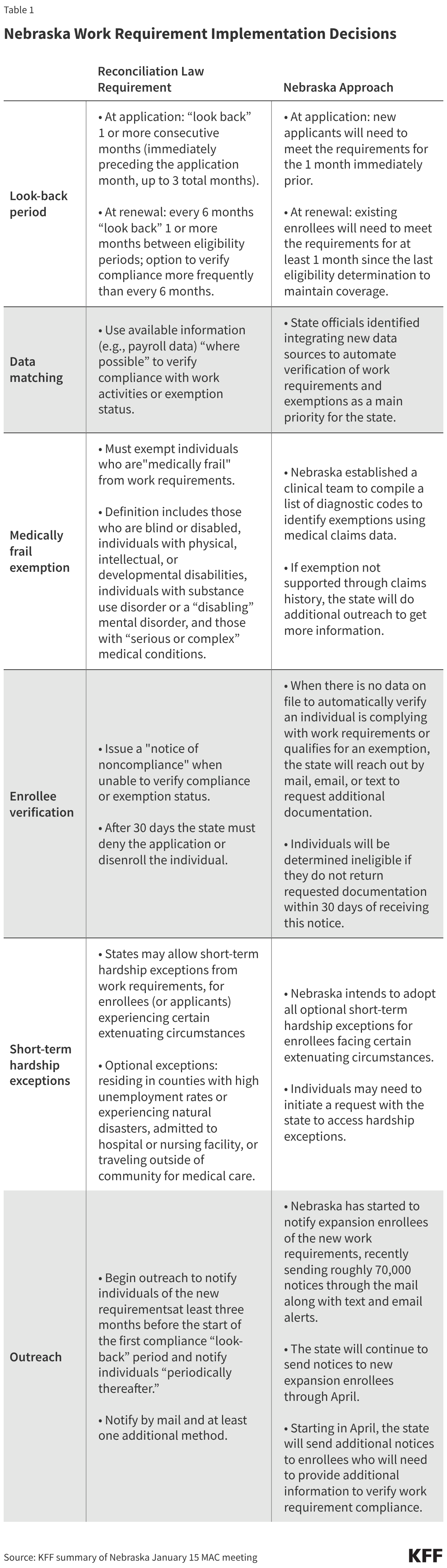
There remain multiple operational and implementation issues the state will need to resolve in the next four months. State officials emphasized that conversations with the federal government are ongoing, and that Centers for Medicare and Medicaid Services (CMS) staff had recently travelled to Nebraska to plan implementation with state officials. As part of the MAC meeting discussion, state officials noted areas where there is ongoing work to identify data sources to verify compliance or exemption status:
- Volunteer activities. Officials acknowledged they had not yet determined how volunteer activities will be defined or how volunteer activities could be identified through data matching. Current guidance from CMS does not clearly outline what types of volunteer activities count towards compliance with Medicaid work requirements.
- Education activities. Officials said the state is working on specifics for defining hours of educational activity using course credit hours. The state is also exploring data matching for educational activities, including higher education enrollment data.
- Work verification. Data matching for work hours was not discussed during the meeting, though officials confirmed that, as required by the reconciliation law, individuals can meet the work requirement if they are working and earn the equivalent of the federal minimum wage multiplied by 80 hours in a qualifying month.
- Number of enrollees affected. State officials could not yet provide internal estimates of how many enrollees could already be identified as in compliance with the new requirements using currently available data sources, but explained they are currently running models to see who they can identify as being in compliance or exempt from Medicaid work requirements.
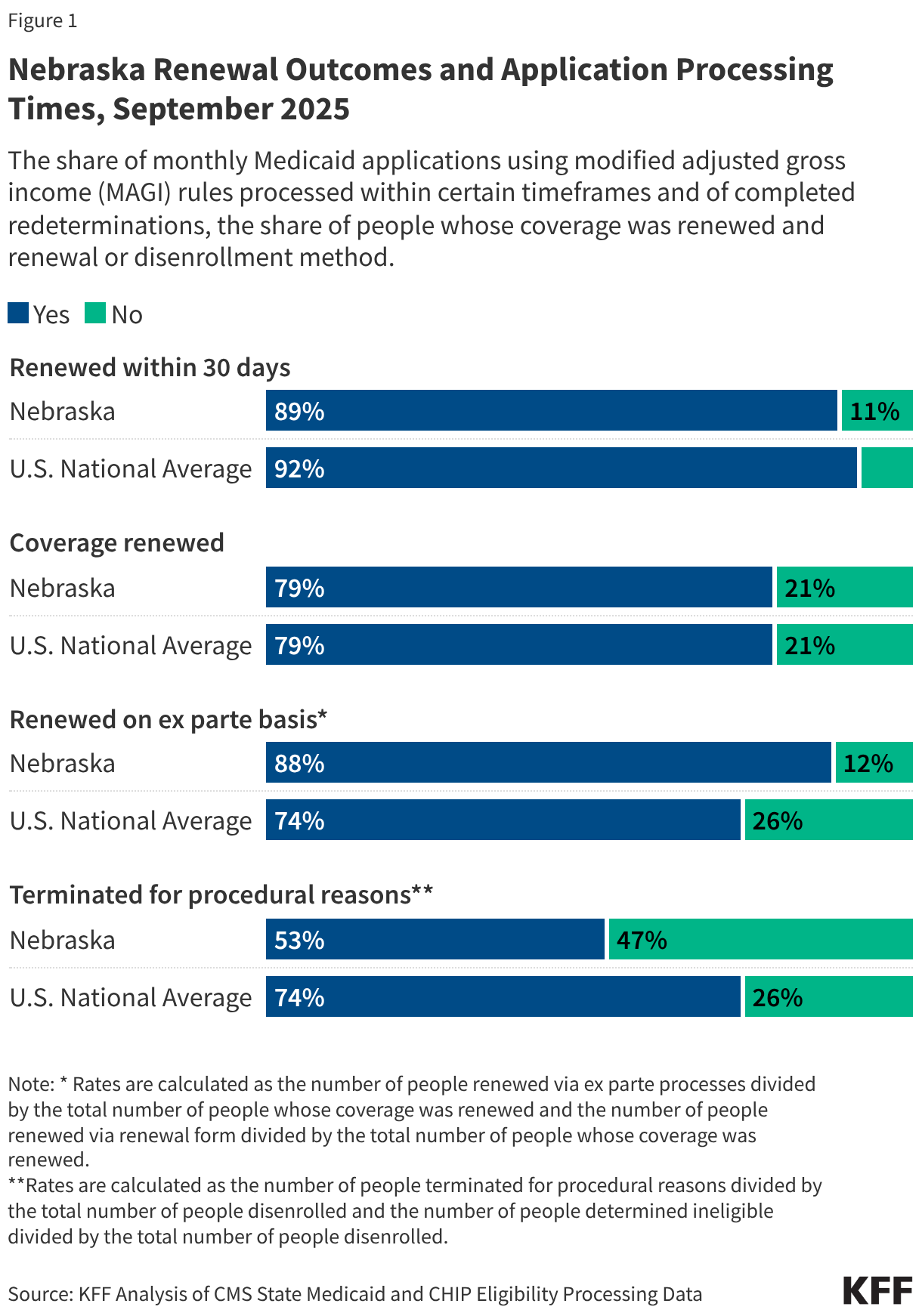
KFF is tracking metrics related to Medicaid enrollment, renewal outcomes, and application processing times that can provide insight into a state’s potential readiness to implement data matching and other necessary system changes. As of September 2025, Nebraska was performing in line or better across several renewal metrics compared to the United States national average (Figure 1). Nearly nine in ten applications were processed within 30 days and eight in ten individuals going through a Medicaid eligibility redetermination had their coverage renewed. Of people who retained coverage, 88% were renewed via ex parte processes (meaning the state verifies ongoing eligibility through available data sources before sending a renewal form or requesting documentation from an enrollee), although this percentage in September 2025 was higher than the average of 69% across the prior 6 months. Among those who were disenrolled, 53% were terminated for procedural reasons (meaning an individual was disenrolled because they did not complete the renewal process). While these metrics provide insight into Nebraska’s Medicaid eligibility systems, they are not the only indicators or predictors of successful implementation of work requirements, which will also require enrollee outreach and education, staff training, and coordination with managed care plans, providers, and other stakeholders.
As states implement work requirements, ongoing monitoring can help assess how processes are working and identify areas of concern. Central to that oversight is timely data on renewal outcomes, including data on disenrollments related to work requirements. While available data (highlighted above) from CMS can be helpful, these data are not timely enough for real-time monitoring and they do not isolate outcomes for the expansion population. States can fill that gap by reporting more timely data on application and renewal outcomes that include breakouts for individuals subject to work requirements. During the MAC meeting, state officials in Nebraska communicated their intention to be transparent in reporting how many enrollees are disenrolled.