Poll: Trust and Confidence in the CDC Remain at Low Point After Changes to Recommended Childhood Vaccines; More Say the Changes Will Hurt than Help Children’s Health
New KFF Data Interactive Tracks Polling on Health Information and Trust
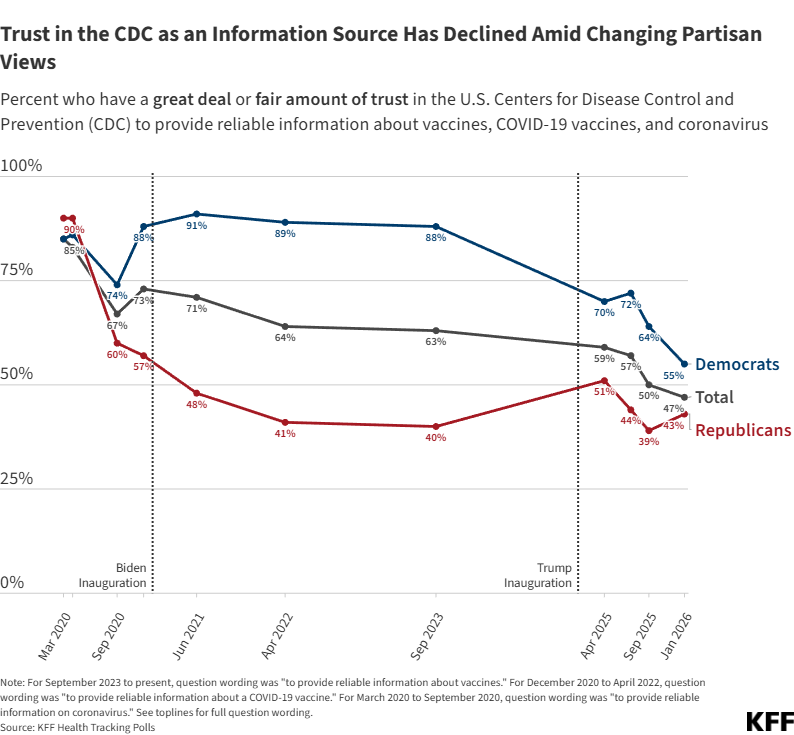
In the weeks after the Trump administration reduced the number of recommended childhood vaccines for routine use, the public’s trust in the Centers for Disease Control and Prevention (CDC) remains at its lowest point, a new KFF Poll on Health Information and Trust finds.
Fewer than half (47%) now say that they trust the agency at least “a fair amount” to provide reliable vaccine information, similar to the share who said the same in September, but down more than 10 percentage points since the beginning of the second Trump administration, and continuing a downward trend first measured during the COVID-19 pandemic.
The recent decline reflects falling confidence among Democrats. Slightly more than half (55%) of Democrats now say they trust the CDC on vaccines, down from 64% September. About 4 in 10 Republicans say they trust the CDC for vaccine information, similar to the share who said the same a few months ago and in 2023, but fewer than half as many as said they trusted the CDC on the coronavirus back in 2020.
“Six years ago, 85% of Americans, and 90% of Republicans, trusted the CDC. Now less than half trust the CDC on vaccines,” KFF President and CEO Drew Altman said. “The wars over COVID, science, and vaccines have left the country without a trusted national voice on vaccines, and that trust will take time to restore.”
Findings from the latest KFF Tracking Poll on Health Information and Trust, and more than a dozen previous polls, are now available on a new interactive dashboard tracking the public’s trusted sources for health information, attitudes toward vaccines, and use of news, social media, and AI for health-related information.
The dashboard provides visual representations of the key trends in the public’s trust in health information and tracks exposure to and belief in false and unproven health claims. The downloadable data and charts allow researchers, policymakers, journalists, and others to explore partisan and demographic differences on key health information issues. The dashboard will be updated regularly.
Awareness of and Views toward Changes in Recommended Childhood Vaccines
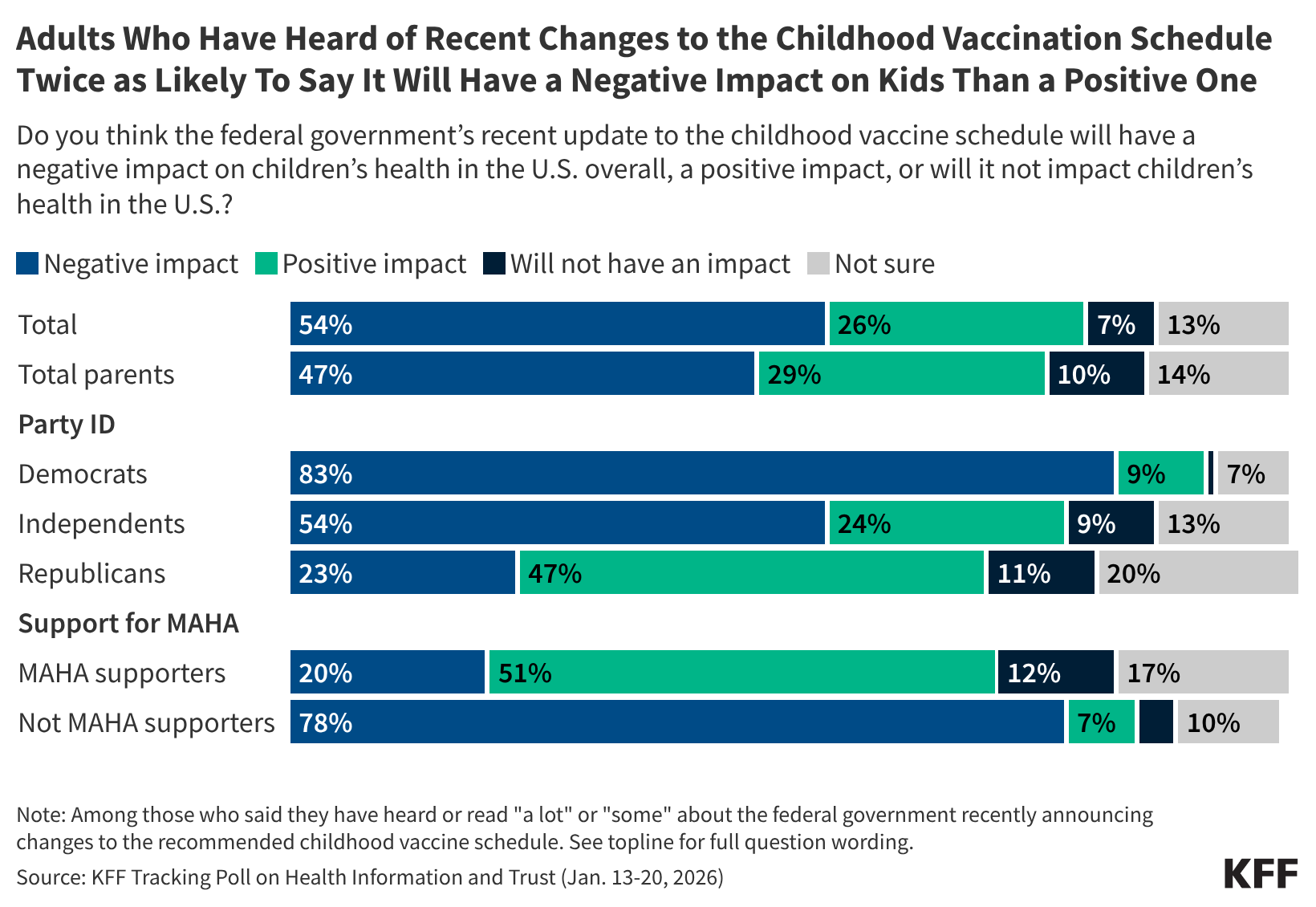
The latest poll finds that among those who have heard about the recent changes to the recommended childhood vaccine schedule, more say they expect the changes to have a negative impact than a positive one on children’s health.
About half of the public (51%), and a similar share of parents (52%), say they’ve heard at least some about the federal government’s recent changes to the recommended childhood vaccine schedule. This group, by a 2-1 margin, say the changes will have a negative impact on children’s health (54%) rather than a positive one (26%). The same is true among parents who heard about the changes, with a larger share saying the changes will negatively impact children’s health (47%) than have a positive impact (29%).
Democrats and independents largely expect the changes to hurt children’s health, while Republicans and supporters of the “Make America Healthy Again” (MAHA) movement largely expect it to improve children’s health.
Amid recent changes, confidence remains high across the public and parents in the safety of the MMR and polio vaccines, two longstanding childhood vaccines that continue to be recommended for routine use. This includes at least 3 in 4 Democrats, independents, Republicans, parents, and MAHA supporters.
But fewer are confident in the safety of the vaccines that are no longer universally recommended, and there are larger partisan differences.
- Majorities of the public are also confident in the safety of the hepatitis B (70%) and flu (65%) vaccines for children, and just under half (48%) are confident in the safety of the COVID-19 vaccine. The recent changes removed these three vaccines from the routine recommended childhood vaccine schedule.
- Partisans are divided on their views of the three vaccines removed from the federal recommended vaccine schedule, with Democrats being more likely than Republicans to express confidence in their safety. The partisan gap is widest for the COVID-19 vaccine, with about eight in ten Democrats confident in their safety, nearly three times the share of Republicans who say the same (79% vs. 28%). Democrats are also more likely than Republicans to be confident in the safety of flu (82% vs. 52%) and hepatitis B vaccines (85% vs. 61%).
Designed and analyzed by public opinion researchers at KFF, this survey was conducted January 13-20, 2026, online and by telephone among a nationally representative sample of 1,426 U.S. adults in English and in Spanish. The margin of sampling error is plus or minus 3 percentage points for the full sample. For results based on other subgroups, the margin of sampling error may be higher.