

VOLUME 36
CDC Vaccine Panel Ends Universal Hepatitis B Recommendation and Reviews Aluminum in Vaccines, Plus Public Awareness of Mifepristone Safety
Summary
This volume examines a CDC advisory panel’s recent vote to change the hepatitis B vaccine recommendation for newborns and its review of aluminum adjuvants in vaccines, despite safety data supporting both. It also provides updates on the CDC’s change to its page on autism and vaccines and new data showing erosion of trust in news organizations. Additionally, it explores Senate committee hearings about alleged government pressure on social media platforms, ongoing efforts to limit states’ ability to regulate artificial intelligence (AI), and a study revealing that misinformation sites are more welcoming to AI web crawlers than reputable news outlets. Lastly, it presents findings from a new KFF poll about perceptions of the safety and prevalence of the abortion medication mifepristone.
What We Are Watching
CDC Vaccine Advisory Panel Changes Hepatitis B Recommendation and Reviews Aluminum Adjuvants

At its December 4-5 meeting, the CDC’s Advisory Committee on Immunization Practices (ACIP) delivered presentations and made decisions that could contribute to misconceptions about vaccine safety for children. One topic of discussion was the timing and necessity of the hepatitis B vaccine for newborns. ACIP voted to end the recommendation that all newborns receive the hepatitis B vaccine at birth, now recommending that parents of infants born to someone who tests negative should consult with their health care provider and decide when or if their child will be vaccinated against hepatitis B. KFF’s monitoring of X, Reddit, and Bluesky identified more than 31,000 posts, reposts, and comments about hepatitis B on December 5, the day the committee voted on its recommendations, up from a daily average of about 3,200 thus far in 2025. The enhanced engagement on this issue can both amplify false claims as well as counter them, and KFF will track whether discussion of hepatitis B vaccines remains widespread in the coming weeks.
The meeting also included a working group presentation about the safety of aluminum adjuvants in vaccines, focusing on the cumulative impact of receiving multiple vaccines containing these adjuvants in a short time frame, despite these compounds having been used safely for nearly a century to boost immune response. ACIP didn’t vote on an action related to these adjuvants, but official scrutiny of vaccine ingredients that are supported by decades of safety data may contribute to public uncertainty about vaccine safety, potentially affecting vaccination rates even before formal policy changes. KFF will continue to monitor online reactions and vaccine narratives as news reports of the ACIP meeting spread.
Update to CDC’s Autism and Vaccines Webpage Could Contribute to Public Uncertainty
On November 19, the CDC updated its “Autism and Vaccines” webpage, replacing evidence-based statements about vaccine safety with misleading claims that studies cannot rule out a link between vaccines and autism. Before the update, the page stated that studies have shown no link between vaccines and autism, a conclusion supported by dozens of studies examining hundreds of thousands of children worldwide. KFF’s Health Information and Trust Tracking Poll has found that most of the public has heard the claim that MMR vaccines have been proven to cause autism, and while very few adults think this claim is definitely true, most express some uncertainty. News of the CDC’s language change may exacerbate this uncertainty, introducing ambiguity that online narratives can exploit. Health communicators should be aware that shifts in official guidance can become focal points for narratives that frame prior statements as misleading, which may deepen skepticism and contribute to declining vaccination rates.
Trust in News Organizations Continues to Decline
New Pew Research data from late October shows that Americans’ trust in information from national and local news organizations continues to decline, with 56% of U.S. adults saying they have at least some trust in information from national news organizations, down 11 percentage points since March 2025 and 20 points since 2016. Trust in local news organizations remains higher, at 70%, but has also dropped 10 percentage points since March. Adults under 30 are about as likely to trust information from national news organizations (51%) as they are to trust information from social media sites (50%). These declines in trust may affect how people seek and evaluate health information, particularly as younger audiences increasingly turn to social media platforms.
Social Media and AI Policy Roundup
Senate Hearings Examine Government Pressure on Social Media Platforms
The Senate Commerce Committee held a series of hearings in October examining allegations that the Biden administration inappropriately pressured social media companies to remove content related to the COVID-19 pandemic. Lawmakers from both parties expressed concern about coercion, signaling that questions about the line between permissible government engagement and unconstitutional influence will remain central to content moderation debates. Meta and Google executives testified that while they faced pressure from Biden administration officials, they made independent decisions about content moderation. The hearing highlights continued scrutiny of how government communication influences platform content moderation decisions, echoing claims central to the 2024 Supreme Court case Murthy v. Missouri. Senator Ted Cruz has indicated plans to introduce legislation that he says would curtail such government pressures on private companies, but witnesses noted a need for such legislation to avoid limiting routine coordination between agencies and platforms on issues like safety or fraud.
Draft Executive Order Challenging State AI Regulations Placed on Hold After Bipartisan Resistance
A draft executive order that would have pre-empted state regulations on artificial intelligence (AI) was placed on hold in late November after lawmakers from both political parties expressed concern about the approach. The proposed order would have withheld federal broadband funding from states with such laws regulating AI and directed the U.S. Attorney General to challenge such laws. Industry leaders have supported federal efforts to pre-empt state laws, but the proposals have been criticized by elected officials from both parties who have said they would encroach on states’ rights and limit their ability to address immediate harms while a federal regulatory framework is still being crafted. The White House has also signaled it is working with Republican lawmakers to include a moratorium on state AI laws in the upcoming National Defense Authorization Act, but similar efforts to include pre-emption in major legislation have failed; a 10-year moratorium was originally included in the One Big Beautiful Bill Act before being struck from the law.
Study Finds Misinformation Sites Welcome AI Scrapers While Reputable News Blocks Them
Generative AI companies regularly crawl the Internet for data that can be used to train and improve their models. Website owners can limit these web crawlers’ ability to access their content, and many choose to do so as part of an effort to protect copyrighted content. A study analyzing over 4,000 websites, though, indicated that differences in how websites respond to AI web crawlers may impact information quality. Using categorizations provided by a third party, the researchers found that 60% of “reputable news” websites, like the Associated Press or The New York Times, block at least one AI crawler from accessing their content, compared to just 9.1% of “misinformation” sites rated by the third party as having low or very low factual information, including Stormfront and Zerohedge. As reputable news organizations increasingly protect their content through litigation and technical blocks, AI models may have easier access to less reliable information sources. AI companies provide different weights to different content, meaning that low-quality information may be filtered out, but users of AI chatbots should be aware that a disparity in training data could influence the quality and accuracy of the responses they receive.
Featured
KFF Poll Shows Fewer than Half of the Public Are Aware of Abortion Pill Mifepristone’s Prevalence or Safety
In September, Health and Human Services (HHS) Secretary Robert F. Kennedy Jr. and U.S. Food and Drug Administration (FDA) Commissioner Marty Makary announced the FDA would be reviewing the safety of the abortion pill mifepristone, which was first approved by the FDA twenty-five years ago and has a long and well documented safety record.
KFF’s latest Health Tracking Poll finds that about half (53%) of the public have heard of mifepristone, but many are unaware of how often the medication is used and are unaware of its established safety record. The public is largely unaware that most abortions in the U.S. are done by taking abortion pills, with about one in four (24%) adults correctly saying that most abortions in the U.S. are medication abortions, three in ten (29%) saying most abortions are done via medical procedure, and about half (47%) saying they’re not sure.
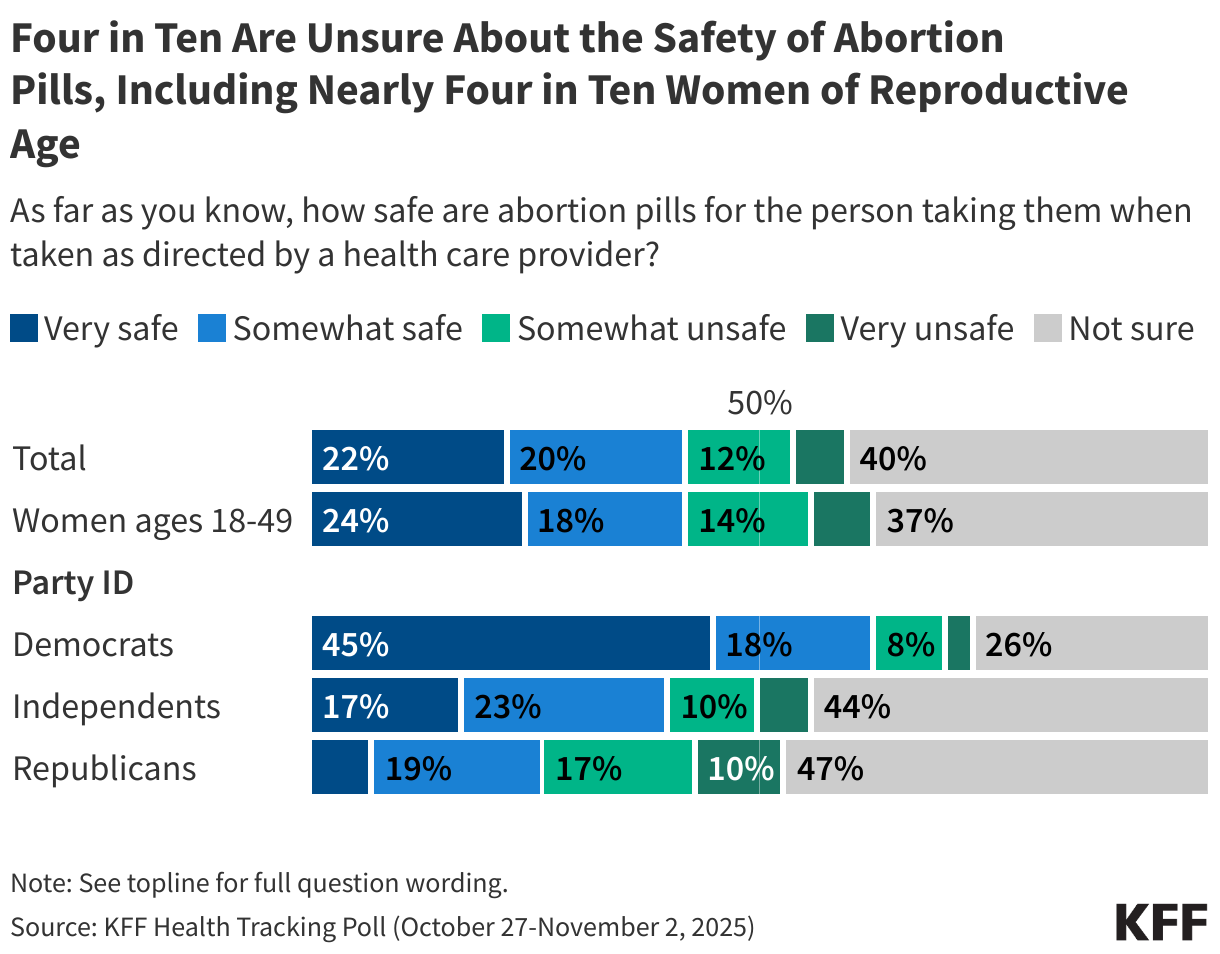
When it comes to safety, about four in ten (42%) adults say abortion pills are “very” or “somewhat safe” when taken as directed by a doctor, about twice the share who say they are “very” or “somewhat unsafe” (18%), while another four in ten say they are not sure. Views of the abortion pill’s safety are similar among women ages 18 to 49. Perceptions of the pill’s safety, however, differ dramatically by partisanship. While nearly two-thirds (63%) of Democrats and four in ten independents correctly say abortion pills are safe when taken as directed by a doctor, just a quarter (26%) of Republicans agree.
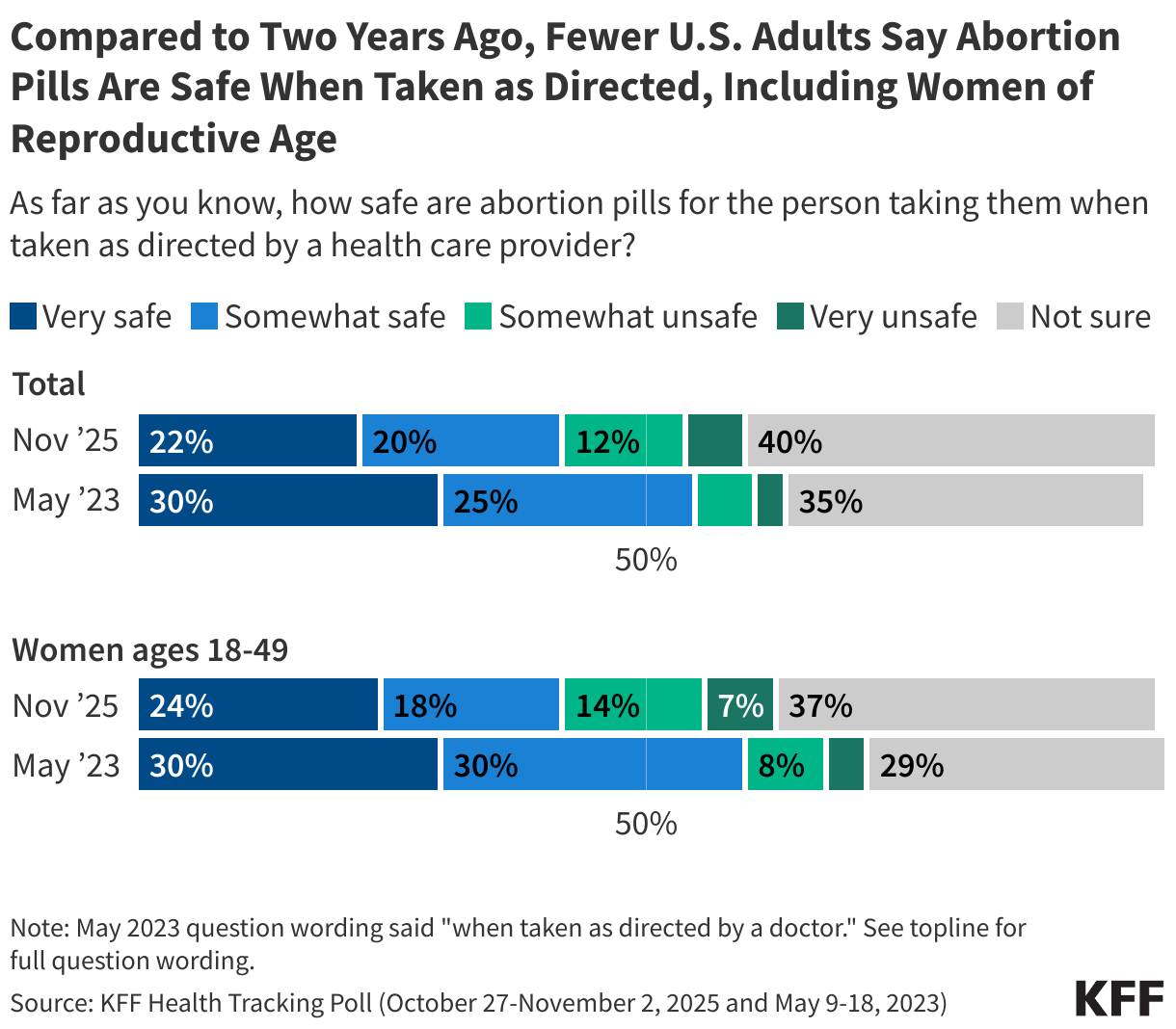
Public perception of the abortion pill’s safety has waned in the past few years, including among women of reproductive age. About four in ten (42%) adults now say abortion pills are safe when taken as directed compared to just over half (55%) who said the same in May 2023. Among women ages 18 to 49, fewer than half (41%) now view the abortion pill as safe, an 18-percentage point drop from 2023 when a majority (59%) said the pills were safe.
About The Health Information and Trust Initiative: the Health Information and Trust Initiative is a KFF program aimed at tracking health misinformation in the U.S., analyzing its impact on the American people, and mobilizing media to address the problem. Our goal is to be of service to everyone working on health misinformation, strengthen efforts to counter misinformation, and build trust.
The Monitor is a report from KFF’s Health Information and Trust initiative that focuses on recent developments in health information. It’s free and published twice a month.
Sign up to receive KFF Monitor
email updates
Support for the Health Information and Trust initiative is provided by the Robert Wood Johnson Foundation (RWJF). The views expressed do not necessarily reflect the views of RWJF and KFF maintains full editorial control over all of its policy analysis, polling, and journalism activities. The data shared in the Monitor is sourced through media monitoring research conducted by KFF.