Editorial Note: Originally published on January 13, 2026, this resource will be updated as needed, most recently on October 8, 2026, to reflect additional developments.
On September 18, 2025, the U.S. government (USG) released its new America First Global Health Strategy, which details how the U.S. will engage in global health efforts moving forward. As part of this new strategy, the U.S. has announced that it will be establishing bilateral health cooperation agreements with countries that receive U.S. global health assistance. These agreements, or Memorandums of Understanding (MOUs), between the U.S. and partner countries represent five-year plans (for the period 2026-2030) outlining U.S. engagement in each country’s health efforts with the goal of “helping countries move toward more resilient and durable health systems.” Central to these plans is transitioning country programs from U.S. assistance to long-term country ownership, with a pledge from each partner country to increase its domestic health spending, or co-investment in health, over the next five years as the U.S. decreases its health assistance. The U.S. began signing these agreements in late 2025 and this process is ongoing. Implementation is slated for later this year.
This tracker provides an overview of the MOUs signed to date. Data are based on press releases issued by the State Department, U.S. embassies, and partner country Ministries of Health, as well as MOU documents (if publicly available). See Methods for more information. This tracker will be updated as agreements are signed and more data become available.


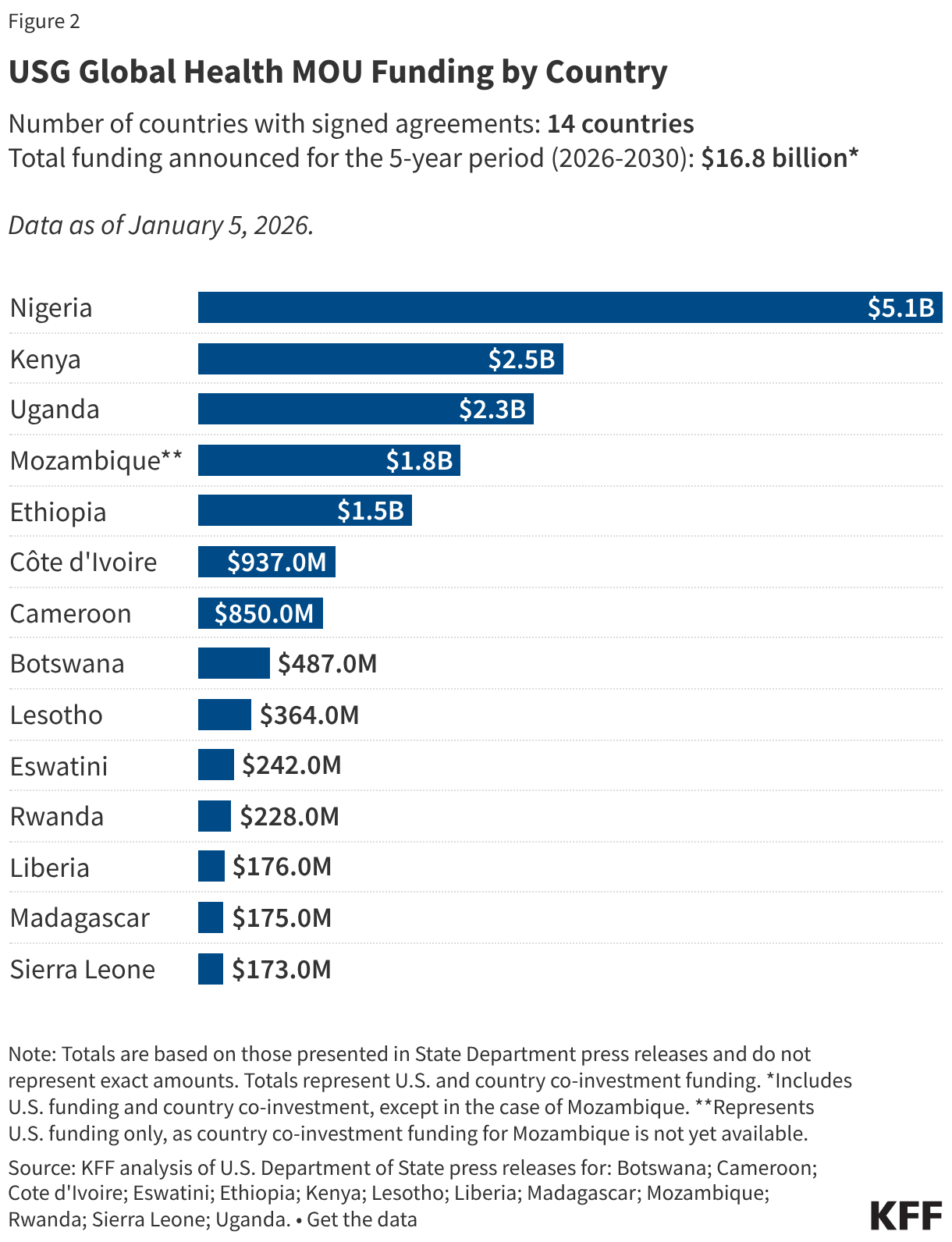
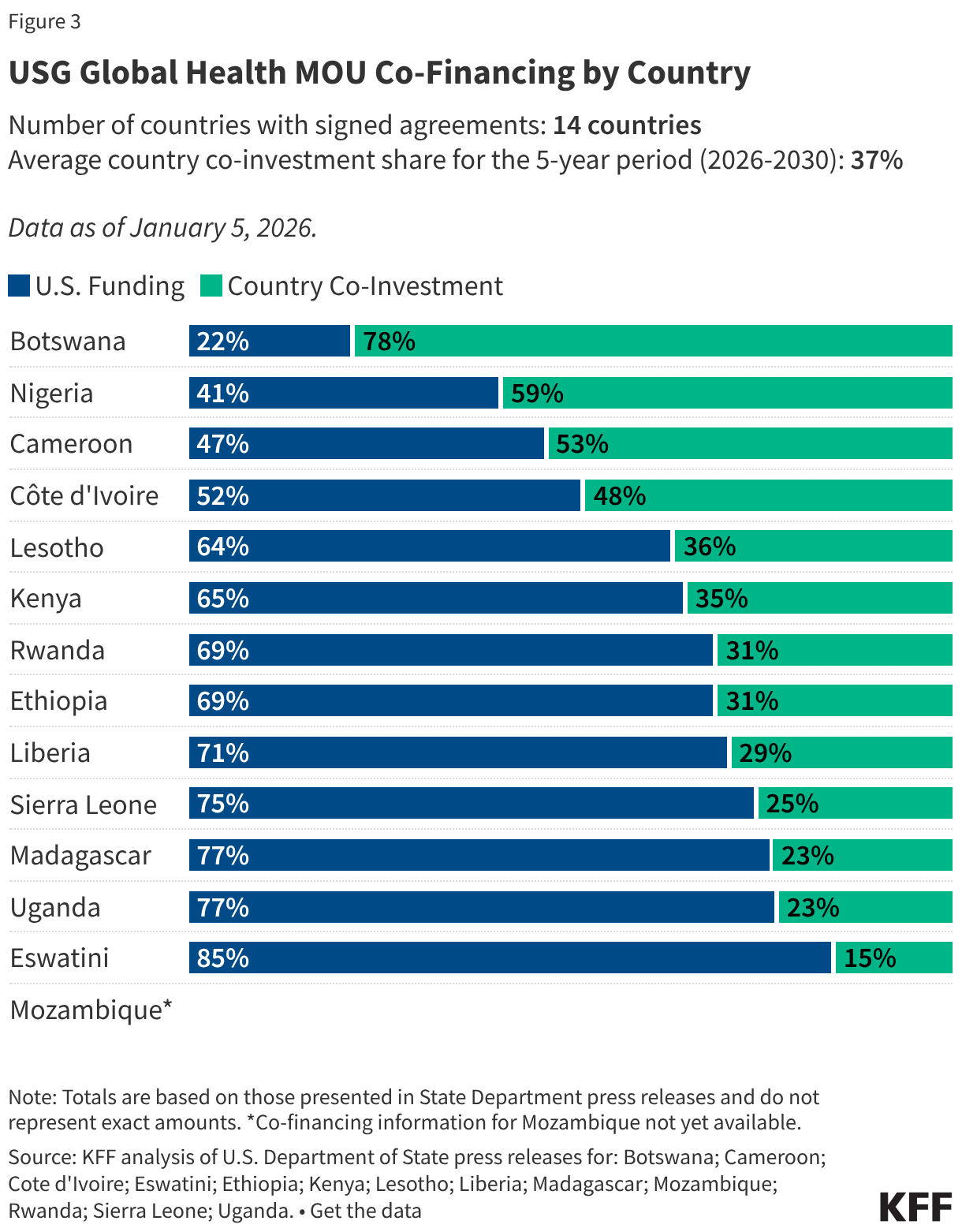
USG Global Health MOU Co-Financing Amount by Country
Number of countries with signed agreements: 36 countries
Click on the buttons below to see data for
different charts:
Share  
Amount
 
Data as of October 8, 2026.
It is unclear if some country co-financing amounts include only new country funding or total country funding (new + existing). For countries with available MOU documents, funding data were sourced directly from MOUs, with the exception of Malawi, which is based on State Department press releases. Global health MOU agreements for Bolivia, Botswana, Panama, and South Sudan are for a three-year period.
*The Philippines did not sign an official MOU but rather a "Strategic Objective Agreement." While an overall funding amount is available, co-financing details are not yet publicly available.
**Co-financing details are not available for Vietnam (the U.S. announced it would provide $98.75m for Vietnam's MOU, but country co-financing details are unclear. The State Department press release states, "[Vietnam's] annual health expenditure is projected to grow by approximately $10.5 billion over the five-year MOU period, from $23.3 billion to $33.8 billion").
KFF analysis of U.S. Department of State, U.S. embassy, and Ministries of Health press releases, and MOU documents.
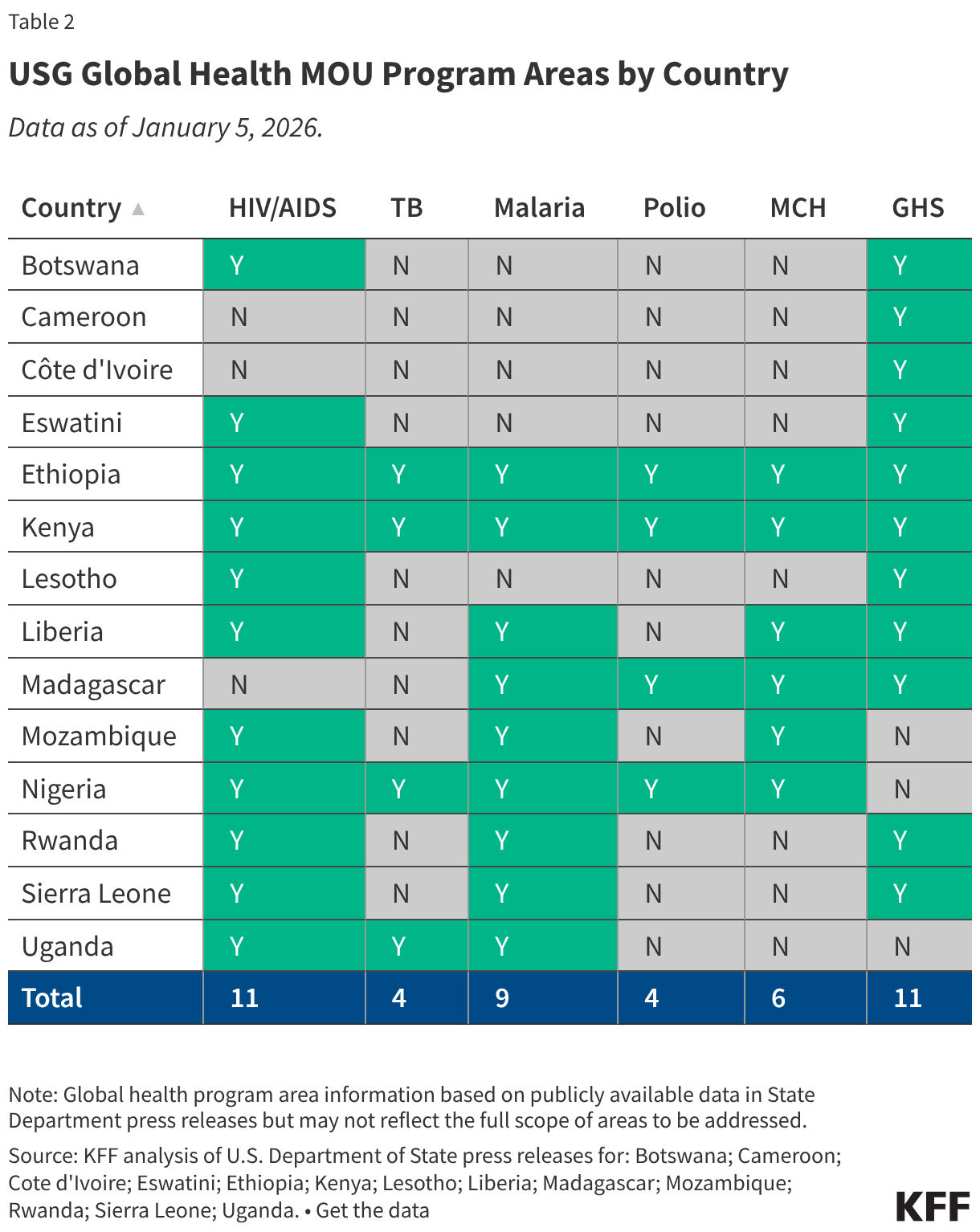
Historical vs. Proposed 5-Year USG Global Health MOU Funding, Funding Change by Country
Number of countries with signed agreements: 36 countries
Total change (and percent change) in 5-year global health funding among countries with agreements: -$8.1 billion (-34%)
Click on the buttons below to see data for
different charts:
Funding Amount
 
Funding Change
 
Percent Change  
Data as of October 8, 2026.
Historical funding totals represent appropriated and planned amounts for FY21-23, and requested amounts for FY24-25 for the Global Health Programs (GHP) account. Represents U.S. funding only; does not include country co-investment funding. For countries with available MOU documents, MOU funding data were sourced directly from MOUs, with the exception of Malawi, which is based on State Department press releases.
*Global health MOU agreements for Bolivia, Botswana, Panama, and South Sudan are for a three-year period. For Botswana and South Sudan, prior funding represents planned global health funding for FY23-25. Due to limited data, Bolivia and Panama comparisons cannot be provided.
**The Philippines did not sign an official MOU but rather a "Strategic Objective Agreement." While an overall funding amount is available, co-financing details are not yet publicly available.
KFF analysis of U.S. Department of State, U.S. embassy, and Ministries of Health press releases, and MOU documents.
Historical vs. Proposed 5-Year USG Global Health MOU Funding, Percent Change by Country
Number of countries with signed agreements: 36 countries
Total change (and percent change) in 5-year global health funding among countries with agreements: -$8.1 billion (-34%)
Click on the buttons below to see data for
different charts:
Funding Amount
 
Funding Change
 
Percent Change  
Data as of October 8, 2026.
Historical funding totals represent appropriated and planned amounts for FY21-23, and requested amounts for FY24-25 for the Global Health Programs (GHP) account. Represents U.S. funding only; does not include country co-investment funding. For countries with available MOU documents, MOU funding data were sourced directly from MOUs, with the exception of Malawi, which is based on State Department press releases.
*Global health MOU agreements for Bolivia, Botswana, Panama, and South Sudan are for a three-year period. For Botswana and South Sudan, prior funding represents planned global health funding for FY23-25. Due to limited data, Bolivia and Panama comparisons cannot be provided.
**The Philippines did not sign an official MOU but rather a "Strategic Objective Agreement." While an overall funding amount is available, co-financing details are not yet publicly available.
KFF analysis of U.S. Department of State, U.S. embassy, and Ministries of Health press releases, and MOU documents.
Methods
This tracker provides information on U.S. MOU bilateral global health agreements to date. Information is sourced from publicly available U.S. Department of State, U.S. embassies, and partner country Ministries of Health press release statements and MOU texts, and will be updated as more information becomes available and when additional agreements are signed. Currently, MOU text, which contains the most detailed information of these sources, is publicly available for only a limited number of countries; for these countries, data were sourced directly from these MOU documents. For countries with available MOU documents, overall totals are based on the sum of annual amounts presented in the text.
Program areas are captured using keyword searches; for global health security (GHS) specifically, country agreements were categorized as targeting GHS if they specifically mentioned GHS, or if they included descriptions of outbreak preparedness and response activities and containing health threats. Due to the limited nature of press release statements, this tracker may not comprehensively capture the global health program areas targeted in each country’s agreement.
