FY 2026 National Security, Department of State and Related Programs (NSRP) Global Health Funding in the Consolidated Appropriations Act
Update: On February 3, 2026, the President signed the “Consolidated Appropriations Act, 2026” which includes funding provided in the FY 2026 National Security, Department of State and Related Programs (NSRP) appropriations bill and accompanying explanatory statement detailed below. This resource was originally published on January 14, 2026.
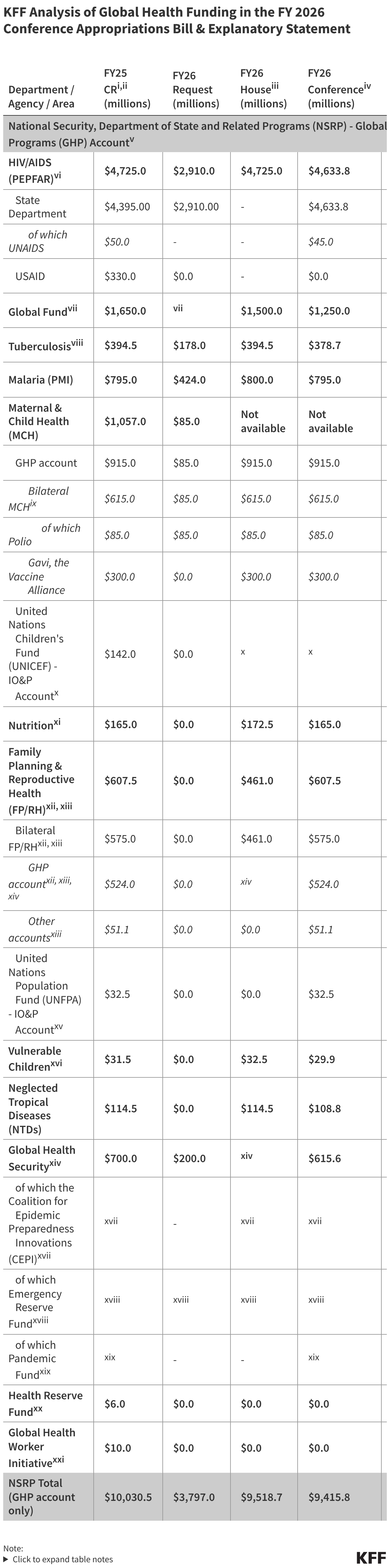
On January 11, 2026, the Appropriations Committee released the FY 2026 National Security, Department of State and Related Programs (NSRP) (formerly State, Foreign Operations, and Related Programs [SFOPs]) appropriations bill and accompanying explanatory statement. The bill and explanatory statement include funding for U.S. global health programs at the State Department. Funding for global health programs at the State Department through the Global Health Programs (GHP) account, which represents the bulk of global health assistance, totals $9.4 billion, which is a decrease of $615 million (-6%) compared to the FY25 level ($10 billion). All program areas either decreased or remained flat as follows:
- Decreased: Funding for the Global Fund to Fight AIDS, Tuberculosis and Malaria (Global Fund), bilateral HIV, tuberculosis (TB), global health security, neglected tropical diseases (NTDs), and vulnerable children declined; while the Global Fund accounted for the largest decrease (-$400 million or -24%), this funding supports the administration’s pledge of $4.6 billion for the eighth replenishment and serves as the first installment of that pledge. In addition, the explanatory statement accompanying the bill states that there are also “sufficient unobligated balances” from prior Acts “to fulfill the United States pledge for the seventh replenishment.”
- Remained Flat: Funding for malaria, maternal and child health (MCH), nutrition, and family planning and reproductive health (FP/RH) remained flat.
In addition, the bill included provisions that either impact or provide direction on global health funding including:
- Program Area Amounts: Funding for many of the global health program areas is specified in the explanatory statement (rather than the bill). Unlike prior years, this bill specifically states that funding “shall be made available at not less than the amounts specifically designated in the respective tables included in the explanatory statement” ensuring that the administration is required to provide the amounts for the areas specified. The bill also prohibits the administration from deviating from the global health amounts in the bill and explanatory statement.
- Funding Availability Timeframe: PEPFAR funding (bilateral HIV and the contribution to the Global Fund) is available for five years. Funding for most other program areas is provided for two years, with the exception of funding for Gavi, the Vaccine Alliance and the Coalition for Epidemic Preparedness Innovations (CEPI), which is provided for one year.
- Reports/Briefings: The bill requires the administration to provide updates (via reports or briefings) on numerous global health areas including (but not limited to) the PEPFAR Transition Strategy, Market Access Strategy, bilateral health agreements, multilateral health engagement, the development of an Innovation Fund, and the status of available funding (i.e. apportionment, allocations, obligations, and disbursements).
- Additional Requirements: The bill requires coordination with the Centers for Disease Control and Prevention (CDC) on global health activities and establishes the Prevention, Treatment, and Response Initiative, which supports “research, development, and delivery of vaccines and other prevention technologies”.
See the table below for additional detail on global health funding. See other budget summaries (including the summary on FY 2026 Labor, Health and Human Services, Education, and Related Agencies (Labor HHS) global health funding) and the KFF budget tracker for details on historical annual appropriations for global health programs.