Poll: 1 in 3 ACA Marketplace Enrollees Say They Would “Very Likely” Shop for a Cheaper Plan If Their Premium Payments Doubled; 1 in 4 Say They “Very Likely” Would Go Without Insurance
As Enhanced Credits Expire, Nearly All Enrollees Expect to Make Coverage Decisions This Year
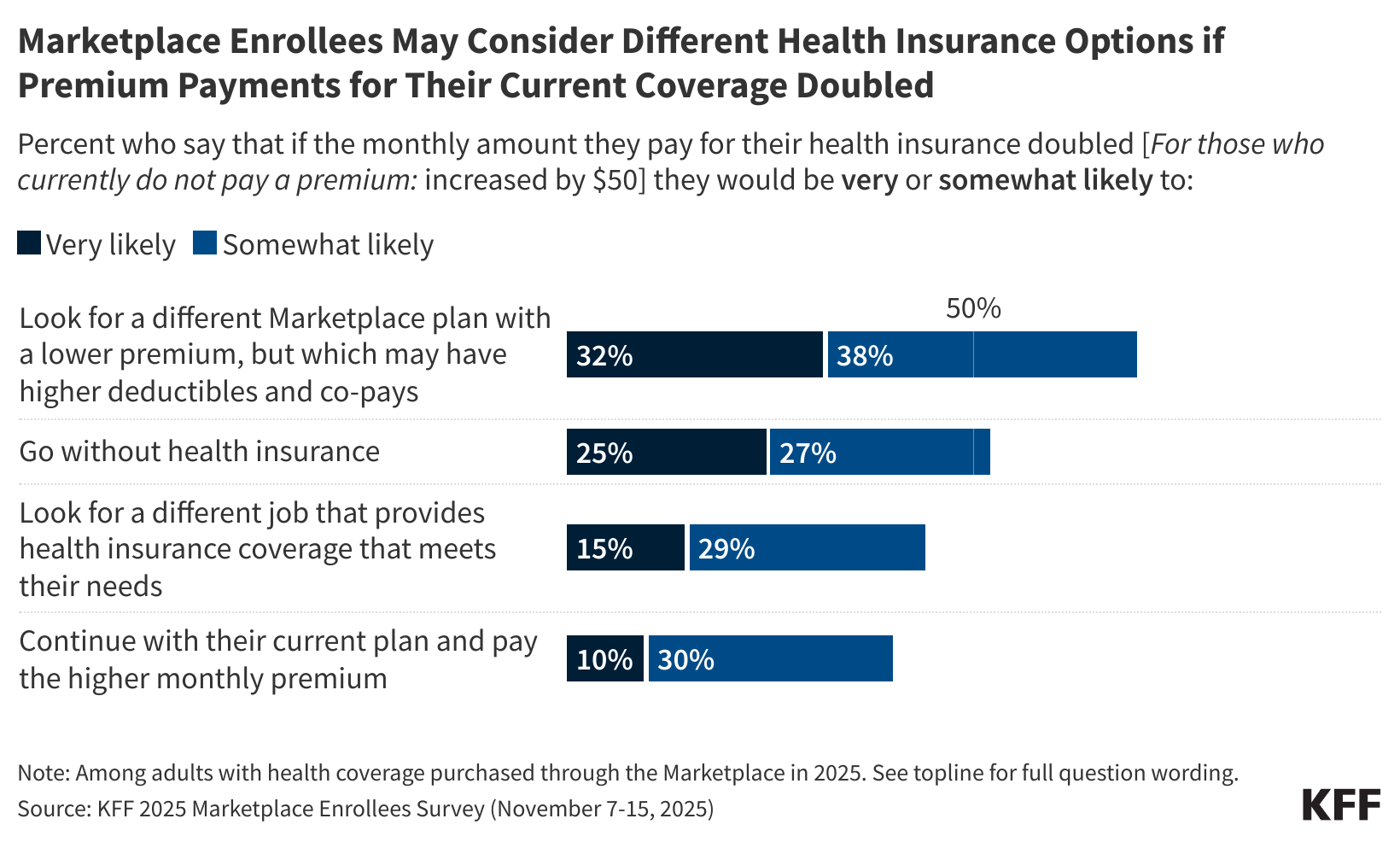
If the amount they pay in premiums doubled, about one in three enrollees in Affordable Care Act Marketplace health plans say they would be “very likely” to look for a lower-premium Marketplace plan (with higher deductibles and co-pays) and one in four would “very likely” go without insurance next year, finds a new survey of Marketplace enrollees fielded shortly after open enrollment began in the first weeks of November.
The survey captures the views and experiences of Marketplace enrollees as they weigh their coverage options for 2026, without the enhanced ACA credits or other policy changes that the Senate could debate this month. About 22 million of the 24 million Marketplace enrollees have benefited from the expiring tax credits, and without them, their premium payments are expected to rise an average of 114%, from $888 to $1,904 annually.
Nearly six in 10 enrollees (58%) say they would not be able to afford an increase of just $300 per year in the amount they pay for insurance without significantly disrupting their household finances. An additional one in five (20%) say they would not be able to afford a $1,000 per year increase in the amount they pay for health insurance without disrupting their finances.
If their total health care costs, including premiums, deductibles and other cost-sharing, increased by $1,000 next year, most Marketplace enrollees (67%) say they would likely cut spending on daily household needs, about half (54%) say they would likely to try to find another job or work extra hours, and four in 10 (41%) say they would likely skip or delay paying other bills. A third (34%) say they would take out a loan or increase their credit card debt.
“The poll shows the range of problems Marketplace enrollees will face if the enhanced tax credits are not extended in some form, and those problems will be the poster child of the struggles Americans are having with health care costs in the midterms if Republicans and Democrats cannot resolve their differences,” KFF President and CEO Drew Altman said.
It asked Marketplace enrollees to say how likely it was that they would take each of four different potential responses if the monthly premiums they pay doubled (or increased $50 a month for those who currently don’t pay a premium).
Open enrollment for Marketplace coverage began Nov. 1 and runs through Jan. 15 in most states, though consumers must enroll in a plan by Dec. 15 if they want their coverage to begin on Jan. 1. The vast majority of enrollees (89%) expect to make a decision by the end of this year, with many saying they have already made their decision about coverage for next year.
More than half of Marketplace enrollees (54%) say they expect that the cost of their health insurance coverage for next year will “increase a lot more than usual.” An additional one in four (26%) expect it to increase a “little more than usual,” while smaller shares expect their insurance costs to “increase about the same as usual” (12%) or “not increase at all” (8%).
If their overall health care expenses, including co-pays, deductibles, and premiums, increased by $1,000 next year, about half of Marketplace enrollees say it would have a “major impact” on their decision to vote in the 2026 midterm elections (54%) or on which party’s candidate they will support (52%).
People with Marketplace insurance are more likely to say that either President Trump (37%) or Congressional Republicans (33%) would deserve most of the blame if their health care costs increased by $1,000 next year than they are to say Congressional Democrats (29%).
Democrats would overwhelmingly blame Republicans in Congress (46%) or President Trump (49%). Most Republicans (65%) would blame Congressional Democrats, though about a third say they would blame either Republicans in Congress (20%) or President Trump (14%). Among independents, more than four in 10 (44%) would blame the President, a third (32%) would blame Congressional Republicans, and about one in four (23%) would blame Congressional Democrats.
Other findings include:
- Overall, about four in 10 Marketplace enrollees (39%) are Republicans or Republican-leaning independents, including about one in four (24%) who identify with President Trump’s Make America Great Again (MAGA) movement. Just over four in 10 enrollees (45%) identify as Democrats or Democratic-leaning independents, while 17% don’t identify or lean toward either party.
- Even with the current levels of financial assistance, many Marketplace enrollees say it is already difficult to afford their deductibles and other out-of-pocket costs for medical care (61%) and to afford the cost of health insurance each month (51%). More enrollees say their out-of-pocket medical costs are difficult to afford than say the same about other household expenses, such as their rent or mortgage, food and groceries, utilities, and gasoline or transportation costs.
- Large majorities of Marketplace enrollees, regardless of partisanship, say that having health insurance is “very important” for their peace of mind (78%), their ability to get needed health care (77%), and their financial well-being (69%). Enrollees between the ages of 50 and 64 are more likely than younger enrollees to say health insurance is very important for each of these three reasons.
- A large majority (84%) of enrollees say that Congress should extend the enhanced tax credits, while one in six (16%) think they should let the tax credits expire. Of them, nearly all Democrats (95%), about eight in 10 independents (84%), and about seven in 10 Republicans (72%) and MAGA supporters (72%) favor extending the expiring tax credits.
Designed and analyzed by public opinion researchers at KFF, the 2025 Marketplace Enrollees Survey was conducted November 7-15, 2025, online and by telephone, in English and in Spanish, among a nationally representative sample of 1,350 U.S. adults ages 18-64 who purchase coverage on the ACA Marketplaces. The margin of sampling error is plus or minus 3 percentage points for the full sample. For results based on other subgroups, the margin of sampling error may be higher.