Medicare

NEW AND NOTEWORTHY

What to Know About Medicare Coverage of Telehealth

Congress has repeatedly extended pandemic-era flexibilities around Medicare coverage of telehealth, but most such flexibilities remain temporary. This brief answers key questions about the current scope of Medicare telehealth coverage, including both temporary and permanent changes adopted through legislation and regulation, and future policy considerations.

Changes to the Medicare Advantage Program Enhance Some Consumer Protections But Roll Back Others

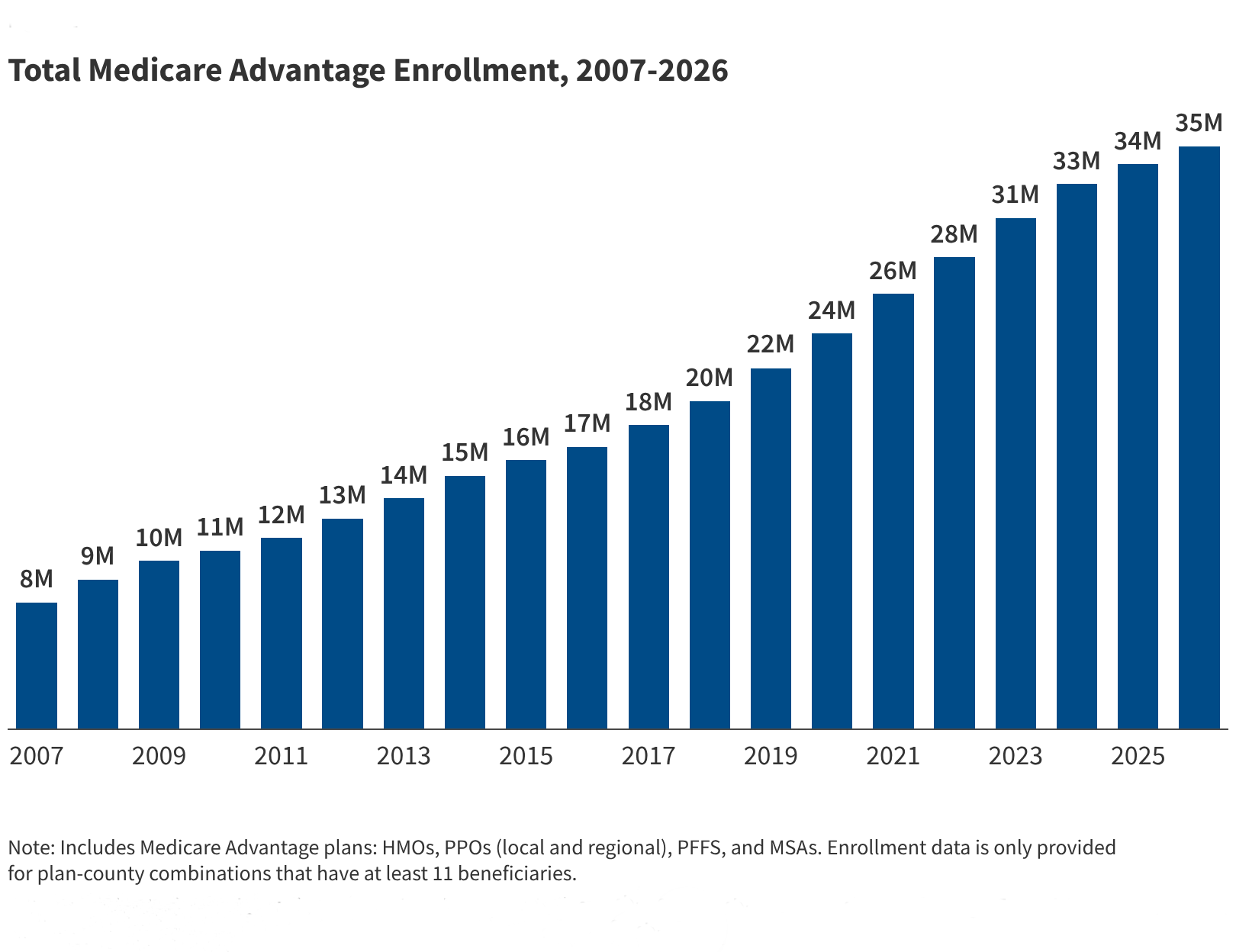
CMS recently finalized policies as part of the 2027 Medicare Advantage final rule that both enhance consumer protections and roll back changes to the Medicare Advantage program that were intended to protect consumers. These changes have gotten less attention than payment issues and changes to the star ratings system, which also affect plan payments, but could have implications for Medicare beneficiaries.

Examining the Potential Impact of Medicare’s New WISeR Model

A federal initiative to establish new prior authorization requirements in traditional Medicare, called the Wasteful and Inappropriate Service Reduction (WISeR) model, is likely to have only modest impact in its first year.

State Profiles for Dual-Eligible Individuals

This data collection draws on Medicare and Medicaid administrative data to present national and state-level information on people who are covered by both Medicare and Medicaid, referred to as dual-eligible individuals (also known as dually-enrolled beneficiaries).

Data Visualization

The Facts About Medicare Spending

This interactive provides the facts on Medicare spending. Medicare, which serves 67 million people and accounts for 12 percent of the federal budget and 21 percent of national health spending, is often the focus of discussions about health expenditures, health care affordability and the sustainability of federal health programs. u003cbru003eu003cbru003eExplore data on enrollment growth, Medicare spending trends overall and per person, growth in Medicare spending relative to private insurance, spending on benefits and Medicare Advantage, Part A trust fund solvency challenges, and growth in out-of-pocket spending by beneficiaries.u003cbru003eu003cbru003eu003ca href=u0022https://www.kff.org/medicare/issue-brief/faqs-on-medicare-financing-and-trust-fund-solvency/u0022 data-type=u0022linku0022 data-id=u0022https://www.kff.org/medicare/issue-brief/faqs-on-medicare-financing-and-trust-fund-solvency/u0022u003eRelated:u003ca href=u0022https://www.kff.org/medicare/issue-brief/faqs-on-medicare-financing-and-trust-fund-solvency/u0022u003e FAQs on Medicare Financing and Trust Fund Solvencyu003c/au003eu003c/au003e

Read More

Subscribe to KFF Emails

Choose which emails are best for you.
Sign up here

Filter

831 - 840 of 1,598 Results

  • New Report on the “Rising Cost of Living Longer” Details Medicare Spending by Age

    News Release

    A new report, The Rising Cost of Living Longer: Analysis of Medicare Spending by Age for Beneficiaries in Traditional Medicare, from the Kaiser Family Foundation takes a detailed look at per person Medicare spending by age and by service among the nearly 30 million people covered by traditional Medicare in 2011

  • The Rising Cost of Living Longer: Analysis of Medicare Spending by Age for Beneficiaries in Traditional Medicare

    Report

    This analysis provides a detailed look at per person Medicare spending on the nearly 30 million beneficiaries over age 65 who are enrolled in the traditional Medicare program. Among the key findings of the report is that per person spending rises with age, peaking at age 96. But this rise is not entirely explained by Medicare spending on end of life care, which declines with age. What Medicare spends money on also changes as beneficiaries…

  • Visualizing Health Policy: Medicare Spending: A Look at Present, Short-Term and Long-Term Trends

    News Release

    This Visualizing Health Policy infographic provides an overview of Medicare spending, including information on current federal spending relative to other government programs (e.g., Social Security) and percent-share of spending across Medicare services, as well as projected Medicare spending over the next decade and beyond. Recent federal spending on Medicare is about a third of Defense and Social Security spending combined. In the short term, Medicare spending per person is expected to be lower relative to…

  • Visualizing Health Policy: Medicare Spending: A Look at Present, Short-Term and Long-Term Trends

    Other Post

    This Visualizing Health Policy infographic with the Journal of the American Medical Association (JAMA) provides an overview of Medicare spending trends in the present, short term and long term. In the long term, Medicare spending as a share of the economy is projected to grow, and Medicare is projected to lack sufficient funds to pay all hospital bills beginning in 2030.

  • Health Affairs Article: At Least Half of New Medicare Advantage Enrollees Had Switched From Traditional Medicare During 2006-11

    Issue Brief

    In an article in Health Affairs, researchers from the Kaiser Family Foundation counter the popular misperception that the steady rise in Medicare Advantage enrollment has been driven by members of the Baby Boom generation overwhelmingly choosing the private plans as they become eligible for Medicare. Their study examines the 2006-2011 growth in Medicare Advantage enrollment and finds that a majority of new enrollees in Medicare Advantage in each year were, in fact, seniors switching from…

  • Report Examines the Role of Medicare and the Indian Health Service for American Indians and Alaska Natives

    News Release

    A new report from the Kaiser Family Foundation examines the role of both Medicare and the Indian Health Service (IHS) in providing access to health care for about 650,000 American Indians and Alaska Natives who are age 65 and older or who have permanent disabilities. While Medicare provides important health care coverage for most in this group, its relatively high cost-sharing and gaps in benefits can be problematic for American Indians and Alaska Native Medicare…

  • The Role of Medicare and the Indian Health Service for American Indians and Alaska Natives: Health, Access and Coverage

    Report

    This report examines the role of both Medicare and the Indian Health Service (IHS) in providing access to health care for about 650,000 American Indians and Alaska Natives who are age 65 and older or who have permanent disabilities. While Medicare provides important health care coverage for most in this group, its relatively high cost-sharing and gaps in benefits can be problematic for American Indians and Alaska Native Medicare beneficiaries who do not have additional…

  • New Study Provides Insight and Analysis to Help Explain the Medicare Spending Slowdown

    News Release

    Medicare, the federal health program that provides health care and coverage to 54 million seniors and younger adults with permanent disabilities, is in the midst of an unprecedented slowdown in spending growth.  A new issue brief from the Kaiser Family Foundation, How Much of the Medicare Spending Slowdown Can be Explained? Insights and Analysis from 2014, examines the factors that help explain why Medicare is on track to spend an estimated $580 billion in 2014,…

  • How Much of the Medicare Spending Slowdown Can be Explained? Insights and Analysis from 2014

    Issue Brief

    This paper identifies and quantifies, to the extent possible, the factors that explain the gap between actual Medicare spending in 2014 and CBO's 2009 projections of what Medicare spending would be this year. The study synthesizes information from a variety of sources and presents new analysis to assess the extent to which lower-than-projected Medicare spending in 2014 can be explained by deliberate policy and program changes, unexpected trends, and other factors.