Medicare

NEW AND NOTEWORTHY

What to Know About Medicare Coverage of Telehealth

Congress has repeatedly extended pandemic-era flexibilities around Medicare coverage of telehealth, but most such flexibilities remain temporary. This brief answers key questions about the current scope of Medicare telehealth coverage, including both temporary and permanent changes adopted through legislation and regulation, and future policy considerations.

Changes to the Medicare Advantage Program Enhance Some Consumer Protections But Roll Back Others

CMS recently finalized policies as part of the 2027 Medicare Advantage final rule that both enhance consumer protections and roll back changes to the Medicare Advantage program that were intended to protect consumers. These changes have gotten less attention than payment issues and changes to the star ratings system, which also affect plan payments, but could have implications for Medicare beneficiaries.

Examining the Potential Impact of Medicare’s New WISeR Model

A federal initiative to establish new prior authorization requirements in traditional Medicare, called the Wasteful and Inappropriate Service Reduction (WISeR) model, is likely to have only modest impact in its first year.

State Profiles for Dual-Eligible Individuals

This data collection draws on Medicare and Medicaid administrative data to present national and state-level information on people who are covered by both Medicare and Medicaid, referred to as dual-eligible individuals (also known as dually-enrolled beneficiaries).

Data Visualization

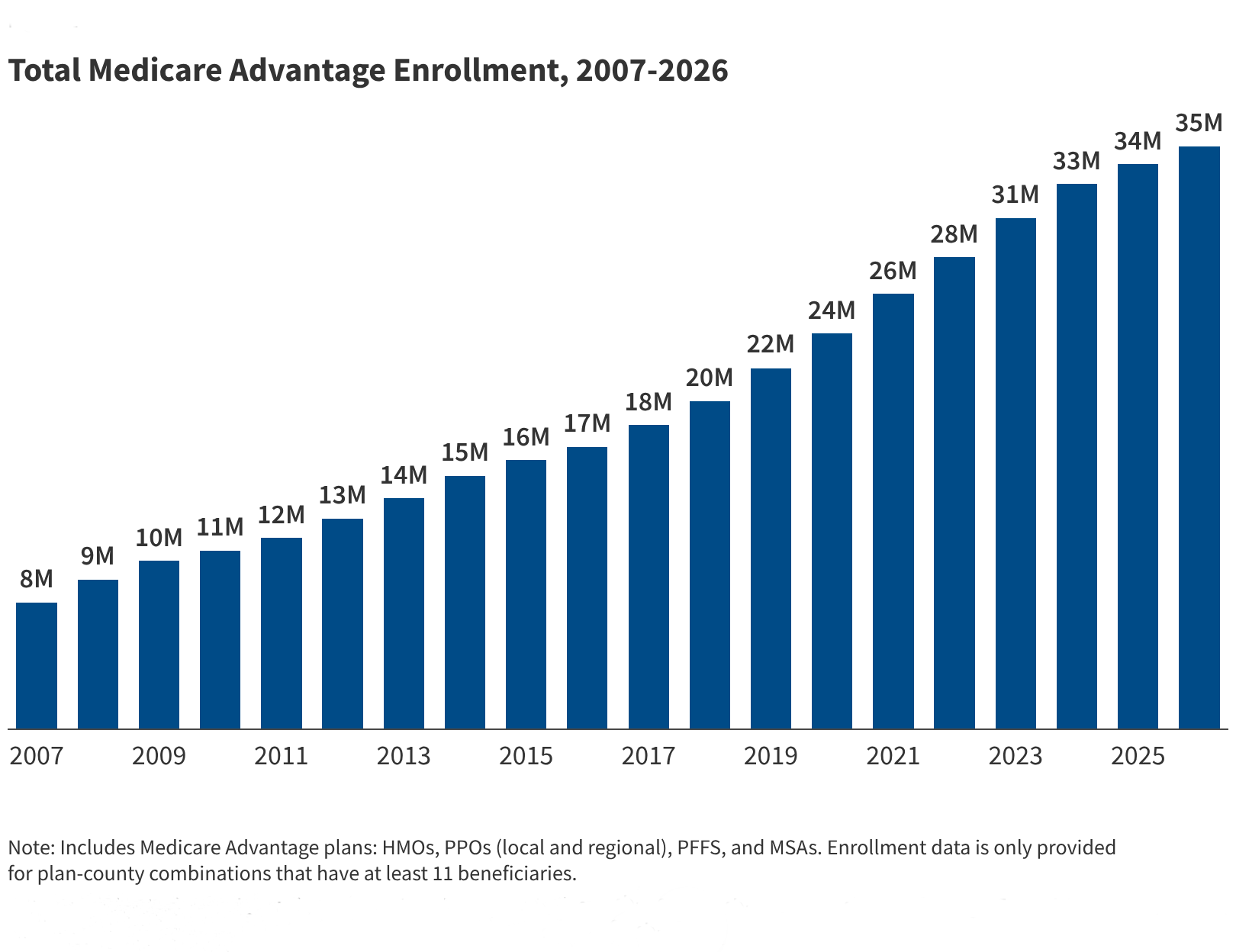
The Facts About Medicare Spending

This interactive provides the facts on Medicare spending. Medicare, which serves 67 million people and accounts for 12 percent of the federal budget and 21 percent of national health spending, is often the focus of discussions about health expenditures, health care affordability and the sustainability of federal health programs. u003cbru003eu003cbru003eExplore data on enrollment growth, Medicare spending trends overall and per person, growth in Medicare spending relative to private insurance, spending on benefits and Medicare Advantage, Part A trust fund solvency challenges, and growth in out-of-pocket spending by beneficiaries.u003cbru003eu003cbru003eu003ca href=u0022https://www.kff.org/medicare/issue-brief/faqs-on-medicare-financing-and-trust-fund-solvency/u0022 data-type=u0022linku0022 data-id=u0022https://www.kff.org/medicare/issue-brief/faqs-on-medicare-financing-and-trust-fund-solvency/u0022u003eRelated:u003ca href=u0022https://www.kff.org/medicare/issue-brief/faqs-on-medicare-financing-and-trust-fund-solvency/u0022u003e FAQs on Medicare Financing and Trust Fund Solvencyu003c/au003eu003c/au003e

Read More

Subscribe to KFF Emails

Choose which emails are best for you.
Sign up here

Filter

541 - 550 of 1,596 Results

  • KFF Analysis: Number of Coronavirus Cases, Distribution of $30B in CARES Act funding and Medicare Advantage Penetration by State

    Fact Sheet

    Number of Coronavirus Cases, Distribution of $30B in CARES Act funding and Medicare Advantage Penetration by StateStateNumber ofCOVID-19 Cases on April 21, 2020Percent of Total COVID-19 CasesFirst Distribution of CARES Act PaymentsPercent of Total Money DistributedPercent of Medicare Beneficiaries in Medicare Advantage, 2020New York253,400.0032.1%$1,859,574,4346.2%40%New Jersey88,806.0011.3%$919,426,8013.1%29%Massachusetts39,643.005.0%$841,425,1202.8%23%Pennsylvania34,005.004.3%$1,246,250,0764.2%41%California33,866.004.3%$2,920,960,7339.7%40%Michigan32,000.004.1%$936,700,1393.1%42%Illinois31,508.004.0%$1,204,103,1804.0%25%Florida27,058.003.4%$2,220,563,1377.4%43%Louisiana24,523.003.1%$474,891,7351.6%38%Connecticut19,815.002.5%$377,981,2571.3%41%Texas20,087.002.5%$2,089,066,4527.0%37%Georgia19,398.002.5%$792,069,1602.6%37%Maryland14,193.001.8%$742,225,3062.5%11%Ohio12,919.001.6%$989,773,4173.3%39%Washington12,486.001.6%$553,838,8061.8%33%Indiana11,688.001.5%$668,604,6142.2%32%Colorado10,112.001.3%$360,905,4821.2%38%Virginia9,097.001.2%$814,360,4672.7%21%Tennessee7,238.000.9%$739,723,3472.5%38%North Carolina6,979.000.9%$919,171,0873.1%36%Missouri5,963.000.8%$618,601,1672.1%35%Rhode Island5,090.000.6%$90,459,8340.3%39%Arizona5,068.000.6%$707,587,4822.4%39%Alabama5,092.000.6%$449,481,9451.5%41%Mississippi4,512.000.6%$374,847,7901.2%20%Wisconsin4,541.000.6%$471,681,0771.6%42%South Carolina4,439.000.6%$518,022,4631.7%28%Nevada3,830.000.5%$241,471,8410.8%36%Utah3,213.000.4%$185,292,4220.6%36%Iowa3,159.000.4%$297,929,1711.0%22%Kentucky3,050.000.4%$452,761,1711.5%34%District of Columbia3,098.000.4%$84,989,0990.3%20%Delaware2,745.000.3%$154,114,1180.5%17%Oklahoma2,680.000.3%$489,853,9981.6%22%Minnesota2,470.000.3%$472,206,1221.6%43%Kansas2,070.000.3%$325,135,9501.1%19%Oregon1,956.000.2%$291,029,0251.0%42%Arkansas1,990.000.3%$326,536,0431.1%26%New Mexico1,971.000.2%$169,486,1320.6%35%South Dakota1,685.000.2%$107,650,2010.4%19%Idaho1,736.000.2%$135,028,0560.5%33%Nebraska1,648.000.2%$225,027,9120.8%17%New Hampshire1,447.000.2%$164,580,3860.5%19%Puerto Rico1,298.000.2%$41,889,8220.1%70%West Virginia908.000.1%$246,574,8510.8%31%Maine875.000.1%$145,763,8120.5%36%Vermont816.000.1%$54,457,8700.2%12%North Dakota627.000.1%$91,064,5790.3%17%Hawaii584.000.1%$132,536,0760.4%44%Montana433.000.1%$111,503,2480.4%18%Alaska321.000.0%$71,248,1230.2%1%Wyoming429.000.1%$66,393,1630.2%3%NOTES: COVID-19 data as of 4/21/2020 at 10:38 AM.SOURCES: Johns Hopkins University, [Coronavirus COVID-19 Global Cases by the Center for…

  • Medicare Beneficiaries Without Supplemental Coverage Are at Risk for Out-of-Pocket Costs Relating to COVID-19 Treatment

    Policy Watch

    Most Medicare Advantage enrollees are in plans that have waived cost sharing for COVID-19 treatment, and many other beneficiaries in traditional Medicare have their cost sharing covered by supplemental insurance. This blog post discusses the 6 million Medicare beneficiaries without supplemental coverage who would face out-of-pocket costs if they require treatment for COVID-19.

  • Possibilities and Limits of Telehealth for Older Adults During the COVID-19 Emergency

    Policy Watch

    Medicare has lifted several restrictions on who can receive telehealth and the types of services they can receive via telehealth during the COVID-19 public health emergency. This post discusses the possibilities and limits of telehealth for older adults, based on findings from the latest KFF Health Tracking Poll.

  • Analysis Estimates Up To 2 Million Uninsured People Could Require COVID-19 Hospitalization

    News Release

    Patients Could Still Be on the Hook for Outpatient Costs, Costs If They Test Negative, and Cost Sharing A new KFF analysis estimates that between 670,000 and 2 million uninsured people around the country eventually could be hospitalized with COVID-19, the respiratory disease caused by the novel coronavirus. Reimbursing hospitals for those treatments could cost between $13.9 billion and $41.8 billion. Trump administration has indicated that it plans to reimburse hospitals for the care of…