Medicare

NEW AND NOTEWORTHY

What to Know About Medicare Coverage of Telehealth

Congress has repeatedly extended pandemic-era flexibilities around Medicare coverage of telehealth, but most such flexibilities remain temporary. This brief answers key questions about the current scope of Medicare telehealth coverage, including both temporary and permanent changes adopted through legislation and regulation, and future policy considerations.

Changes to the Medicare Advantage Program Enhance Some Consumer Protections But Roll Back Others

CMS recently finalized policies as part of the 2027 Medicare Advantage final rule that both enhance consumer protections and roll back changes to the Medicare Advantage program that were intended to protect consumers. These changes have gotten less attention than payment issues and changes to the star ratings system, which also affect plan payments, but could have implications for Medicare beneficiaries.

Examining the Potential Impact of Medicare’s New WISeR Model

A federal initiative to establish new prior authorization requirements in traditional Medicare, called the Wasteful and Inappropriate Service Reduction (WISeR) model, is likely to have only modest impact in its first year.

State Profiles for Dual-Eligible Individuals

This data collection draws on Medicare and Medicaid administrative data to present national and state-level information on people who are covered by both Medicare and Medicaid, referred to as dual-eligible individuals (also known as dually-enrolled beneficiaries).

Data Visualization

The Facts About Medicare Spending

This interactive provides the facts on Medicare spending. Medicare, which serves 67 million people and accounts for 12 percent of the federal budget and 21 percent of national health spending, is often the focus of discussions about health expenditures, health care affordability and the sustainability of federal health programs. u003cbru003eu003cbru003eExplore data on enrollment growth, Medicare spending trends overall and per person, growth in Medicare spending relative to private insurance, spending on benefits and Medicare Advantage, Part A trust fund solvency challenges, and growth in out-of-pocket spending by beneficiaries.u003cbru003eu003cbru003eu003ca href=u0022https://www.kff.org/medicare/issue-brief/faqs-on-medicare-financing-and-trust-fund-solvency/u0022 data-type=u0022linku0022 data-id=u0022https://www.kff.org/medicare/issue-brief/faqs-on-medicare-financing-and-trust-fund-solvency/u0022u003eRelated:u003ca href=u0022https://www.kff.org/medicare/issue-brief/faqs-on-medicare-financing-and-trust-fund-solvency/u0022u003e FAQs on Medicare Financing and Trust Fund Solvencyu003c/au003eu003c/au003e

Read More

Subscribe to KFF Emails

Choose which emails are best for you.
Sign up here

Filter

481 - 490 of 1,599 Results

  • What’s the Latest on Medicare Drug Price Negotiations?

    Issue Brief

    In response to prescription drug spending growth and heightened attention to drug prices, some policymakers have proposed allowing the federal government to negotiate the price of prescription drugs for Medicare and private payers. This brief describes the current status of drug price negotiation proposals, looks back at the history of proposals to give the federal government the authority to negotiate drug prices in Medicare, describes the negotiation provisions in key legislation (H.R. 3), and discusses…

  • Millions of Medicare Part D Enrollees Have Had Out-of-Pocket Drug Spending Above the Catastrophic Threshold Over Time

    Issue Brief

    Medicare Part D, the outpatient prescription drug benefit for Medicare beneficiaries, provides catastrophic coverage for high out-of-pocket drug costs, but there is no limit on the total amount that beneficiaries have to pay out of pocket each year. Policymakers on both sides of the aisle support proposals to modify the design of the Part D benefit and establish a hard cap on out-of-pocket prescription drug spending by Part D enrollees. This analysis shows the number…

  • Black Medicare Beneficiaries Are More Likely Than White Beneficiaries to Have Cost-Related Problems with Their Health Care, Across both Traditional Medicare and in Medicare Advantage Plans

    News Release

    Among people with Medicare, Black beneficiaries are more likely to have cost-related problems with their health care than White beneficiaries, finds a new KFF analysis, with the racial disparity persisting among beneficiaries in both traditional Medicare and Medicare Advantage plans. While 17 percent of all Medicare beneficiaries, or about 1 in 6, reported health care cost-related problems in 2018, the rate among Black beneficiaries was double that among White beneficiaries (28% vs. 14%), according to…

  • Cost-Related Problems Are Less Common Among Beneficiaries in Traditional Medicare Than in Medicare Advantage, Mainly Due to Supplemental Coverage

    Issue Brief

    This analysis examines health care cost-related problems among Medicare beneficiaries, comparing beneficiaries in traditional Medicare, including those with and without supplemental coverage, to those in Medicare Advantage, with a focus on racial equity. We compare rates of cost-related problems among White, Black, and Hispanic beneficiaries, those in fair or poor health, and those under age 65 with long-term disabilities. The measure of cost-related problems include problems getting care due to cost, delays seeking care due…

  • Why Drug Price Negotiation Has Staying Power

    From Drew Altman

    In this Axios column, Drew Altman looks beyond Medicare to what’s at stake for employers and workers in the debate about the government negotiating drug prices.

  • Although Their Share of the Market Varies By State, Enrollment in Medicare Advantage Plans Has More Than Doubled Over the Past Decade, with More than 4 in 10 Medicare Beneficiaries Now Enrolled in the Private Plans

    News Release

    The private plans known as Medicare Advantage now cover more than 4 in 10 Medicare beneficiaries, reflecting a more than doubling of enrollment over the past decade even as the plans remain a far larger presence in some states than others, according to a new KFF analysis. More than 26 million of the nation’s nearly 63 million Medicare beneficiaries are enrolled in Medicare Advantage plans in 2021. The share varies considerably by state, ranging from…

  • Medicare Advantage in 2021: Star Ratings and Bonuses

    Issue Brief

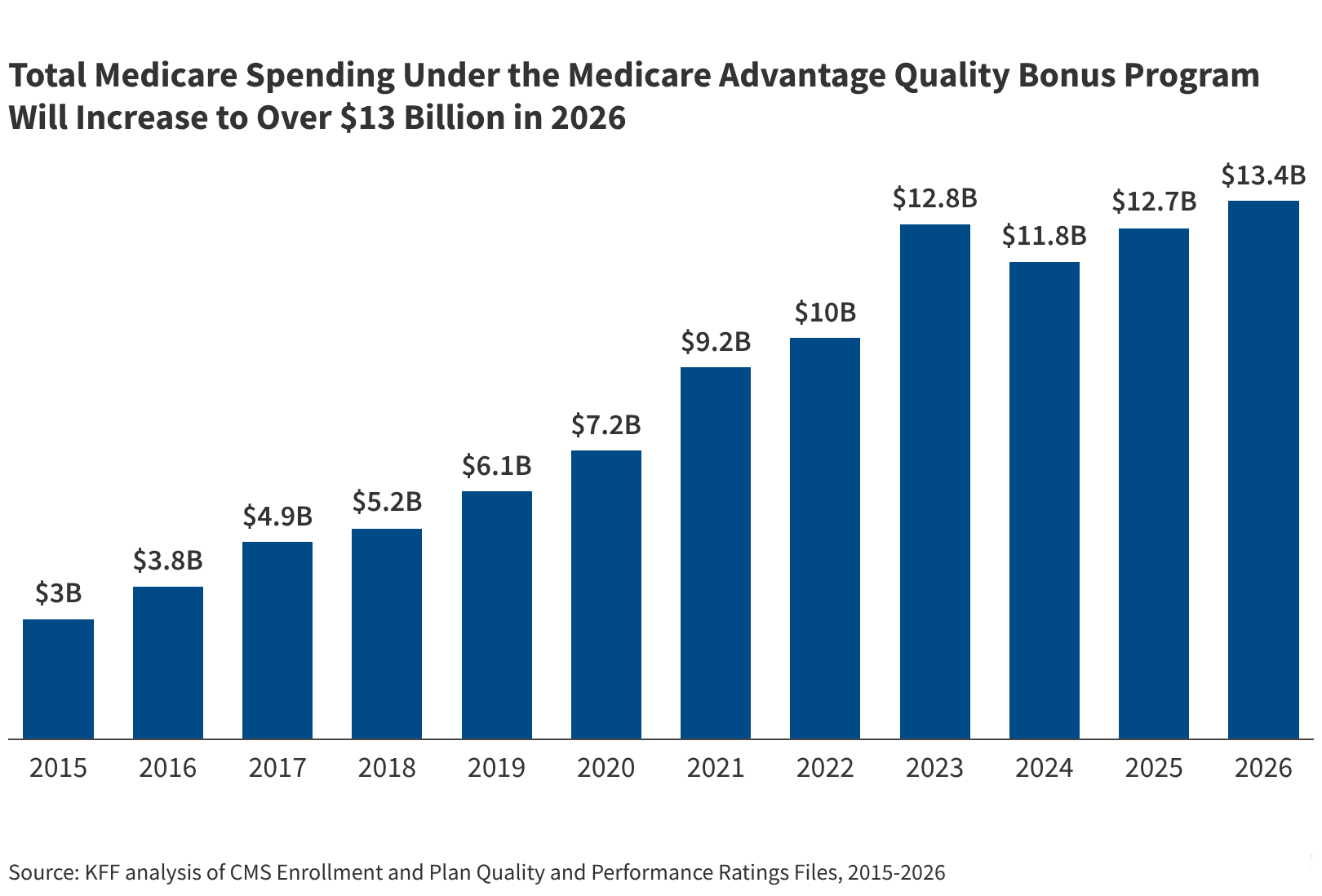
    In 2021, 81 percent of all Medicare Advantage enrollees are in plans that receive a bonus payment from Medicare based on star quality ratings (or because they are new), substantially higher than the share in 2015 (55 percent). Annual bonus payments from the federal government to Medicare Advantage insurers have increased correspondingly, quadrupling from $3 billion in 2015 to $11.6 billion in 2021.

  • FDA’s Approval of Biogen’s New Alzheimer’s Drug Has Huge Cost Implications for Medicare and Beneficiaries

    Issue Brief

    The question of what would happen when a new, expensive prescription drug comes to market for a disease like Alzheimer’s that afflicts millions of people has loomed large in discussions over drug prices in the U.S. This brief analyzes the cost implications for Medicare and beneficiaries associated with Biogen's new FDA-approved Alzheimer's drug, which will cost $56,000 per year.

  • Key Facts About Medicare Part D Enrollment, Premiums, and Cost Sharing in 2021

    Issue Brief

    The Medicare Part D program provides an outpatient prescription drug benefit to older adults and people with long-term disabilities in Medicare who enroll in private plans, including stand-alone drug plans and Medicare Advantage drug plans. This analysis provides the latest data about Part D enrollment, premiums, and cost sharing in 2021 and trends over time.