Medicare

NEW AND NOTEWORTHY

What to Know About Medicare Coverage of Telehealth

Congress has repeatedly extended pandemic-era flexibilities around Medicare coverage of telehealth, but most such flexibilities remain temporary. This brief answers key questions about the current scope of Medicare telehealth coverage, including both temporary and permanent changes adopted through legislation and regulation, and future policy considerations.

Changes to the Medicare Advantage Program Enhance Some Consumer Protections But Roll Back Others

CMS recently finalized policies as part of the 2027 Medicare Advantage final rule that both enhance consumer protections and roll back changes to the Medicare Advantage program that were intended to protect consumers. These changes have gotten less attention than payment issues and changes to the star ratings system, which also affect plan payments, but could have implications for Medicare beneficiaries.

Examining the Potential Impact of Medicare’s New WISeR Model

A federal initiative to establish new prior authorization requirements in traditional Medicare, called the Wasteful and Inappropriate Service Reduction (WISeR) model, is likely to have only modest impact in its first year.

State Profiles for Dual-Eligible Individuals

This data collection draws on Medicare and Medicaid administrative data to present national and state-level information on people who are covered by both Medicare and Medicaid, referred to as dual-eligible individuals (also known as dually-enrolled beneficiaries).

Data Visualization

The Facts About Medicare Spending

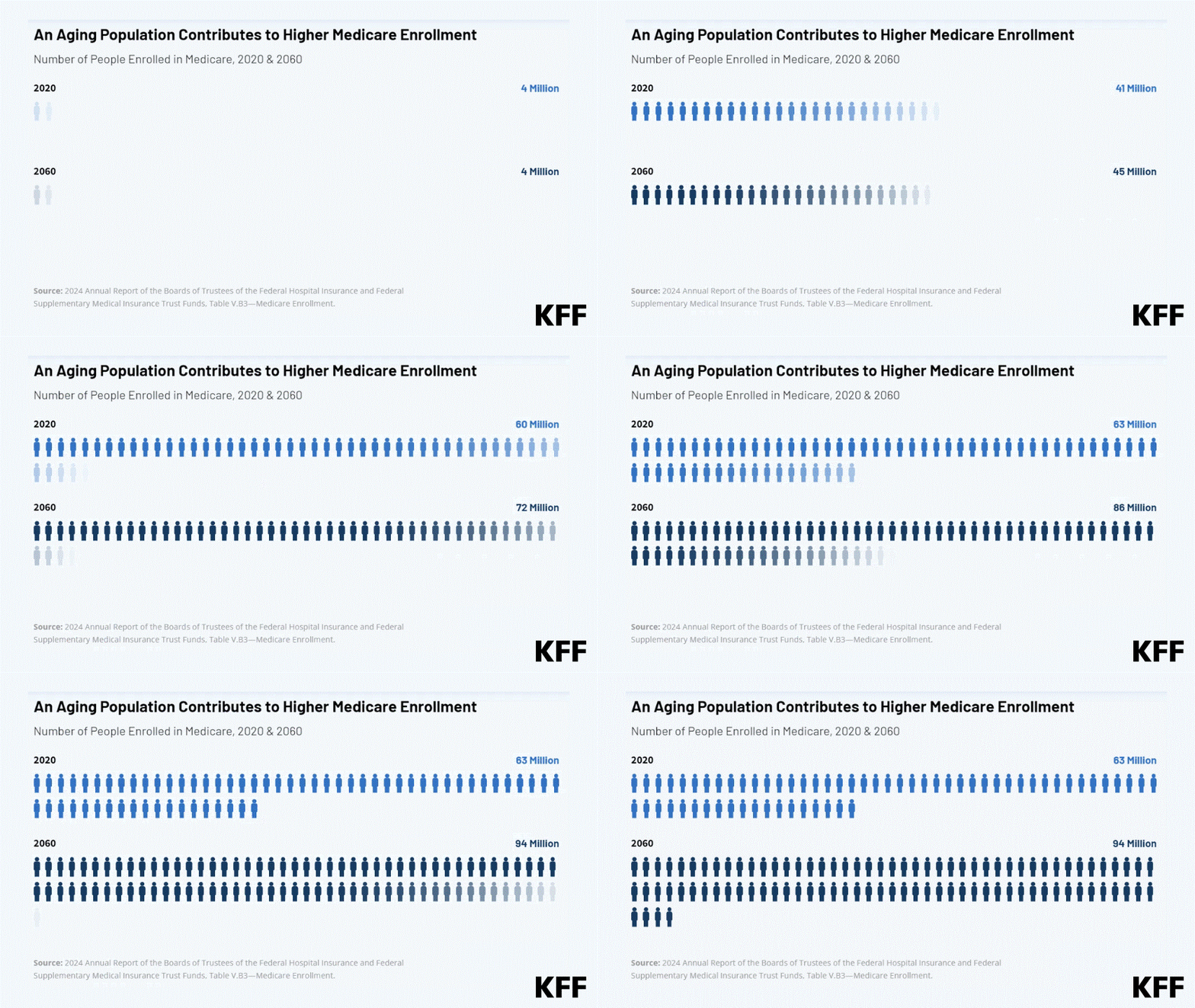
This interactive provides the facts on Medicare spending. Medicare, which serves 67 million people and accounts for 12 percent of the federal budget and 21 percent of national health spending, is often the focus of discussions about health expenditures, health care affordability and the sustainability of federal health programs. u003cbru003eu003cbru003eExplore data on enrollment growth, Medicare spending trends overall and per person, growth in Medicare spending relative to private insurance, spending on benefits and Medicare Advantage, Part A trust fund solvency challenges, and growth in out-of-pocket spending by beneficiaries.u003cbru003eu003cbru003eu003ca href=u0022https://www.kff.org/medicare/issue-brief/faqs-on-medicare-financing-and-trust-fund-solvency/u0022 data-type=u0022linku0022 data-id=u0022https://www.kff.org/medicare/issue-brief/faqs-on-medicare-financing-and-trust-fund-solvency/u0022u003eRelated:u003ca href=u0022https://www.kff.org/medicare/issue-brief/faqs-on-medicare-financing-and-trust-fund-solvency/u0022u003e FAQs on Medicare Financing and Trust Fund Solvencyu003c/au003eu003c/au003e

Read More

Subscribe to KFF Emails

Choose which emails are best for you.
Sign up here

Filter

1,431 - 1,440 of 1,598 Results

  • How Do M+C Plans Manage Pharmacy Benefits? Implications for Medicare Reform

    Report

    Understanding how Medicare+Choice (M+C) plans manage their drug benefits may generate important lessons for Medicare. This report, based on interviews with both national and regional managed care firms, provides an in-depth look at how plans have managed their M+C outpatient pharmacy benefits in recent years. Findings show that plans rely on a number of cost management strategies to constrain the growth in drug spending including formularies, tiered-copayments, mail-order benefits, and fixed caps or dollar limits…

  • Private Long-Term Care Insurance:  Who Should Buy It and What Should They Buy?

    Report

    Private Long-Term Care Insurance: Who Should Buy It and What Should They Buy? Despite the growing interest in private long-term care insurance (LTCI), there has been little independent examination of how much protection LTCI policies provide consumers or whether LTCI policies are a worthwhile purchase for people of average means. This report draws on data from the 1998 Survey of Consumer Finances (SCF) and the 1996 Medical Expenditures Panel Survey (MEPS) to explore the feasibility…

  • Regulation of Private Long-Term Care Insurance: Implementation Experience and Key Issues

    Report

    Regulation of Private Long-Term Care Insurance: Implementation Experience and Key Issues While private long-term care insurance (LTCI) has been available since the mid-1970s, its popularity has grown rapidly in recent years, and Congress is considering proposals that would further encourage LTCI purchase through expanded tax subsidies. Yet there has been little research on how well LTCI works and how much security it really provides. This report focuses on consumer protections for individuals buying LTCI in…

  • Paying for Choice: The Cost Implications of Health Plan Options For People on Medicare

    Report

    This report illustrates the financial stakes for Medicare beneficiaries when making choices about supplemental insurance coverage, by examining how much people on Medicare could spend out-of-pocket including premiums and other cost-sharing requirements under different supplemental insurance options. To assess the cost implications of choosing between different Medigap and Medicare+Choice insurance options, the research team estimated the range in health care expenditures associated with three prototypical beneficiaries (a 50 year-old man with disabilities, a relatively healthy…

  • Disability, Health Coverage, and Welfare Reform

    Report

    This report analyzes data from a survey of 42 low-income families with children with moderate or severe disabilities to better understand the impact of welfare reform on health coverage for these families. Report

  • The Current State of Retiree Health Benefits: Findings from the Kaiser/Hewitt 2002 Retiree Health Survey

    Other Post

    The Current State of Retiree Health Benefits: Findings from the Kaiser/Hewitt 2002 Retiree Health Survey This report presents findings from a study of large private-sector employers conducted by researchers at Hewitt Associates and the Kaiser Family Foundation between July and September of 2002. The study is based on survey responses of 435 large private-sector firms (1,000+ employees) that currently offer retiree health benefits, and includes 36% of all Fortune 100 companies and 28% of all…

  • The Current State of Retiree Health Benefits: Findings from the Kaiser/Hewitt 2002 Retiree Health Survey

    Report

    This report presents findings from a study of large private-sector employers conducted by researchers at Hewitt Associates and the Kaiser Family Foundation between July and September of 2002. The study is based on survey responses of 435 large private-sector firms (1,000+ employees) that currently offer retiree health benefits, and includes 36% of all Fortune 100 companies and 28% of all Fortune 500 companies. Information was collected on a variety of topics including costs, premiums, retiree…

  • Kaiser Health Poll Report – October 2002

    Poll Finding

    A broad and informative bimonthly report, the new Kaiser Health Poll Report provides key tracking information, including historical trends and in-depth analysis of public opinion about hot health care topics. The current Featured Topic contains additional trends in public knowledge and attention to news about seniors and prescription drugs, as well as public opinion about who should be covered by a Medicare prescription drug benefit and what constitutes a good plan. Report Topline & Methodology

  • Medicare’s Disabled Beneficiaries: The Forgotten Population in the Debate Over Drug Benefits

    Report

    About 5 million Americans under age 65 qualify for Medicare coverage because they are totally and permanently disabled. They are more likely than the elderly to live in poverty, to be in poor health, and to experience difficulties living independently and performing basic daily tasks. A new study from The Commonwealth Fund and the Henry J. Kaiser Family Foundation, reports that the disabled have few options other than Medicaid for obtaining prescription coverage. In ,…

  • Medicare+Choice in California: Lessons and Insights

    Report

    Thirty-five percent of all California Medicare beneficiaries are enrolled in a M+C plan, far in excess of the 14 percent rate nationwide. This report seeks to identify what lessons for the nation can be drawn from the California M+C experience, as Congress debates the implications of major withdrawals from the M+C program and potential policy changes aimed at reversing this trend. The report is based largely on analysis of M+C data on plan participation, withdrawals,…