Medicare

NEW AND NOTEWORTHY

What to Know About Medicare Coverage of Telehealth

Congress has repeatedly extended pandemic-era flexibilities around Medicare coverage of telehealth, but most such flexibilities remain temporary. This brief answers key questions about the current scope of Medicare telehealth coverage, including both temporary and permanent changes adopted through legislation and regulation, and future policy considerations.

Changes to the Medicare Advantage Program Enhance Some Consumer Protections But Roll Back Others

CMS recently finalized policies as part of the 2027 Medicare Advantage final rule that both enhance consumer protections and roll back changes to the Medicare Advantage program that were intended to protect consumers. These changes have gotten less attention than payment issues and changes to the star ratings system, which also affect plan payments, but could have implications for Medicare beneficiaries.

Examining the Potential Impact of Medicare’s New WISeR Model

A federal initiative to establish new prior authorization requirements in traditional Medicare, called the Wasteful and Inappropriate Service Reduction (WISeR) model, is likely to have only modest impact in its first year.

State Profiles for Dual-Eligible Individuals

This data collection draws on Medicare and Medicaid administrative data to present national and state-level information on people who are covered by both Medicare and Medicaid, referred to as dual-eligible individuals (also known as dually-enrolled beneficiaries).

Data Visualization

The Facts About Medicare Spending

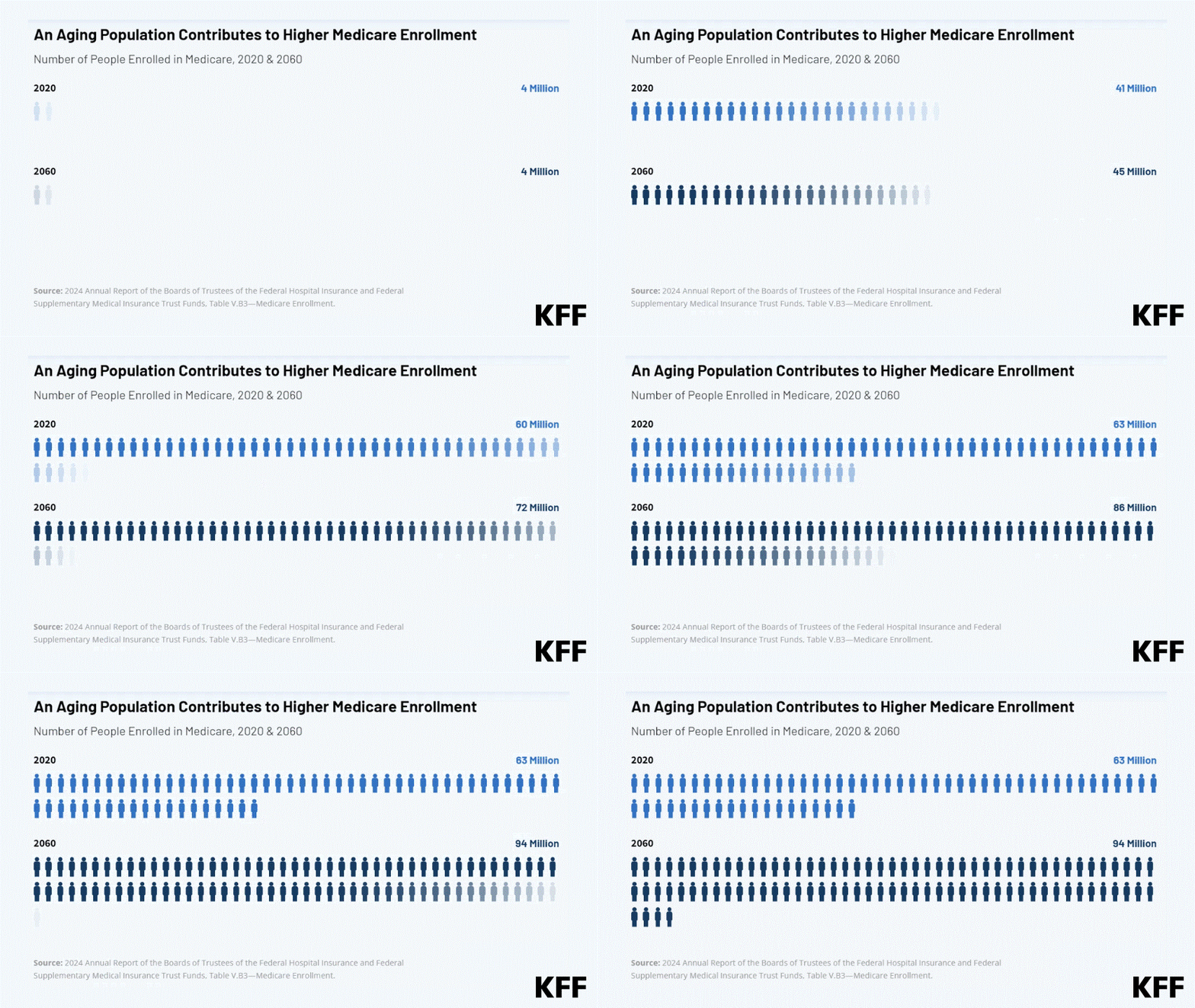
This interactive provides the facts on Medicare spending. Medicare, which serves 67 million people and accounts for 12 percent of the federal budget and 21 percent of national health spending, is often the focus of discussions about health expenditures, health care affordability and the sustainability of federal health programs. u003cbru003eu003cbru003eExplore data on enrollment growth, Medicare spending trends overall and per person, growth in Medicare spending relative to private insurance, spending on benefits and Medicare Advantage, Part A trust fund solvency challenges, and growth in out-of-pocket spending by beneficiaries.u003cbru003eu003cbru003eu003ca href=u0022https://www.kff.org/medicare/issue-brief/faqs-on-medicare-financing-and-trust-fund-solvency/u0022 data-type=u0022linku0022 data-id=u0022https://www.kff.org/medicare/issue-brief/faqs-on-medicare-financing-and-trust-fund-solvency/u0022u003eRelated:u003ca href=u0022https://www.kff.org/medicare/issue-brief/faqs-on-medicare-financing-and-trust-fund-solvency/u0022u003e FAQs on Medicare Financing and Trust Fund Solvencyu003c/au003eu003c/au003e

Read More

Subscribe to KFF Emails

Choose which emails are best for you.
Sign up here

Filter

1,341 - 1,350 of 1,596 Results

  • Views of the New Medicare Drug Law – Chartpack By Income Group

    Report

    This comprehensive survey of people on Medicare, conducted in June and July 2004, assesses their attitudes toward the new Medicare drug law. This chartpack, issued in September 2004, presents additional analysis on the survey data, looking at key findings broken down by income group. Chartpack (.pdf)

  • Grievance and Appeals Procedures: An Analysis of the MMA and Proposed Regulations

    Issue Brief

    This paper, by Sara Rosenbaum, J.D., Director of the Center for Health Services Research and Policy at George Washington University, examines the procedures for resolving beneficiaries' grievances and appeals under the new Medicare drug benefit. It is one in a series commissioned by the Kaiser Family Foundation that analyzes issues surrounding the implementation of the Medicare Prescription Drug, Improvement, and Modernization Act of 2003 (MMA) and the proposed regulations. Issue Brief (.pdf)

  • Issues for Medicare Beneficiaries in Long-Term Care Facilities: An Analysis of the MMA and Proposed Regulations

    Issue Brief

    This paper, by Vicki Gottlich, J.D., of the Center for Medicare Advocacy, looks at issues related to the new Medicare prescription drug benefit for people with Medicare who live in nursing homes or other long-term-care settings. It is one in a series commissioned by the Kaiser Family Foundation that analyzes issues surrounding the implementation of the Medicare Prescription Drug, Improvement, and Modernization Act of 2003 (MMA) and the proposed regulations. Issue Brief (.pdf)

  • The Effect of Formularies and Other Cost Management Tools on Access to Medications: An Analysis of the MMA and Proposed Regulations

    Issue Brief

    This paper, by John F. Hoadley, Ph.D., of the Health Policy Institute at Georgetown University, examines how formulary designs and other cost-management tools may affect Medicare beneficiaries’ access to medications through their Medicare Part D prescription drug plans. It is one in a series commissioned by the Kaiser Family Foundation that analyzes issues surrounding the implementation of the Medicare Prescription Drug, Improvement, and Modernization Act of 2003 (MMA) and the proposed regulations. Issue Brief (.pdf)

  • Health Care and the 2004 Elections

    Other Post

    ** Update: For information on health care and the 2008 election, visit www.health08.org. ** Health care issues continue to be important for many Americans and a vital part of the policy debates in Washington and around the country. During an election season, candidates propose and debate their solutions for the pressing policy issues facing their constituents. The 2004 election season is no different and the Kaiser Family Foundation is issuing informational materials on some of…

  • Health Care and the 2004 Elections: Medicare Coverage and Financing

    Issue Brief

    Medicare Coverage and Financing Download a printable .pdf of Health Care and the 2004 Elections: Medicare Coverage and Financing. IssueBackgroundPolicy Challenges Facing MedicareAssessing Candidate PositionsIssue The Medicare program is a valuable source of health insurance coverage for more than 41 million Americans. Medicare enjoys broad public support, but the program faces a number of challenges in the years ahead, including the implementation of the new Medicare drug benefit beginning in 2006. Another issue pertains to…

  • Views of the New Medicare Drug Law – Toplines

    Poll Finding

    This document includes the toplines from a comprehensive survey of people on Medicare and their attitudes toward the new Medicare drug law. The survey provides detailed insight in their perceptions and opinions about the law, the Medicare-approved drug-discount card program and the new Medicare drug benefit set to begin in January 2006. It also assesses views on the law’s implications for the 2004 elections. Survey Toplines (.pdf)

  • Views of the New Medicare Drug Law: A Survey of People On Medicare

    Poll Finding

    A national Kaiser Family Foundation/Harvard School of Public Health survey of people on Medicare finds nearly twice as many people on Medicare have an unfavorable view of the law as have a favorable view. Conducted from June 16 to July 21, 2004, the survey of 1,223 people on Medicare finds that most don’t think the law will be helpful to them personally. Two out of three people on Medicare say that lawmakers in Washington should…

  • Views of the New Medicare Drug Law – Summary & Chartpack

    Report

    This comprehensive survey of people on Medicare assesses their attitudes toward the new Medicare drug law. The survey provides detailed insight in their perceptions and opinions about the law, the Medicare-approved drug-discount card program and the new Medicare drug benefit set to begin in January 2006. It also assesses views on the law’s implications for the 2004 elections. Summary/Chartpack (.pdf)

  • Medicare Drug Discount Cards: A Work In Progress

    Report

    This report examines the early experience with the Medicare-Approved Drug Discount Card Program, prices offered by card sponsors, and potential savings for enrollees. The report presents information about approved discount card programs, including sponsors, enrollment fees, and drugs covered, as well as beneficiary education and outreach efforts by the Centers for Medicare & Medicaid Services. The pricing analysis shows that discount cards can deliver savings off of full retail drug prices, but also that savings…