Medicare

NEW AND NOTEWORTHY

What to Know About Medicare Coverage of Telehealth

Congress has repeatedly extended pandemic-era flexibilities around Medicare coverage of telehealth, but most such flexibilities remain temporary. This brief answers key questions about the current scope of Medicare telehealth coverage, including both temporary and permanent changes adopted through legislation and regulation, and future policy considerations.

Changes to the Medicare Advantage Program Enhance Some Consumer Protections But Roll Back Others

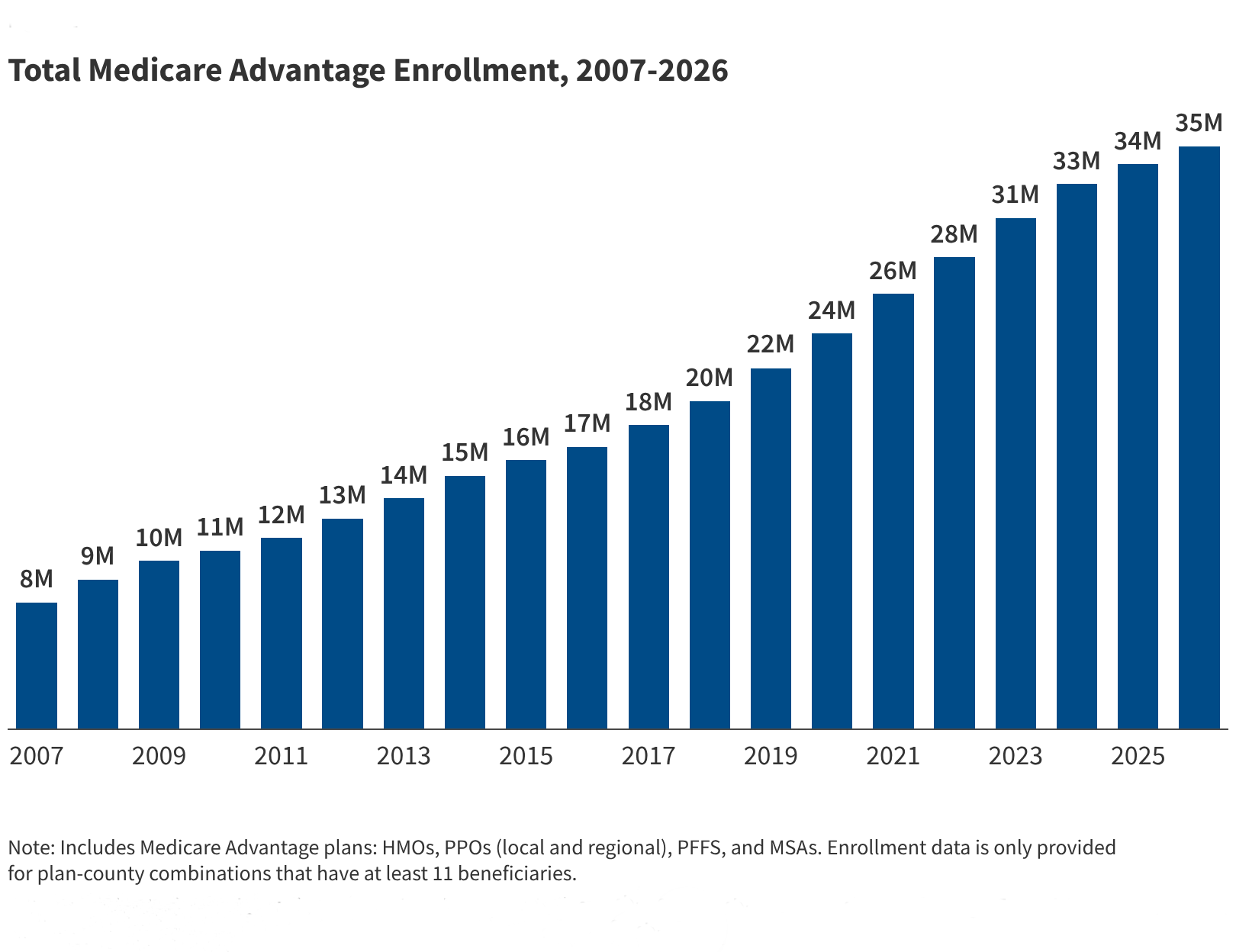
CMS recently finalized policies as part of the 2027 Medicare Advantage final rule that both enhance consumer protections and roll back changes to the Medicare Advantage program that were intended to protect consumers. These changes have gotten less attention than payment issues and changes to the star ratings system, which also affect plan payments, but could have implications for Medicare beneficiaries.

Examining the Potential Impact of Medicare’s New WISeR Model

A federal initiative to establish new prior authorization requirements in traditional Medicare, called the Wasteful and Inappropriate Service Reduction (WISeR) model, is likely to have only modest impact in its first year.

State Profiles for Dual-Eligible Individuals

This data collection draws on Medicare and Medicaid administrative data to present national and state-level information on people who are covered by both Medicare and Medicaid, referred to as dual-eligible individuals (also known as dually-enrolled beneficiaries).

Data Visualization

The Facts About Medicare Spending

This interactive provides the facts on Medicare spending. Medicare, which serves 67 million people and accounts for 12 percent of the federal budget and 21 percent of national health spending, is often the focus of discussions about health expenditures, health care affordability and the sustainability of federal health programs. u003cbru003eu003cbru003eExplore data on enrollment growth, Medicare spending trends overall and per person, growth in Medicare spending relative to private insurance, spending on benefits and Medicare Advantage, Part A trust fund solvency challenges, and growth in out-of-pocket spending by beneficiaries.u003cbru003eu003cbru003eu003ca href=u0022https://www.kff.org/medicare/issue-brief/faqs-on-medicare-financing-and-trust-fund-solvency/u0022 data-type=u0022linku0022 data-id=u0022https://www.kff.org/medicare/issue-brief/faqs-on-medicare-financing-and-trust-fund-solvency/u0022u003eRelated:u003ca href=u0022https://www.kff.org/medicare/issue-brief/faqs-on-medicare-financing-and-trust-fund-solvency/u0022u003e FAQs on Medicare Financing and Trust Fund Solvencyu003c/au003eu003c/au003e

Read More

Subscribe to KFF Emails

Choose which emails are best for you.
Sign up here

Filter

1,141 - 1,150 of 1,598 Results

  • Health Coverage and Expenses: Impact on Older Women’s Economic Well-Being

    Issue Brief

    In this article in the Journal of Women, Politics & Policy, researchers from the Kaiser Family Foundation examine how health issues that women face over the course of their lives, as well as policies that shape Medicare, Medicaid and other supplemental coverage, can affect retired women's economic well-being. They found that women's health care expenses were higher than men's; that older women paid for a greater share of their total spending out of pocket and that…

  • Health Reform Opportunities: Improving Policy for Dual Eligibles

    Issue Brief

    As the nation considers national health reform, this brief provides an overview of opportunities to realign federal and state policy for the dual eligibles to promote a more rational, cost-efficient system for 9 million of the poorest, sickest and highest-cost people covered by both Medicaid and Medicare. Navigating two programs with different rules and financing incentives is complex for beneficiaries and providers, impedes efforts to improve care coordination and results in cost-shifting between programs that…

  • Strategies for Simplifying the Medicare Advantage Market

    Other Post

    Most Medicare beneficiaries have at least 40 Medicare Advantage (MA) plan options to choose from this year. While some favor a robust marketplace, others argue that fewer plan offerings, or more transparent differences across plans designs, would help beneficiaries choose plans most likely to meet their individual needs. While consumers generally show interest in choice and economists see it as enhancing value, research shows that individuals faced with a large number of alternatives often avoid…

  • Explaining Health Care Reform: How Might a Reform Plan Be Financed?

    Issue Brief

    One of the key challenges in enacting a health care reform plan is how to finance it among government, employers, and individuals. Of particular concern to policymakers is what effect a health reform plan would have on government spending and the federal budget. President Obama and Congressional leaders have said that any health reform plan should not add to the budget deficit over a 10 year period. This brief explains the likely sources of added…

  • Medicare Part D Update: Lessons Learned and Unfinished Business

    Report

    Enacted in 2003, Medicare’s Part D prescription drug benefit reflected an unprecedented and controversial new approach for Medicare, relying exclusively on private plans to provide health coverage and including an unusual gap in coverage. This analysis by Kaiser researchers examines in detail how the new model has worked since its launch almost four years ago. Published as an article in today’s New England Journal of Medicine, the analysis by Kaiser vice president Patricia Neuman and…

  • Pulling it Together: Last Week’s Health Reform “Shocker”

    Perspective

    Last week we learned that health reform could cost the federal government at least a trillion dollars over ten years, and that it will be really difficult to forge bipartisan agreement on legislation and keep major interest groups on board. This obviously brought more angst to the deliberations, several Republicans seized the moment to criticize the Democrats' plans, and the press was all over it, with many commentators declaring health reform in dire straits. But…

  • Pulling it Together: The Sleeper in Health Reform

    Perspective

    The health reform legislation currently being crafted on Capitol Hill is undeniably complex.  To oversimplify slightly it can be boiled down into four parts: coverage (subsidies for private coverage and Medicaid expansions); delivery and payment reforms; insurance market reforms and regulations; and prevention, with each broad category containing a range of specific policy proposals and ideas. There’s been a lot of discussion so far about coverage expansions and how to pay for them, as well…

  • Medicare’s Role for Women

    Fact Sheet

    Medicare’s Role for Women This fact sheet highlights Medicare’s important role in providing women with health care coverage. It examines the demographic profile of women on Medicare, including their health and income status, the program’s benefits and cost-sharing requirements, and the prevalence of supplemental coverage to fill gaps in Medicare’s coverage. Fact Sheet (.pdf)

  • Medicare Part D 2009 Data Spotlight: Ten Most Common Brand-Name Drugs

    Issue Brief

    This Data Spotlight focuses on Part D plan coverage of the ten brand-name drugs that were most commonly prescribed for Medicare beneficiaries in 2006 and lack generic equivalents in 2009. Findings are based on an analysis of data for the 44 unique, national and near-national stand-alone prescription drug plans. The list of the top ten brand-name drugs is based on the number of prescriptions filled in 2006 in all Part D plans. The list includes…

  • Medicare Prescription Drug Plans in 2009 and Key Changes Since 2006: Summary of Findings

    Issue Brief

    Since 2006, Medicare beneficiaries have had access to prescription drug coverage offered by private plans, either stand-alone prescription drug plans (PDPs) or Medicare Advantage prescription drug plans (MA-PD plans). Today, more than 26 million Medicare beneficiaries are enrolled in Medicare drug plans, including 17.5 million in stand-alone prescription drug plans and 9 million in Medicare Advantage drug plans. This report summarizes findings from a series of Medicare Part D 2009 Data Spotlights documenting changes in…