Medicare

NEW AND NOTEWORTHY

What to Know About Medicare Coverage of Telehealth

Congress has repeatedly extended pandemic-era flexibilities around Medicare coverage of telehealth, but most such flexibilities remain temporary. This brief answers key questions about the current scope of Medicare telehealth coverage, including both temporary and permanent changes adopted through legislation and regulation, and future policy considerations.

Changes to the Medicare Advantage Program Enhance Some Consumer Protections But Roll Back Others

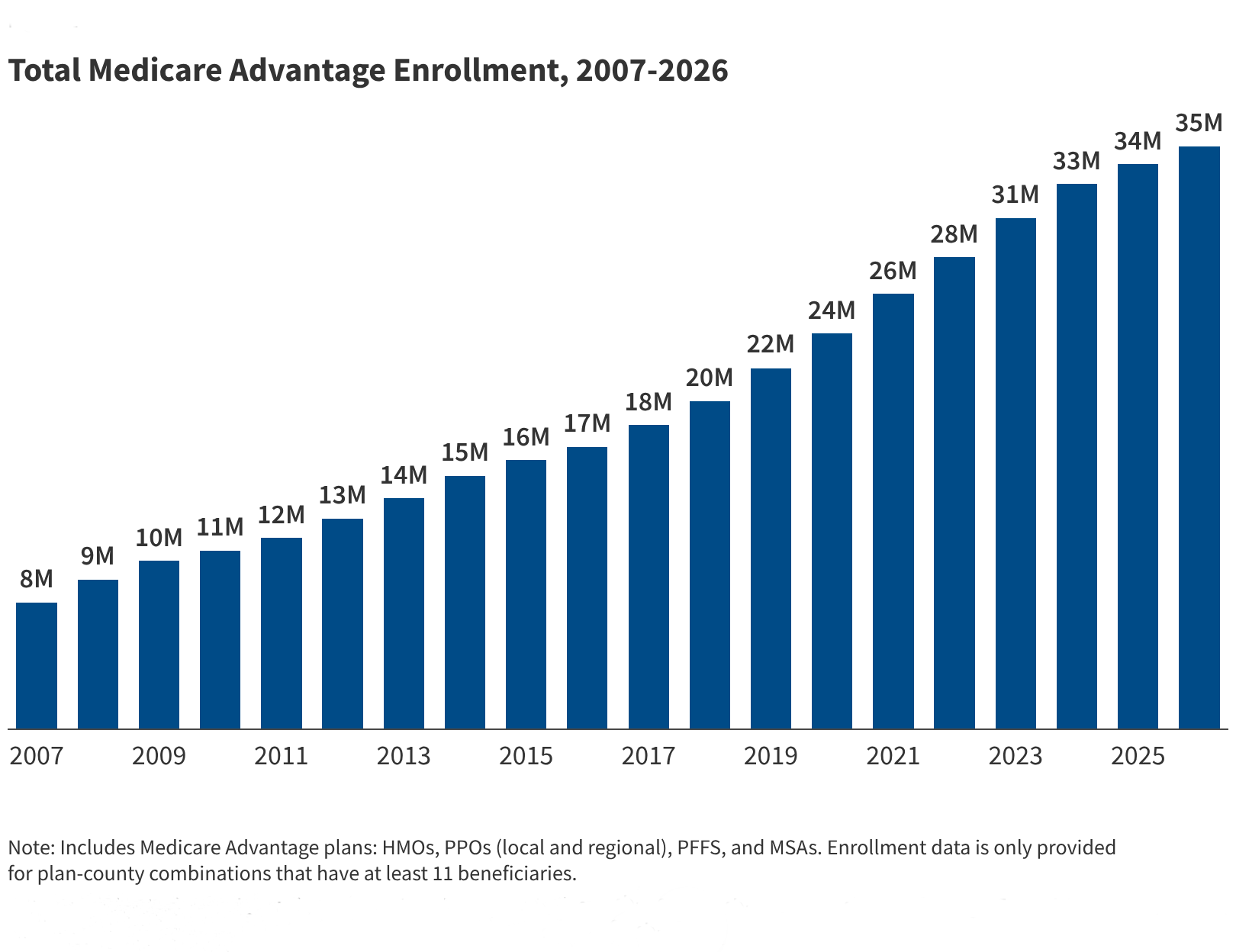
CMS recently finalized policies as part of the 2027 Medicare Advantage final rule that both enhance consumer protections and roll back changes to the Medicare Advantage program that were intended to protect consumers. These changes have gotten less attention than payment issues and changes to the star ratings system, which also affect plan payments, but could have implications for Medicare beneficiaries.

Examining the Potential Impact of Medicare’s New WISeR Model

A federal initiative to establish new prior authorization requirements in traditional Medicare, called the Wasteful and Inappropriate Service Reduction (WISeR) model, is likely to have only modest impact in its first year.

State Profiles for Dual-Eligible Individuals

This data collection draws on Medicare and Medicaid administrative data to present national and state-level information on people who are covered by both Medicare and Medicaid, referred to as dual-eligible individuals (also known as dually-enrolled beneficiaries).

Data Visualization

The Facts About Medicare Spending

This interactive provides the facts on Medicare spending. Medicare, which serves 67 million people and accounts for 12 percent of the federal budget and 21 percent of national health spending, is often the focus of discussions about health expenditures, health care affordability and the sustainability of federal health programs. u003cbru003eu003cbru003eExplore data on enrollment growth, Medicare spending trends overall and per person, growth in Medicare spending relative to private insurance, spending on benefits and Medicare Advantage, Part A trust fund solvency challenges, and growth in out-of-pocket spending by beneficiaries.u003cbru003eu003cbru003eu003ca href=u0022https://www.kff.org/medicare/issue-brief/faqs-on-medicare-financing-and-trust-fund-solvency/u0022 data-type=u0022linku0022 data-id=u0022https://www.kff.org/medicare/issue-brief/faqs-on-medicare-financing-and-trust-fund-solvency/u0022u003eRelated:u003ca href=u0022https://www.kff.org/medicare/issue-brief/faqs-on-medicare-financing-and-trust-fund-solvency/u0022u003e FAQs on Medicare Financing and Trust Fund Solvencyu003c/au003eu003c/au003e

Read More

Subscribe to KFF Emails

Choose which emails are best for you.
Sign up here

Filter

1,021 - 1,030 of 1,598 Results

  • Prescription Drug Procurement and the Federal Budget

    Issue Brief

    This brief commissioned by the Foundation considers areas where Medicare faces limited opportunity for market-based competition and price negotiation to drive down drug spending. These areas include drug purchasing for low-income people enrolled in Part D plans who face minimal cost-sharing requirements, and purchasing certain unique drugs, such as biologicals, that have no therapeutic alternatives or competitors. Authored by Richard G. Frank of Harvard University, the brief discusses policy options that could lower Medicare spending…

  • Medicare Part D Spending Trends: Understanding Key Drivers and the Role of Competition

    Issue Brief

    This brief commissioned by the Foundation examines factors that contributed to Medicare's lower-than-expected spending on prescription drugs under the Medicare Part D drug benefit that started in 2006. Since its launch, Medicare has spent about 30 percent less on Part D benefits than the Congressional Budget Office originally projected. Some cite the program's design, with private plans competing for enrollment, as the driving factor in lower spending; others point to factors in the overall market…

  • Federal Funding Under the Affordable Care Act

    Fact Sheet

    This fact sheet provides highlights from an analysis tracking the flow of federal Affordable Care Act funds to states as reporter in the Department of Health and Human Services grant database as well as periodic reports from HHS and the Internal Revenue Service. The analysis distinguishes between funds awarded to state and local governments (including state and local health departments and school districts) and private entities (including private employers, health centers, universities, and other community-based…

  • The Role of High-Income Seniors in Medicare Reforms: The Public’s Perspective

    Feature

    Medicare remains in the spotlight as policymakers and presidential candidates look for ways to rein in Medicare spending. One facet of the debate has centered on whether seniors with higher incomes should pay more for their coverage under Medicare. Based on data from the February 2012 Health Tracking Poll, this data note examines at what income level the public sees seniors as 'wealthy,' and finds that the answer has a lot to do with how…

  • How Does the Benefit Value of Medicare Compare to the Benefit Value of Typical Large Employer Plans?: A 2012 Update

    Issue Brief

    This study compares the value of Medicare's fee-for-service benefits last year with the value of benefits in two large employer health plans -- a large health plan serving federal employees and a typical large employer Preferred Provider Organization (PPO) plan. For individuals ages 65 and older, the study finds that Medicare remains less generous on average than typical large employer health plans, even after recent improvements in the program's drug coverage. Overall, Medicare would cover…

  • Medicare’s Role for Dual Eligible Beneficiaries

    Issue Brief

    About 9 million low-income seniors and younger people with disabilities in the United States are covered by both Medicare and Medicaid. This brief examines the role of Medicare in providing health coverage for these beneficiaries. Medicare is the primary source of health insurance, while Medicaid provides supplemental coverage, helping with premiums and cost-sharing and paying for services not covered by Medicare. This brief examines overall and per capita Medicare spending for these beneficiaries, including variations…

  • An Update on CMS’s Capitated Financial Alignment Demonstration Model For Medicare-Medicaid Enrollees

    Issue Brief

    Beginning in January, 2013, the Centers for Medicare and Medicaid Services (CMS) will implement a three year multi-state demonstration to test new service delivery and payment models for people dually eligible for Medicare and Medicaid. These demonstrations will enroll full dual eligibles in managed fee-for-service or capitated managed care plans that seek to integrate benefits and align financial incentives between the two programs. On January 25, 2012, CMS issued a memorandum providing additional guidance for…

  • Among Dual Eligibles, Identifying The Highest Cost Individuals Could Help In Crafting More Targeted And Effective Responses

    Report

    This Health Affairs article by researchers at the Urban Institute analyzes linked Medicare and Medicaid data to examine dual eligibles' utilization and spending in both programs in 2007. It finds that while the population of people dually eligible for Medicare and Medicaid is indeed costly, it is not monolithic. For instance, although 20 percent of dual eligibles accounted for more than 60 percent of combined Medicaid and Medicare spending, nearly 40 percent of dual eligibles…

  • The Diversity of Dual Eligible Beneficiaries: An Examination of Services and Spending for People Eligible for Both Medicaid and Medicare

    Issue Brief

    This issue brief analyzes linked Medicare and Medicaid data to examine dual eligibles' utilization and spending in both programs in 2007. As a group, dual eligibles are costly—with per capita Medicare and Medicaid spending over four times Medicare spending for other beneficiaries. However, a small share of dual eligibles account for most of the group's spending, and dual eligibles who are high cost to the Medicare program are generally not the same individuals who are…

  • Key Issues in Understanding the Economic and Health Security of Current and Future Generations of Seniors

    Issue Brief

    As part of broad deficit-reduction plans, policymakers are considering reforms to the nation's three major entitlement programs - Medicare, Medicaid and Social Security - that could significantly affect the economic security of seniors in their retirement years. This brief examines the role of these programs in ensuring seniors' financial security as well as the challenges facing current and future generations when it comes to economic and health security. Drawing from current research and data, the…