Medicare

New & Noteworthy

What to Know About Pharmacy Benefit Managers and Federal Efforts at Regulation

The top three pharmacy benefit managers (PBMs) manage 79% of prescription drug claims on behalf of 270 million people. We look at the role PBMs play in influencing drug costs and access to medicines, as well as efforts to regulate them.

State Profiles for Dual-Eligible Individuals

This data collection draws on Medicare and Medicaid administrative data to present national and state-level information on people who are covered by both Medicare and Medicaid, referred to as dual-eligible individuals (also known as dually-enrolled beneficiaries).

Data Visualization

The Facts About Medicare Spending

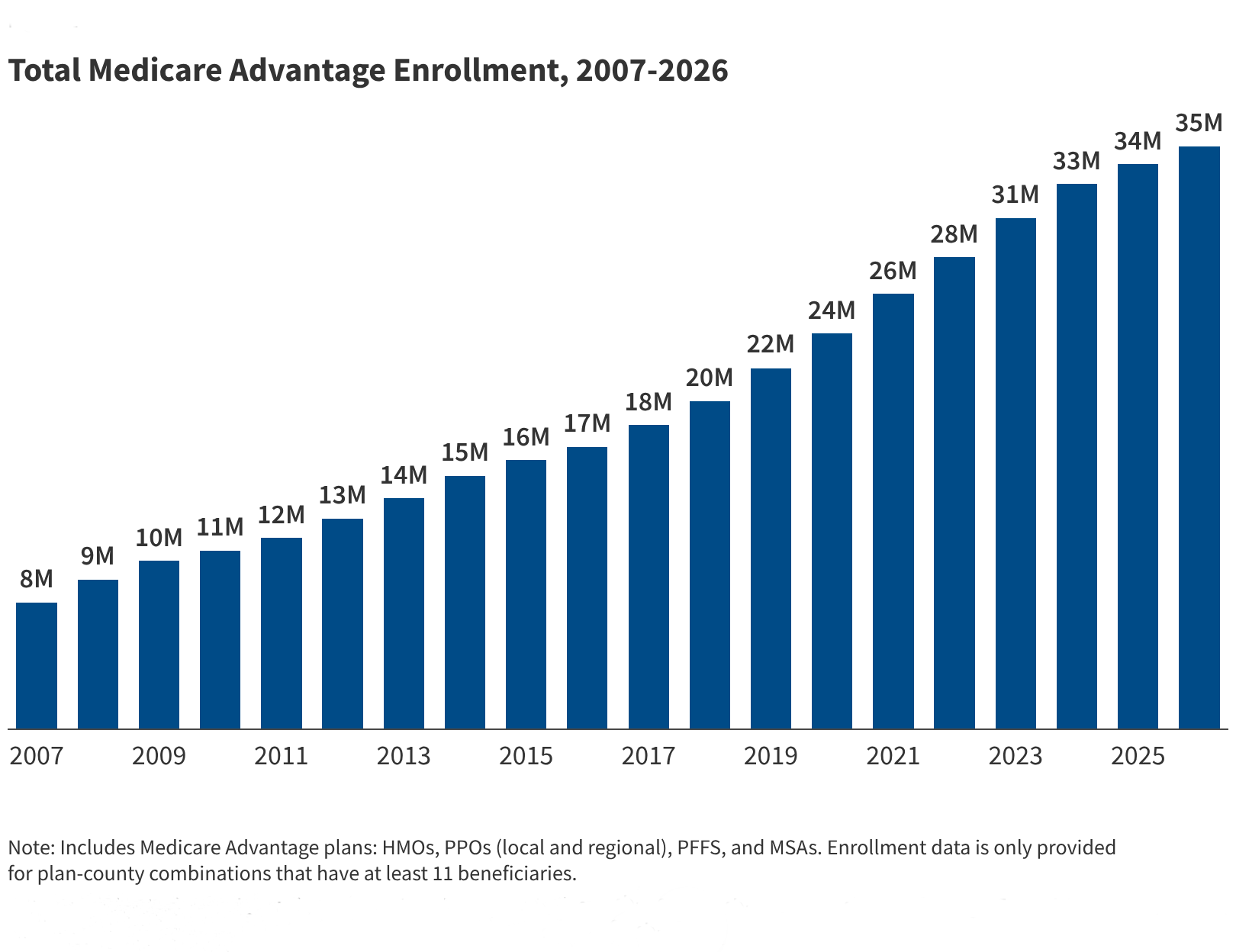
This interactive provides the facts on Medicare spending. Medicare, which serves 67 million people and accounts for 12 percent of the federal budget and 21 percent of national health spending, is often the focus of discussions about health expenditures, health care affordability and the sustainability of federal health programs.

Explore data on enrollment growth, Medicare spending trends overall and per person, growth in Medicare spending relative to private insurance, spending on benefits and Medicare Advantage, Part A trust fund solvency challenges, and growth in out-of-pocket spending by beneficiaries.

Related: FAQs on Medicare Financing and Trust Fund Solvency

Read More

Subscribe to KFF Emails

Choose which emails are best for you.
Sign up here

Filter

11 - 20 of 1,588 Results

  • FAQs: What’s the Latest on IPAB?

    Issue Brief

    The Independent Payment Advisory Board was authorized by the Affordable Care Act to help slow the growth in Medicare spending. These FAQs address common questions about IPAB, including how it was designed to operate and the implications of eliminating it.

  • Poll: Family Members of Older Adults with Serious Illness Are More Confident That They Know Their Medical Wishes When They Have Written Documents

    News Release

    Most Seriously Ill Seniors Struggle with Cognitive and Mental Health Challenges; Nearly Half Reportedly Have Problems Understanding Drug and Medical Instructions Seniors with serious illness and their families are more likely to feel their wishes for medical care are being followed when they have written them down, finds a new Kaiser Family Foundation survey on…

  • Serious Illness in Late Life: The Public’s Views and Experiences

    Report

    In context of the rapidly growing number of older adults in the U.S. and increasing challenges that this population faces, the Kaiser Family Foundation conducted a large scale, nationally representative telephone survey to better understand people’s expectations about later life and efforts they’ve taken to plan for if they become seriously ill. To learn more about the experiences of those with serious illness specifically, this survey also included interviews with adults who are either personally age 65 or older living with a serious illness, or have an older family member who is or was before they recently died.

  • Medicare Part D: A First Look at Prescription Drug Plans in 2018

    Issue Brief

    This issue brief provides an overview of the 2018 Medicare Part D stand-alone prescription drug plan landscape, the largest segment of the Part D marketplace, It includes national and state-level data on plan availability, premiums, benefit design, cost sharing, information about premium-free plans for low-income beneficiaries, and information about the top ten Part D plans in 2018.

  • Medicare Advantage 2018 Data Spotlight: First Look

    Issue Brief

    This data note analyzes the number and variety of Medicare Advantage plan choices available to beneficiaries, and also describes changes in the health care insurers offering private health plans in 2018. This spotlight is part of a series of spotlights tracking key changes in the Medicare Advantage program.

  • “What is CMMI?” and 11 other FAQs about the CMS Innovation Center

    Fact Sheet

    The Center for Medicare and Medicaid Innovation (CMMI), also known as the "Innovation Center," was authorized under the Affordable Care Act with the goals of designing, implementing, and testing new payment and delivery system reform models to address concerns about rising costs, quality of care, and inefficient spending. These FAQs provide an overview of the Innovation Center, as well as details on model performance, beneficiary involvement, and more.

  • Summary of Recent and Proposed Changes to Medicare Prescription Drug Coverage and Reimbursement

    Issue Brief

    On February 9, 2018 the President signed into law the Bipartisan Budget Act of 2018, which included some provisions related to Medicare Part D prescription drug coverage. Shortly thereafter, the Office of Management and Budget released the President’s fiscal year (FY) 2019 budget, which also included several proposals related to Medicare Part D drug coverage and Part B drug reimbursement. This brief summarizes these recently enacted and proposed changes.