Very Few Parents Report Skipping or Delaying the Hepatitis B Vaccine for their Children
Published: December 5, 2025
On Friday, a CDC vaccine advisory panel voted to stop recommending that newborns be vaccinated against hepatitis B when their mothers are negative for the virus. Despite the vaccine’s long-running safety record, the decision passed via an 8-3 vote by members of the CDC’s Advisory Committee on Immunization Practices (ACIP), which is made up of members appointed by HHS Secretary Robert F. Kennedy Jr.
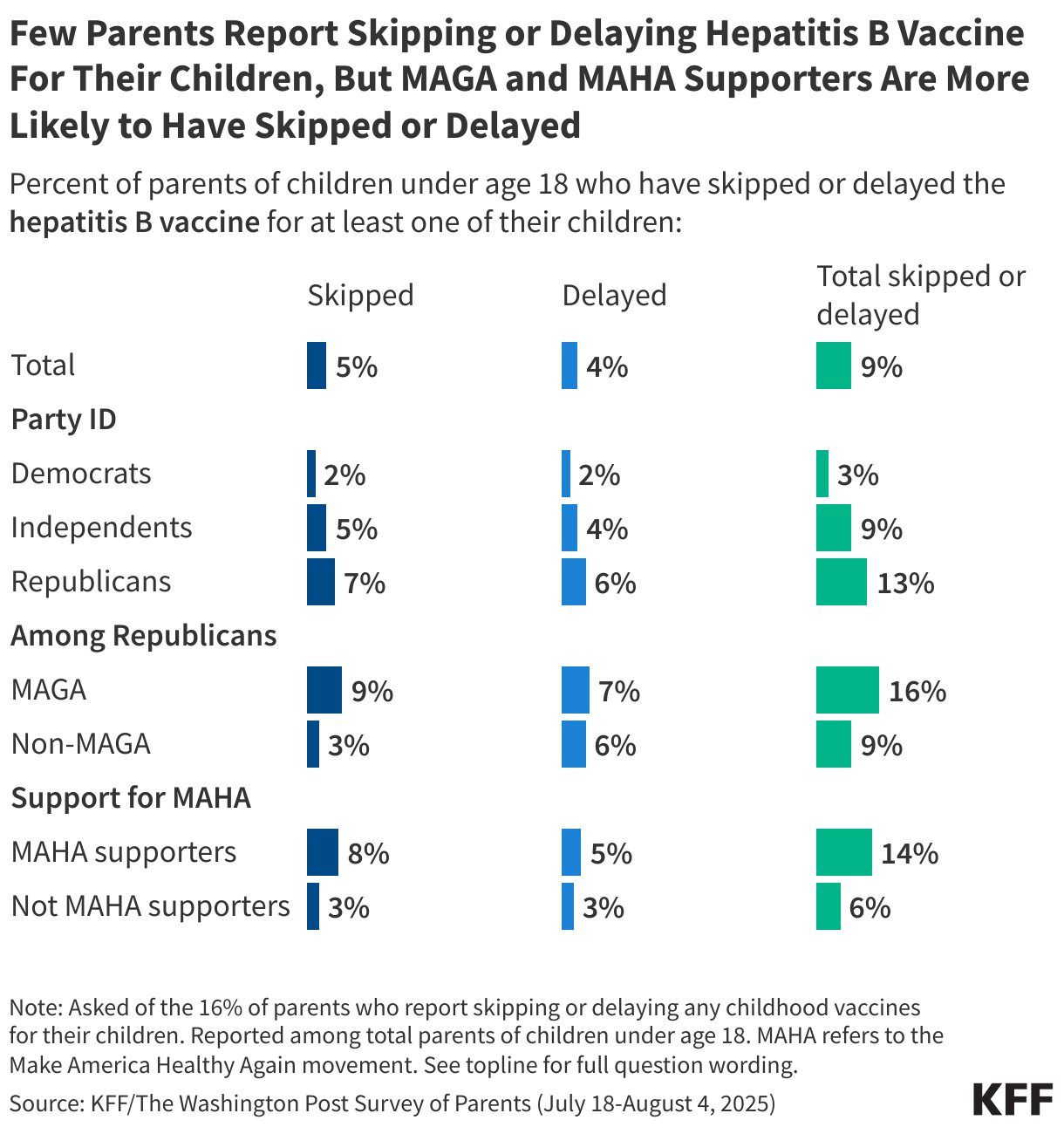
Our recent KFF/Washington Post Survey of Parents found very few parents (9%) report skipping or delaying the hepatitis B vaccine for their children, including 5% who skipped the vaccine entirely and 4% who delayed a dose. This is similar to a 2023 KFF survey showing that most adults overall stayed up-to-date on the hepatitis B vaccine, with just 10% reporting having skipped or delayed it.
Notably, partisanship and support for the Make America Great Again (MAGA) and the Make America Healthy Again (MAHA) movements are major factors influencing parents’ decisions around the hepatitis B vaccine. Republican parents are much more likely to report skipping or delaying the hepatitis B vaccine for their children compared to Democratic parents (13% v. 3%). However, there are divisions even among Republican parents, with MAGA-supporting Republican parents significantly more likely than non-MAGA Republicans to say they skipped or delayed the hepatitis B vaccine for their children (16% v. 9%). Fourteen percent of MAHA-supporting parents also report delaying or skipping the hepatitis B vaccine for their children.
The CDC panel’s decision comes at a time when U.S. childhood vaccination rates continue to decline amid partisan divisions on views of vaccine safety and recommendations.
It is unclear whether these changes to federal guidelines will impact parents’ future decisions over hepatitis B vaccinations, particularly as public trust in the CDC to provide reliable vaccine information has recently declined to half of the public, while trust in personal doctors and pediatricians remains high. But what is clear is that this move is more in-line with a small share of the Trump administration’s most ardent supporters, many of whom are as likely to trust Secretary Kennedy as they are their own health care provider to provide reliable vaccine information. As the landscape of vaccine recommendations shift, the interplay between partisanship and ideology may become even stronger predictors of vaccine uptake.