Health Care Costs Tops the Public’s Economic Worries as the Runup to the Midterms Begins; Independent Voters Are More Likely to Trust Democrats than Republicans on the Issue
Two Thirds of Public Say Congress "Did the Wrong Thing" by Not Extending ACA Enhanced Tax Credits, But Republicans Largely Say Congress “Did the Right Thing”
Heading into this midterm election year, the cost of health care tops the public’s economic anxieties and more than 4 in 10 voters say the issue will have a major impact on their vote, a new KFF Health Tracking poll finds. Voters, including independents, currently trust Democrats more than Republicans to address the cost of health care and most other health care issues, though neither party has an advantage on addressing the overall cost of living, the poll finds.
The poll provides an early look at how the public and voters view health care issues, including costs, following a year of substantial debate and changes. Congress last year enacted major Medicaid changes expected to cut federal spending and increase the number of uninsured and allowed the Affordable Care Act’s enhanced tax credits to expire, sharply increasing the premium payments for most ACA Marketplace enrollees.
Across a range of measures, the poll finds significant concerns about health care costs:
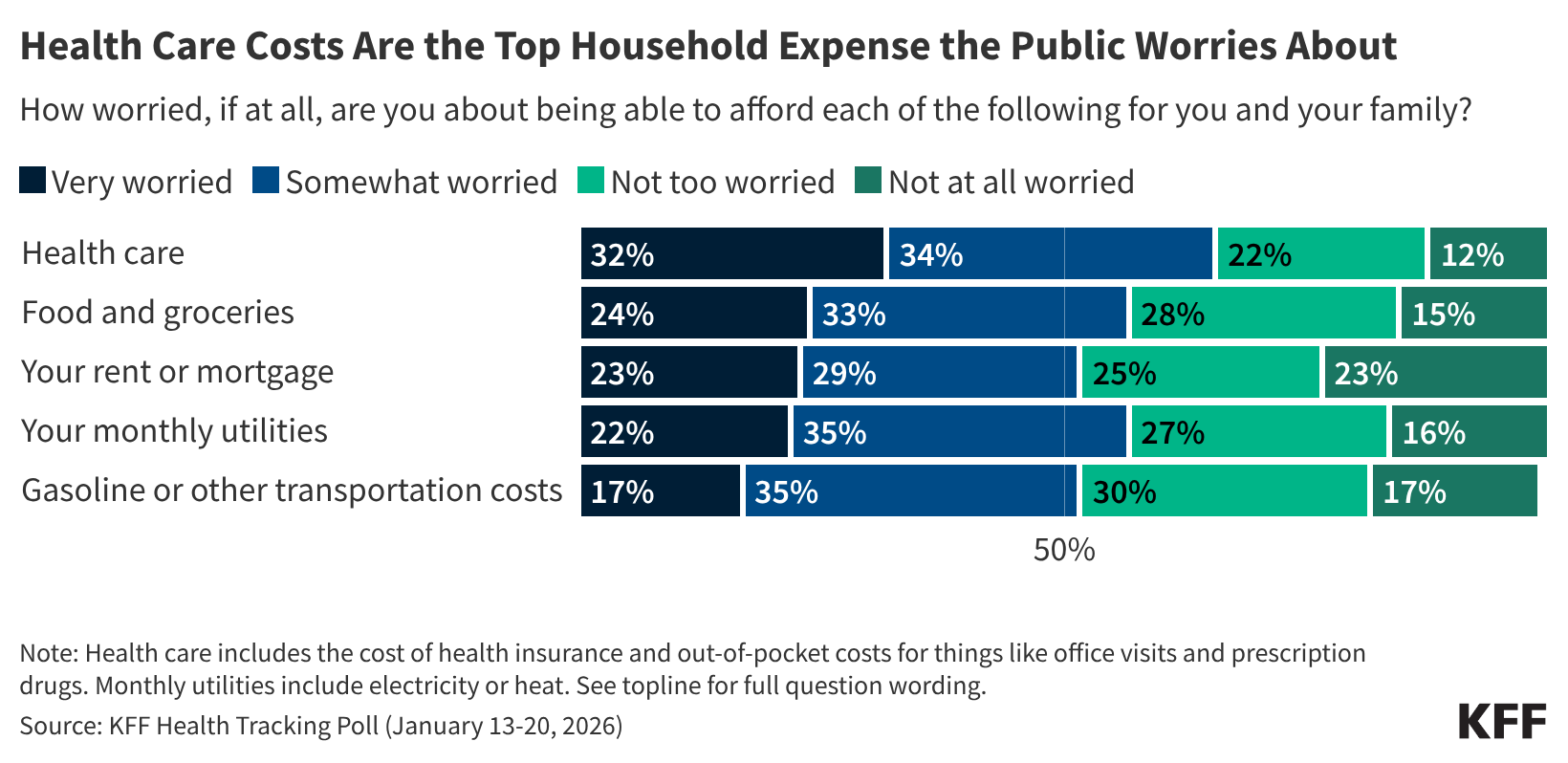
- The public was given a list of household expenses families worry about. A third (32%) say that they are “very worried” about their ability to afford health care for them and their families – more than say the same about affording food and groceries (24%), rent or mortgage (23%), monthly utility bills (22%), or gasoline and other transportation costs (17%).
- Health care costs are the top economic worry for Democrats, independents, Republicans, and supporters of President Trump’s “Make America Great Again” movement.
- A majority (56%) of the public expect health care costs for their family to become less affordable in the coming year. About 1 in 5 say that their health care costs have increased more quickly than other necessities such as monthly utilities (23%) and food and groceries (21%).
- Among independent voters, more trust the Democratic Party (35%) than the Republican Party (15%) to address health care costs. Independent voters also give Democrats an advantage over Republicans on Medicaid, the ACA, Medicare, and the cost of prescription drugs, though sizeable shares say they trust neither party. Among all voters, trust in Republicans (30%) is within 5 percentage points of Democrats (35%) on drug prices, an issue President Trump has championed.
More than 4 in 10 voters say that health care costs will have a “major impact” both on their decision to vote in the midterm elections (44%) and on which party’s candidates they will support (43%). This includes two thirds of Democrats, more than 4 in 10 independents, and about a fifth of Republicans.
Health Care Costs Tops the Public’s Economic Worries as the Runup to the Midterms Begins; Independent Voters Are More Likely to Trust Democrats than Republicans on the Issue
Most Continue to View ACA Favorably, But Support Falls Among Republicans After Debate
The poll also gauges the public’s views on the ACA after Congress allowed the law’s enhanced tax credits to expire after extensive debate.
Two thirds (67%) of the public say that Congress did “the wrong thing” by allowing the tax credits to expire, twice the share (33%) that says Congress did “the right thing.”
Large majorities of Democrats (89%) and independents (72%) say that Congress did the wrong thing. While most Republicans (63%) and MAGA supporters (64%) say Congress did the right thing, about a third of each group says that Congress did the wrong thing.
Most (58%) of the public continues to hold favorable views of the ACA, though support this month is down 6 percentage points since September (64%).
The shift reflects a drop in favorability among Republicans (22% now vs. 36% in September) and among MAGA supporters (16% now vs. 31% in September).
Designed and analyzed by public opinion researchers at KFF, this survey was conducted January 13-20, 2026, online and by telephone among a nationally representative sample of 1,426 U.S. adults in English and in Spanish. The margin of sampling error is plus or minus 3 percentage points for the full sample. For results based on other subgroups, the margin of sampling error may be higher.
Finding on other topics including prior authorization will be reported separately.