How Will the Uninsured in the District of Columbia Fare Under the Affordable Care Act?

Published: Jan 6, 2014

The 2010 Affordable Care Act (ACA) has the potential to extend coverage to many of the 47 million nonelderly uninsured people nationwide, including the 50,000 uninsured DC residents. The ACA establishes coverage provisions across the income spectrum, with the expansion of Medicaid eligibility for adults serving as the vehicle for covering low-income individuals and premium tax credits to help people purchase insurance directly through new Health Insurance Marketplaces serving as the vehicle for covering people with moderate incomes. The June 2012 Supreme Court ruling made the Medicaid expansion optional for states, and as of December 2013, the District of Columbia was planning to implement the expansion in 2014. As a result, the ACA will be fully implemented in the District of Columbia, and almost all nonelderly uninsured, most of whom are adults, are eligible for coverage expansions. As the ACA coverage expansions are implemented and coverage changes are assessed, it is important to understand the potential scope of the law in the district.

How Does the ACA Expand Health Insurance Coverage in the District of Columbia?

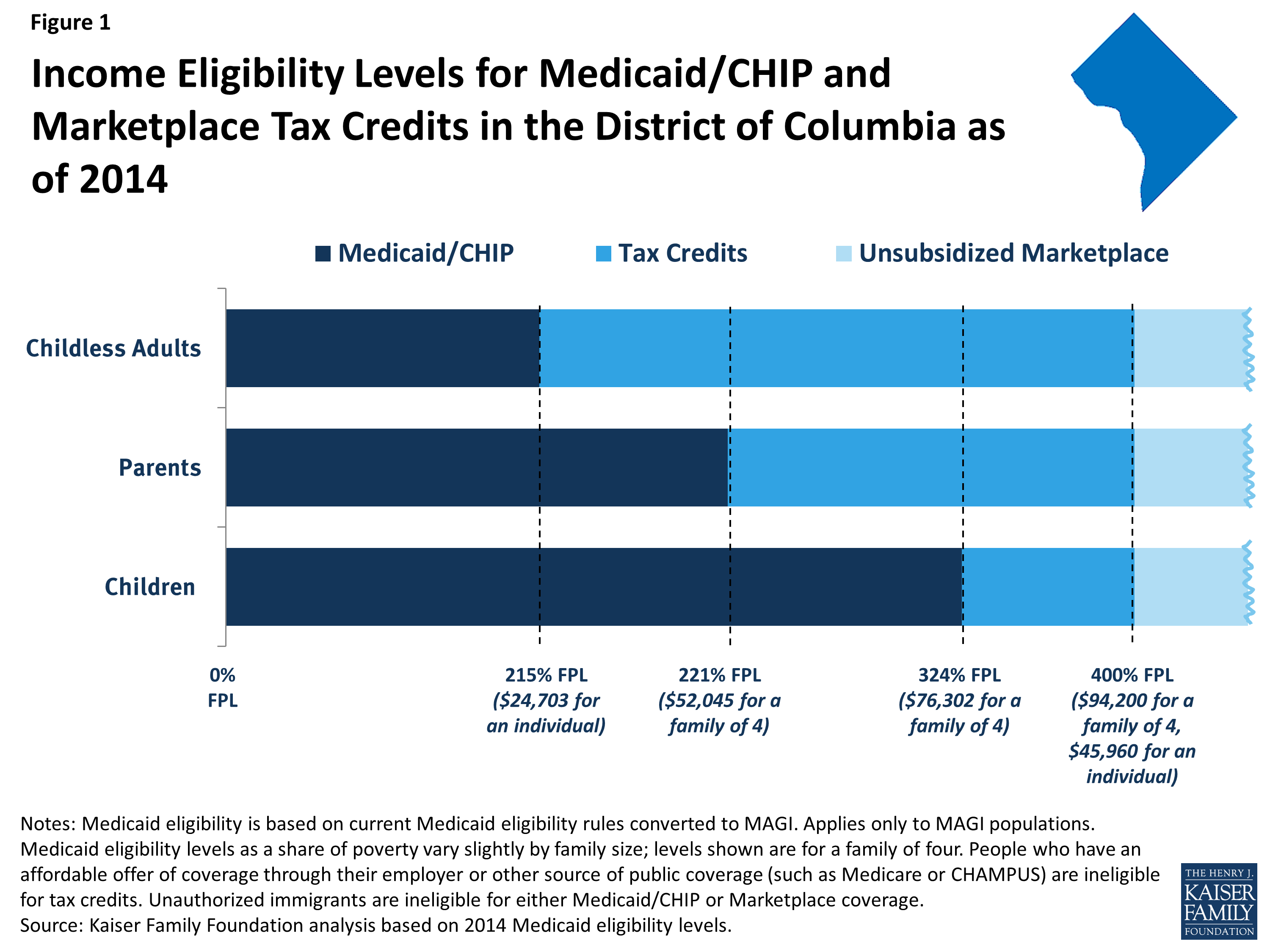
Historically, Medicaid had gaps in coverage for adults because eligibility was restricted to specific categories of low-income individuals, such as children, their parents, pregnant women, the elderly, or individuals with disabilities. In most states, adults without dependent children were ineligible for Medicaid, regardless of their income, and income limits for parents were very low—often below half the poverty level.1  However, some states and the District of Columbia had expanded coverage to parents at higher income levels or provided coverage to adults without children. The ACA aimed to fill in gaps in coverage by extending Medicaid to nearly all nonelderly adults with incomes at or below 138% of poverty (about $32,500 for a family of four in 2013).  As of January 2014, Medicaid eligibility in the District of Columbia covers almost all nonelderly parents up to 221% of poverty and other non-disabled adults up to 215% of poverty, as shown by the dark blue shading in Figure 1. All states previously expanded eligibility for children to higher levels than adults through Medicaid and the Children’s Health Insurance Program (CHIP), and in the District of Columbia, children with family incomes up to 324% of poverty (about $76,300 for a family of four) are eligible for Medicaid or CHIP. As was the case before the ACA, undocumented immigrants remain ineligible to enroll in Medicaid, and recent lawfully residing immigrants are subject to certain Medicaid eligibility restrictions.2 
8531-DC Figure 1

Under the ACA, people with incomes between 100% and 400% of poverty may be eligible for premium tax credits when they purchase coverage in a Marketplace. The amount of the tax credit is based on income and the cost of insurance, and tax credits are only available to people who are not eligible for other coverage, such as Medicaid/CHIP, Medicare, or employer coverage, and who are citizens or lawfully-present immigrants. Thus, the effective lower income limit for tax credits in Connecticut is 324% of poverty for children, 221% of poverty for parents, and 215% of poverty for other non-disabled adults, as indicated by the bright blue shading in Figure 1.  Citizens and lawfully-present immigrants with incomes above 400% of poverty can purchase unsubsidized coverage through the Marketplace.

How Many Uninsured DC residents Are Eligible for Assistance Under the ACA?

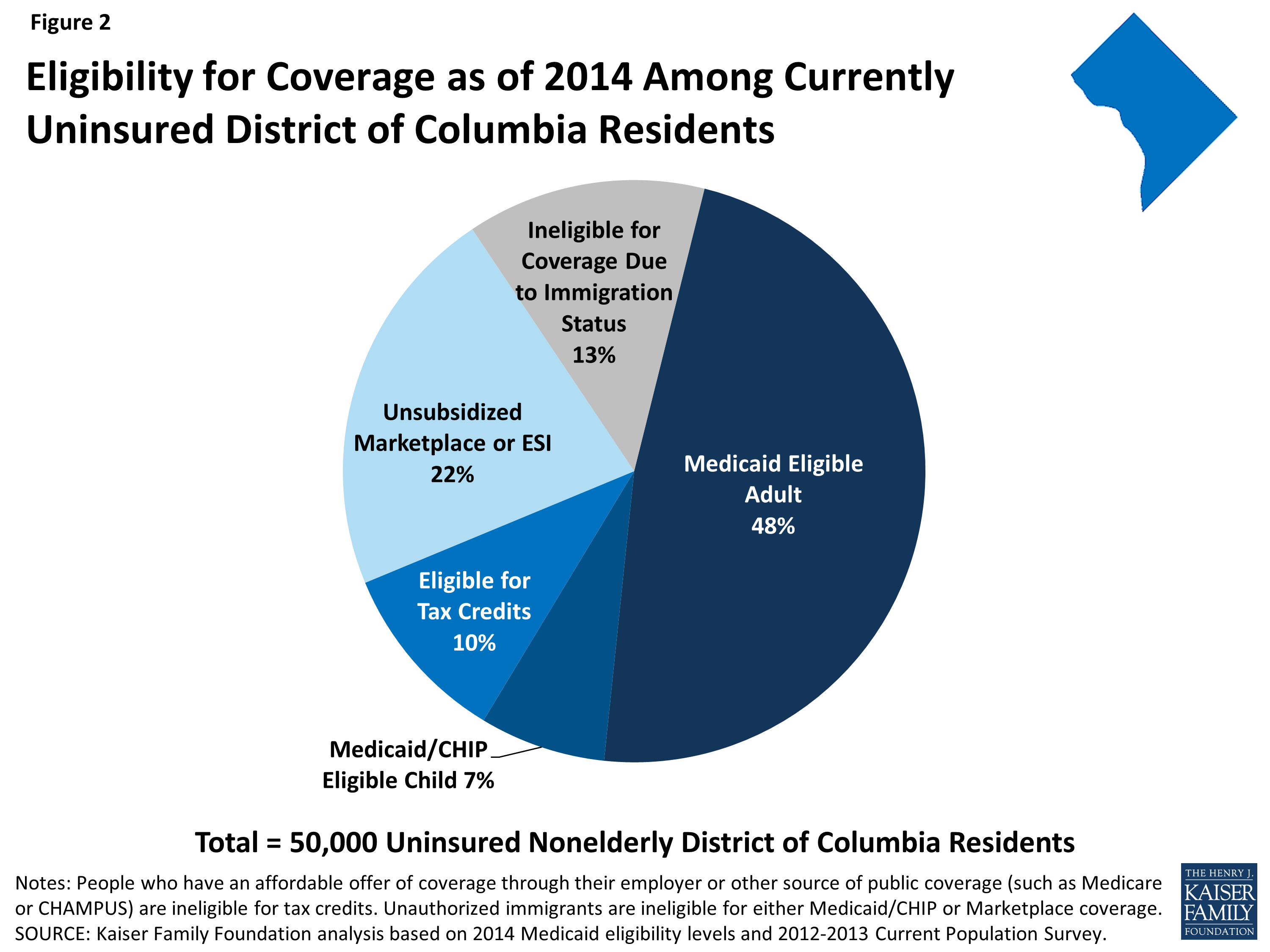
With the District of Columbia deciding to implement the Medicaid expansion, nearly two-thirds (65%) of uninsured nonelderly people in the district are eligible for financial assistance to gain coverage through either Medicaid or the Marketplaces (Figure 2). Given the income distribution of the uninsured in the District of Columbia, the main pathway for coverage is Medicaid, with over half (55%) of uninsured residents eligible for either Medicaid or CHIP as of 2014. While some of these people (such as eligible children) are eligible under pathways in place before the ACA, many adults will be newly-eligible through the ACA expansion.  One in ten (10%) of all uninsured people in the District of Columbia are eligible for premium tax credits to help them purchase coverage in the Marketplace.
8531-DC Figure 2

Other uninsured DC residents may gain coverage under the ACA but will not receive direct financial assistance. These people include the 22 percent of DC residents with incomes too high to be eligible for premium tax subsidies or who have an affordable offer of coverage through their employer. Some of these people are still able to purchase unsubsidized coverage in the Marketplace, which may be more affordable or more comprehensive than coverage they could obtain on their own through the individual market. Last, the approximately 13 percent of uninsured people in the District of Columbia who are undocumented immigrants are ineligible for financial assistance under the ACA and barred from purchasing coverage through the Marketplaces. This group is likely to remain uninsured, though they will still have a need for health care services.

***

The ACA will help many currently uninsured DC residents gain health coverage by providing coverage options across the income spectrum for low and moderate-income people. While almost all of the uninsured in the District of Columbia are eligible for some type of coverage under the ACA, the impact of the ACA will depend on take-up of coverage among the eligible uninsured, and outreach and enrollment efforts will be an important factor in decreasing the uninsured rate. The ACA includes a requirement that most individuals obtain health coverage, but some people (such as the lowest income or those without an affordable option) are exempt and others may still remain uninsured. There is no deadline for enrolling in Medicaid coverage under the ACA, and open enrollment in the Marketplaces continues through March 2014. Continued attention to who gains coverage as the ACA is fully implemented and who is excluded from its reach—as well as whether and how their health needs are being met—can help inform decisions about the future of health coverage in the District of Columbia.

  1. Some states, including the District of Columbia, had expanded coverage to parents at higher income levels or provided coverage to adults without children. See http://modern.kff.org/medicaid/fact-sheet/medicaid-eligibility-for-adults-as-of-january-1-2014/ for more detail on pre- and post-ACA Medicaid eligibility for adults. ↩︎
  2. For more detail on Medicaid coverage for immigrants, see: http://modern.kff.org/disparities-policy/fact-sheet/key-facts-on-health-coverage-for-low/. ↩︎
How Will the Uninsured in North Dakota Fare Under the Affordable Care Act?

Published: Jan 6, 2014

The 2010 Affordable Care Act (ACA) has the potential to extend coverage to many of the 47 million nonelderly uninsured people nationwide, including the 70,000 uninsured North Dakotans. The ACA establishes coverage provisions across the income spectrum, with the expansion of Medicaid eligibility for adults serving as the vehicle for covering low-income individuals and premium tax credits to help people purchase insurance directly through new Health Insurance Marketplaces serving as the vehicle for covering people with moderate incomes. The June 2012 Supreme Court ruling made the Medicaid expansion optional for states, and as of December 2013, North Dakota was planning to implement the expansion in 2014. As a result, the ACA will be fully implemented in North Dakota, and almost all nonelderly uninsured, most of whom are adults, are eligible for coverage expansions. As the ACA coverage expansions are implemented and coverage changes are assessed, it is important to understand the potential scope of the law in the state.

How Does the ACA Expand Health Insurance Coverage in North Dakota?

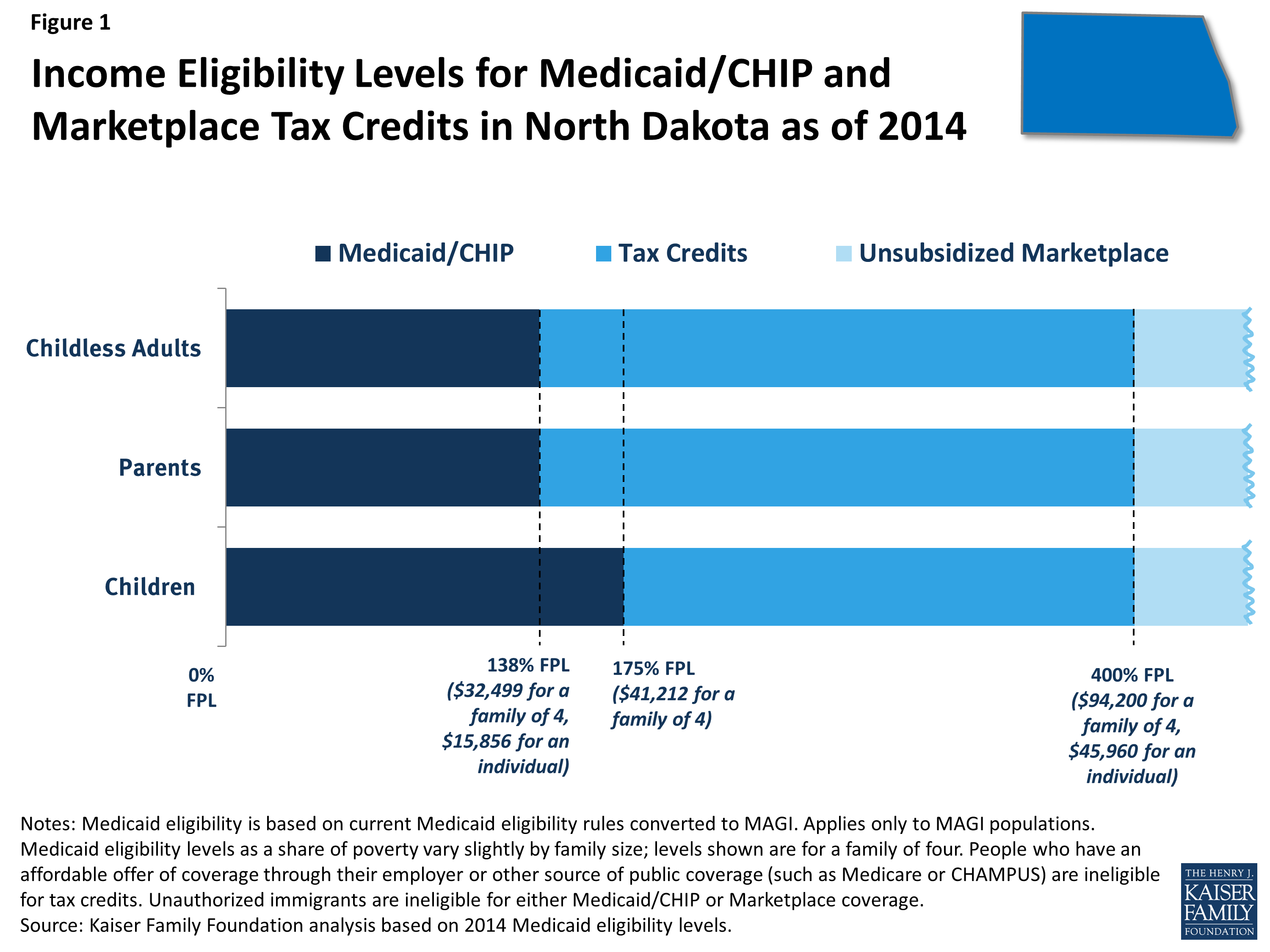
Historically, Medicaid had gaps in coverage for adults because eligibility was restricted to specific categories of low-income individuals, such as children, their parents, pregnant women, the elderly, or individuals with disabilities. In most states, adults without dependent children were ineligible for Medicaid, regardless of their income, and income limits for parents were very low—often below half the poverty level.1  The ACA aimed to fill in these gaps by extending Medicaid to nearly all nonelderly adults with incomes at or below 138% of poverty (about $32,500 for a family of four in 2013).  Thus, as of January 2014, Medicaid eligibility in North Dakota covers almost all nonelderly adults up to 138% of poverty, as shown by the dark blue shading in Figure 1. All states previously expanded eligibility for children to higher levels than adults through Medicaid and the Children’s Health Insurance Program (CHIP), and in North Dakota, children with family incomes up to 175% of poverty (about $41,200 for a family of four) are eligible for Medicaid or CHIP. As was the case before the ACA, undocumented immigrants remain ineligible to enroll in Medicaid, and recent lawfully residing immigrants are subject to certain Medicaid eligibility restrictions.2 

8531 -ND Figure 1

Under the ACA, people with incomes between 100% and 400% of poverty may be eligible for premium tax credits when they purchase coverage in a Marketplace. The amount of the tax credit is based on income and the cost of insurance, and tax credits are only available to people who are not eligible for other coverage, such as Medicaid/CHIP, Medicare, or employer coverage, and who are citizens or lawfully-present immigrants. Thus, the effective lower income limit for tax credits in North Dakota is 175% of poverty for children and 138% of poverty for adults, as indicated by the bright blue shading in Figure 1. Citizens and lawfully-present immigrants with incomes above 400% of poverty can purchase unsubsidized coverage through the Marketplace.

How Many Uninsured North Dakotans Are Eligible for Assistance Under the ACA?

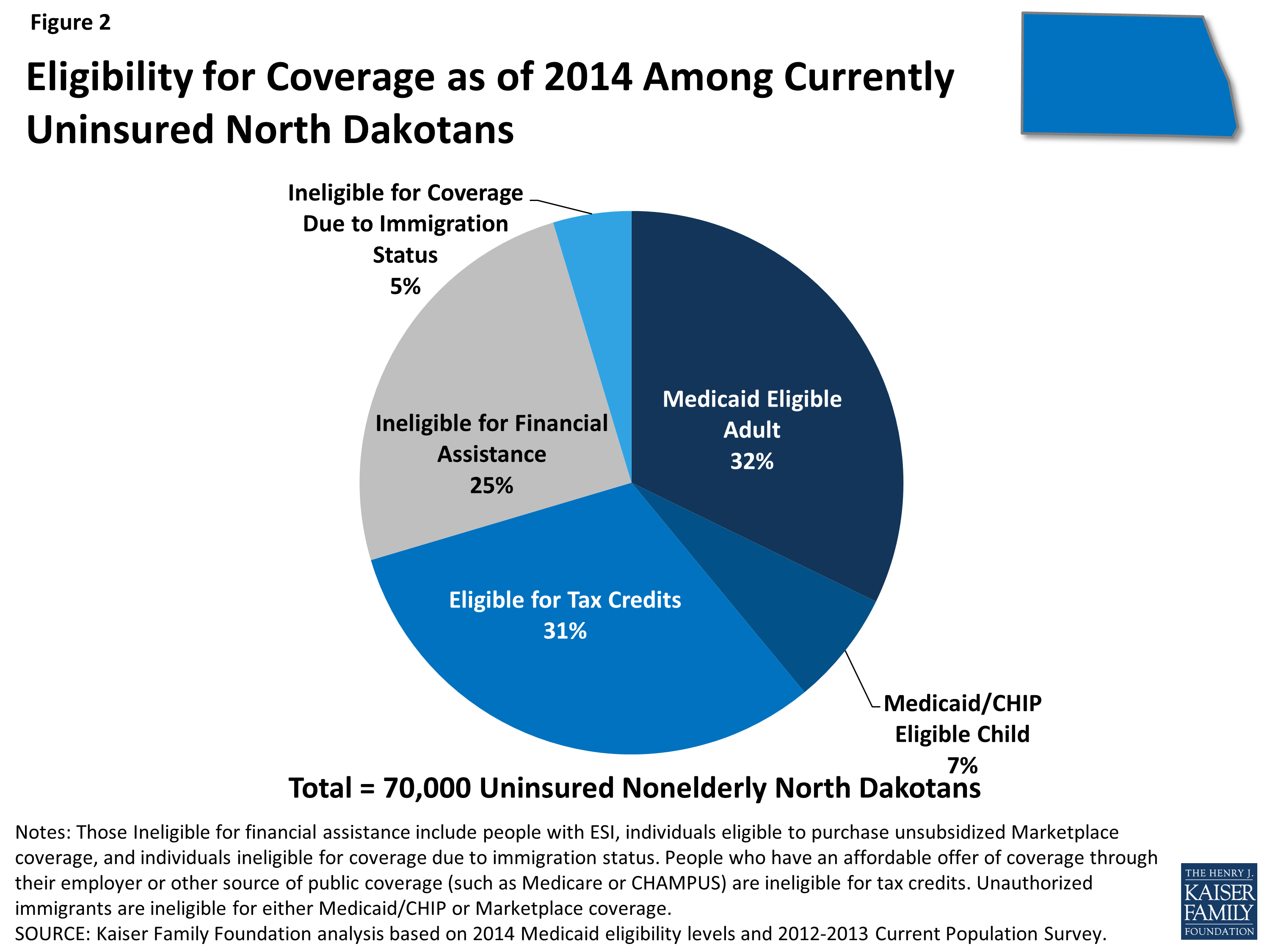
With North Dakota deciding to implement the Medicaid expansion, seven in ten (70%) uninsured nonelderly people in the state are eligible for financial assistance to gain coverage through either Medicaid or the Marketplaces (Figure 2). Given the income distribution of the uninsured in the state, the main pathway for coverage is Medicaid, with nearly four in ten (39%) of uninsured North Dakotans eligible for either Medicaid or CHIP as of 2014. While some of these people (such as eligible children) are eligible under pathways in place before the ACA, most adults are newly-eligible through the ACA expansion.  Nearly a third (31%) of all uninsured people in North Dakota are eligible for premium tax credits to help them purchase coverage in the Marketplace.

8531 -ND Figure 2

Other North Dakotans may gain coverage under the ACA but will not receive direct financial assistance. These people include the 25 percent with incomes too high to be eligible for premium tax subsidies or who have an affordable offer of coverage through their employer. Some of these people still are able to purchase unsubsidized coverage in the Marketplace, which may be more affordable or more comprehensive than coverage they could obtain on their own through the individual market. Lastly, the approximately five percent of uninsured people in North Dakota who are undocumented immigrants are ineligible for financial assistance under the ACA and barred from purchasing coverage through the Marketplaces. This group is likely to remain uninsured, though they will still have a need for health care services.

***

The ACA will help many currently uninsured North Dakotans gain health coverage by providing coverage options across the income spectrum for low and moderate-income people. While almost all of the uninsured in North Dakota are eligible for some type of coverage under the ACA, the impact of the ACA will depend on take-up of coverage among the eligible uninsured, and outreach and enrollment efforts will be an important factor in decreasing the uninsured rate. The ACA includes a requirement that most individuals obtain health coverage, but some people (such as the lowest income or those without an affordable option) are exempt and others may still remain uninsured. There is no deadline for enrolling in Medicaid coverage under the ACA, and open enrollment in the Marketplaces continues through March 2014. Continued attention to who gains coverage as the ACA is fully implemented and who is excluded from its reach—as well as whether and how their health needs are being met—can help inform decisions about the future of health coverage in North Dakota.

  1. Some states had expanded coverage to parents at higher income levels or provided coverage to adults without children. See http://modern.kff.org/medicaid/fact-sheet/medicaid-eligibility-for-adults-as-of-january-1-2014/ for more detail on pre- and post-ACA Medicaid eligibility for adults. ↩︎
  2. For more detail on Medicaid coverage for immigrants, see: http://modern.kff.org/disparities-policy/fact-sheet/key-facts-on-health-coverage-for-low/. ↩︎
How Will the Uninsured in Kentucky Fare Under the Affordable Care Act?

Published: Jan 6, 2014

The 2010 Affordable Care Act (ACA) has the potential to extend coverage to many of the 47 million nonelderly uninsured people nationwide, including the 647,000 uninsured Kentuckians. The ACA establishes coverage provisions across the income spectrum, with the expansion of Medicaid eligibility for adults serving as the vehicle for covering low-income individuals and premium tax credits to help people purchase insurance directly through new Health Insurance Marketplaces serving as the vehicle for covering people with moderate incomes. The June 2012 Supreme Court ruling made the Medicaid expansion optional for states, and as of December 2013, Kentucky was planning to implement the expansion in 2014. As a result, the ACA will be fully implemented in Kentucky, and almost all nonelderly uninsured, most of whom are adults, will be eligible for coverage expansions. As the ACA coverage expansions are implemented and coverage changes are assessed, it is important to understand the potential scope of the law in the state.

How Does the ACA Expand Health Insurance Coverage in Kentucky?

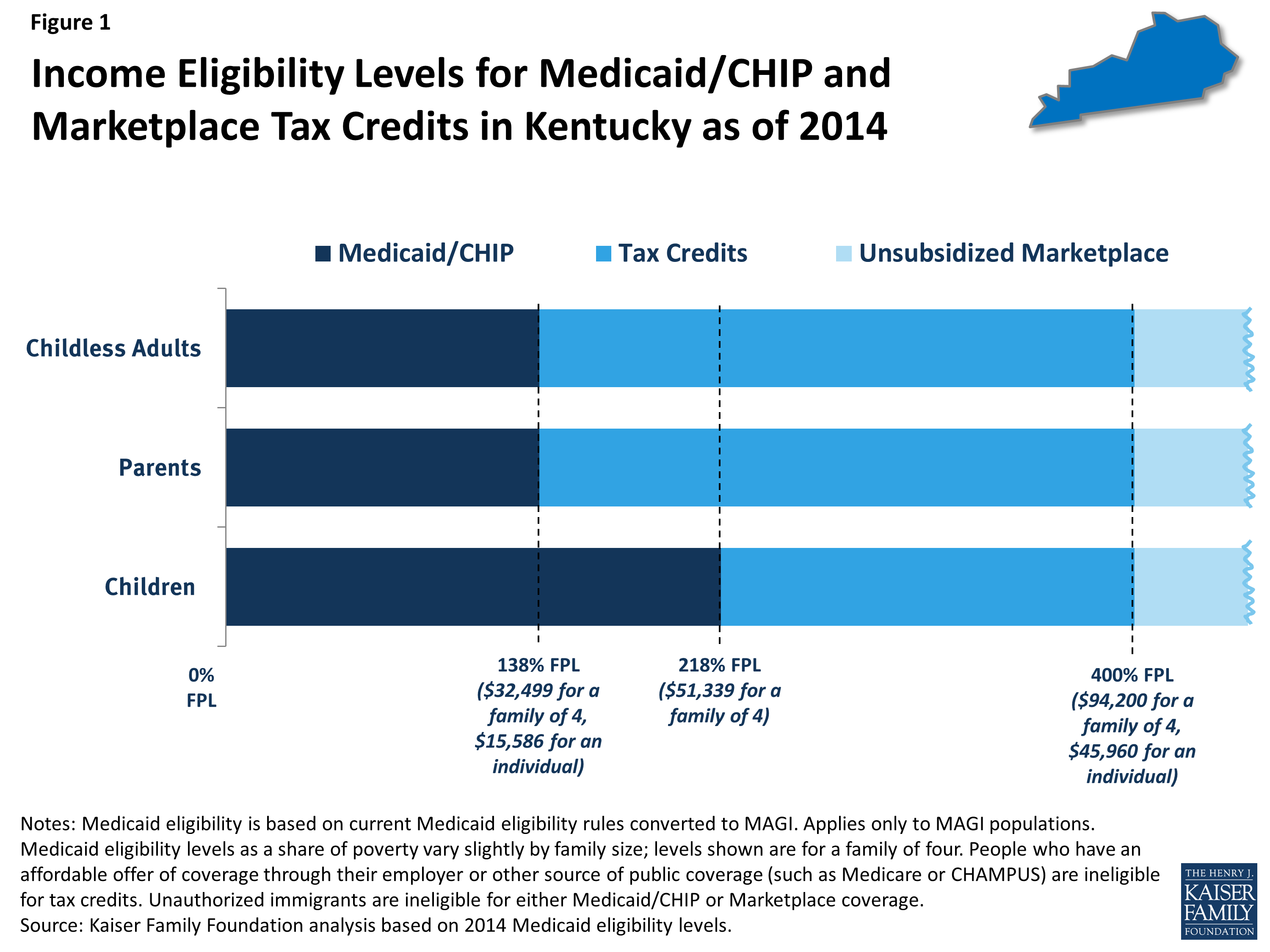
Historically, Medicaid had gaps in coverage for adults because eligibility was restricted to specific categories of low-income individuals, such as children, their parents, pregnant women, the elderly, or individuals with disabilities. In most states, adults without dependent children were ineligible for Medicaid, regardless of their income, and income limits for parents were very low—often below half the poverty level.1  The ACA aimed to fill in these gaps by extending Medicaid to nearly all nonelderly adults with incomes at or below 138% of poverty (about $32,500 for a family of four in 2013).  Thus, as of January 2014, Medicaid eligibility in Kentucky will cover almost all nonelderly adults up to 138% of poverty, as shown by the dark blue shading in Figure 1. All states previously expanded eligibility for children to higher levels than adults through Medicaid and the Children’s Health Insurance Program (CHIP), and in Kentucky, children with family incomes up to 218% of poverty (about $51,300 for a family of four) will be eligible for Medicaid or CHIP. As was the case before the ACA, undocumented immigrants will remain ineligible to enroll in Medicaid, and recent lawfully residing immigrants will be subject to certain Medicaid eligibility restrictions.2 

8531-KY Figure 1

Under the ACA, people with incomes between 100% and 400% of poverty may be eligible for premium tax credits when they purchase coverage in a Marketplace. The amount of the tax credit is based on income and the cost of insurance, and tax credits are only available to people who are not eligible for other coverage, such as Medicaid/CHIP, Medicare, or employer coverage, and who are citizens or lawfully-present immigrants. Because nearly everyone up to 138% of poverty will be eligible for Medicaid in Kentucky, the effective lower income limit for tax credits in the state is 138% of poverty, as indicated by the bright blue shading in Figure 1.  Citizens and lawfully-present immigrants with incomes above 400% of poverty can purchase unsubsidized coverage through the Marketplace.

How Many Uninsured Kentuckians Are Eligible for Assistance under the ACA?

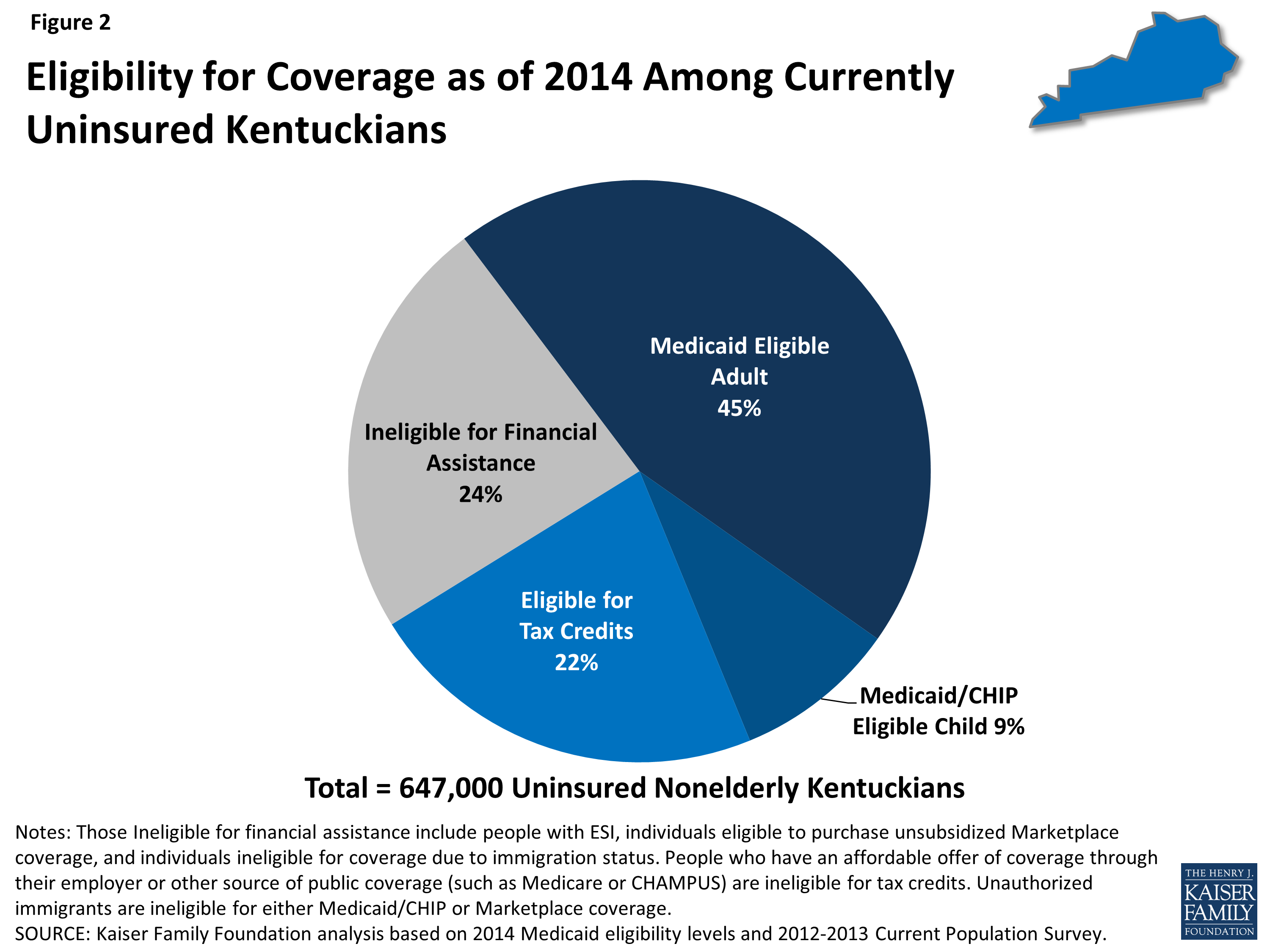
With Kentucky deciding to implement the Medicaid expansion, over three-quarters (76%) of uninsured nonelderly people in the state will be eligible for financial assistance to gain coverage through either Medicaid or the Marketplaces (Figure 2). Given the income distribution of the uninsured in the state, the main pathway for coverage will be Medicaid, with over half (54%) of uninsured Kentuckians eligible for either Medicaid or CHIP as of 2014. While some of these people (such as eligible children) are eligible under pathways in place before the ACA, most adults will be newly-eligible through the ACA expansion.  More than one in five (22%) uninsured people in Kentucky are eligible for premium tax credits to help them purchase coverage in the Marketplace.

8531-KY Figure 2

About one quarter (24%) of uninsured Kentuckians may gain coverage under the ACA but will not receive direct financial assistance. These people include those with incomes above the limit for premium tax subsidies or who have an affordable offer of coverage through their employer. Some of these people still will be able to purchase unsubsidized coverage in the Marketplace, which may be more affordable or more comprehensive than coverage they could obtain on their own through the individual market. Lastly, uninsured people in Kentucky who are undocumented immigrants are ineligible for financial assistance under the ACA and barred from purchasing coverage through the Marketplaces. This group is likely to remain uninsured, though they will still have a need for health care services.

***

The ACA will help millions of currently uninsured Kentuckians gain health coverage by providing coverage options across the income spectrum for low and moderate-income people. While almost all of the uninsured in Kentucky are eligible for some type of coverage under the ACA, the impact of the ACA will depend on take-up of coverage among the eligible uninsured, and outreach and enrollment efforts will be an important factor in decreasing the uninsured rate. The ACA includes a requirement that most individuals obtain health coverage, but some people (such as the lowest income or those without an affordable option) are exempt and others may still remain uninsured. There is no deadline for enrolling in Medicaid coverage under the ACA, and open enrollment in the Marketplaces continues through March 2014. Continued attention to who gains coverage as the ACA is fully implemented and who is excluded from its reach—as well as whether and how their health needs are being met—can help inform decisions about the future of health coverage in Kentucky.

  1. Some states had expanded coverage to parents at higher income levels or provided coverage to adults without children. See http://modern.kff.org/medicaid/fact-sheet/medicaid-eligibility-for-adults-as-of-january-1-2014/ for more detail on pre- and post-ACA Medicaid eligibility for adults. ↩︎
  2. For more detail on Medicaid coverage for immigrants, see: http://modern.kff.org/disparities-policy/fact-sheet/key-facts-on-health-coverage-for-low/. ↩︎
How Will the Uninsured in Arizona Fare Under the Affordable Care Act?

Published: Jan 6, 2014

The 2010 Affordable Care Act (ACA) has the potential to extend coverage to many of the 47 million nonelderly uninsured people nationwide, including the 1.1 million uninsured Arizonans. The ACA establishes coverage provisions across the income spectrum, with the expansion of Medicaid eligibility for adults serving as the vehicle for covering low-income individuals and premium tax credits to help people purchase insurance directly through new Health Insurance Marketplaces serving as the vehicle for covering people with moderate incomes. The June 2012 Supreme Court ruling made the Medicaid expansion optional for states, and as of December 2013, Arizona was planning to implement the expansion in 2014. As a result, the ACA will be fully implemented in Arizona, and almost all nonelderly uninsured, most of whom are adults, are eligible for coverage expansions. As the ACA coverage expansions are implemented and coverage changes are assessed, it is important to understand the potential scope of the law in the state.

How Does the ACA Expand Health Insurance Coverage in Arizona?

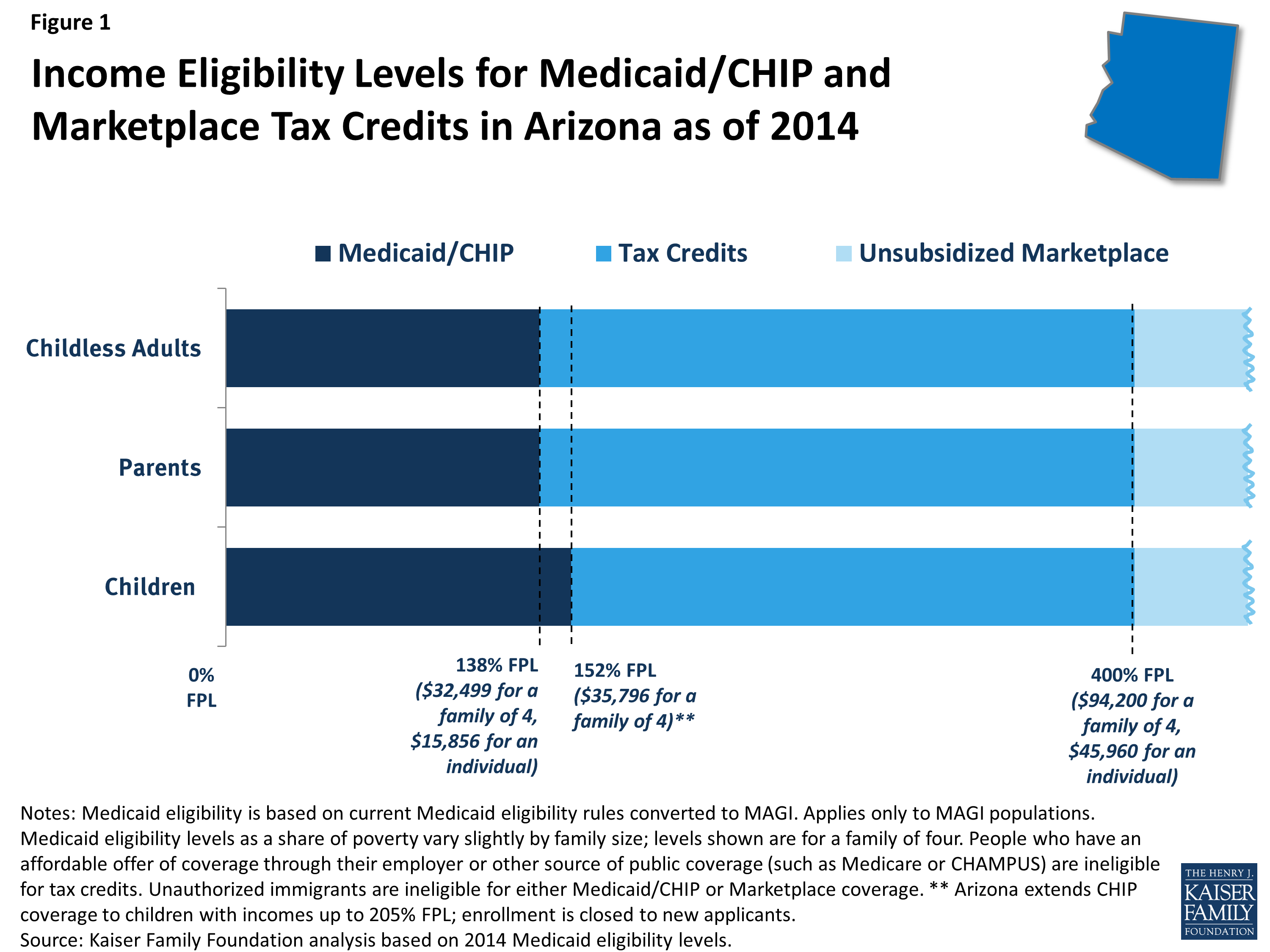
Historically, Medicaid had gaps in coverage for adults because eligibility was restricted to specific categories of low-income individuals, such as children, their parents, pregnant women, the elderly, or individuals with disabilities. In most states, adults without dependent children were ineligible for Medicaid, regardless of their income, and income limits for parents were very low—often below half the poverty level.1  However, some states, including Arizona, had expanded coverage to parents at higher income levels or provided coverage to adults without children. The ACA aimed to fill in gaps in coverage by extending Medicaid to nearly all nonelderly adults with incomes at or below 138% of poverty (about $32,500 for a family of four in 2013).  As of January 2014, Medicaid eligibility in Arizona covers almost all nonelderly adults up to 138% of poverty, as shown by the dark blue shading in Figure 1. All states previously expanded eligibility for children to higher levels than adults through Medicaid and the Children’s Health Insurance Program (CHIP), and in Arizona, children with family incomes up to 152% of poverty (about $35,800 for a family of four) are eligible for Medicaid. The state also provides CHIP coverage to children with family incomes up to 205% of poverty (about $48,300 for a family of four), but enrollment in the program is closed to new applicants. As was the case before the ACA, undocumented immigrants remain ineligible to enroll in Medicaid, and recent lawfully residing immigrants are subject to certain Medicaid eligibility restrictions.2 

8531-AZ Figure 1

Under the ACA, people with incomes between 100% and 400% of poverty may be eligible for premium tax credits when they purchase coverage in a Marketplace. The amount of the tax credit is based on income and the cost of insurance, and tax credits are only available to people who are not eligible for other coverage, such as Medicaid/CHIP, Medicare, or employer coverage, and who are citizens or lawfully-present immigrants. Thus, the effective lower income limit for tax credits in Arizona is 152% of poverty for children and 138% for adults, as indicated by the bright blue shading in Figure 1. Citizens and lawfully-present immigrants with incomes above 400% of poverty can purchase unsubsidized coverage through the Marketplace.

How Many Uninsured Arizonans Are Eligible for Assistance Under the ACA?

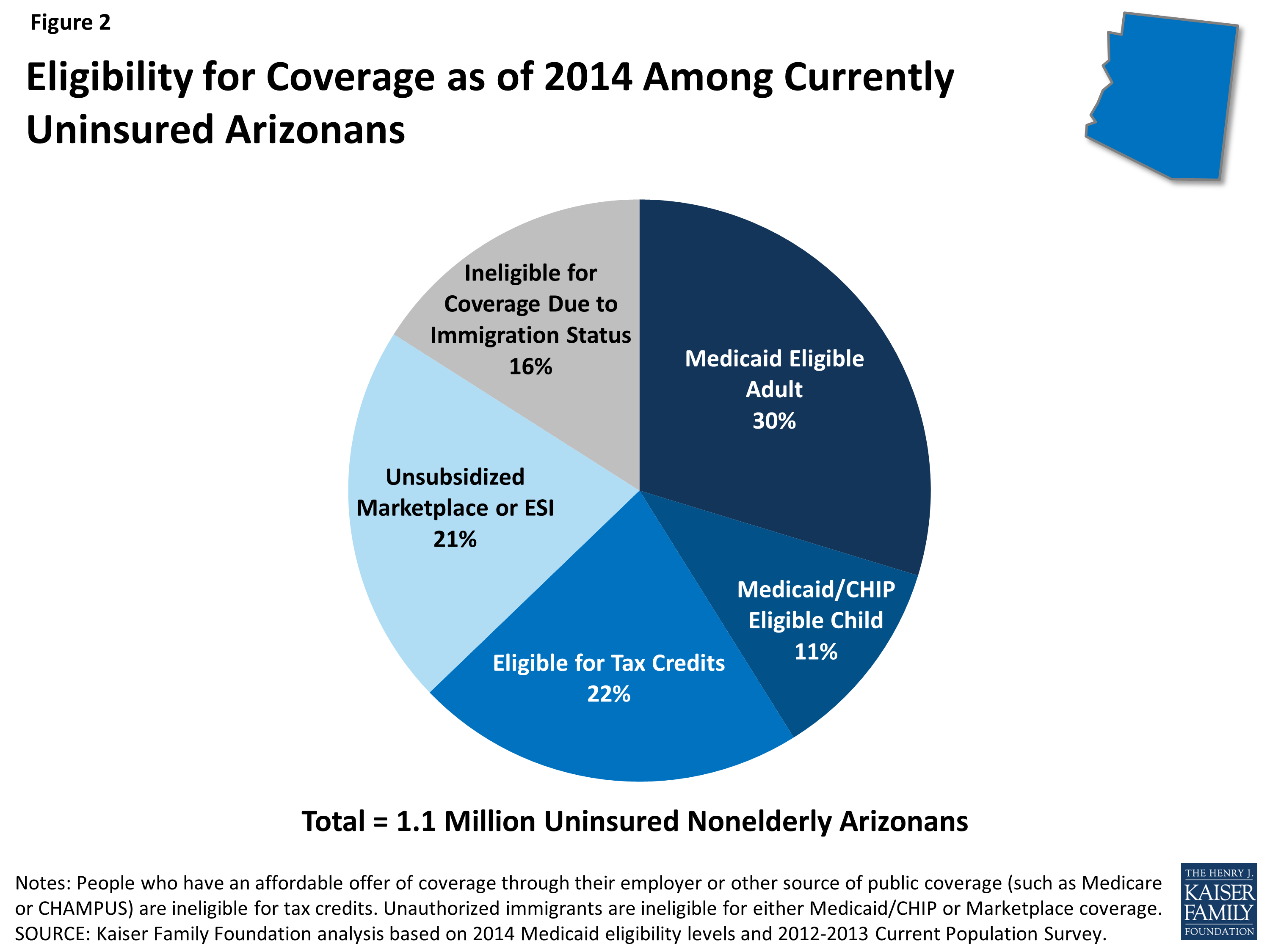
With Arizona deciding to implement the Medicaid expansion, over six in ten (63%) uninsured nonelderly people in the state are eligible for financial assistance to gain coverage through either Medicaid or the Marketplaces (Figure 2). Given the income distribution of the uninsured in the state, the main pathway for coverage is Medicaid, with four in ten (41%) uninsured Arizonans eligible for Medicaid as of 2014. While some of these people (such as eligible children) are eligible under pathways in place before the ACA, most adults are newly-eligible through the ACA expansion.  More than one in five (22%) uninsured people in Arizona is eligible for premium tax credits to help them purchase coverage in the Marketplace.

8531-AZ Figure 2

Other uninsured Arizonans may gain coverage under the ACA but will not receive direct financial assistance. These people include the 21 percent with incomes with incomes too high to be eligible for premium tax subsidies or who have an affordable offer of coverage through their employer. Some of these people are still able to purchase unsubsidized coverage in the Marketplace, which may be more affordable or more comprehensive than coverage they could obtain on their own through the individual market. Lastly, the approximately 16 percent of uninsured people in Arizona who are undocumented immigrants are ineligible for financial assistance under the ACA and barred from purchasing coverage through the Marketplaces. This group is likely to remain uninsured, though they will still have a need for health care services.

***

The ACA will help many currently uninsured Arizonans gain health coverage by providing coverage options across the income spectrum for low and moderate-income people. While almost all of the uninsured in Arizona are eligible for some type of coverage under the ACA, the impact of the ACA will depend on take-up of coverage among the eligible uninsured, and outreach and enrollment efforts will be an important factor in decreasing the uninsured rate. The ACA includes a requirement that most individuals obtain health coverage, but some people (such as the lowest income or those without an affordable option) are exempt and others may still remain uninsured. There is no deadline for enrolling in Medicaid coverage under the ACA, and open enrollment in the Marketplaces continues through March 2014. Continued attention to who gains coverage as the ACA is fully implemented and who is excluded from its reach—as well as whether and how their health needs are being met—can help inform decisions about the future of health coverage in Arizona.

  1. Some states had expanded coverage to parents at higher income levels or provided coverage to adults without children. See http://modern.kff.org/medicaid/fact-sheet/medicaid-eligibility-for-adults-as-of-january-1-2014/ for more detail on pre- and post-ACA Medicaid eligibility for adults. ↩︎
  2. For more detail on Medicaid coverage for immigrants, see: http://modern.kff.org/disparities-policy/fact-sheet/key-facts-on-health-coverage-for-low/. ↩︎
How Will the Uninsured in Wisconsin Fare Under the Affordable Care Act?

Published: Jan 6, 2014

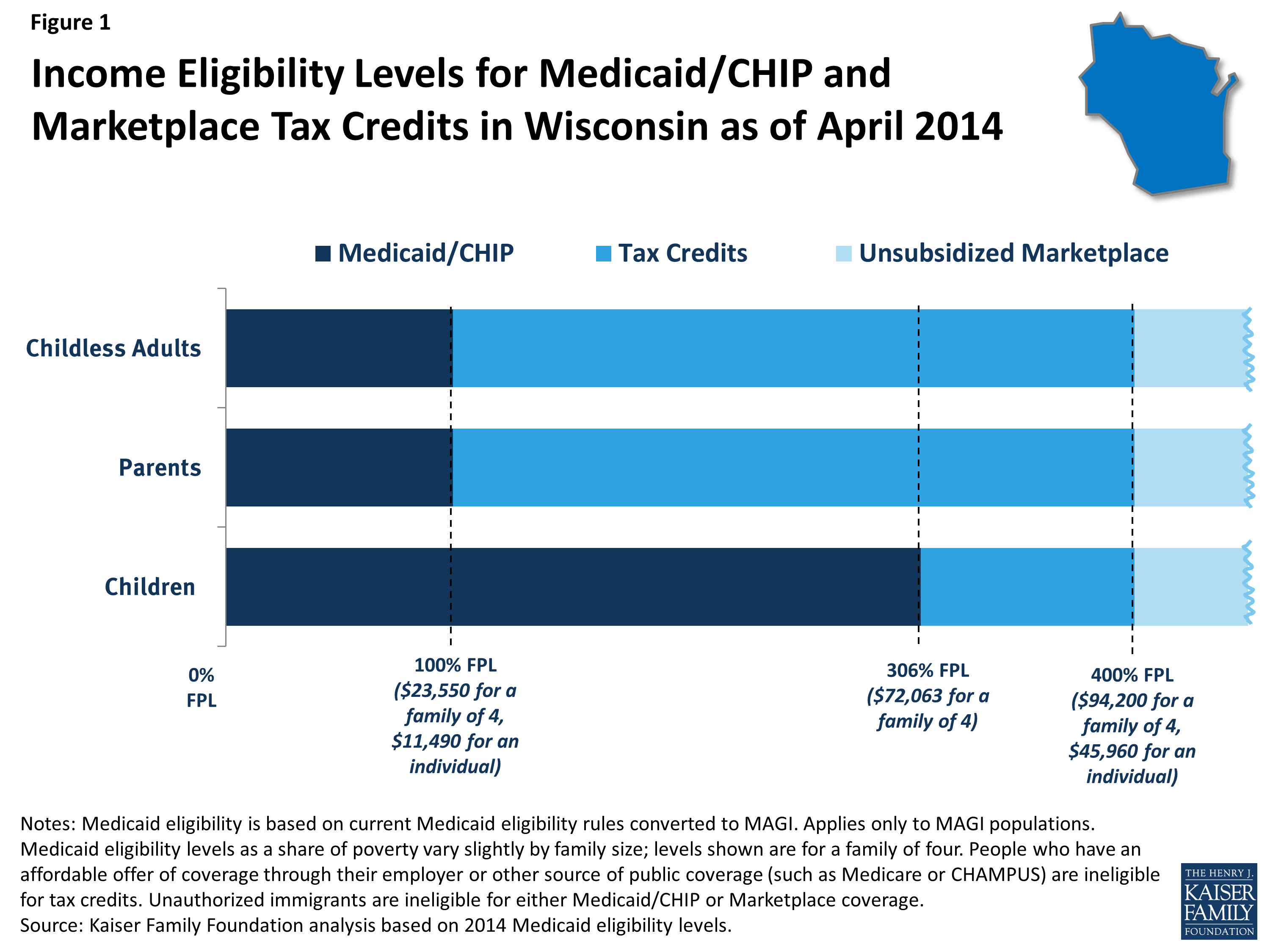
The 2010 Affordable Care Act (ACA) has the potential to extend coverage to many of the 47 million nonelderly uninsured people nationwide, including the 566,000 uninsured Wisconsinites. The ACA establishes coverage provisions across the income spectrum, with the expansion of Medicaid eligibility for adults serving as the vehicle for covering low-income individuals and premium tax credits to help people purchase insurance directly through new Health Insurance Marketplaces serving as the vehicle for covering people with moderate incomes. With the June 2012 Supreme Court ruling, the Medicaid expansion became optional for states, and as of December 2013, Wisconsin was not planning to implement the full expansion. Instead, the state amended its Medicaid state plan and existing Section 1115 waiver to cover adults up to 100% FPL in Medicaid, but did not adopt the expansion. As the ACA coverage expansions are implemented and coverage changes are assessed, it is important to understand the potential scope of the law in the state.

How Does the ACA Expand Health Insurance Coverage in Wisconsin?

Historically, Medicaid had gaps in coverage for adults because eligibility was restricted to specific categories of low-income individuals, such as children, their parents, pregnant women, the elderly, or individuals with disabilities. In most states, adults without dependent children were ineligible for Medicaid, regardless of their income, and income limits for parents were very low—often below half the poverty level.1   However, some states, including Wisconsin, had expanded coverage to parents at higher income levels or provided coverage to adults without children. The ACA aimed to extend Medicaid to nearly all nonelderly adults with incomes at or below 138% of poverty (about $32,500 for a family of four in 2013).


8531 - WI Figure 1

In states that do not implement the expansion (such as Wisconsin), Medicaid eligibility for adults will remain below 138% of poverty, as shown by the dark blue shading in Figure 1. As of April 2014, in Wisconsin, Medicaid eligibility for non-disabled adults will be limited to parents and adults without dependent children with incomes below 100% of poverty, or about $23,600 a year for a family of four and $11,500 for an individual. All states previously expanded eligibility for children to higher levels than adults through Medicaid and the Children’s Health Insurance Program (CHIP), and in Wisconsin, children with family incomes up to 306% of poverty (about $72,100 for a family of four) are eligible for Medicaid or CHIP. As was the case before the ACA, undocumented immigrants remain ineligible to enroll in Medicaid, and recent lawfully residing immigrants are subject to certain Medicaid eligibility restrictions.2 

Under the ACA, people with incomes between 100% and 400% of poverty may be eligible for premium tax credits when they purchase coverage in a Marketplace, as indicated by the bright blue shading in Figure 1. The amount of the tax credit is based on income and the cost of insurance, and tax credits are only available to people who are not eligible for other coverage, such as Medicaid/CHIP, Medicare, or employer coverage, and who are citizens or lawfully-present immigrants. Thus, the effective lower income limit for tax credits in Wisconsin is 306% of poverty for children and 100% of poverty for adults, as indicated by the bright blue shading in Figure 1. Citizens and lawfully-present immigrants with incomes above 400% of poverty can purchase unsubsidized coverage through the Marketplace. Because the ACA envisioned low-income people receiving coverage through Medicaid, people below poverty are not eligible for Marketplace subsidies.

How Many Uninsured Wisconsinites Are Eligible for Assistance Under the ACA?

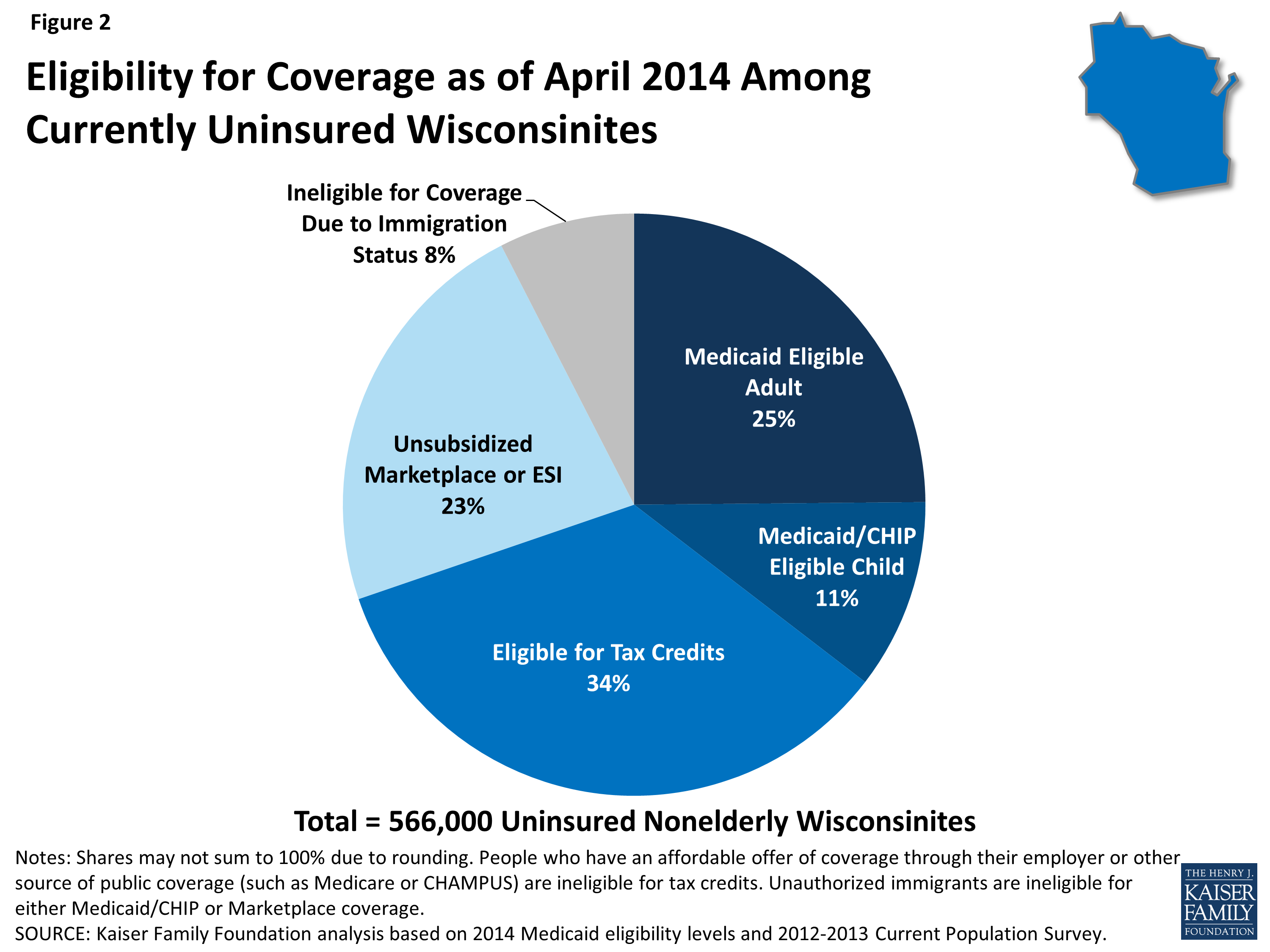
Under the ACA, in Wisconsin, seven in ten (70%) uninsured nonelderly people are eligible for financial assistance to gain coverage through either Medicaid or the Marketplaces (Figure 2). With the state’s expansion of Medicaid to 100% of poverty, over one-third (36%) of uninsured Wisconsinites are eligible for either Medicaid or CHIP as of 2014. An additional third (34%) of those currently uninsured in the state are eligible for premium tax credits to help them purchase coverage in the Marketplace.

8531 - WI Figure 2

Other uninsured Wisonsinites may gain coverage under the ACA but will not receive direct financial assistance. These people include the 23 percent with incomes too high to be eligible for premium tax subsidies or who have an affordable offer of coverage through their employer. Some of these people are still able to purchase unsubsidized coverage in the Marketplace, which may be more affordable or more comprehensive than coverage they could obtain on their own through the individual market. Lastly, the approximately 8 percent of uninsured people in Wisconsin who are undocumented immigrants are ineligible for financial assistance under the ACA and barred from purchasing coverage through the Marketplaces. This group is likely to remain uninsured, though they will still have a need for health care services.

***

The ACA will help millions of currently uninsured Wisconsinites gain health coverage, and the state’s expansion to adults with income up to 100 percent of poverty will extend coverage to many uninsured poor adults. The impact of the ACA will depend on take-up of coverage among the eligible uninsured, and outreach and enrollment efforts will be an important factor in determining how the law affects the uninsured rate in the state. The ACA includes a requirement that most individuals obtain health coverage, but some people (such as the lowest income or those without an affordable option) are exempt and others may still remain uninsured. Notably, there is no deadline for state decisions about implementing the Medicaid expansion, and open enrollment in the Marketplaces continues through March 2014. Continued attention to who gains coverage as the ACA is fully implemented and who is excluded from its reach—as well as whether and how their health needs are being met—can help inform decisions about the future of health coverage in Wisconsin.

  1. Some states had expanded coverage to parents at higher income levels or provided coverage to adults without children. See http://modern.kff.org/medicaid/fact-sheet/medicaid-eligibility-for-adults-as-of-january-1-2014/ for more detail on pre- and post-ACA Medicaid eligibility for adults. ↩︎
  2. For more detail on Medicaid coverage for immigrants, see: http://modern.kff.org/disparities-policy/fact-sheet/key-facts-on-health-coverage-for-low/. ↩︎
How Will the Uninsured in North Carolina Fare Under the Affordable Care Act?

Published: Jan 6, 2014

The 2010 Affordable Care Act (ACA) has the potential to extend coverage to many of the 47 million nonelderly uninsured people nationwide, including the 1.6 million uninsured North Carolinians. The ACA establishes coverage provisions across the income spectrum, with the expansion of Medicaid eligibility for adults serving as the vehicle for covering low-income individuals and premium tax credits to help people purchase insurance directly through new Health Insurance Marketplaces serving as the vehicle for covering people with moderate incomes. With the June 2012 Supreme Court ruling, the Medicaid expansion became optional for states, and as of December 2013, North Carolina was not planning to implement the expansion. As a result, many uninsured adults in North Carolina who would have been newly-eligible for Medicaid will remain without a coverage option. As the ACA coverage expansions are implemented and coverage changes are assessed, it is important to understand the potential scope of the law in the state.

How Does the ACA Expand Health Insurance Coverage in North Carolina?

Historically, Medicaid had gaps in coverage for adults because eligibility was restricted to specific categories of low-income individuals, such as children, their parents, pregnant women, the elderly, or individuals with disabilities. In most states, adults without dependent children were ineligible for Medicaid, regardless of their income, and income limits for parents were very low—often below half the poverty level.1  The ACA aimed to fill in these gaps by extending Medicaid to nearly all nonelderly adults with incomes at or below 138% of poverty (about $32,500 for a family of four in 2013).

8531-NC Figure 1

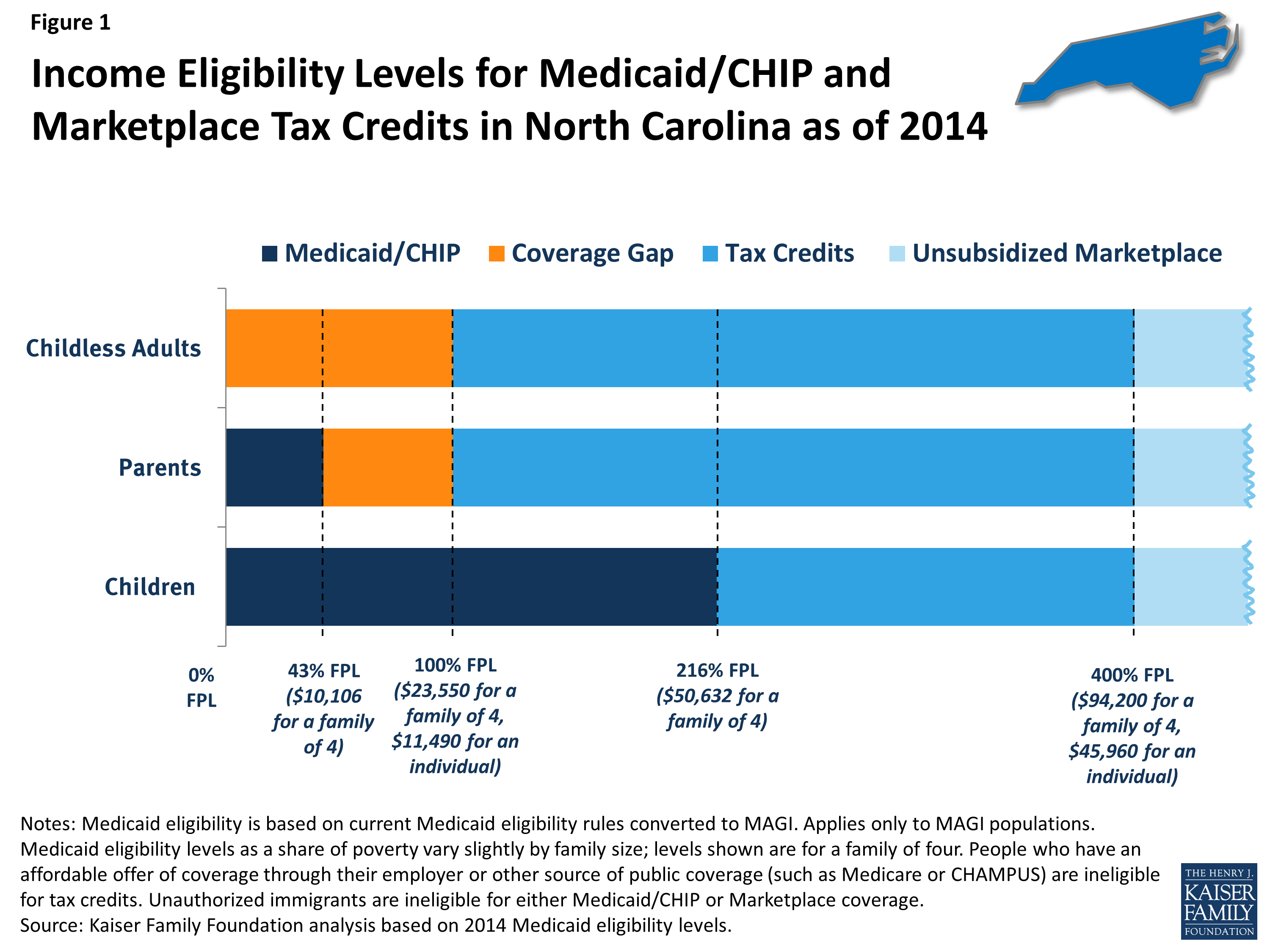
In states that do not implement the expansion (such as North Carolina), Medicaid eligibility for adults will remain quite limited, as shown by the dark blue shading in Figure 1. As of January 2014, in North Carolina, Medicaid eligibility for non-disabled adults is limited to parents with incomes below 43% of poverty, or about $10,100 a year for a family of four, and adults without dependent children remain ineligible regardless of their income. All states previously expanded eligibility for children to higher levels than adults through Medicaid and the Children’s Health Insurance Program (CHIP), and in North Carolina, children with family incomes up to 216% of poverty (about $50,600 for a family of four) are eligible for Medicaid or CHIP. As was the case before the ACA, undocumented immigrants remain ineligible to enroll in Medicaid, and recent lawfully residing immigrants are subject to certain Medicaid eligibility restrictions.2 

Under the ACA, people with incomes between 100% and 400% of poverty may be eligible for premium tax credits when they purchase coverage in a Marketplace, as indicated by the bright blue shading in Figure 1. The amount of the tax credit is based on income and the cost of insurance, and tax credits are only available to people who are not eligible for other coverage, such as Medicaid/CHIP, Medicare, or employer coverage, and who are citizens or lawfully-present immigrants. Citizens and lawfully-present immigrants with incomes above 400% of poverty can purchase unsubsidized coverage through the Marketplace. Because the ACA envisioned low-income people receiving coverage through Medicaid, people below poverty are not eligible for Marketplace subsidies. Thus, some adults in North Carolina fall into a “coverage gap” of earning too much to qualify for Medicaid but not enough to qualify for premium tax credits, as shown by the orange shading in Figure 1. People in the coverage gap are ineligible for financial assistance under the ACA, while people with higher incomes are eligible for tax credits to purchase coverage.

How Many Uninsured North Carolinians Are Eligible for Assistance Under the ACA?

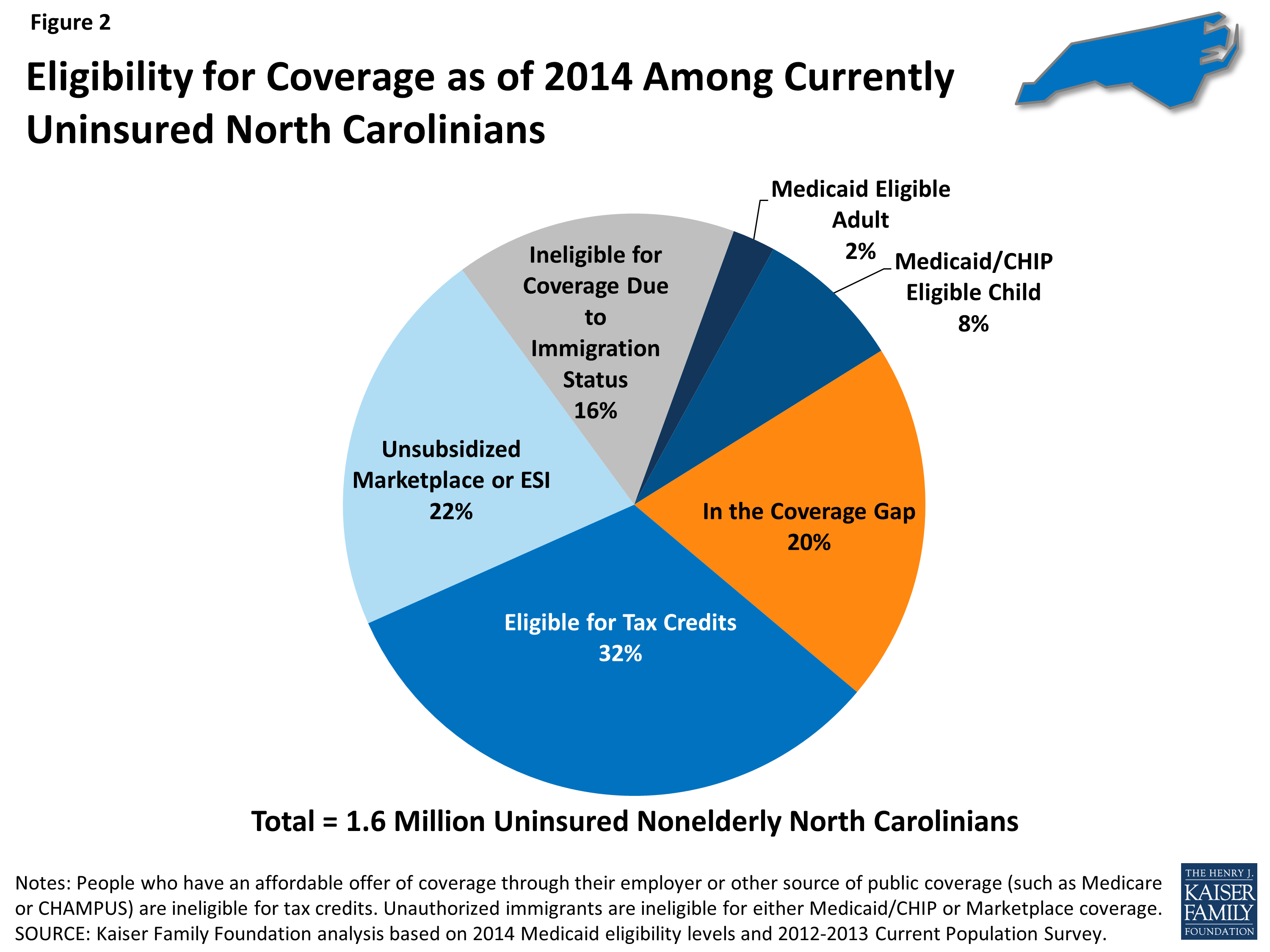
Under the ACA, in North Carolina, more than four in ten (42%) currently uninsured non-elderly people are eligible for financial assistance in gaining coverage (Figure 2). The main pathway for the currently uninsured to gain coverage is the Marketplace, the new coverage option in the state: about 513,000 (nearly one in three) uninsured North Carolinians are eligible for premium tax credits to help them purchase coverage in the Marketplace.

8531-NC Figure 2

Even though the state is not expanding Medicaid eligibility, some currently uninsured people are eligible for Medicaid in 2014. Reflecting higher eligibility levels for children than for adults, the majority (77%) of uninsured North Carolinians eligible for Medicaid are children who are already eligible but not yet enrolled in coverage. A small number of uninsured adult parents (2% of the uninsured in the state) are eligible for Medicaid in North Carolina under eligibility pathways in place before the ACA. Not all eligible individuals are enrolled in the program due to lack of knowledge about their eligibility and historic enrollment barriers. As the ACA coverage expansions are implemented, it is likely that broad outreach efforts and new streamlined enrollment processes will lead to increased enrollment of eligible individuals into Medicaid.

In North Carolina, 319,000 uninsured adults (20% of the uninsured in the state) who would have been eligible for Medicaid if the state expanded fall into the coverage gap. These adults are all below the poverty line and thus have very limited incomes.  Because they do not gain an affordable coverage option under the ACA, they are most likely to remain uninsured.

Two other groups of uninsured North Carolinians are outside the reach of financial assistance for health coverage under the ACA. First, people with incomes above the limit for premium tax subsidies or who have an affordable offer of coverage through their employer are ineligible for financial assistance. Some of these people are still able to purchase unsubsidized coverage in the Marketplace, which may be more affordable or more comprehensive than the coverage they could obtain on their own through the individual market. Second, uninsured undocumented immigrants (16% of uninsured non-elderly North Carolinians) are ineligible for assistance under the ACA and barred from purchasing coverage through the Marketplace. This group is likely to remain uninsured, though they will still have a need for health care services.

***

The ACA will help many currently uninsured North Carolinians gain health coverage, but many who could have obtained financial assistance through the Medicaid expansion will remain outside its reach. Further, the impact of the ACA will depend on take-up of coverage among the eligible uninsured, and outreach and enrollment efforts will be an important factor in determining how the law affects the uninsured rate in the state. The ACA includes a requirement that most individuals obtain health coverage, but some people (such as the lowest income or those without an affordable option) are exempt and others may still remain uninsured. Notably, there is no deadline for state decisions about implementing the Medicaid expansion, and open enrollment in the Marketplaces continues through March 2014. Continued attention to who gains coverage as the ACA is fully implemented and who is excluded from its reach—as well as whether and how their health needs are being met—can help inform decisions about the future of health coverage in North Carolina.

  1. Some states had expanded coverage to parents at higher income levels or provided coverage to adults without children. See http://modern.kff.org/medicaid/fact-sheet/medicaid-eligibility-for-adults-as-of-january-1-2014/ for more detail on pre- and post-ACA Medicaid eligibility for adults. ↩︎
  2. For more detail on Medicaid coverage for immigrants, see: http://modern.kff.org/disparities-policy/fact-sheet/key-facts-on-health-coverage-for-low/. ↩︎
How Will the Uninsured in Louisiana Fare Under the Affordable Care Act?

Published: Jan 6, 2014

The 2010 Affordable Care Act (ACA) has the potential to extend coverage to many of the 47 million nonelderly uninsured people nationwide, including the 866,000 uninsured Louisianans. The ACA establishes coverage provisions across the income spectrum, with the expansion of Medicaid eligibility for adults serving as the vehicle for covering low-income individuals and premium tax credits to help people purchase insurance directly through new Health Insurance Marketplaces serving as the vehicle for covering people with moderate incomes. With the June 2012 Supreme Court ruling, the Medicaid expansion became optional for states, and as of December 2013, Louisiana was not planning to implement the expansion. As a result, many uninsured adults in Louisiana who would have been newly-eligible for Medicaid will remain without a coverage option. As the ACA coverage expansions are implemented and coverage changes are assessed, it is important to understand the potential scope of the law in the state.

How Does the ACA Expand Health Insurance Coverage in Louisiana?

Historically, Medicaid had gaps in coverage for adults because eligibility was restricted to specific categories of low-income individuals, such as children, their parents, pregnant women, the elderly, or individuals with disabilities. In most states, adults without dependent children were ineligible for Medicaid, regardless of their income, and income limits for parents were very low—often below half the poverty level.1  The ACA aimed to fill in these gaps by extending Medicaid to nearly all nonelderly adults with incomes at or below 138% of poverty (about $32,500 for a family of four in 2013).

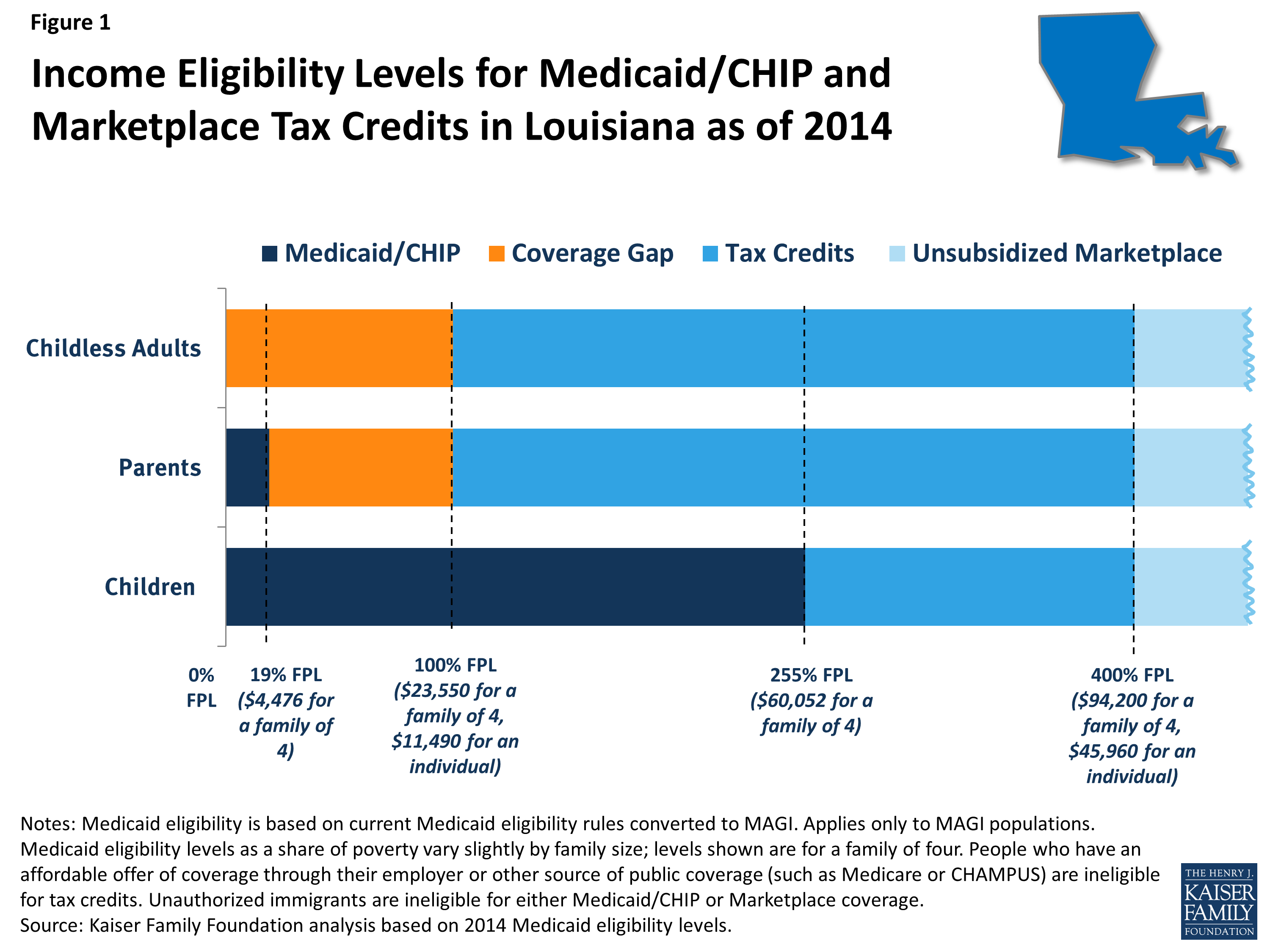
In states that do not implement the expansion (such as Louisiana), Medicaid eligibility for adults will remain quite limited, as shown by the dark blue shading in Figure 1. As of January 2014, in Louisiana, Medicaid eligibility for non-disabled adults is limited to parents with incomes below 19% of poverty, or about $4,500 a year for a family of four, and adults without dependent children remain ineligible regardless of their income. All states previously expanded eligibility for children to higher levels than adults through Medicaid and the Children’s Health Insurance Program (CHIP), and in Louisiana, children with family incomes up to 255% of poverty (about $60,100 for a family of four) are eligible for Medicaid or CHIP. As was the case before the ACA, undocumented immigrants remain ineligible to enroll in Medicaid, and recent lawfully residing immigrants are subject to certain Medicaid eligibility restrictions.2 

8531-LA Figure 1

Under the ACA, people with incomes between 100% and 400% of poverty may be eligible for premium tax credits when they purchase coverage in a Marketplace, as indicated by the bright blue shading in Figure 1. The amount of the tax credit is based on income and the cost of insurance, and tax credits are only available to people who are not eligible for other coverage, such as Medicaid/CHIP, Medicare, or employer coverage, and who are citizens or lawfully-present immigrants. Citizens and lawfully-present immigrants with incomes above 400% of poverty can purchase unsubsidized coverage through the Marketplace. Because the ACA envisioned low-income people receiving coverage through Medicaid, people below poverty are not eligible for Marketplace subsidies. Thus, some adults in Louisiana fall into a “coverage gap” of earning too much to qualify for Medicaid but not enough to qualify for premium tax credits, as shown by the orange shading in Figure 1. People in the coverage gap are ineligible for financial assistance under the ACA, while people with higher incomes are eligible for tax credits to purchase coverage.

How Many Uninsured Louisianans Are Eligible for Assistance Under the ACA?

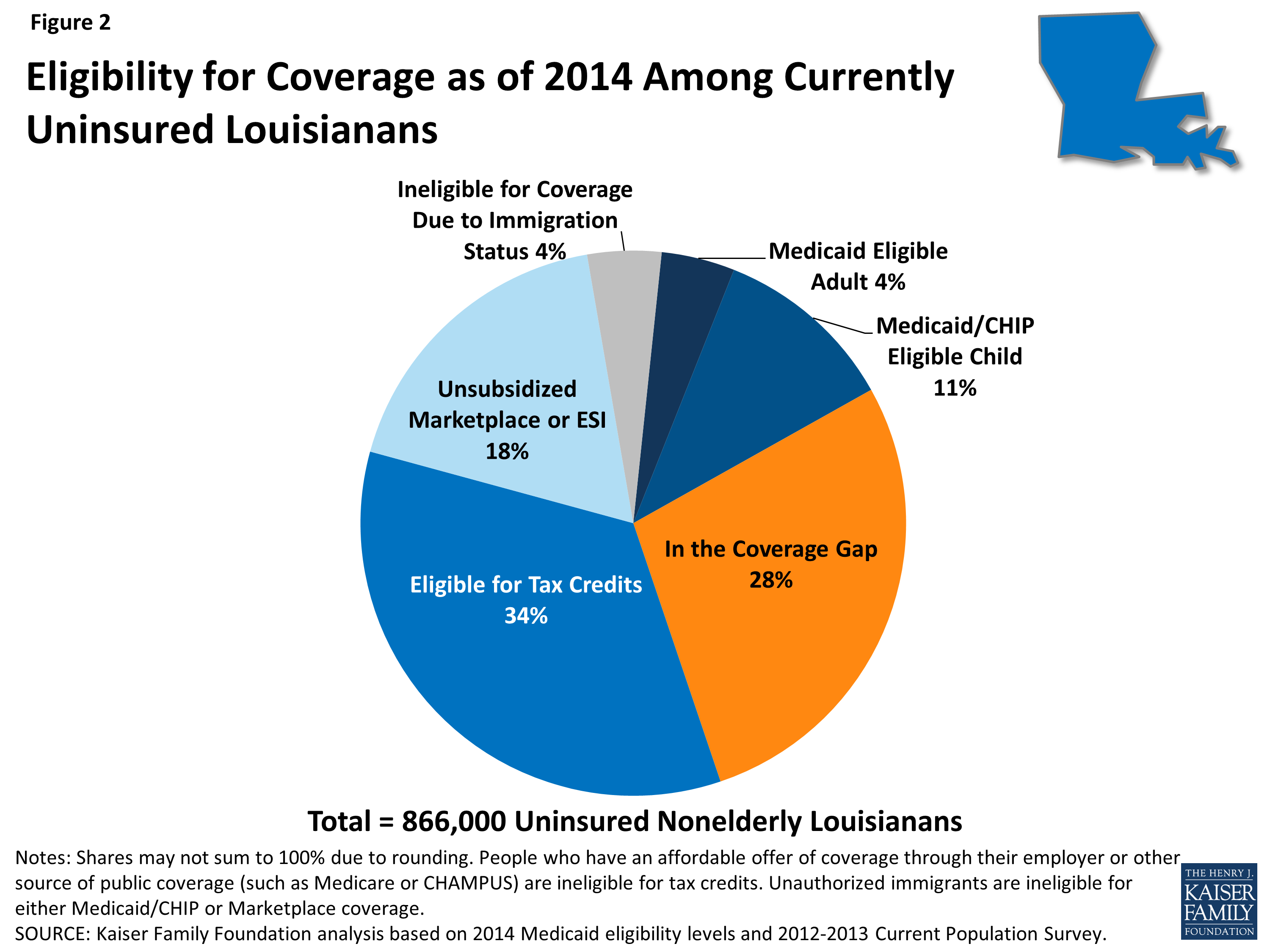
Under the ACA, in Louisiana, nearly half (49%) of  uninsured nonelderly people are eligible for financial assistance in gaining coverage (Figure 2). The main pathway for the currently uninsured to gain coverage is the Marketplace, the new coverage option in the state: about 298,000 (over a third) uninsured Louisianans are eligible for premium tax credits to help them purchase coverage in the Marketplace.

8531-LA Figure 2

Even though the state is not expanding Medicaid eligibility, some currently uninsured people are eligible for Medicaid in 2014. Reflecting higher eligibility levels for children than for adults, the majority (71%) of uninsured Louisianans eligible for Medicaid are children who are already eligible but not yet enrolled in coverage. A small number of uninsured adult parents (4% of the uninsured in the state) are eligible for Medicaid in Louisiana under eligibility pathways in place before the ACA. Not all eligible individuals are enrolled in the program due to lack of knowledge about their eligibility and historic enrollment barriers. As the ACA coverage expansions are implemented, it is likely that broad outreach efforts and new streamlined enrollment processes will lead to increased enrollment of eligible individuals into Medicaid.

In Louisiana, 242,000 uninsured adults (28% of the uninsured in the state) who would have been eligible for Medicaid if the state expanded fall into the coverage gap. These adults are all below the poverty line and thus have very limited incomes.  Because they do not gain an affordable coverage option under the ACA, they are most likely to remain uninsured.

Two other groups of uninsured Louisianans are outside the reach of financial assistance for health coverage under the ACA. First, people with incomes above the limit for premium tax subsidies or who have an affordable offer of coverage through their employer are ineligible for financial assistance. Some of these people are still able to purchase unsubsidized coverage in the Marketplace, which may be more affordable or more comprehensive than coverage they could obtain on their own through the individual market. Second, uninsured undocumented immigrants (about 4% of uninsured Louisianans) are ineligible for assistance under the ACA and barred from purchasing coverage through the Marketplace. This group is likely to remain uninsured, though they will still have a need for health care services.

***

The ACA will help many currently uninsured Louisianans gain health coverage, but many who could have obtained financial assistance through the Medicaid expansion will remain outside its reach. Further, the impact of the ACA will depend on take-up of coverage among the eligible uninsured, and outreach and enrollment efforts will be an important factor in determining how the law affects the uninsured rate in the state. The ACA includes a requirement that most individuals obtain health coverage, but some people (such as the lowest income or those without an affordable option) are exempt and others may still remain uninsured. Notably, there is no deadline for state decisions about implementing the Medicaid expansion, and open enrollment in the Marketplaces continues through March 2014. Continued attention to who gains coverage as the ACA is fully implemented and who is excluded from its reach—as well as whether and how their health needs are being met—can help inform decisions about the future of health coverage in Louisiana.

  1. Some states had expanded coverage to parents at higher income levels or provided coverage to adults without children. See http://modern.kff.org/medicaid/fact-sheet/medicaid-eligibility-for-adults-as-of-january-1-2014/ for more detail on pre- and post-ACA Medicaid eligibility for adults. ↩︎
  2. For more detail on Medicaid coverage for immigrants, see: http://modern.kff.org/disparities-policy/fact-sheet/key-facts-on-health-coverage-for-low/. ↩︎
How Will the Uninsured in New Jersey Fare Under the Affordable Care Act?

Published: Jan 6, 2014

The 2010 Affordable Care Act (ACA) has the potential to extend coverage to many of the 47 million nonelderly uninsured people nationwide, including the 1.3 million uninsured New Jerseyans. The ACA establishes coverage provisions across the income spectrum, with the expansion of Medicaid eligibility for adults serving as the vehicle for covering low-income individuals and premium tax credits to help people purchase insurance directly through new Health Insurance Marketplaces serving as the vehicle for covering people with moderate incomes. The June 2012 Supreme Court ruling made the Medicaid expansion optional for states, and as of December 2013, New Jersey was planning to implement the expansion in 2014. As a result, the ACA will be fully implemented in New Jersey, and almost all nonelderly uninsured, most of whom are adults, are eligible for coverage expansions. As the ACA coverage expansions are implemented and coverage changes are assessed, it is important to understand the potential scope of the law in the state.

How Does the ACA Expand Health Insurance Coverage in New Jersey?

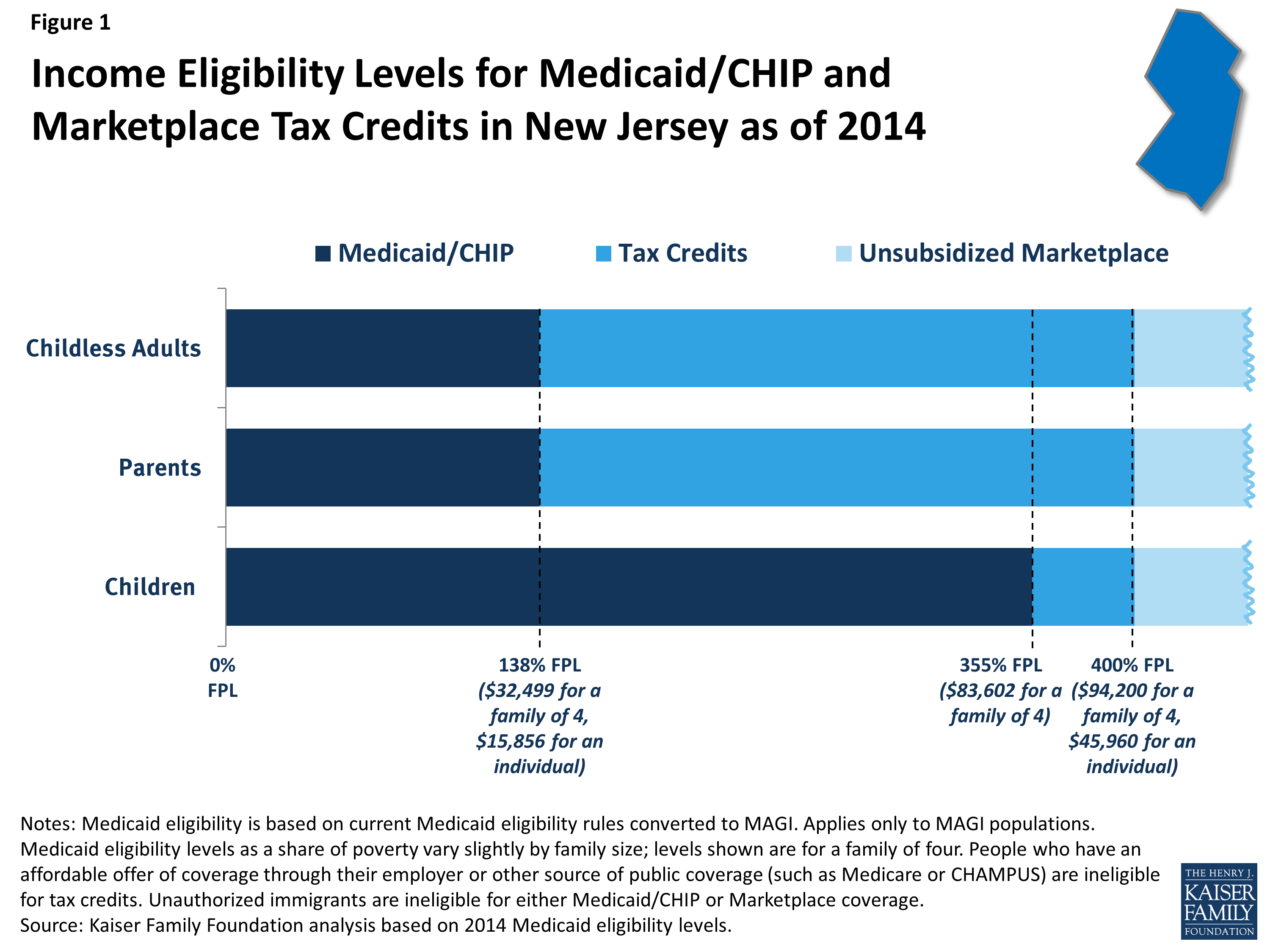
Historically, Medicaid had gaps in coverage for adults because eligibility was restricted to specific categories of low-income individuals, such as children, their parents, pregnant women, the elderly, or individuals with disabilities. In most states, adults without dependent children were ineligible for Medicaid, regardless of their income, and income limits for parents were very low—often below half the poverty level.1  The ACA aimed to fill in these gaps by extending Medicaid to nearly all nonelderly adults with incomes at or below 138% of poverty (about $32,500 for a family of four in 2013).  Thus, as of January 2014, Medicaid eligibility in New Jersey covers almost all nonelderly adults up to 138% of poverty, as shown by the dark blue shading in Figure 1. All states previously expanded eligibility for children to higher levels than adults through Medicaid and the Children’s Health Insurance Program (CHIP), and in New Jersey, children with family incomes up to 355% of poverty (about $83,600 for a family of four) are eligible for Medicaid or CHIP. As was the case before the ACA, undocumented immigrants remain ineligible to enroll in Medicaid, and recent lawfully residing immigrants are subject to certain Medicaid eligibility restrictions.2 

8531 - NJ Figure 1

Under the ACA, people with incomes between 100% and 400% of poverty may be eligible for premium tax credits when they purchase coverage in a Marketplace. The amount of the tax credit is based on income and the cost of insurance, and tax credits are only available to people who are not eligible for other coverage, such as Medicaid/CHIP, Medicare, or employer coverage, and who are citizens or lawfully-present immigrants. Thus, the effective lower income limit for tax credits in New Jersey is 355% of poverty for children and 138% of poverty for adults, as indicated by the bright blue shading in Figure 1 Citizens and lawfully-present immigrants with incomes above 400% of poverty can purchase unsubsidized coverage through the Marketplace.

How Many Uninsured New Jerseyans Are Eligible for Assistance Under the ACA?

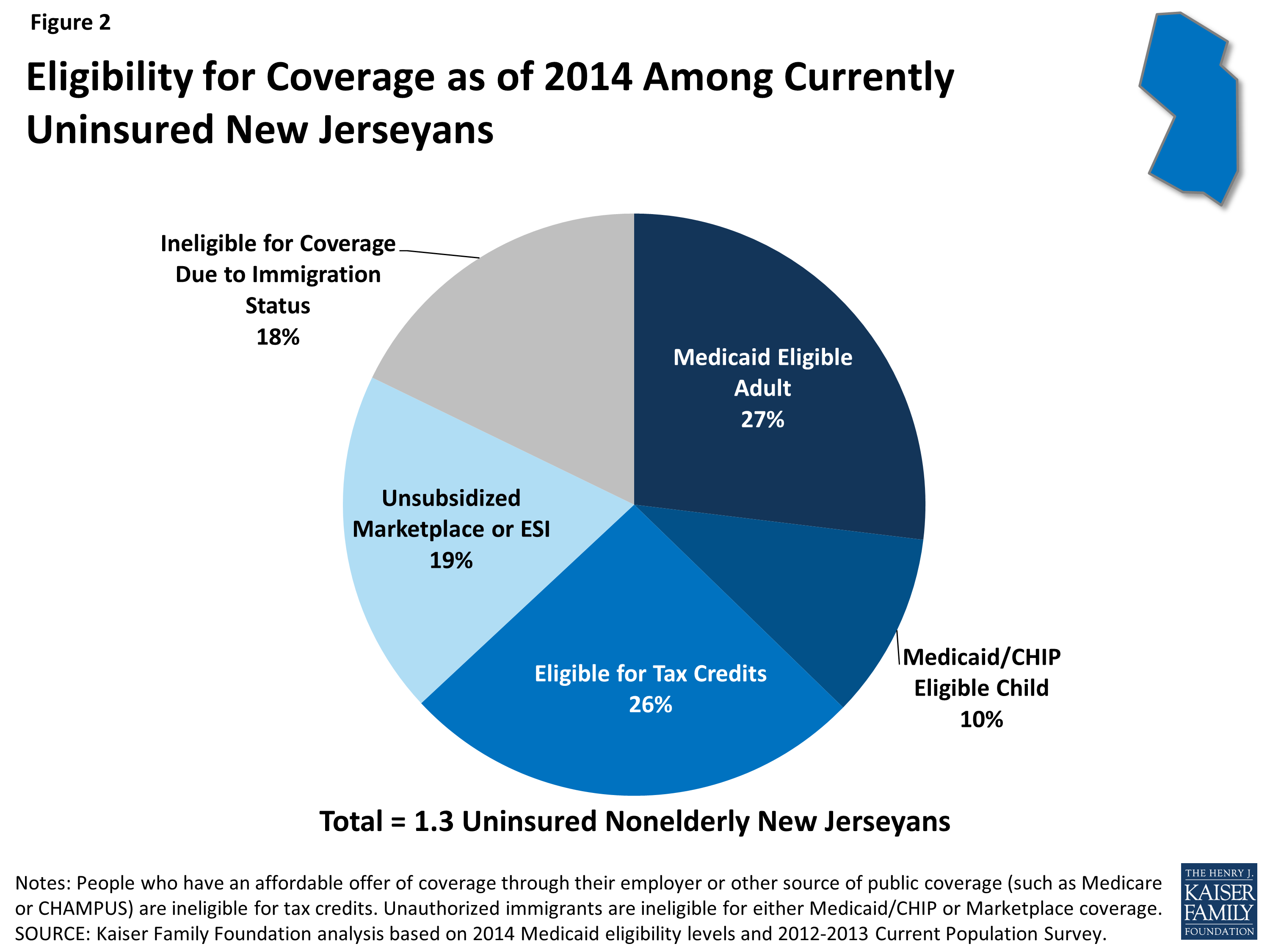
With New Jersey deciding to implement the Medicaid expansion, over six in ten (63%) uninsured nonelderly people in the state are eligible for financial assistance to gain coverage through either Medicaid or the Marketplaces (Figure 2). Given the income distribution of the uninsured in the state, the main pathway for coverage is Medicaid, with over a third (37%) of uninsured New Jerseyans eligible for either Medicaid or CHIP as of 2014. While some of these people (such as eligible children) are eligible under pathways in place before the ACA, most adults are newly-eligible through the ACA expansion.  About a quarter (26%) of all uninsured people in New Jersey are eligible for premium tax credits to help them purchase coverage in the Marketplace.

8531 - NJ Figure 2

Other uninsured New Jerseyans may gain coverage under the ACA but will not receive direct financial assistance. These people include the 19 percent with incomes too high to be eligible for premium tax subsidies or who have an affordable offer of coverage through their employer. Some of these people are still able to purchase unsubsidized coverage in the Marketplace, which may be more affordable or more comprehensive than the coverage they could obtain on their own through the individual market. Lastly, the approximately 18 percent of uninsured people in New Jersey who are undocumented immigrants are ineligible for financial assistance under the ACA and barred from purchasing coverage through the Marketplaces. This group is likely to remain uninsured, though they will still have a need for health care services.

***

The ACA will help many currently uninsured New Jerseyans gain health coverage by providing coverage options across the income spectrum for low and moderate-income people. While almost all of the uninsured in New Jersey are eligible for some type of coverage under the ACA, the impact of the ACA will depend on take-up of coverage among the eligible uninsured, and outreach and enrollment efforts will be an important factor in decreasing the uninsured rate. The ACA includes a requirement that most individuals obtain health coverage, but some people (such as the lowest income or those without an affordable option) are exempt and others may still remain uninsured. There is no deadline for enrolling in Medicaid coverage under the ACA, and open enrollment in the Marketplaces continues through March 2014. Continued attention to who gains coverage as the ACA is fully implemented and who is excluded from its reach—as well as whether and how their health needs are being met—can help inform decisions about the future of health coverage in New Jersey.

  1. Some states had expanded coverage to parents at higher income levels or provided coverage to adults without children. See http://modern.kff.org/medicaid/fact-sheet/medicaid-eligibility-for-adults-as-of-january-1-2014/ for more detail on pre- and post-ACA Medicaid eligibility for adults. ↩︎
  2. For more detail on Medicaid coverage for immigrants, see: http://modern.kff.org/disparities-policy/fact-sheet/key-facts-on-health-coverage-for-low/. ↩︎
How Will the Uninsured in Ohio Fare Under the Affordable Care Act?

Published: Jan 6, 2014

The 2010 Affordable Care Act (ACA) has the potential to extend coverage to many of the 47 million nonelderly uninsured people nationwide, including the 1.5 million uninsured Ohioans. The ACA establishes coverage provisions across the income spectrum, with the expansion of Medicaid eligibility for adults serving as the vehicle for covering low-income individuals and premium tax credits to help people purchase insurance directly through new Health Insurance Marketplaces serving as the vehicle for covering people with moderate incomes. The June 2012 Supreme Court ruling made the Medicaid expansion optional for states, and as of December 2013, Ohio was planning to implement the expansion in 2014. As a result, the ACA will be fully implemented in Ohio, and almost all nonelderly uninsured, most of whom are adults, are eligible for coverage expansions. As the ACA coverage expansions are implemented and coverage changes are assessed, it is important to understand the potential scope of the law in the state.

How Does the ACA Expand Health Insurance Coverage in Ohio?

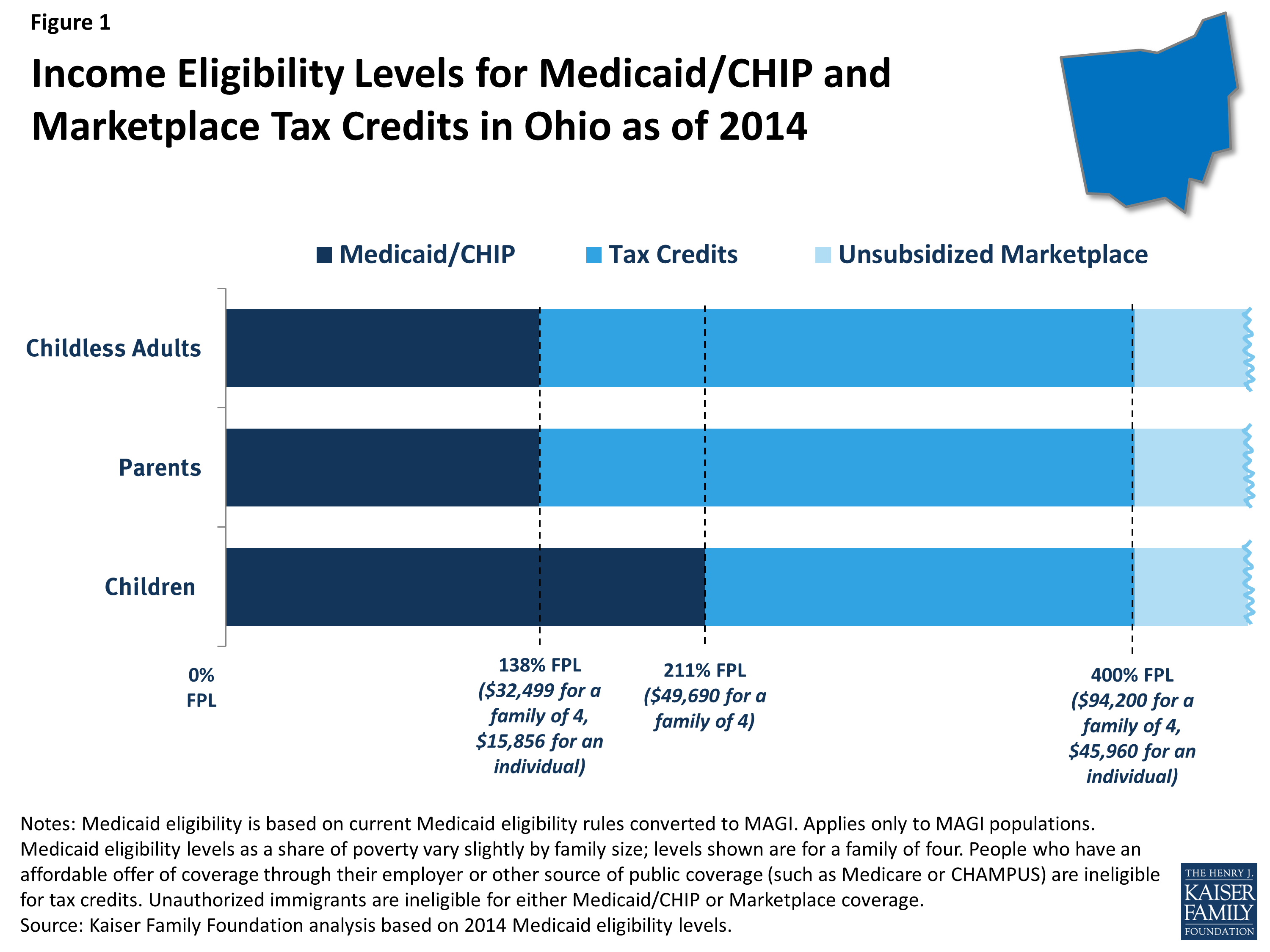
Historically, Medicaid had gaps in coverage for adults because eligibility was restricted to specific categories of low-income individuals, such as children, their parents, pregnant women, the elderly, or individuals with disabilities. In most states, adults without dependent children were ineligible for Medicaid, regardless of their income, and income limits for parents were very low—often below half the poverty level.1  The ACA aimed to fill in these gaps by extending Medicaid to nearly all nonelderly adults with incomes at or below 138% of poverty (about $32,500 for a family of four in 2013).  Thus, as of January 2014, Medicaid eligibility in Ohio covers almost all nonelderly adults up to 138% of poverty, as shown by the dark blue shading in Figure 1. All states previously expanded eligibility for children to higher levels than adults through Medicaid and the Children’s Health Insurance Program (CHIP), and in Ohio, children with family incomes up to 211% of poverty (about $49,700 for a family of four) are eligible for Medicaid or CHIP. As was the case before the ACA, undocumented immigrants remain ineligible to enroll in Medicaid, and recent lawfully residing immigrants are subject to certain Medicaid eligibility restrictions.2 

8531 - OH Figure 1

Under the ACA, people with incomes between 100% and 400% of poverty may be eligible for premium tax credits when they purchase coverage in a Marketplace. The amount of the tax credit is based on income and the cost of insurance, and tax credits are only available to people who are not eligible for other coverage, such as Medicaid/CHIP, Medicare, or employer coverage, and who are citizens or lawfully-present immigrants. Thus, the effective lower income limit for tax credits in Ohio is 211% of poverty for children and 138% of poverty for adults, as indicated by the bright blue shading in Figure 1. Citizens and lawfully-present immigrants with incomes above 400% of poverty can purchase unsubsidized coverage through the Marketplace.

How Many Uninsured Ohioans Are Eligible for Assistance Under the ACA?

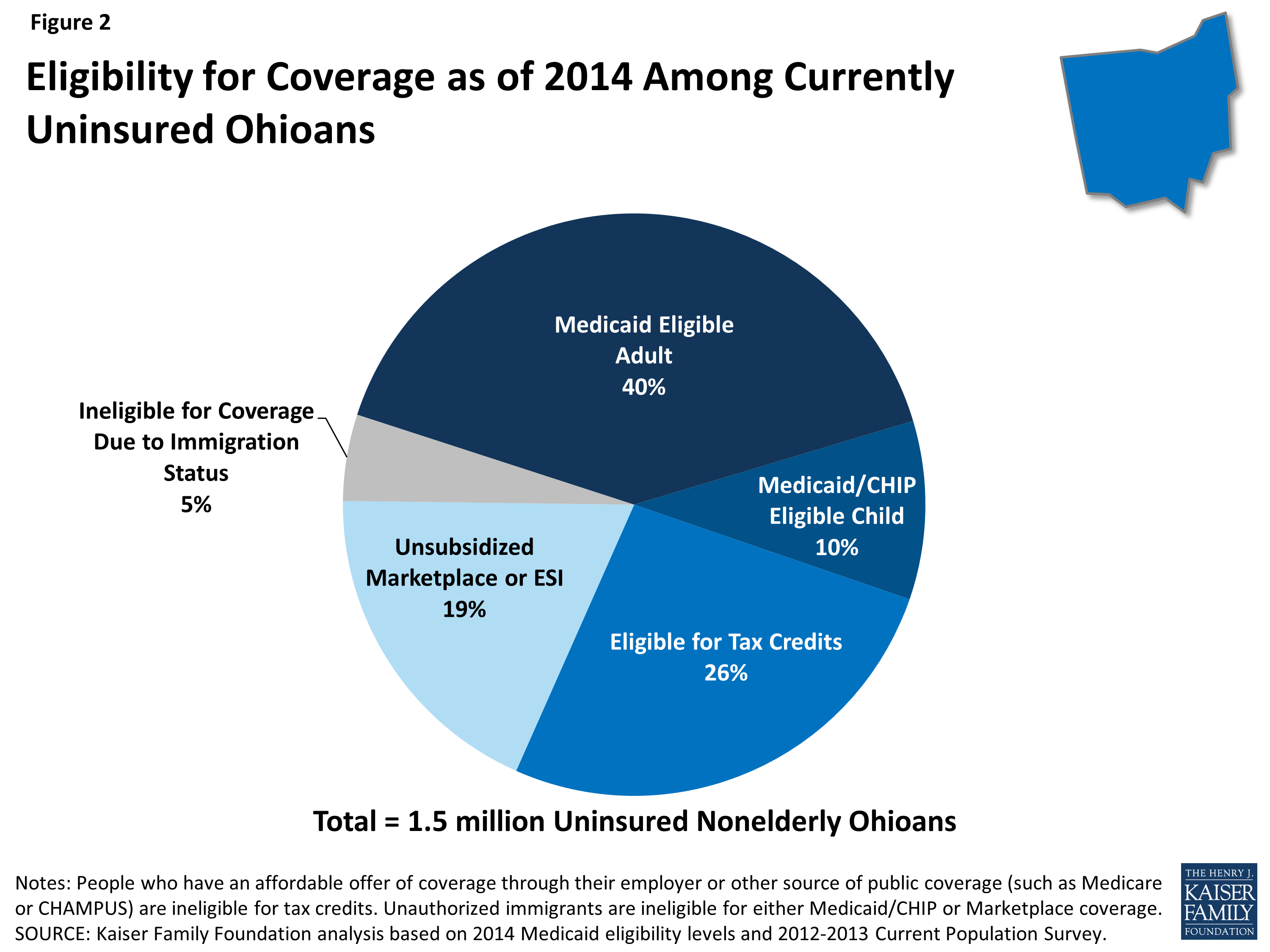
With Ohio deciding to implement the Medicaid expansion, over three-quarters (77%) of uninsured nonelderly people in the state are eligible for financial assistance to gain coverage through either Medicaid or the Marketplaces (Figure 2). Given the income distribution of the uninsured in the state, the main pathway for coverage is Medicaid, with half of uninsured Ohioans eligible for either Medicaid or CHIP as of 2014. While some of these people (such as eligible children) are eligible under pathways in place before the ACA, most adults are newly-eligible through the ACA expansion.  Over a quarter (26%) of all uninsured people in Ohio are eligible for premium tax credits to help them purchase coverage in the Marketplace.

8531 - OH Figure 2

Other uninsured Ohioans may gain coverage under the ACA but will not receive direct financial assistance. These people include the 19 percent with incomes too high to be eligible for premium tax subsidies or who have an affordable offer of coverage through their employer. Some of these people are still able to purchase unsubsidized coverage in the Marketplace, which may be more affordable or more comprehensive than the coverage they could obtain on their own through the individual market. Lastly, the approximately five percent of uninsured people in Ohio who are undocumented immigrants are ineligible for financial assistance under the ACA and barred from purchasing coverage through the Marketplaces. This group is likely to remain uninsured, though they will still have a need for health care services.

***

The ACA will help many currently uninsured Ohioans gain health coverage by providing coverage options across the income spectrum for low and moderate-income people. While almost all of the uninsured in Ohio are eligible for some type of coverage under the ACA, the impact of the ACA will depend on take-up of coverage among the eligible uninsured, and outreach and enrollment efforts will be an important factor in decreasing the uninsured rate. The ACA includes a requirement that most individuals obtain health coverage, but some people (such as the lowest income or those without an affordable option) are exempt and others may still remain uninsured. There is no deadline for enrolling in Medicaid coverage under the ACA, and open enrollment in the Marketplaces continues through March 2014. Continued attention to who gains coverage as the ACA is fully implemented and who is excluded from its reach—as well as whether and how their health needs are being met—can help inform decisions about the future of health coverage in Ohio.

  1. Some states had expanded coverage to parents at higher income levels or provided coverage to adults without children. See http://modern.kff.org/medicaid/fact-sheet/medicaid-eligibility-for-adults-as-of-january-1-2014/ for more detail on pre- and post-ACA Medicaid eligibility for adults. ↩︎
  2. For more detail on Medicaid coverage for immigrants, see: http://modern.kff.org/disparities-policy/fact-sheet/key-facts-on-health-coverage-for-low/. ↩︎
How Will the Uninsured in Oklahoma Fare Under the Affordable Care Act?

Published: Jan 6, 2014

The 2010 Affordable Care Act (ACA) has the potential to extend coverage to many of the 47 million nonelderly uninsured people nationwide, including the 632,000 uninsured Oklahomans. The ACA establishes coverage provisions across the income spectrum, with the expansion of Medicaid eligibility for adults serving as the vehicle for covering low-income individuals and premium tax credits to help people purchase insurance directly through new Health Insurance Marketplaces serving as the vehicle for covering people with moderate incomes. With the June 2012 Supreme Court ruling, the Medicaid expansion became optional for states, and as of December 2013, Oklahoma was not planning to implement the expansion. As a result, many uninsured adults in Oklahoma who would have been newly-eligible for Medicaid will remain without a coverage option. As the ACA coverage expansions are implemented and coverage changes are assessed, it is important to understand the potential scope of the law in the state.

How Does the ACA Expand Health Insurance Coverage in Oklahoma?

Historically, Medicaid had gaps in coverage for adults because eligibility was restricted to specific categories of low-income individuals, such as children, their parents, pregnant women, the elderly, or individuals with disabilities. In most states, adults without dependent children were ineligible for Medicaid, regardless of their income, and income limits for parents were very low—often below half the poverty level.1  The ACA aimed to fill in these gaps by extending Medicaid to nearly all nonelderly adults with incomes at or below 138% of poverty (about $32,500 for a family of four in 2013).

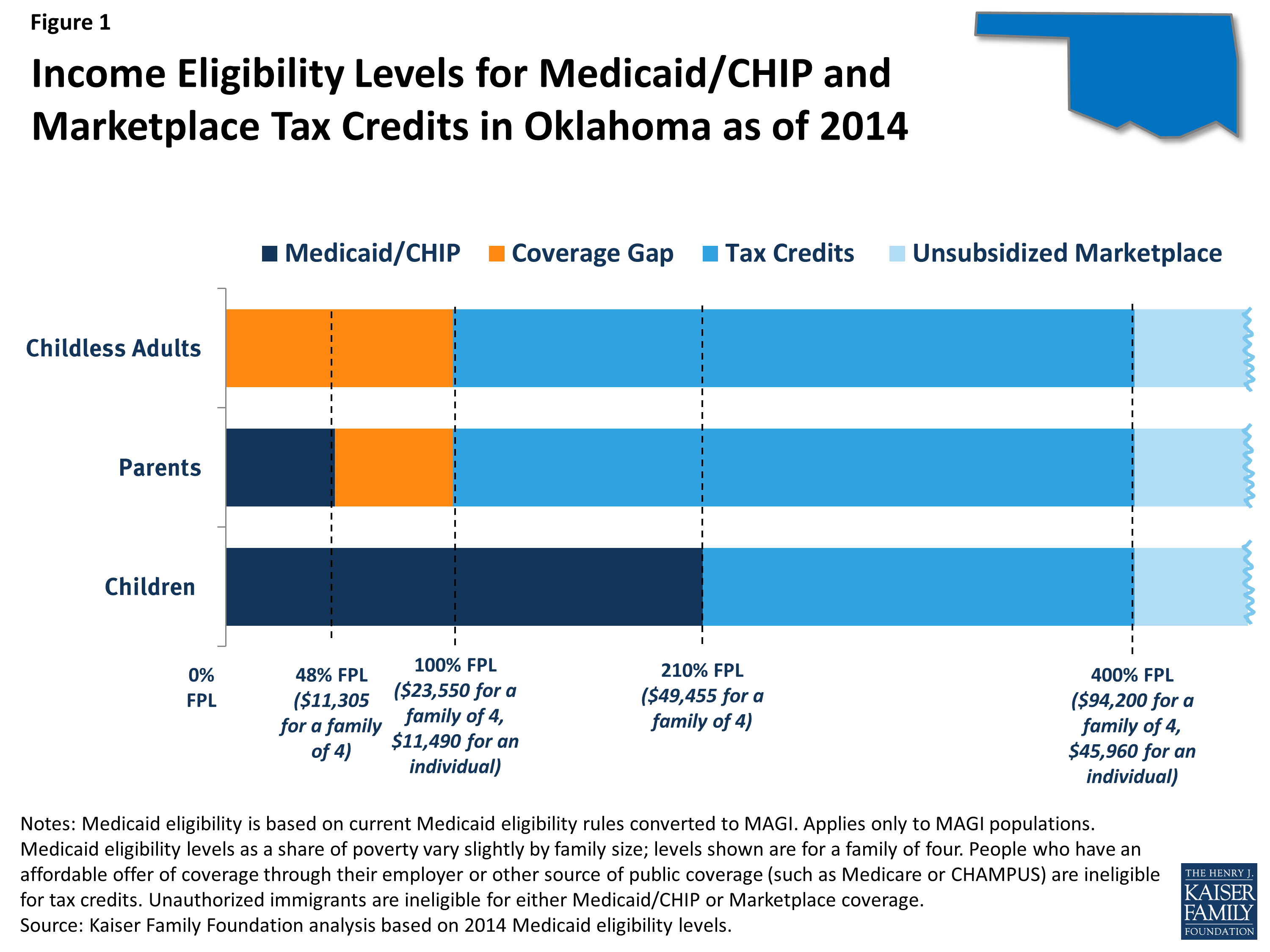
8531-OK Figure 1

In states that do not implement the expansion (such as Oklahoma), Medicaid eligibility for adults will remain quite limited, as shown by the dark blue shading in Figure 1. As of January 2014, in Oklahoma, Medicaid eligibility for non-disabled adults is limited to parents with incomes below 48% of poverty, or about $11,300 a year for a family of four, and adults without dependent children remain ineligible regardless of their income. All states previously expanded eligibility for children to higher levels than adults through Medicaid and the Children’s Health Insurance Program (CHIP), and in Oklahoma, children with family incomes up to 210% of poverty (about $49,500 for a family of four) are eligible for Medicaid or CHIP. As was the case before the ACA, undocumented immigrants remain ineligible to enroll in Medicaid, and recent lawfully residing immigrants are subject to certain Medicaid eligibility restrictions.2 

Under the ACA, people with incomes between 100% and 400% of poverty may be eligible for premium tax credits when they purchase coverage in a Marketplace, as indicated by the bright blue shading in Figure 1. The amount of the tax credit is based on income and the cost of insurance, and tax credits are only available to people who are not eligible for other coverage, such as Medicaid/CHIP, Medicare, or employer coverage, and who are citizens or lawfully-present immigrants. Citizens and lawfully-present immigrants with incomes above 400% of poverty can purchase unsubsidized coverage through the Marketplace. Because the ACA envisioned low-income people receiving coverage through Medicaid, people below poverty are not eligible for Marketplace subsidies. Thus, some adults in Oklahoma fall into a “coverage gap” of earning too much to qualify for Medicaid but not enough to qualify for premium tax credits, as shown by the orange shading in Figure 1. People in the coverage gap are ineligible for financial assistance under the ACA, while people with higher incomes are eligible for tax credits to purchase coverage.

How Many Uninsured Oklahomans Are Eligible for Assistance Under the ACA?

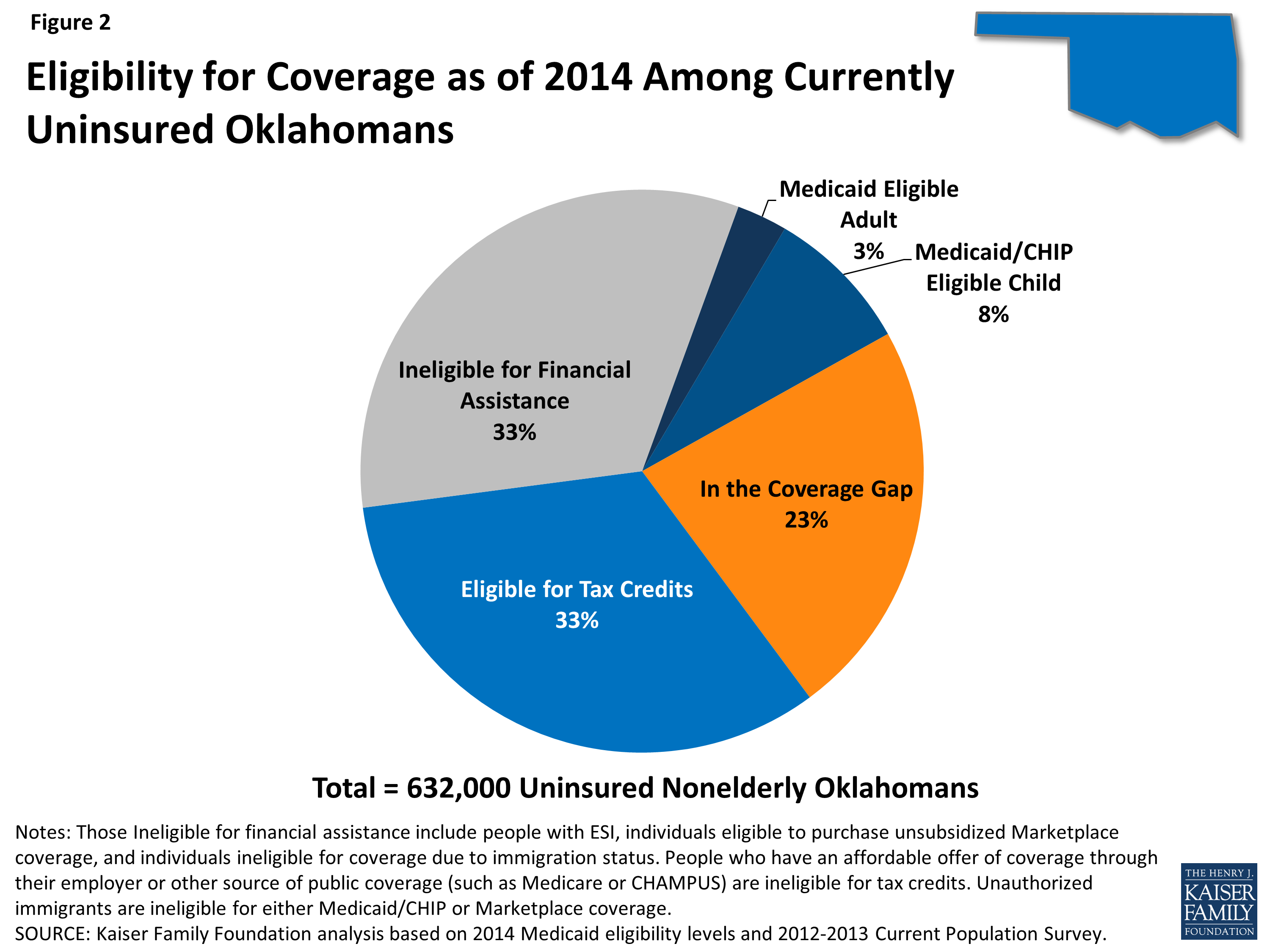
Under the ACA, in Oklahoma, more than four in ten (44%) currently uninsured nonelderly people are eligible for financial assistance in gaining coverage (Figure 2). The main pathway for the currently uninsured to gain coverage is the Marketplace, the new coverage option in the state: about 208,000 (one in three) uninsured Oklahomans are eligible for premium tax credits to help them purchase coverage in the Marketplace.

8531-OK Figure 2

Even though the state is not expanding Medicaid eligibility, some currently uninsured people are eligible for Medicaid in 2014. Reflecting higher eligibility levels for children than for adults, the majority (75%) of uninsured Oklahomans eligible for Medicaid are children who are already eligible but not yet enrolled in coverage. A small number of uninsured adult parents (3% of the uninsured in the state) are eligible for Medicaid in Oklahoma under eligibility pathways in place before the ACA. Not all eligible individuals are enrolled in the program due to lack of knowledge about their eligibility and historic enrollment barriers. As the ACA coverage expansions are implemented, it is likely that broad outreach efforts and new streamlined enrollment processes will lead to increased enrollment of eligible individuals into Medicaid.

In Oklahoma, 144,000 uninsured adults (23% of the uninsured in the state) who would have been eligible for Medicaid if the state expanded fall into the coverage gap. These adults are all below the poverty line and thus have very limited incomes.  Because they do not gain an affordable coverage option under the ACA, they are most likely to remain uninsured.

Two other groups of uninsured Oklahomans are outside the reach of financial assistance for health coverage under the ACA. First, people with incomes above the limit for premium tax subsidies or who have an affordable offer of coverage through their employer are ineligible for financial assistance. Some of these people are still able to purchase unsubsidized coverage in the Marketplace, which may be more affordable or more comprehensive than the coverage they could obtain on their own through the individual market. Second, uninsured undocumented immigrants are ineligible for assistance under the ACA and barred from purchasing coverage through the Marketplace. This group is likely to remain uninsured, though they will still have a need for health care services.

***

The ACA will help many currently uninsured Oklahomans gain health coverage, but many who could have obtained financial assistance through the Medicaid expansion will remain outside its reach. Further, the impact of the ACA will depend on take-up of coverage among the eligible uninsured, and outreach and enrollment efforts will be an important factor in determining how the law affects the uninsured rate in the state. The ACA includes a requirement that most individuals obtain health coverage, but some people (such as the lowest income or those without an affordable option) are exempt and others may still remain uninsured. Notably, there is no deadline for state decisions about implementing the Medicaid expansion, and open enrollment in the Marketplaces continues through March 2014. Continued attention to who gains coverage as the ACA is fully implemented and who is excluded from its reach—as well as whether and how their health needs are being met—can help inform decisions about the future of health coverage in Oklahoma.

  1. Some states had expanded coverage to parents at higher income levels or provided coverage to adults without children. See http://modern.kff.org/medicaid/fact-sheet/medicaid-eligibility-for-adults-as-of-january-1-2014/ for more detail on pre- and post-ACA Medicaid eligibility for adults. ↩︎
  2. For more detail on Medicaid coverage for immigrants, see: http://modern.kff.org/disparities-policy/fact-sheet/key-facts-on-health-coverage-for-low/. ↩︎