Trump Administration Drops Medicaid Vaccine Reporting Requirements
In a letter to state health officials last month, the Centers for Medicare & Medicaid Services (CMS) announced the removal of immunization measures from the Child Core Set and Adult Core Set. These “Core Sets” measure health care performance annually, with the goal of improving the health of Medicaid and Children’s Health Insurance Program (CHIP) enrollees. Dropping Medicaid vaccine reporting requirements may make it more challenging to monitor vaccination trends and the impact of recent vaccine policy changes. This policy watch describes the recent Trump administration changes to Medicaid vaccine reporting requirements and explores what impact this change may have on state Medicaid programs and enrollees.
The “Core Sets” are a set of quality measures designed to measure and improve health care quality and access. The Core Set of Children’s Health Care Quality Measures for Medicaid and CHIP, or the “Child Core Set”, includes quality measures that capture various aspects of children’s health such as behavior health care, preventive care, maternal health, acute and chronic conditions, oral health care, and experience of care as well as vaccination status. The Child Core Set was developed in 2009, voluntary annual state reporting began in 2010, and reporting became mandatory in 2024. There is also a separate set of quality measures for adult enrollees, the “Adult Core Set”. The Adult Core Set was developed in 2012, voluntary annual state reporting began in 2014, and the behavioral health measures became mandatory for states to report in 2024. To enforce compliance with mandatory measures, CMS has the authority to withhold federal Medicaid payments, though states can request a one-year exemption if they are unable to report for a specific population and measure. The Core Set data are made publicly available and are designed to measure health care access and quality for Medicaid/CHIP enrollees, allowing states to monitor health care quality, identify improvement opportunities, and address health disparities.
The Trump administration recently removed four immunization measures from the Core Sets, making them voluntary for states to report. CMS’s December 2025 letter to state health officials made all of the immunization-related measures in the Child Core Set and one of two immunization-related measures in the Adult Core Set “voluntary utilization measures” for 2026 and 2027 (see Table 1). The letter also states that federal Medicaid payments are not tied to performance on the immunization quality measures and encourages states not to use the immunization measures in any payment arrangements (for example, incentives for managed care plans). Two other measures for 2027 were retired (Medical Assistance with Smoking and Tobacco Use Cessation, MSC-AD, and the Asthma Medication Ratio, AMR-CH and AMR-AD), though CMS notes that they will explore adding other tobacco use and asthma measures in the future.
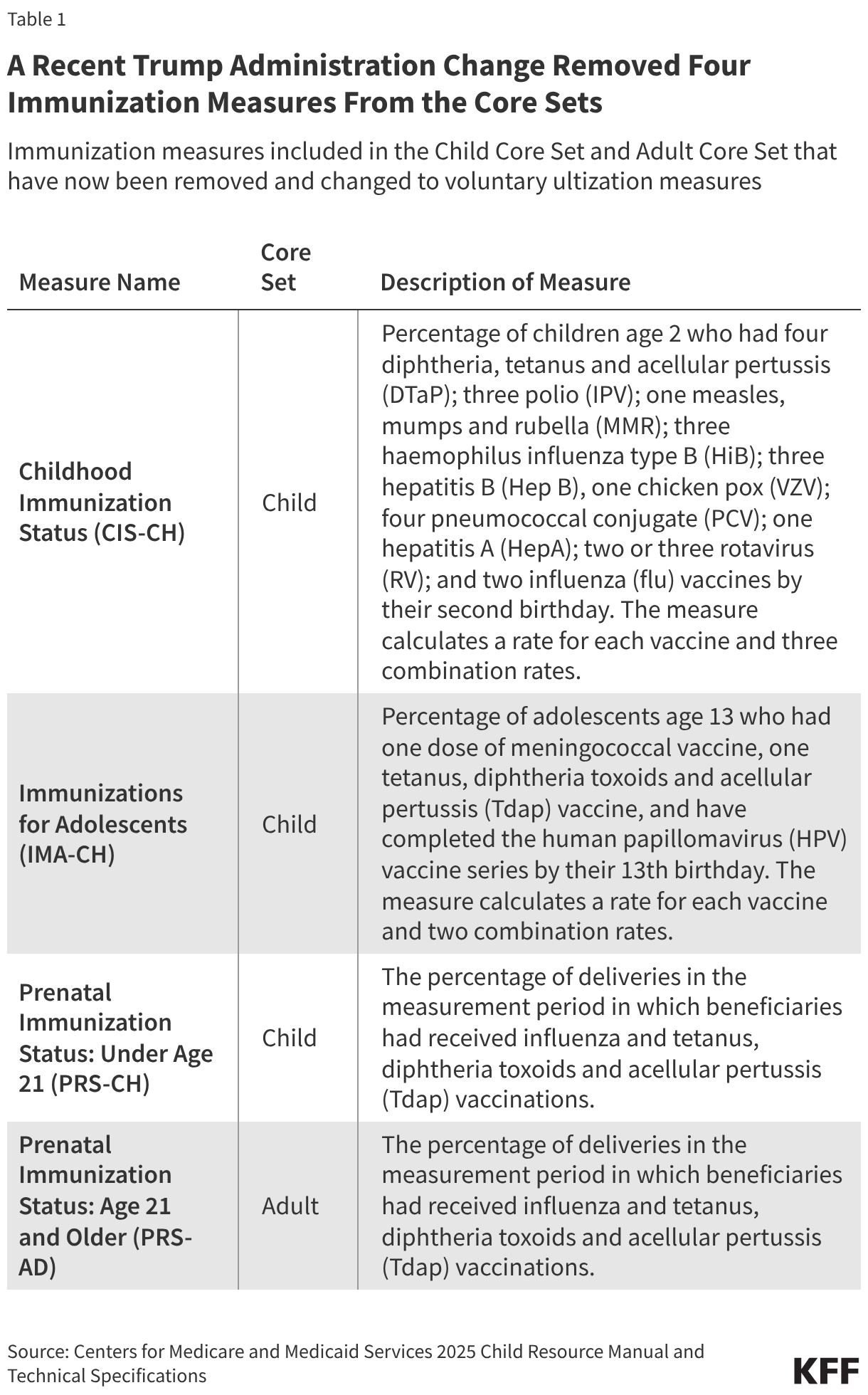
The recent Core Set changes did not follow the typical process for updates. To advance and improve the quality measures, CMS is required by federal law to update the Core Sets, ensuring the measures “reflect the testing, validation, and consensus process for the development of pediatric quality measures”. As finalized in federal regulation under the Biden Administration in 2023, the development of the Core Sets each year begins with a workgroup of Medicaid/CHIP stakeholders and quality measure experts who review the Core Sets and make recommendations for changes through the annual review and selection process. The workgroup’s recommendations are then published for public comment and submitted to CMS, who ultimately releases the final Core Sets based on the recommendations. CMS’s recent decision to remove the immunization measures did not follow this process, though the letter notes the Secretary has the “discretion to make changes to the Core Sets that he deems best to improve and strengthen the Core Sets” under federal law.
While seemingly a small, technical change, the removal of vaccine reporting in Medicaid and CHIP may make it more difficult to monitor and understand vaccination trends for a large share of children in the U.S. State-level data from the 2024 Child Core Set for the now removed immunization measures show variation in vaccination rates across states and vaccination type (Figure 1) and trends across the 2022-2024 Core Sets show declines in vaccination rates for some vaccines. These data can help state Medicaid programs understand vaccination trends, compare their state to others, inform state Medicaid policy, and improve rates to reach longstanding vaccination rate goals. Nearly four in 10 children in the U.S. are covered by Medicaid, making even small changes to the program relevant to broader children’s health trends.
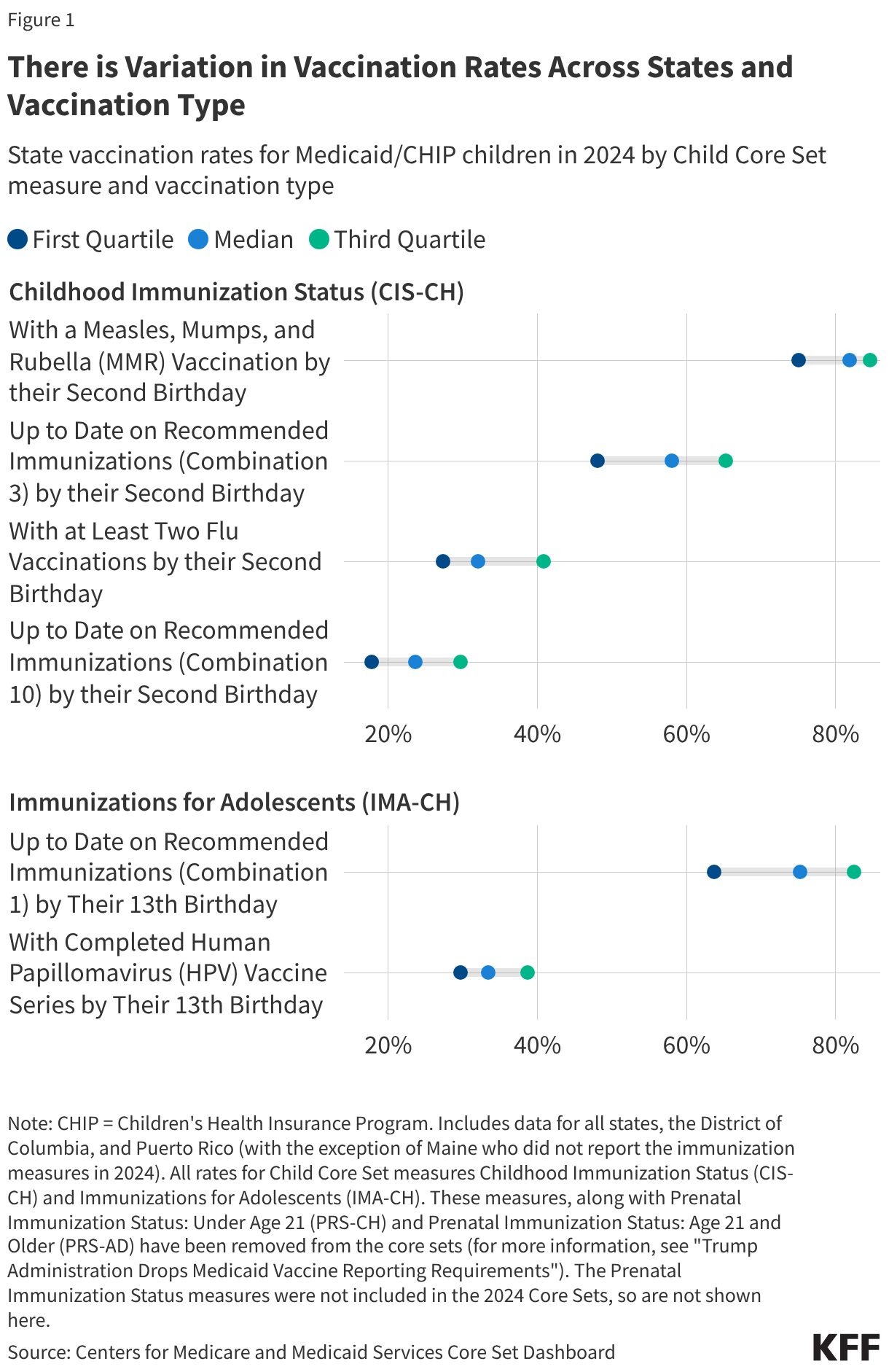
It remains unclear how many states will continue to report the voluntary immunization measures and what will happen to these measures in future years. Prior to mandatory reporting, the number of states reporting the Child Core Set measures increased over time, with voluntary responses to CIS-CH and IMA-CH (show in Figure 1) reaching 46 to 48 responding states by 2023 depending on the vaccine. Given the infrastructure is already in place to report, states may continue to voluntarily report the immunization measures. However, CMS has indicated they will be considering options for new immunization measures to replace the now voluntary measures. They plan to engage stakeholders, including states, quality measure experts, providers as well as vaccine registry managers and electronic health record vendors, to develop measures that capture “whether parents and families were informed about vaccine choices, vaccine safety and side effects, and alternative vaccine schedules” and to explore whether data can account for “person and family preferences related to vaccines” and religious exemptions for vaccinations. Without the Child Core Set immunization measures, at this time it may still be possible to monitor Medicaid/CHIP children’s vaccination trends through other data sources, such as the National Immunization Survey or individual state collected data, but these data are not easily accessible and may not be comparable across states.
Dropping vaccine reporting requirements could also make it more challenging to monitor recent declines in childhood vaccinations rates and the impact of vaccine policy changes. Children’s routine and seasonal vaccination rates have declined in recent years, due in part to rising vaccine hesitancy fueled by vaccine misinformation, increasingly partisan views on vaccine requirements, and a decline in trust of health authorities. In addition, the Administration recently announced significant changes to the children’s vaccination schedule, reducing the number of diseases targeted from 17 to 11 and the number of routine vaccines from 13 to 7. Changes to the vaccine schedule at the federal level (and confusion about the changes) coupled with other public health policy actions under the Trump administration could further drive down vaccination rates among children and increase incidence of vaccine preventable diseases. Limited vaccination status data means reduced visibility into vaccination trends and what impact recent policy changes may have.