The U.S. President’s Emergency Plan for AIDS Relief (PEPFAR)
Note: This fact sheet largely reflects activities prior to the second Trump administration, which has issued numerous executive actions that directly affect global health efforts, and has been updated to highlight key recent actions that may affect PEPFAR. See also the KFF fact sheet on the Trump administration’s foreign aid review and the status of PEPFAR.
Key Facts
- Although the U.S. has been involved in efforts to address the global AIDS crisis since the mid-1980s, the creation of the President’s Emergency Plan for AIDS Relief (PEPFAR) in 2003 marked a significant increase in funding and attention to the epidemic. Now, 20 years in, PEPFAR reports saving an estimated 26 million lives and is currently providing HIV prevention and treatment services to millions.
- PEPFAR is the largest commitment by any nation to address a single disease in the world, credited with not only saving millions of lives but also helping to change the trajectory of the global HIV epidemic.
- PEPFAR funding is comprised of U.S. bilateral funding and U.S. contributions to multilateral organizations addressing HIV, primarily the Global Fund to Fight AIDS, Tuberculosis and Malaria (Global Fund).1
- To date, U.S. funding for PEPFAR has totaled over $120 billion, growing from $1.9 billion in FY 2004 to $6.5 billion in FY 2025; FY 2025 funding, which Congress provided through a continuing resolution, includes $4.8 billion provided for bilateral HIV efforts and $1.7 billion for multilateral efforts ($50 million for UNAIDS and $1.65 billion for the Global Fund).2
- PEPFAR has been reauthorized by Congress four times, most recently in March 2024 for one year. Although that authorization expired on March 25, 2025, PEPFAR is a permanent part of U.S. law and, other than a set of eight time-bound provisions, continues as long as Congress appropriates funding for the program.
- More broadly, PEPFAR is – for the first time in its two-decade history – facing significant challenges that could impede its ability to fulfill its mission. The Trump administration has instituted a review of all foreign assistance, including for PEPFAR, as well as a funding freeze. These actions have already resulted in significant disruption and limitation of PEPFAR’s scope and services, and it is unknown whether the administration will recommend further changes to PEPFAR and how or if Congress will respond to these recommendations.
Global Situation
HIV, the virus that causes AIDS (“acquired immunodeficiency syndrome” or Advanced HIV Disease), has become one of the world’s most serious health and development challenges. Today, there are approximately 39.9 million people living with HIV, and tens of millions of people have died of AIDS-related causes since the beginning of the epidemic (see the KFF fact sheet on the global HIV epidemic).3
Box 1: Snapshot of Global Epidemic Today
- Number of people living with HIV: 39.9 million
- Number of people newly infected with HIV: 1.3 million
- Number of AIDS-related deaths: 630,000
- Number of people with HIV on treatment: 30.7 million
Notes: Reflects 2023 data.
U.S. Government Efforts
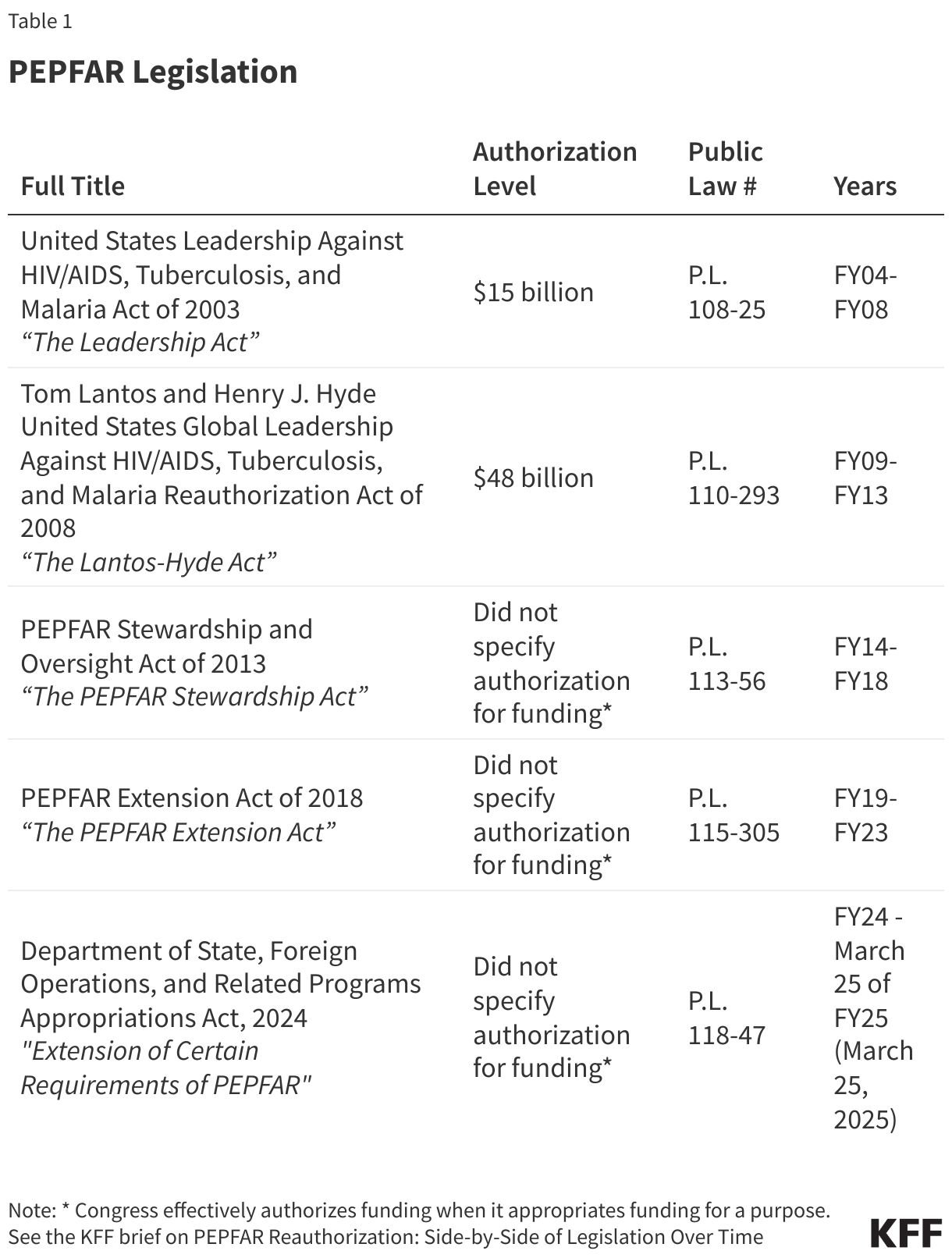
Although the U.S. has been involved in efforts to address the global HIV/AIDS crisis since the mid-1980s,4 the creation of the President’s Emergency Plan for AIDS Relief (PEPFAR) in 2003 marked a significant increase in funding and attention to the epidemic.5 PEPFAR, the U.S. government’s global effort to combat HIV and the largest global health program devoted to a single disease, is credited with saving millions of lives and helping to change the trajectory of the global HIV epidemic. It was announced in January 2003 during President George W. Bush’s State of the Union and authorized by Congress that same year through the Leadership Act (see Table 1). The Leadership Act governs PEPFAR’s HIV response, as well as U.S. participation in the Global Fund (an independent, international multilateral financing institution that provides grants to countries to address HIV, TB, and malaria) and bilateral assistance for TB and malaria programs.6 Congress has updated, extended, and made changes to the program through the Lantos-Hyde Act of 2008, the PEPFAR Stewardship Act of 2013, the PEPFAR Extension Act of 2018, and more recently, a short-term reauthorization of PEPFAR that extended certain timebound provisions through late March 2025, when they were allowed to lapse (see Table 1 and the KFF brief on PEPFAR reauthorization legislation over time). This short term reauthorization signaled a departure from the program’s long history of strong bipartisan support across multiple Congresses and administrations when, in an increasingly partisan environment, it was caught up in the broader U.S. political debate over abortion (see the KFF brief on PEPFAR’s short term reauthorization). This and other rapidly-evolving developments, including the Trump administration’s review of foreign assistance, has introduced significant uncertainty about PEPFAR’s future, including its reauthorization prospects, although PEPFAR is a permanent part of U.S. law and will continue as long as Congress continues to provide funding to it.
Organization
PEPFAR’s original authorization established new structures and authorities, consolidating all U.S. bilateral and multilateral activities and funding for global HIV/AIDS. Several U.S. agencies, host country governments, and other organizations are involved in implementation.7
PEPFAR is overseen by the U.S. Global AIDS Coordinator, who is appointed by the President, confirmed by the Senate, and reports directly to the Secretary of State, as established through PEPFAR’s authorizing legislation.8 The Coordinator holds the rank of Ambassador and leads the Office of the Global AIDS Coordinator (OGAC) at the Department of State.9 The Coordinator has primary responsibility for the oversight and coordination of all U.S. global HIV activities and funding across multiple U.S. implementing agencies and departments. In addition, the Coordinator serves as the U.S. Government’s board member to the Global Fund (the U.S. Government holds a permanent seat on the Global Fund’s Board). The Coordinator is dual-hatted as the U.S. Special Representative for Global Health Diplomacy and also leads the broader Bureau of Global Health Security and Diplomacy, which brings together PEPFAR with global health security and global health diplomacy functions.10 Currently, the President has not yet nominated a Coordinator and it is unclear when or whether someone will be nominated.
In addition to the Department of State, other implementing departments and agencies for HIV activities include: the U.S. Agency for International Development (USAID), PEPFAR’s largest government implementing agency (the Trump administration has moved to dissolve USAID, creating uncertainty about how PEPFAR’s implementation will be managed by the U.S. government going forward); the Department of Health and Human Services, primarily through the Centers for Disease Control and Prevention (CDC); the Departments of Labor, Commerce, and Defense (DoD); and the Peace Corps.11 As the Trump administration continues its review of foreign assistance and pursues reorganization of global health programs, Congress has yet to weigh in and it is unclear what the future of PEPFAR will look like.
Key Activities and Results
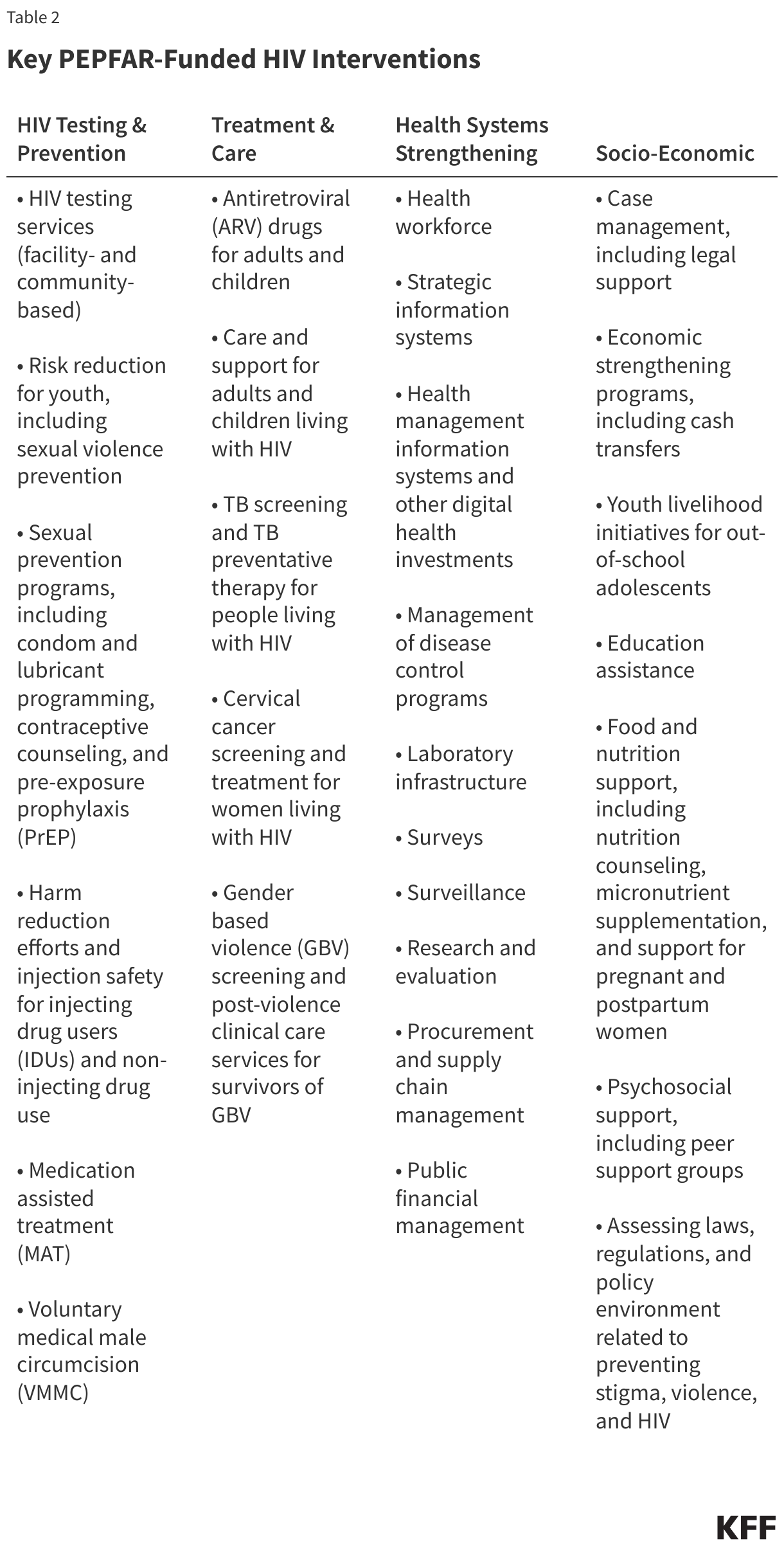
PEPFAR reports saving an estimated 26 million lives and its activities have focused on expanding access to HIV prevention, treatment, and care interventions. These have included provision of antiretroviral treatment, pre-exposure prophylaxis, voluntary male circumcision, condoms, and other commodities related to HIV services (see Table 2).12 ,13 In addition, PEPFAR has launched specific initiatives in key strategic areas. For example, in 2015, PEPFAR launched DREAMS, a public-private partnership that aims to reduce HIV infections in adolescent girls and young women.
The latest results reported by PEPFAR indicate that it has:
- supported testing services for 83.8 million people in FY 2024;
- prevented 7.8 million babies from being born with HIV, who would have otherwise been infected;
- provided care for more than 6.6 million orphans, vulnerable children (OVC), and their caregivers;
- supported training for nearly 342,000 new health care workers; and
- supported antiretroviral treatment for 20.6 million people.14
Additionally, it reports that PEPFAR reached 2.3 million adolescent girls and young women with HIV prevention services in FY 2024, and new diagnoses among this population have declined, with the higher rate of initiation of pre-exposure prophylaxis (PrEP) to prevent HIV infection in countries implementing the DREAMS initiative compared to areas without DREAMS programming.15 The Trump administration’s foreign aid review and funding freeze have limited PEPFAR’s activities to those defined in a limited waiver, significantly scaling back PEPFAR’s scope to what the waiver defines as “life-saving HIV services,” which include only certain activities: HIV treatment and care, prevention of mother-to-child transmission (PMTCT), pre-exposure prophylaxis (PrEP) for pregnant and breastfeeding women, and HIV testing.
Countries Reached
Historically, PEPFAR bilateral programs were carried out in more than 50 countries.16 Additional countries are reached through U.S. contributions to the Global Fund. PEPFAR currently requires 25 countries17 and the Asia, Western Hemisphere, and West Africa regional programs to develop “Country Operational Plans” (COPs) and “Regional Operational Plans” (ROPs), respectively, to document annual investments and anticipated results.18 OGAC reviews and the Global AIDS Coordinator approves COP/ROPs.
Funding19
Total PEPFAR funding20 includes bilateral funding for HIV activities conducted by U.S. implementing agencies as well as U.S. contributions to the Global Fund and UNAIDS,21 as specified by Congress for PEPFAR in annual appropriations bills.22 It represents the majority of U.S. global health funding (about 53% in recent years23 ) and is the largest commitment by any nation to address a single disease in the world. To date, PEPFAR funding has totaled over $120 billion, with funding reaching $6.5 billion in FY 2025 (in FY 2025, PEFPAR funding was provided through a continuing resolution, which maintained the prior year amount; see figure).

PEPFAR’s creation marked a significant increase in the amount of funding provided by the U.S. for HIV. Trends in funding for bilateral programs and contributions to multilateral organizations are as follows (see the KFF fact sheet on the U.S. Global Health Budget: Global HIV Funding, Including PEPFAR and U.S. Global Health Budget: The Global Fund):
- Bilateral HIV Funding: The majority of PEPFAR funding (ranging from 70-77% each year over the past decade) is provided for bilateral programs through the State Department (most of which is then transferred to other agencies), USAID, CDC, and DoD. Bilateral funding rose rapidly from $822 million in FY 2003 (the year before PEPFAR) to a peak of $5.0 billion in FY 2010. Between FY 2010 and FY 2013, it declined by more than $750 million. While it has risen since then, bilateral funding in FY 2025 ($4.8 billion), which Congress provided through a continuing resolution, was still $233 million below its peak level, and funding has been mostly flat for the past several years.
- Multilateral Contributions: The U.S. also supports global HIV efforts through contributions to the Global Fund and UNAIDS. Support for the Global Fund, which accounts for most of the multilateral contributions, increased rapidly in its early years and fluctuated over time; it reached its highest level to date ($2.0 billion) in FY 2023. In FY 2025, funding for the Global Fund, which represented a carry-over from FY 2024 levels due to the continuing resolution, was $1.65 billion, $375 million less than the FY 2023 level, though this is due to a legislative requirement that limits the amount the U.S. can contribute to the Global Fund to not more than 33% of all contributions.24 The U.S. contribution to UNAIDS was $45 million for most years over the past decade, but increased to $50 million in FY 2022, where it has remained.
- Emergency Funding: In FY 2021, an additional $3.8 billion in emergency supplemental funding was provided for bilateral HIV ($250 million) and the Global Fund ($3.5 billion) to address COVID-19.25
Spending Directives26
PEPFAR has included several spending directives, or earmarks, from Congress over the course of its history, many of which have changed over time:
- The Leadership Act, PEPFAR’s original authorization, included the following spending directives: 55% of funds were to be spent on treatment; 15% on palliative care; 20% on prevention, of which at least 33% be spent on abstinence-until-marriage programs; and 10% on OVC. While these were included as “sense of Congress” recommendations, the treatment, OVC, and abstinence-until-marriage earmarks were made requirements as of FY 2006.
- The Lantos-Hyde Act relaxed some of these directives for the FY 2009 – FY 2013 period: while still requiring that 10% of funds be spent on programs targeting OVC, it changed the treatment earmark from 55% to requiring that at least half of bilateral HIV assistance be spent on treatment and care. It removed the 33% abstinence-until-marriage directive and replaced it with a requirement of “balanced funding” for prevention to be accompanied by a report to Congress if less than half of prevention funds were spent on abstinence, delay of sexual debut, monogamy, fidelity, and partner reduction activities in any host country with a generalized (high prevalence) epidemic.
- The PEPFAR Stewardship Act, The PEPFAR Extension Act, and recent short-term reauthorization have maintained the language in the Lantos-Hyde Act. With the expiration of the short-term reauthorization, eight timebound provisions have now lapsed.
PEPFAR & The Global Fund
The U.S. is the single largest donor to the Global Fund. Appropriations for the U.S. contribution to the Global Fund totaled approximately $31.5 billion from FY 2001 through FY 2025.27 This includes, $3.5 billion in FY 2021 emergency funding that the U.S. government provided to the Global Fund to help the organization address the impacts of COVID-19 (in addition to the $250 million in emergency funds provided to bilateral HIV for COVID-19-related efforts).28
The Global Fund provides another mechanism for U.S. support by funding programs developed by recipient countries, reaching a broader range of countries, and supporting TB, malaria, and health systems strengthening (HSS) programs in addition to (and beyond their linkage with) HIV.29 To date, over 120 countries30 have received Global Fund grants. Most Global Fund support (52%) has been committed to HIV and HIV/TB programs,31 followed by 29% to malaria, 15% to TB, and 4% to other health issues.32 The original authorization of PEPFAR, and subsequent reauthorizations, included a limit on annual U.S. contributions to the Global Fund that prevented them from causing cumulative U.S. contributions to exceed 33% of the Global Fund’s total contributions (see the KFF fact sheet on the Global Fund). 33 ,34
- KFF analysis of The Global Fund: https://data-service.theglobalfund.org/downloads. ↩︎
- Totals represent funding specified by Congress in annual appropriations bills and/or identified by agencies for the Department of State, USAID, CDC, and DoD. In addition, international HIV research activities are supported by the NIH Office of AIDS Research (OAR) through its annual appropriated budget, but these amounts are not considered part of PEPFAR. See KFF’s “Breaking Down the U.S. Global Health Budget by Program Area” for additional information. ↩︎
- UNAIDS. 2024 UNAIDS Global AIDS Update: The urgency of now – AIDS at the crossroads; July 2024. ↩︎
- The U.S. first provided funding to address the global HIV epidemic in 1986. Then, in 1999, President Bill Clinton announced the Leadership and Investment in Fighting an Epidemic (LIFE) Initiative to address HIV in 14 African countries and in India. Later, in 2002, President George W. Bush announced the International Mother and Child HIV Prevention Initiative focused on 12 African and two Caribbean countries. ↩︎
- PEPFAR. 2009 Annual Report to Congress; Jan. 2009. ↩︎
- U.S. Congress. P.L. 108-25; May 27, 2003. ↩︎
- KFF. The U.S. Government and Global Health, Sep. 2022. CRS. PEPFAR Reauthorization: Key Policy Debates and Changes to U.S. International HIV/AIDS, Tuberculosis, Malaria and Programs and Funding; Jan. 2009. ↩︎
- U.S. Congress. Public Law No: 108-25; May 27, 2003. ↩︎
- U.S. Department of State. “Leadership – Bureau of Global Health Security and Diplomacy” webpage, https://www.state.gov/leadership-bureau-of-global-health-security-and-diplomacy. ↩︎
- Department of State. “ Leadership – Bureau of Global Health Security and Diplomacy,” webpage, https://www.state.gov/leadership-bureau-of-global-health-security-and-diplomacy/. ↩︎
- PEPFAR. “About Us,” webpage, https://www.state.gov/about-us-pepfar/. ↩︎
- Table 2 categorization is based on interventions laid out in the PEPFAR Financial Classification Reference Guide, used for program budgeting. See: PEPFAR Financial Classifications Reference Guide, June 2024. ↩︎
- KFF. Funding for Key HIV Commodities in PEPFAR Countries; July 2021. ↩︎
- PEPFAR. PEPFAR Latest Global Results; December 2024. ↩︎
- The 15 African countries that are implementing DREAMS include Botswana, Cote d’Ivoire, Eswatini, Haiti, Kenya, Lesotho, Malawi, Mozambique, Namibia, Rwanda, South Africa, Tanzania, Uganda, Zambia, and Zimbabwe. PEPFAR. DREAMS Country Fact Sheets; June 27, 2020; PEPFAR. PEPFAR Latest Global Results; December 2024. ↩︎
- PEPFAR, “Where We Work” webpage, https://www.state.gov/where-we-work-pepfar/; PEPFAR 2023 Country Operational Plan Guidance for all PEPFAR Countries; and CDC’s “Where We Work” webpage, https://www.cdc.gov/global-hiv-tb/php/where-we-work/. ↩︎
- The 25 countries that are required to complete a FY23 COP are Angola, Botswana, Burundi, Cameroon, Cote d’Ivoire, Democratic Republic of the Congo, Dominican Republic, Eswatini, Ethiopia, Haiti, Kenya, Lesotho, Malawi, Mozambique, Namibia, Nigeria, Rwanda, South Africa, South Sudan, Tanzania, Uganda, Ukraine, Vietnam, Zambia, and Zimbabwe. PEPFAR. “Where We Work” webpage, https://www.state.gov/where-we-work-pepfar/. ↩︎
- PEPFAR. 2023 Country and Regional Operational Plan Guidance and Technical Considerations; Feb. 2023. ↩︎
- U.S. Congress. Public Law No: 112-25; Aug. 2, 2011. White House Office of Management and Budget (OMB). OMB Report to the Congress on the Joint Committee Sequestration for Fiscal Year 2013; March 1, 2013. KFF analysis of data from: Congressional appropriations bills and reports; Federal Agency Budget and Congressional Justification documents; ForeignAssistance.gov; KFF personal communication with the Office of Management and Budget. ↩︎
- Overall PEPFAR funding technically includes support for bilateral HIV and TB activities, as well as contributions to multilateral organizations (specifically, the Global Fund and UNAIDS). This analysis only focuses on bilateral funding for HIV and contributions to multilateral organizations. ↩︎
- UNAIDS is the Joint United Nations Programme on HIV/AIDS, the U.N. system’s coordinating body that serves to help galvanize worldwide attention to AIDS. ↩︎
- Totals represent funding specified by Congress for PEPFAR in annual appropriations bills and/or identified by agencies for the Department of State, USAID, CDC, and DoD. In addition, international HIV research activities are supported by the NIH Office of AIDS Research (OAR) through its annual appropriated budget, but these amounts are not considered part of PEPFAR. See KFF’s “Breaking Down the U.S. Global Health Budget by Program Area” for additional information. ↩︎
- Includes bilateral funding for HIV as well as U.S. contributions to UNAIDS and the Global Fund to Fight AIDS, Tuberculosis and Malaria through regular appropriations. ↩︎
- U.S. Congress. Public Law No: 118-47; March 23, 2024. ↩︎
- KFF analysis of data from the “American Rescue Plan Act of 2021” (P.L. 117-2). ↩︎
- U.S. Congress. Public Law No: 108-25; May 27, 2003. U.S. Congress. Public Law No: 110-293; July 30, 2008. U.S. Congress. Public Law No: 113-56; Dec. 2, 2013. U.S. Congress. Public Law No: 115-305; Dec. 11, 2018. U.S. Congress. Public Law No: 118-47; March 23, 2024. ↩︎
- Includes funding through regular appropriations and emergency supplemental funding. KFF analysis of data from: Congressional appropriations bills and reports; Federal Agency Budget and Congressional Justification documents; ForeignAssistance.gov; KFF personal communication with the Office of Management and Budget. ↩︎
- KFF analysis of data from the “American Rescue Plan Act of 2021” (P.L. 117-2). ↩︎
- Congress states that the Global Fund is the multilateral component of PEPFAR in the following: U.S. Congress. Public Law No: 110-293; July 30, 2008. U.S. Congress. Public Law No: 113-56; Dec. 2, 2013. ↩︎
- Does not include countries that may have received funding through multi-country or regional programs. Additional countries may be reached through multi-country or regional programs. ↩︎
- Of the 52% committed to HIV and HIV/TB programs, 39.4% was for HIV activities and 12.3% was for HIV/TB activities. ↩︎
- In 2020, some donor governments provided COVID-specific emergency contributions to the Global Fund in addition to their contributions to core activities. For the purposes of this fact sheet, these COVID-specific amounts have been excluded as they cannot be attributed to a specific area, such as HIV, TB, or malaria. The Global Fund. Data Explorer; accessed July 2024: https://data.theglobalfund.org/. ↩︎
- U.S. Congress. Public Law No: 108-25; May 27, 2003. U.S. Congress. Public Law No: 110-293; July 30, 2008. U.S. Congress. Public Law No: 113-56; Dec. 2, 2013. U.S. Congress. Public Law No: 118-47; March 23, 2024. KFF. PEPFAR Reauthorization: Side-by-Side of Legislation Over Time, brief. ↩︎
- See the KFF. The U.S. & The Global Fund to Fight AIDS, TB and Malaria, fact sheet; and KFF. PEPFAR Reauthorization: Side-by-Side of Legislation Over Time, brief. ↩︎