How Has Projected Medicaid Spending and Enrollment Changed Since Passage of the 2025 Reconciliation Law?

Published: Jul 1, 2026

The Congressional Budget Office (CBO), known as Congress’s “scorekeeper,” projects federal spending and revenues over the next decade and cost estimates of proposed legislation are measured against those projections. Those projections include spending on major federal programs, such as Medicaid. CBO also typically releases a detailed baseline for federal spending on Medicaid that includes estimates of enrollment by eligibility group and spending by service category. The 2025 reconciliation law, signed into law by President Trump on July 4, 2025, made major changes to federal revenues and spending, with CBO estimating the new law would reduce federal spending on Medicaid by $911 billion over the 2025-2034 period, relative to its January 2025 baseline projections of Medicaid spending under the law and regulations at the time.

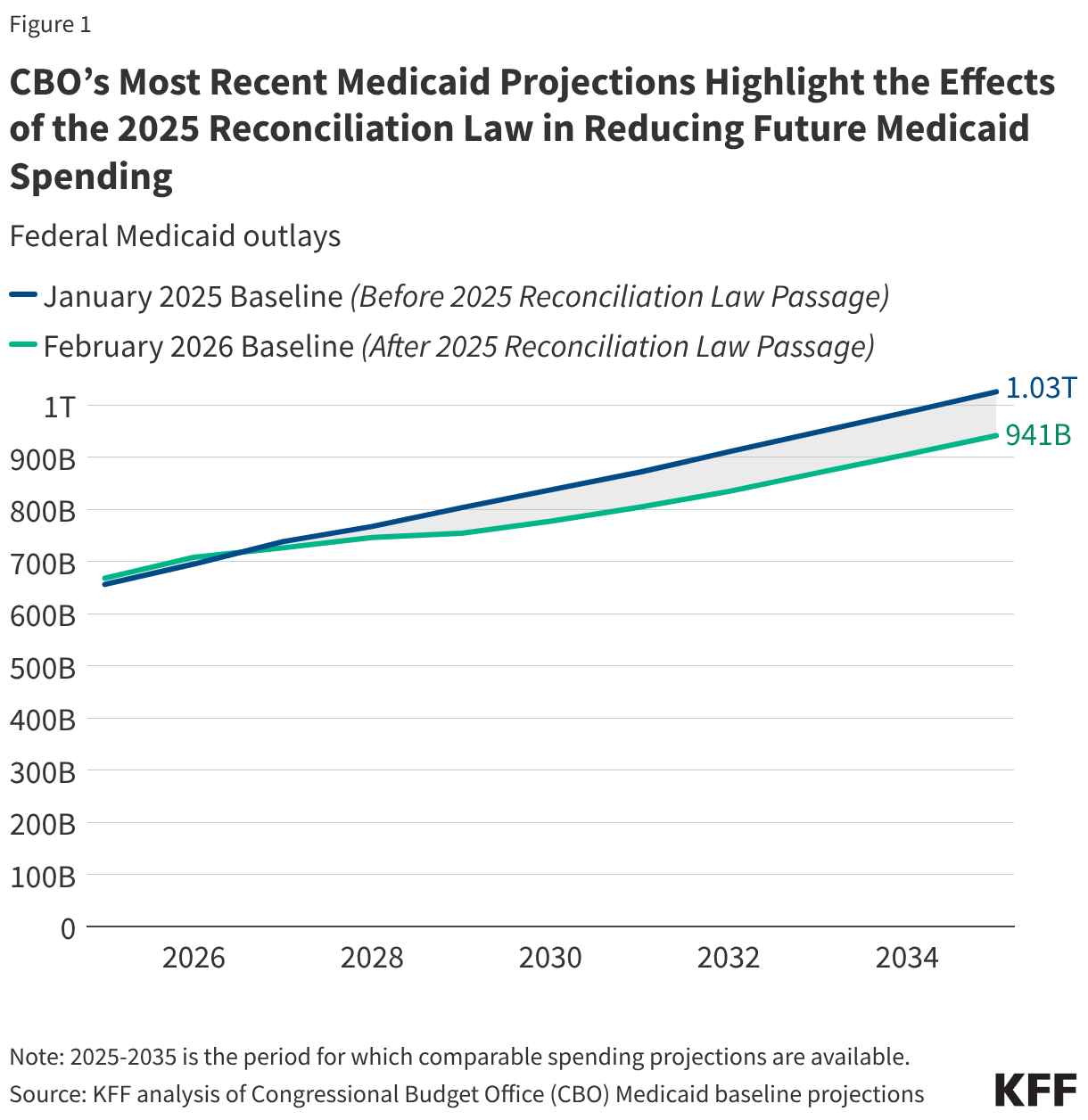
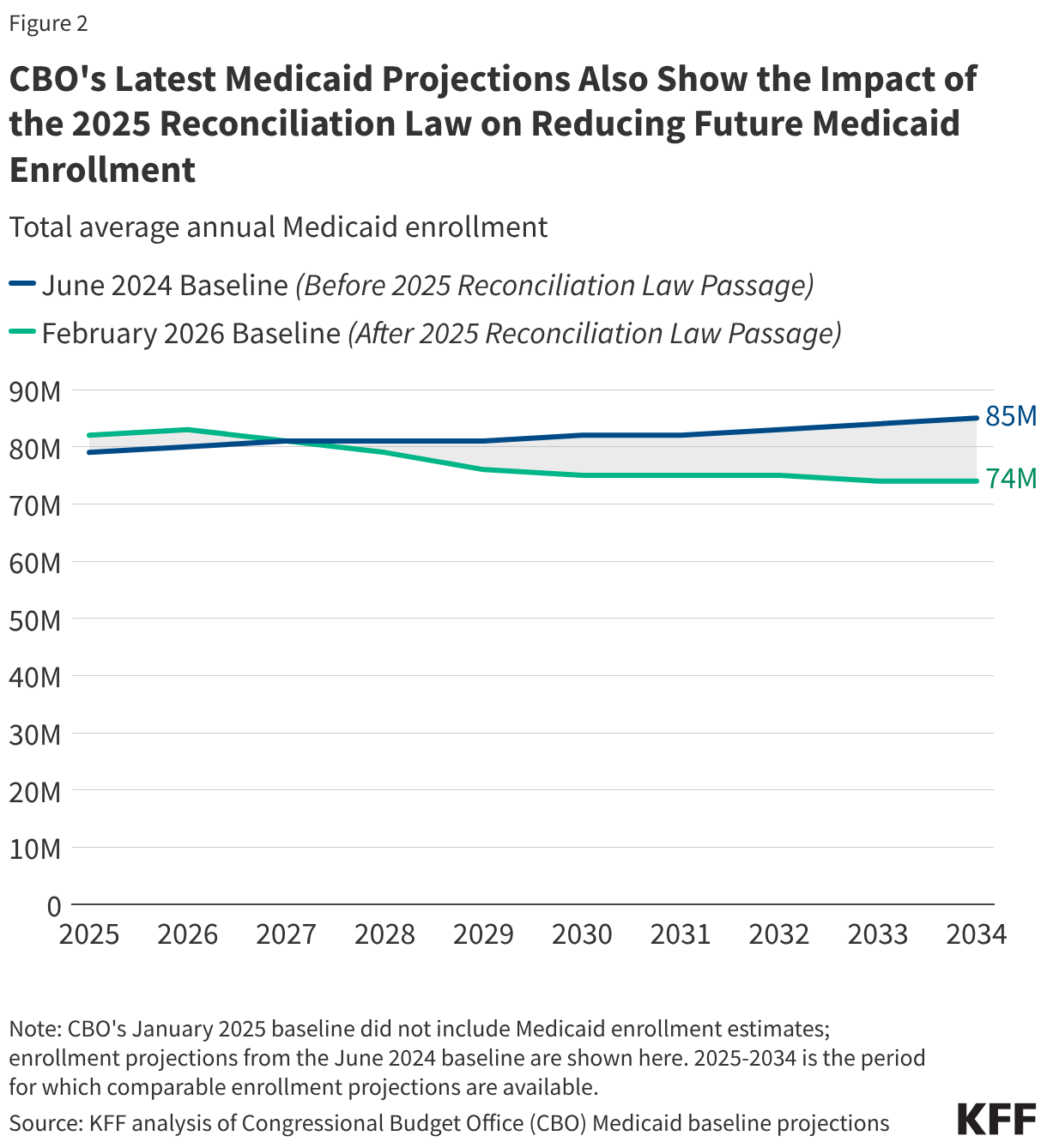
CBO’s latest projections of Medicaid spending and enrollment from February 2026 show how enrollment and spending are expected to change over the next decade, accounting for the historic policy changes and their expected reductions in future federal Medicaid spending as well as other economic and technical changes. This policy watch compares CBO’s February 2026 projections of Medicaid spending and enrollment to earlier CBO projections. Projections of spending are compared to those from January 2025 (the baseline used to score the 2025 reconciliation law), but the most recent prior Medicaid enrollment projections are from June 2024. CBO’s newest projections show that enrollment is estimated to be 13% lower and spending 8% lower at the end of the budget windows, highlighting a significant shift in baselines stemming from Medicaid cuts in the 2025 reconciliation law. However, those changes understate the true effects of the 2025 reconciliation law because other factors caused Medicaid baseline spending to increase. 

CBO’s most recent Medicaid projections highlight the effects of the 2025 reconciliation law in reducing future Medicaid spending. The most recently released detailed CBO baseline shows that, following passage of the Medicaid changes in the reconciliation law, Medicaid spending is now expected to grow more slowly over time relative to earlier projections. As a result, 2035 spending is projected to be 8% lower than it was in the January 2025 baseline ($941 billion instead of $1.03 trillion, Figure 1). Over the entire 2025-2035 period, federal Medicaid spending in CBO’s latest baseline is projected to be $503 billion lower than estimated in the January 2025 baseline, before the passage of the 2025 reconciliation law. The reconciliation law included major changes to Medicaid eligibility, including the implementation of new Medicaid work requirements, and substantial changes to Medicaid financing, which together contribute to Medicaid’s lower baseline compared with prior years. CBO projects that federal Medicaid spending will still grow but more slowly because of the reductions in the reconciliation law. As a result, fewer people will be covered, and aggregate federal Medicaid spending will likely not keep pace with the increase in health care costs.

CBO’s Most Recent Medicaid Projections Highlight the Effects of the 2025 Reconciliation Law in Reducing Future Medicaid Spending (Line chart)

CBO’s latest spending projections also account for economic and technical changes that increased Medicaid spending relative to the January 2025 baseline, so comparing baselines may understate the effects of Medicaid cuts in the 2025 reconciliation law. One of the biggest reasons for increased spending was higher-than-expected per enrollee spending in 2025. CBO reports that costs per enrollee grew by 16% in that year, primarily because of declining health status after the COVID-19 continuous enrollment period ended. Those higher 2025 costs per enrollee compound over time due to inflation and rising health care costs. If the most recent baseline projections did not account for those 2025 cost increases, the differences between January 2025 and February 2026 Medicaid spending projections, driven by the Medicaid policy changes in the reconciliation law, would be larger.

CBO’s latest Medicaid projections also show the impact of the 2025 reconciliation law on reducing future Medicaid enrollment. The latest baseline shows that total average annual Medicaid enrollment is expected to decline, falling to 74 million enrollees by 2034 (a 13% reduction) compared with 85 million projected in the detailed baseline released before the new law’s passage. Many individuals who lose Medicaid coverage do not have another source of affordable health coverage and will become uninsured. CBO’s earlier estimates of the Medicaid policy changes in the reconciliation law found the new law will reduce Medicaid enrollment by more than 11 million and increase the number of people without insurance by 7.5 million in 2034, though these estimates do not account for recently released rules related to work requirements that could affect enrollment projections. CBO may release updated coverage estimates in the coming months. Data show that being uninsured has implications for access to care, financial stability, and health outcomes.

CBO's Latest Medicaid Projections Also Show the Impact of the 2025 Reconciliation Law on Reducing Future Medicaid Enrollment (Line chart)

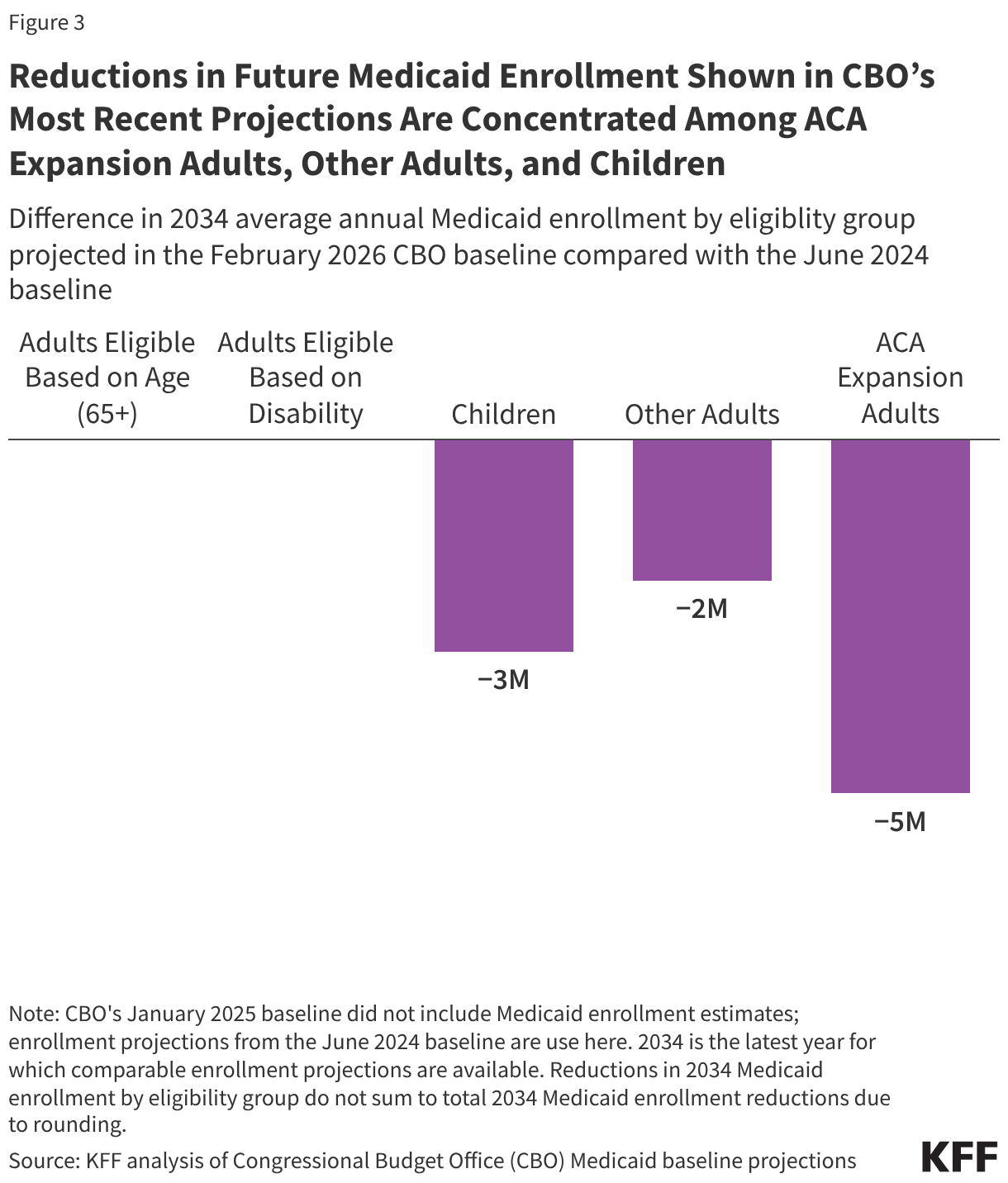
Reductions in future Medicaid enrollment shown in CBO’s most recent projections are concentrated among ACA expansion adults, other adults, and children. The eligibility changes in the 2025 reconciliation law primarily affect adults in the ACA Medicaid expansion group (including new work requirements and more frequent eligibility determinations). Comparing CBO’s projections with those prior to passage of the reconciliation law shows the largest change in enrollment among the ACA Medicaid expansion group (5 million fewer expansion enrollees in 2034). The latest detailed baseline also shows 3 million fewer children and 2 million fewer other adult enrollees than the previous detailed baseline, likely due to provisions that affect groups beyond the expansion group and research showing that coverage loss among parents may reduce enrollment among children.

Reductions in Future Medicaid Enrollment Shown in CBO’s Most Recent Projections Are Concentrated Among ACA Expansion Adults, Other Adults, and Children (Grouped column chart)

Tennessee Plans to Share Data on Children with Disabilities with Immigration Authorities

Published: Jun 29, 2026

According to recent news reports, the families of about 400 children with disabilities who are enrolled in Tennessee’s Children’s Special Services (CSS) program received notices from the state health department in early June stating that if their child continued to remain enrolled in CSS beyond June 30, 2026, their information would be reported to a central state immigration enforcement agency. However, following a lawsuit filed by physicians in the state, a judge issued a temporary restraining order on June 24, 2026, to prevent this data sharing from taking place. Tennessee is one of at least six states that have taken actions as of June 2026 to require state agencies to report applicants or recipients of Medicaid and/or other public benefits whose immigration status could not be verified and/or who were verified to not have lawful presence with immigration enforcement authorities. Under longstanding federal law, Medicaid and other federally funded health coverage are already limited to lawfully present immigrants.

In Tennessee, the legislation requires every state governmental entity, local governmental entity, and local health department to verify that each applicant who is 18 years of age or older and applies for a federal, state, or local public benefit is a United States citizen or lawfully present immigrant. It also requires these entities to report all identifying information for individuals who are not lawfully present and who receive federal, state, or local public benefits to the state’s centralized immigration enforcement division and makes it a criminal offense for an employee or official to intentionally fail to report an individual who is not lawfully present.

Tennessee has interpreted this law to include its CSS program, although Tennessee Representative Steve Cohen wrote a letter to Governor Bill Lee indicating that the law reads as limited to applicants who are at least 18 years old. Tennessee’s CSS program provides care coordination and payment assistance for certain services to people under age 21 whose family income is at or below 225% of the federal poverty level and who have a physical disability, such as cerebral palsy, cystic fibroses, sickle cell anemia or other serious medical conditions without immigrant eligibility restrictions. A recent report indicates more than 4,600 children in Tennessee are enrolled in CSS.

Health care providers and advocates in the state have warned that this data sharing will likely lead families to stop participating in the program, which could lead to disruptions in care that have life threatening consequences. Reporting requirements could also have “chilling effects” that lead to disenrollment and forgone enrollment among a broader group of families than those subject to the new reporting requirements due to confusion and fear. 

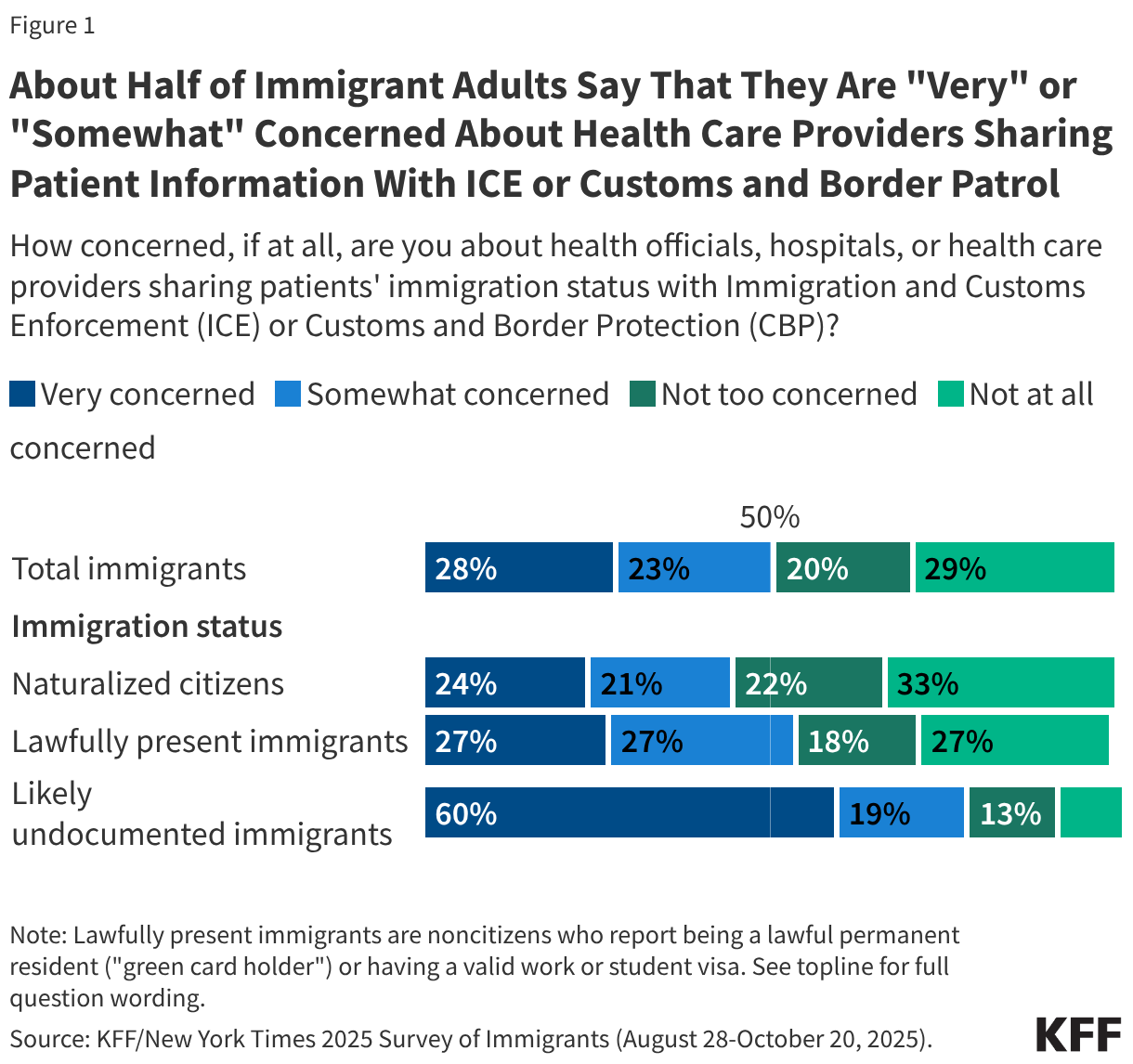
A 2025 national KFF survey shows that the share of immigrant adults who said they avoided applying for a government program that helps pay for food, housing, or health care in the past 12 months because they did not want to draw attention to their or a family member’s immigration status rose from 8% to 12% between 2023 and 2025. Further, 11% of immigrant adults say they have stopped participating in such a program since January 2025 because of immigration-related worries, including about four in ten (42%) of those who are likely undocumented and about one in six (17%) parents. Moreover, about half (51%) of immigrant adults overall and about eight in ten (78%) of those who are likely undocumented said they are “somewhat” or “very” concerned about health officials or providers sharing patient information with immigration enforcement officials (Figure 1). These data were collected prior to recent state-level actions to share data on immigrant families with immigration enforcement officials.

About Half of Immigrant Adults Say That They Are "Very" or "Somewhat" Concerned About Health Care Providers Sharing Patient Information With ICE or Customs and Border Patrol (Stacked Bars)

Beyond the data sharing actions in Tennessee and several other states, in July 2025, the Centers for Medicare and Medicaid Services (CMS) and U.S. Immigration and Customs Enforcement (ICE) established an Information Exchange Agreement that enables immigration enforcement officials to access the personal data of millions of Medicaid enrollees to help identify and locate “aliens in the United States.” This data sharing represents a reversal in prior policy that asserted CMS would not share such information and ICE would not use such information for immigration enforcement purposes, with assurances made to the public, applicants and enrollees, health care providers, and states that information collected to determine eligibility for health coverage programs would not be used for immigration enforcement. The administration also has directed the Internal Revenue Service to share personal information of individuals for immigration enforcement purposes, although these actions are facing court challenges.

A Closer Look at North Carolina’s Implementation of the 2025 Reconciliation Law Medicaid Provisions and Other Changes Amid Medicaid Budget Shortfalls

Published: May 29, 2026

On April 30, 2026, North Carolina Governor Josh Stein signed legislation that includes Medicaid policy changes and closes an estimated $319 million shortfall in funding for the state’s Medicaid program for FY 2026. Many of the legislation’s Medicaid policy changes are related to implementation of the 2025 federal reconciliation law. The 2025 reconciliation law requires states to condition Medicaid eligibility for adults in the Affordable Care Act (ACA) Medicaid expansion group and enrollees in partial expansion waiver programs (Georgia and Wisconsin) on meeting work requirements starting January 1, 2027. The 2025 reconciliation law also limits states’ ability to raise the state share of Medicaid spending through provider taxes, restricts state-directed payments (SDPs) to hospitals, nursing facilities, and other providers, and increases barriers to enrolling in and renewing Medicaid coverage. As states are preparing to implement the reconciliation law provisions, many states are facing more tenuous budget situations with slowing revenue growth and broader reductions in federal funding.

This policy watch examines the current budget context in North Carolina, the state’s recently passed legislation, the state’s Medicaid Advisory Committee (MAC) meetings, and data from KFF’s Medicaid work requirements tracker to provide initial insight into how North Carolina is preparing to implement certain Medicaid provisions of the 2025 reconciliation law and how other policy changes may affect coverage and access to care. While some of the issues North Carolina is facing are unique to that state, others are likely to be faced by other states as they implement federal changes to Medicaid in the midst of other fiscal challenges.

What is the budgetary context as North Carolina prepares to implement the 2025 reconciliation law’s provisions?

North Carolina is facing a more tenuous fiscal climate like in other states, and state legislators have not yet enacted a comprehensive state budget for the FY 2025-27 biennium. In the past year, revenue volatility and rising costs have led to slowing state revenue growth following a period of record-breaking revenue and expenditure growth for states after the initial pandemic-induced economic downturn. In North Carolina, scheduled tax cuts have been projected to drive declines in state revenue, and debates over whether to proceed with the cuts have contributed to a budget stalemate in the legislature.

In August 2025, Governor Stein signed a stopgap funding bill  that appropriated $600 million from the state general fund for Medicaid, but it left a $319 million shortfall for FY 2026 in funding for the cost of services for non-expansion (traditional) enrollees. The shortfall and budget stalemate led to rate cuts and the elimination of GLP-1 coverage, both of which were eventually restored. The Medicaid agency ceased “Healthy Opportunities Pilots” program services in FY 2026 due to a lack of appropriations. The pilots covered certain non-medical services that target social needs, including housing, nutrition, transportation, and interpersonal relationship supports to specific and limited enrollees, and evaluations of the “Healthy Opportunity Pilots” 1115 waiver showed lower costs over time and largely positive outcomes. The Medicaid agency also implemented changes to reduce administrative expenses, including reducing temporary staff and contractors, ending certain contracts, pausing quality improvement projects, and scaling back compliance and quality oversight activities. The legislation signed in April 2026 appropriated $319 million to close the shortfall for FY 2026 and made changes aimed at addressing financing pressures associated with new federal limits on provider taxes, which the state uses to help finance its Medicaid expansion and hospital state directed payment program (which increases payment rates for hospitals).

What are some of the Medicaid policy changes included in North Carolina’s recent legislation?

Eligibility and Cost Sharing

North Carolina’s new legislation includes more restrictive standards for how the state will implement work requirements than is required in current law. At a minimum, the 2025 reconciliation law requires states to look back one month immediately preceding the application month and one month between renewal periods to confirm compliance with the requirements. North Carolina’s legislation requires the state to confirm compliance for the three months preceding the application month. At renewal, the state must confirm compliance for at least three of the six months since the last determination of eligibility. The North Carolina legislation also prohibits the acceptance of self-attestation as the only evidence in verification of eligibility requirements (unless required by federal law or regulation, or pursuant to a court order). States await guidance from CMS as to whether self-attestation of medical frailty, parent/caretaker status, or other exemptions or work status can be accepted, but most states report plans to accept self-attestation if allowed. 

The legislation increases the frequency of data checks to identify changes in circumstances for Medicaid enrollees from quarterly to monthly. The state will review information on earned and unearned income, employment status and changes in employment, residency status, enrollment status for other public assistance programs administered by the state and outside of the state, financial resources, incarceration status, and lottery and gambling winnings. States are required to follow up on reported changes that potentially affect eligibility and give individuals an opportunity to respond before taking adverse action. In North Carolina, when data indicates an individual is no longer eligible, enrollees only have 10 days in advance of case closure to submit documentation verifying ongoing eligibility. Increasing the frequency of periodic data checks with insufficient response times can lead to procedural disenrollments and exacerbate churn.

The Medicaid agency will be required to set Medicaid copayments at the highest allowable amounts for both traditional Medicaid enrollees and ACA expansion enrollees. Current federal rules limit cost sharing in Medicaid because of enrollees’ low income and limited ability to pay out of pocket costs. The maximum allowable cost sharing varies by type of service and enrollee income. North Carolina has set current cost sharing amounts, regardless of enrollee income, at $4 per service. Starting July 1, 2027, the legislation requires the Medicaid agency to increase current cost sharing amounts for services where the maximum allowable amount is more than $4 and to increase cost sharing for ACA expansion adults with income 100-138% FPL to up to 10% of the cost of the service, except for prescription drugs and non-emergency use of the emergency department. Beginning in October 2028, when states are required to implement mandatory cost sharing of up to $35 per service for ACA expansion adults with income between 100%-138% FPL, the state will be required to set cost sharing amounts at $35 per service, except for prescription drugs, for all non-exempt services for this group. 

The legislative text implementing the changes to Medicaid eligibility for certain lawfully residing immigrants effectively ends the state’s long-standing optional Medicaid coverage for lawfully residing children and pregnant immigrants without a five-year waiting period. The law limits Medicaid coverage for immigrants to coverage that is required under federal law. However, North Carolina is one of 40 states that have taken up the option to extend Medicaid and/or CHIP coverage to children and/or pregnant adults who are lawfully residing and waive the five-year wait for these groups. The 2025 reconciliation law imposed additional eligibility restrictions for many lawfully present immigrants but allows states to maintain the option to cover lawfully residing children and pregnant adults. By limiting coverage for immigrants to only what is required by federal law, the state law effectively ends this optional coverage as of October 1, 2026. In a recent Medicaid Advisory Committee (MAC) meeting, the Medicaid agency indicated it was working with the legislature to make “corrections” and restore coverage for these populations.

The legislation requires the Medicaid agency to report certain Medicaid applicants and enrollees for whom it cannot verify citizenship or “satisfactory” immigration status to the Department of Homeland Security. These include applicants and enrollees who, after a reasonable opportunity period, have not verified satisfactory immigration status or whose final verification indicates that they do not have a satisfactory immigration status and are not lawfully present. This group would include those found ineligible based on immigration status and individuals receiving Emergency Medicaid services (where Medicaid pays hospitals for emergency care provided to ineligible immigrants who would otherwise be eligible for Medicaid based on their income).

Medicaid Financing

The legislation increases intergovernmental transfers (IGTs) from public hospitals, reducing reliance on the state’s hospital taxes for financing the nonfederal share of Medicaid spending. The 2025 reconciliation law imposes significant new restrictions on states’ ability to generate Medicaid provider tax revenue, including prohibiting all states from establishing new provider taxes or from increasing existing taxes, as well as reducing existing provider taxes for states that have adopted the ACA Medicaid expansion. North Carolina uses provider taxes to help finance the nonfederal share of Medicaid spending. State law requires the nonfederal share for the expansion program to be fully funded by certain non-general fund sources, including hospital taxes and hospital IGTs, and requires the end of expansion coverage if those sources cannot fully fund the nonfederal share. The state estimates $14.3 million in one-time administrative costs for the current state fiscal year and $44.4 million in recurring annual administrative costs (including both state and county expenditures) for the expansion program to implement work requirements and six-month eligibility redeterminations that existing financing mechanisms did not account for. The increased public hospital IGTs aim to offset the financing of some of the existing costs under the state’s hospital tax, as well as to help finance the new administrative costs.

By increasing reliance on IGTs as a financing source, the state may aim to retain higher hospital SDPs under new federal provider tax limits, but new federal requirements for state directed payments are expected to require further changes. North Carolina’s Healthcare Access and Stabilization Program (HASP), a hospital SDP program launched alongside Medicaid expansion in 2023, is also financed through hospital taxes and IGTs. An earlier state report indicated the new federal provider tax limits would eliminate all or most of HASP SDPs. The state has been using HASP payments to incentivize hospitals to relieve medical debt, and as of October 2025, more than $6.5 billion in debt had been relieved for more than 2.5 million North Carolinians under the initiative.

There is significant uncertainty about how federal regulations and state legislation may affect the state’s plan for financing the nonfederal share of Medicaid spending, including for the Medicaid expansion and HASP. New proposed rules on state directed payments and forthcoming provider taxes may affect the state’s financing plans. The state’s legislation created a “trigger” to end the new funding should HASP payments fall below certain thresholds or a change in federal law or regulation result in at least a 20% decrease to IGTs.

Is The U.S. Stepping Up In The Fight Against Ebola?

Published: May 23, 2026

Editorial Note: Originally published on May 21, this Policy Watch was updated on May 23 to incorporate additional information and developments.

The recently announced Ebola outbreak in the Democratic Republic of the Congo (DRC), which is quickly escalating in the region, emerges at a time when the larger fiscal and programmatic environment for global health efforts faces particular hurdles, and international cooperation has been significantly challenged. This is in large part due to policy decisions made by the Trump administration and presents the first real global outbreak test following those changes.

On May 15, news broke of a large, ongoing Ebola outbreak concentrated in northeastern DRC. Two days later, the Director-General of the World Health Organization (WHO) declared the outbreak to be a “public health emergency of international concern” (PHEIC) given its size and because Ebola cases were already reported across the border in Uganda, making the outbreak a regional threat. Despite only recently being detected and reported, this already appears to be one of the largest Ebola outbreaks to date, with almost 746 suspected cases and over 176 suspected deaths as of May 21st. 

National and international health authorities have recent experience responding to Ebola outbreaks, such as in West Africa in 2014-2015 (the largest since the virus was discovered in 1976) and in DRC between 2018 and 2020. However, this outbreak presents particular challenges. These include:

  • First, the species of Ebola virus circulating in the current outbreak is different from that which caused most prior major outbreaks, which means countermeasures such vaccines and treatments are not available, and even testing for this species can only be done at more specialized labs currently.
  • Second, the outbreak is happening in a geographic area with ongoing insecurity, multiple concurrent humanitarian crises, high population mobility, and limited access to health services. These factors played a role in the delayed identification of the outbreak and pose difficulties for the response.
  • Third, the international environment of health cooperation and financial support has changed significantly since the last big outbreak, driven in large part by the U.S. withdrawal from WHO and international cooperation more broadly as well as its reductions in foreign aid and health programming, but also by larger financial constraints due to aid cuts by other donors.

Even so, the public health effort has already started to ramp up, with DRC and Ugandan health authorities leading responses in their respective countries, supported by WHO, United Nations humanitarian agencies, the Africa CDC, and a network of other local, regional, and international non-governmental organizations.

For its part, the U.S. government has reported that it has already taken a number of steps in response to the outbreak, including:

  • Providing some financial support to national Ebola responses in DRC and Uganda. Within two days of learning of the outbreak, the State Department announced it had mobilized $23 million in emergency funding to support DRC and Ugandan government health responses. The State Department also announced it would direct U.S. humanitarian funding to assist with the broader humanitarian response in these countries. By comparison, this initial funding amount is larger than the $8 million the U.S. provided through USAID in the weeks following the identification of the 2018 Ebola outbreak in Equateur province in DRC, though the 2026 outbreak is already much larger and affects a wider geographic area. It is unclear at this point how much funding will ultimately be necessary for the current Ebola response, with authorities still trying to understand the true scope of the outbreak and community needs. The State Department expects the U.S. will increase its financial support for the current outbreak response over time. Over the course of the series of DRC Ebola outbreaks from 2018-2020, which ultimately caused over 2,300 deaths, USAID contributed $324 million, and CDC $37 million, to country response efforts, with these funds drawn entirely from prior emergency Ebola appropriations provided by Congress during the 2014-2015 West Africa Ebola epidemic.
  • Activating CDC emergency operations and mobilizing CDC staff and resources. CDC held a press conference within two days of the outbreak announcement, reporting that the agency has begun to assist DRC and Ugandan officials and connect with other partners via CDC offices in each country. CDC and State Department have begun supporting partner organizations in procuring and deploying needed supplies, such as personal protective equipment (PPE). CDC says it has a “long-standing” team of 30 staff in its DRC country office (primarily located in the capital, Kinshasa, which is hundreds of miles from the affected areas in northeastern DRC) and about 100 in Uganda, with more expected to be mobilized in the coming days, including experts from Atlanta who will travel to the affected countries. According to reports, CDC is taking the lead role for the U.S. government in the Ebola response in affected countries. For some context, during the response to Ebola outbreaks in DRC that began in 2018 and eventually grew to thousands of cases, CDC had 187 staff members complete 278 deployments through June 2019.  
  • Committing to help stand up Ebola isolation and treatment units. In a May 19 announcement, the State Department says it will be financing the deployment of “up to 50” Ebola Treatment Units and “associated frontline costs” to assist further with the response. These units will provide emergency Ebola screening, triage, and isolation capacity in affected areas.  According to the State Department, the U.S. funding will be delivered via “pooled funding vehicles administered by the United Nations Office for the Coordination of Humanitarian Affairs (OCHA).”
  • Deploying a Disaster Assistance Response Team (DART) to the region.  The State Department reports it will be deploying a DART to DRC, which is a mechanism meant to align and coordinate resources from various U.S. agencies under a single organizational structure. The State Department expects the DRC DART will allow CDC, State, and other U.S. agencies to be located together, fostering unified communications with host country governments and other partners.
  • Investigating potential monoclonal antibody treatments. According to a spokesperson for the Department of Health and Human Services (HHS), the Biomedical Advanced Research and Development Authority (BARDA) is working with a biotechnology company to make available an experimental Ebola treatment based on monoclonal antibodies for potential use in high-risk individuals. It is unclear how much may be made available and under what circumstances the treatment may be used.  

Still, given all of the changes made by the U.S. to its foreign assistance and global health response, U.S. support is taking shape under very different circumstances and through different organizational mechanisms compared to past Ebola responses. For example:

  • The absence of USAID. USAID supported Ebola prevention and detection activities in DRC, Uganda, and elsewhere for many years, employing dozens of staff members with outbreak surveillance and response expertise. However, much of that expertise and the underlying network of organizations was lost when USAID was dissolved and almost all its staff was fired last year. Historically, USAID was the lead agency representing the U.S. government during major Ebola response and was home to interagency DARTs. Now, the newly created State Department Bureau of Global Health Security and Diplomacy (GHSD) and State’s Bureau of Disaster and Humanitarian Response (DHR) are responsible for overseeing diplomatic and coordinating with CDC on technical aspects of an Ebola response for the first time, including through the newly announced DART, despite having fewer personnel than USAID had and limited prior experience overseeing an operational response. Ultimately, staffing for the U.S. response could be scaled up over time, as it was during prior outbreaks, such as during the 2014-2015 West Africa Ebola response, which ultimately consisted of a large U.S. government interagency presence that included the deployment of thousands of U.S. military personnel, hundreds of CDC and HHS staff, and representatives from other agencies.
  • Ongoing effects of foreign assistance funding freeze and cuts. Alongside the dissolution of USAID, in early 2025 the Trump administration implemented a freeze on all foreign assistance funding for a period last year. As a consequence, partner organizations report that they had to fire staff and cease many disease prevention and detection activities, including Ebola-focused activities in Uganda and DRC. . Eventually, the State Department issued “waivers” to allow funding for existing “life-saving” assistance programs to continue, which included infectious disease outbreak detection and response programs. While certain activities resumed, the underlying system itself was affected.
  • Withdrawal of U.S. membership in WHO. During past response to major Ebola outbreaks, WHO played important coordinating and financing roles, and is poised to serve a leading role in bringing international resources to bear in DRC and Uganda. WHO has already mobilized almost $4 million funding from its Contingency Fund for Emergencies (CFE), the mechanism created after the 2014-2015 West Africa Ebola outbreak to rapidly channel donor funding to support public health emergency response efforts. In the past, the U.S. had always been a major supporter of WHO’s responses and the CFE, including as one of the largest donors to the CFE, and to the multilateral Ebola response, during the 2018-2020 DRC Ebola outbreaks. However, given the U.S. withdrawal from WHO and more limited formal communications between U.S. government officials and WHO officials, the U.S. does has not indicated an interest in directly supporting a WHO-led response this time, a departure from past practices. With just $5.4 million in total donor contributions to the fund in 2026, CFE is already close to being exhausted, with other donors so far unable to fill the funding gaps left by the U.S. absence. While some formal communications between the U.S. and WHO have been limited, CDC has explicit permission to coordinate as necessary with international organizations involved in the response on the ground, including staff from WHO.
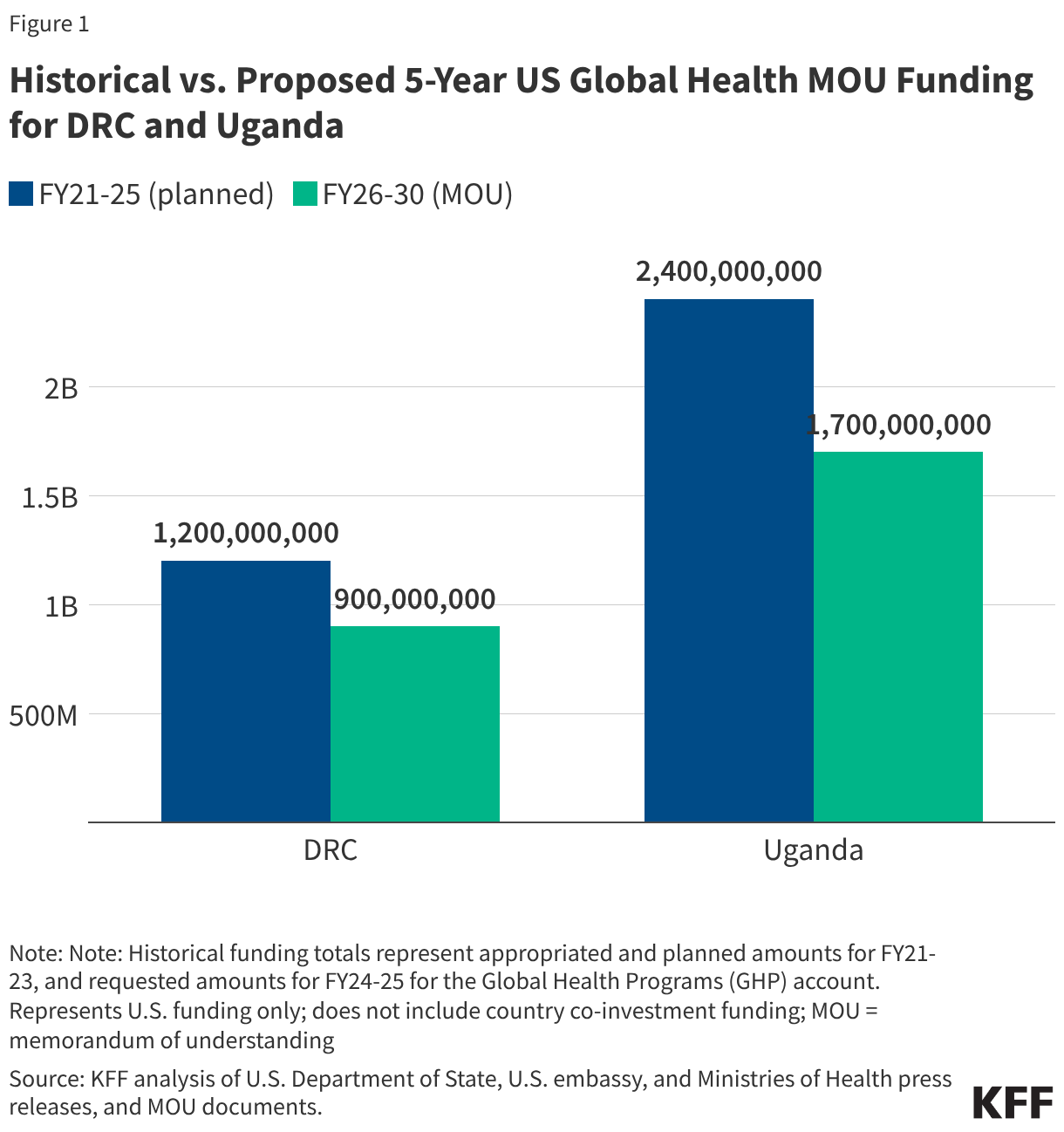
  • Reduced funding for global health in new U.S. agreements with DRC and Uganda. As referenced above, the dissolution of USAID and the foreign assistance funding freeze last year created de facto cuts to global health assistance in the Ebola-affected countries, affecting country programs. U.S. pledges of assistance over the next few years do represent a cut in funding compared to previous years. The new U.S. approach to global health assistance relies on negotiating country-specific agreements (memoranda of understanding, or MOUs), and such agreements have already been reached with Uganda (signed December 2025) and DRC (signed February 2026). However, the amount of funding pledged by the U.S. for the next 5 years represents a 27% cut compared to that provided over the past five years (see Figure).  The MOUs also outline priorities for the US and the partner countries for global health assistance, with disease surveillance and response being a key aspect for both the DRC and Uganda agreements. For example, the MOU with Uganda states the U.S. wishes to “advance its bilateral relationship with the Government of Uganda and prevent the spread of emerging and existing infectious disease threats globally”, and outlines the funding amounts the U.S. intends to provide the country each year to advance these priorities. However, it is not exactly clear how this new mechanism will shape the programs and outcomes from U.S. global health funding in these priority areas going forward.
Historical vs. Proposed 5-Year US Global Health MOU Funding for DRC and Uganda (Grouped column chart)

While these are still early days in a response that could last months (and facing an outbreak that appears to be escalating quickly), there are several key questions regarding the U.S. response going forward:

  • If the needs on the ground increase significantly, will the Trump administration request additional emergency funding from Congress, as previous administrations have done? In addition to the United Nations OCHA funds the U.S. is tapping into, are there other, as of yet untapped existing resources that could be mobilized?
  • If the outbreak worsens significantly, will the U.S. scale up its on the ground presence? Because the outbreak is occurring in an area with active conflict, direct deployment of CDC staff to affected areas in eastern DRC is unlikely, which is similar to the situation during the 2019 outbreaks of Ebola in DRC, where CDC provided support from afar but was not directly stationed in the field in affected areas. Could military personnel once again be called on to assist with the response, echoing the role they played in the 2014-2015 response?
  • How far have U.S., WHO, and other disease response capacities been stretched now that officials are responding to two international emerging disease events in a short span – hantavirus and Ebola? And what might happen if yet another strain is placed on the already strained global response system?
  • Will the Ebola outbreak and response affect other U.S. global health programs operating in the affected countries, and how might the U.S. government address any temporary interruptions or changes in services delivered through those programs?

Given its scale, the urgent messaging, and a rapid series of actions taken by national and international health authorities already, it appears that this Ebola outbreak will be a significant regional public health emergency ideally requiring a sustained, coordinated response. It also presents as the first real test of U.S. government commitment to supporting a major global outbreak response effort since the beginning of this administration, not unlike how hantavirus has been a test of sorts for U.S. domestic public health response to an emerging disease threat.

Texas Emerges as Focus of New Trump Administration Actions to Limit Gender-Affirming Care 

Author: Lindsey Dawson
Published: May 21, 2026

Since early 2025, the Trump Administration has sought to limit youth access to gender-affirming care, taking a comprehensive approach to impose and enforce limitations. The administration has implemented or initiated dozens of actions with this aim, some of which have been challenged in court. In response to these actions, at least 40 health care institutions have walked back the provision of gender-affirming care over the last year and a half. This attrition has occurred in waves and in direct response to policy making – first following an executive order laying out the administration’s approach to limiting this care in January 2025, and then several times since in response to subpoenas (see below), proposed rulemaking, and a (now vacated) “declaration” from the Secretary of Health and Human Services, among other efforts. Over this period, when providers shut down services, they have generally said they were doing for reasons such “external pressures beyond our control,” “new federal orders targeting such procedures,” and “mounting pressure from the federal government”, not because they had concerns about safety, medical indication, or effectiveness. At times state Attorneys General have pushed providers to reopen or maintain services, stating that failing to do so would put them in potential violation of state non-discrimination laws and some have expressed frustration that pulling back on this care has at times preempted formal policy making. Pressure from the federal government to end care, oppositional pressure from states to provide care, and institutional barriers to providing best practice care, have left clinics and clinicians in a challenging position.

Notably, the most recent actions out of the administration have been concentrated in Texas, even though the state has banned youth access to gender-affirming medical care since 2023. The administration may have  selected Texas as a site to enforce and pursue investigations against providers in an effort to forum shop and force changes within a hospital in a state where the Attorney General has aligned policy priorities. This includes three main actions in just the last couple of weeks, widely seen as intensifying federal efforts to limit this care. The three actions are as follows:

  • On April 30, 2026, the DOJ sought assistance from a federal district court in Texas  in enforcing a subpoena of Rhode Island Hospital (RIH). This request for enforcement stemmed from a July 2025 action where the department issued over 20 civil subpoenas (at least 7 of which have been quashed in court) to providers delivering gender-affirming care to young people, including to RIH. While the hospital does not operate in Texas, DOJ states its investigation of Federal Food, Drug, and Cosmetic Act (FDCA) claims is taking place in the Northern District of Texas in front of Judge Reed O’Connor  without providing a more detailed explanation for the relevance of the venue. The DOJ appears to be especially focused on off-label prescribing of hormonal/puberty blocking prescription medication, a common practice in medicine across medication classes and diagnoses. The FDA regulates drug approval, labeling and manufacturer promotion. However, the FDA does not regulate physicians’ prescribing decisions. This marked the first time the department asked a court to compel compliance with these administrative subpoenas. Within hours of the request for enforcement, and before hearing from RIH, the Texas court ordered RIH to comply within 14 days. RIH appealed to the 5th Circuit Court of Appeals (covering Texas, Louisiana, and Mississippi) and sought a stay which was denied, though the appeal continues.

    In parallel, on May 4, 2026, the Rhode Island Child Advocate, the state official charged with protecting the legal rights of children in state care, asked a  federal district court in Rhode Island  to quash the same subpoena and on May 9th the hospital asked to join as an intervenor (specifically noting it had not had an opportunity to respond to DOJ’s petition in Texas and that the clock to comply with the order was running), which the court granted. RIH filed its own motion to quash on May 11th. On May 13, 2026, the court quashed the subpoena and enjoined DOJ from “seeking, receiving, using, retaining, or disseminating any patient-identifying information or protected health information produced by RIH in response to Administrative Subpoena.” The court also questioned the case’s nexus to Texas. DOJ stated it would comply and appeal to the 1st Circuit Court of Appeals (covering Maine, Massachusetts, Rhode Island, and Puerto Rico), which it filed on May 15th.

    On May 18th the federal district court in Texas demanded that RIH produce the requested documents in just over 24 hours in camera (to be held by the court and not available to DOJ). In response, though they were not a party in the Texas matter, Rhode Island Child Advocate sought an emergency injunction with the 1st Circuit on May 19th , requesting the court order the hospital not to produce documentation (to the Texas district court). The 1st Circuit denied the emergency request that night. At the same time, RIH told the Texas court it planned to comply with the document request and would anonymize and de-identify patient information (though on an extend timeline than that requested by the court). Watching what happens next will require monitoring both district (Texas and Rhode Island) and both appellate (5th and 1st) courts moving forward and teasing out parallel litigation.   
  • On May 6, 2026, the U.S. Attorney’s office in the Northern District of Texas issued grand jury subpoenas to NYU Langone Hospital, and per NYU, other health care institutions. A grand jury summons suggests a criminal investigation, as does the direction to turn requested documents over to the FDA’s Office of Criminal Investigation. This is widely viewed as an escalation over the previous subpoena efforts that were administrative in nature. These subpoenas were issued by the Federal District Court in the Northern District of Texas  less than a week after DOJ efforts to enforce the out of state RIH administrative subpoena in Texas, in the same federal district court (discussed above).

    What is known is based on information released by NYU Langone, first by way of a public statement, and then in making the full subpoena public (and eventually adding it to an updated version of their statement. New York’s Shield Law requires any entity in the state that receives a request for legally protected health information to attempt to notify the individuals to whom that request pertains at least 30 days before complying with it, which may have influenced the hospital’s decision to go public.  The subpoena to NYU included a sweeping demand for document production for the 2020-2026 time period. The documents requested included, for example, personnel files of those associated with provision of or billing for gender-affirming care, billing records and documentation policies, communications and materials with pharmaceutical companies regarding gender-affirming care, the identities of and detailed medical information on patients seen for gender-affirming care, communications related to off-label use of hormones, communications with World Professional Association for Transgender Health (WPATH), among other types of information. The subpoena requests that the produced materials be sent to the FDA Office of Criminal Investigations in the Kansas field office which might suggest an investigation related to the FDCA. 
  • On May 15, 2026, the DOJ announced a “resolution to end pediatric ‘gender-affirming care’ and create [a] detransition clinic” with Texas Children’s Hospital [TCH]. DOJ stated the settlement is part of its “ongoing national investigation into violations of federal law in connection with the provision of sex-rejecting procedures on minors” (their term for gender-affirming care). The release stated TCH “entered into agreements with the Department and the Texas Attorney General that include commitments” not to provide young people with gender-affirming medical care (which is already banned in Texas) and “pay over $10 million in damages and civil penalties” related to “false billing” allegations under the FDCA, the False Claims Act, and federal fraud and conspiracy laws. Additionally, TCH agreed to establish a clinic dedicated to providing detransition-related services, an unusual move that the state and DOJ say are “first-of-its-kind”.In relatively rare cases when someone seeks medical care in detransitioning, they would not need a specialized clinic to do so.Separately, the Texas AG, Ken Paxton, issued his own press release with similar content to the one issued by DOJ except that it additionally notes that as part of the settlement, multiple providers were terminated and had their privileges revoked.

    The DOJ wrote that “the claims resolved by the United States in the settlements are allegations only and there has been no determination of liability. Both entities have denied all allegations.” In a press statement that has since been removed from their website, TCH, wrote that throughout the process with the DOJ and Texas AG they have been “navigating an unconscionable campaign of mistruths and mischaracterizations related to gender affirming care.” The institution writes they have been compliant with all laws and is “settling to protect our resources from endless and costly litigation.” 

The administrative and grand jury subpoenas as well as the settlement DOJ entered into with TCH, especially relating to provider terminations and revocation of privileges, will likely add to the chilling effect already characterizing the provision of gender-affirming care. Additionally, the language used throughout the DOJ documents discussed here could foster misinformation related to gender-affirming medical care (such as referring to it as a “destructive and discredited practice”), which remains recommended for young people who need it.

While Texas has banned core gender-affirming medical services for young people since 2023, the Trump administration DOJ has chosen a federal district court in Texas to file its enforcement efforts, and with the help of the Texas Attorney General negotiated a settlement with a Texas hospital, potentially seeing it as a warning to other hospital systems. The Rhode Island federal district court judge who quashed the administrative subpoena offers one theory as to why the lone star state has been in the spotlight, in a generally sternly worded order, accusing DOJ of selecting Texas “in favor of a distant forum that DOJ deems friendly to its political positions.”

A Look at the High Unemployment Hardship Exception to Medicaid Work Requirements Based on Unemployment Data from February 2025 to January 2026

Published: May 18, 2026

The 2025 reconciliation law will—for the first time—require adults who are enrolled in Medicaid though the Affordable Care Act (ACA) expansion, along with those in partial expansion waiver programs in Georgia and Wisconsin, to meet work requirements or qualify for an exemption as a condition of eligibility starting in January 2027 in most states.

States may adopt an optional hardship exception to Medicaid work requirements for individuals living in counties with unemployment rates at or above 8%, or at least 1.5 times the national average unemployment rate. A recent KFF survey found that most states plan to adopt this exception, which will exempt both Medicaid applicants and enrollees in counties with unemployment rates that meet the specified thresholds. However, four states, Indiana, Iowa, Missouri, and Oklahoma, do not plan to adopt the exception.

An update to a previous KFF analysis of county unemployment rates, using 12-month average unemployment rates from February 2025 through January 2026, and county-level Medicaid expansion enrollment estimates that:

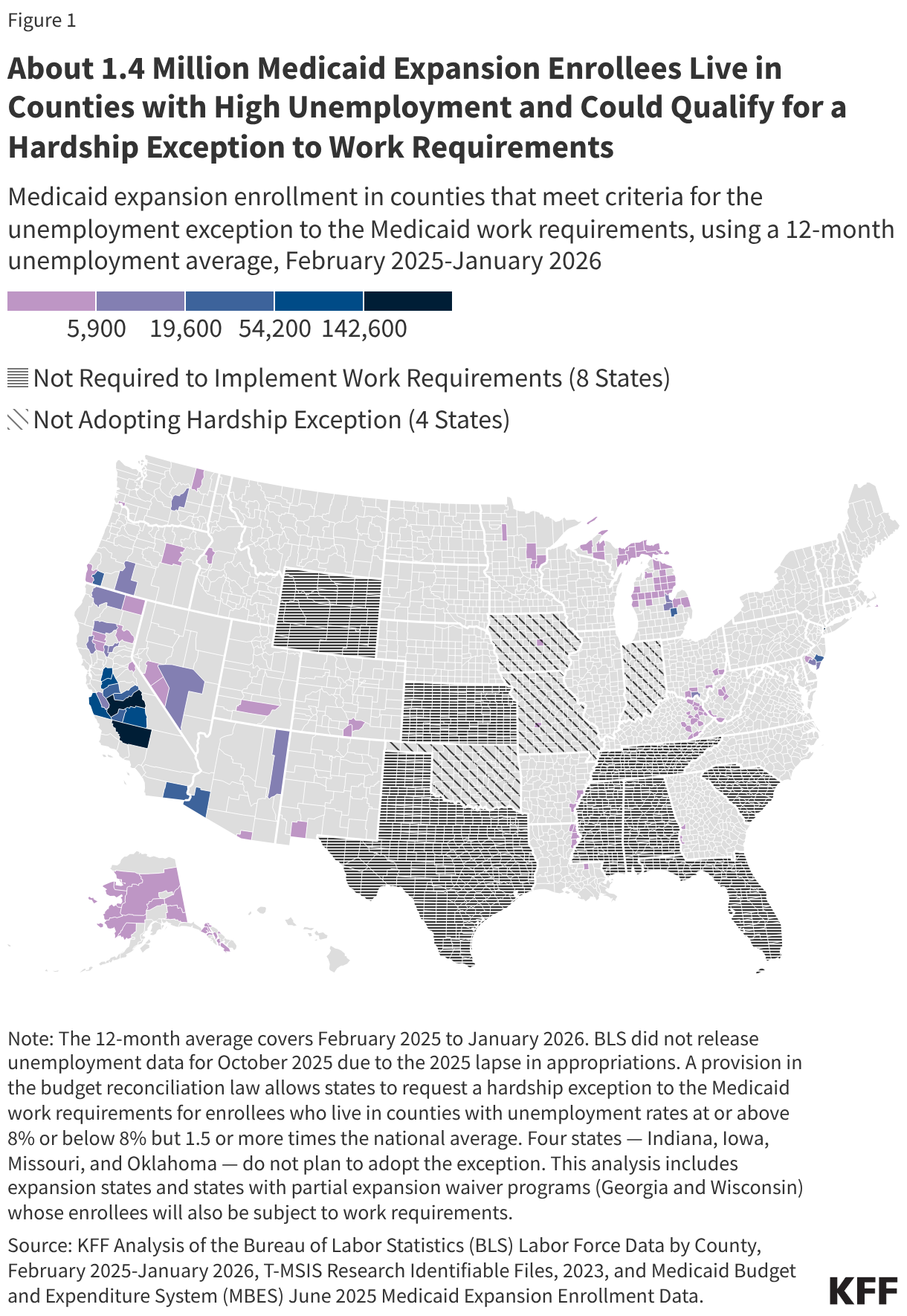
  • 1.4 million expansion enrollees, or 7.5% of expansion enrollees, live in counties that meet the high unemployment threshold and may qualify for the hardship exception in the 27 states that plan to adopt the exception and in the 12 states that had not made a decision on adoption at the time of the KFF survey. 
  • Among the states that are planning to adopt or may adopt the exception, 133 counties in 22 states meet the high unemployment thresholds, representing 7% of counties in expansion states and states with partial expansion waiver programs. No counties meet the thresholds in 16 states, and DC does not meet the thresholds. 
  • Nine in ten expansion enrollees who are in counties that meet the high unemployment criteria and could be exempt from the work requirements live in five states—California, New York, Michigan, New Jersey, and Oregon.
  • Among the states that do not plan to adopt the hardship exception, two counties in Iowa and Missouri meet the high unemployment thresholds, and approximately 3,300 expansion enrollees in those counties may have qualified for the high unemployment hardship exception if the states had decided to adopt the exception. In Indiana and Oklahoma, there are no counties that meet the thresholds.

Nebraska began enforcing work requirements on May 1, 2026, the first state to implement the new requirements. Although the state indicated it would adopt the high unemployment hardship exception, no counties in the state currently meet the thresholds. 

About 1.4 Million Medicaid Expansion Enrollees Live in Counties with High Unemployment and Could Qualify for a Hardship Exception to Work Requirements (Choropleth map)

States are waiting for federal guidance on how to implement this hardship exception, including what data will be used to identify counties that meet the thresholds and what additional information states must submit. This analysis uses the most recent available county-level unemployment data from Bureau of Labor Statistics (BLS) and is consistent with the methods used to determine whether any counties qualify for the high unemployment exemption waiver from SNAP work requirements. However, the guidance, which CMS is expected to release in early June, may require a different method.

KFF’s interactive Medicaid work requirements tracker includes new county-level unemployment data by state, showing which counties meet the high unemployment thresholds and how many expansion enrollees in those counties may be exempt from work requirements.

Measles Elimination Status: What It Is and How the U.S. Could Lose It

Author: Josh Michaud
Published: Apr 7, 2026

Originally published in July 2025, this policy watch has been updated in April 2026 to reflect additional developments and updated measles trends.

Measles has been officially “eliminated” from the U.S. since 2000, which means the country had not seen very large outbreaks and had not had 12 months or more of uncontrolled domestic transmission of the virus since before that time. However, a series of measles outbreaks began in the U.S. in early 2025 that continue today: from January 2025 through the end of March 2026, U.S. states have reported over 3,800 measles cases. Several factors have contributed to the ongoing transmission of measles in the U.S. These include funding and staffing cuts for public health efforts at the federal, state, and local levels that have affected measles prevention and response efforts across the country, along with mixed messages from federal health officials such as Department of Health and Human Services (HHS) Secretary Robert F. Kennedy, Jr. regarding measles response at the same time there has been no Senate-confirmed leader at CDC for almost the whole period since these outbreaks began. Further, there is increased skepticism among the public about the safety and effectiveness of measles vaccines and a decline in trust of health authorities in general, which has contributed to lower measles vaccination rates and complicated outreach and communication efforts in addressing the current outbreak.

What does this mean for U.S. elimination status and control of the disease going forward? This policy watch provides an overview of the definition of measles elimination, including how this status is decided and declared, and its significance. Further, it assesses how the current measles outbreak may threaten elimination status and what that might mean for control of measles in the U.S.

Measles and the Measles Vaccine

Measles is one of the most contagious human viruses. When spreading in a population with no prior immunity, it is estimated that on average one measles case can result in 12- 18 other cases (this is the basic “reproduction number” of measles). While most measles infections are not severe, health complications can occur in about 30% of measles cases, and around 1 in 1,000 measles infections lead to death. There is a higher risk of severe outcomes in young children and immunocompromised individuals. Among the 2,288 confirmed measles cases in 2025, 243 (11%) were hospitalized and three deaths have occurred. Besides the risk of the infection itself, measles can also have long-lasting negative impacts on the immune system more broadly, especially in children, leaving people more prone to serious outcomes from other infections. Those who recover from a measles infection usually develop long-term immunity to further measles infection.

Measles vaccines have been available in the U.S. since 1963 and are safe and effective at providing protection against illness and, importantly, against infection and onward transmission of the virus. It is estimated that two doses of a measles-containing vaccine are 97% effective in preventing infection. CDC recommends children get their first measles vaccine dose between 12 and 15 months of age, and the second dose between 4 and 6 years of age, before entering school. Currently, the most common measles-containing vaccine in the U.S. is the combination measles, mumps and rubella (MMR) vaccine. Epidemiologists estimate that when >95% of a population has immunity to measles, through previous infection or vaccination, then “herd immunity” is reached and measles transmission is interrupted and large outbreaks will not occur. Therefore, at least 95% coverage with two doses of the measles vaccine is a common goal for immunization campaigns and is the current Healthy People 2030 target in the U.S. However, it is estimated that national two-dose MMR coverage in the United States is for children entering kindergarten in 2024 was 92.5%, a figure that had declined from 94.7% in 2011. In addition, this coverage varied significantly across states, ranging from 78.5% in Idaho to 98.2% in Connecticut. Just 10 states had reported coverage levels at 95% or above in 2024-2025.

National, Regional, and Global Measles Elimination Goals and Prior U.S. Certifications

The first national goal to interrupt measles transmission in the U.S. was announced in 1966, just a few years after licensure of the first measles vaccine, and CDC announced further measles elimination goals in 1978 and 1993. In 1994, the member states of the Pan American Health Organization (PAHO, the Americas regional office of the World Health Organization (WHO) that includes the U.S.) set a goal of interrupting endemic measles virus transmission in the region by the year 2000 and in 2012, member states of the WHO endorsed a Global Vaccine Action Plan that included a measles elimination goal for all six WHO regions by 2020. 

Despite setting multiple goals since 1966, the U.S. did not officially achieve measles elimination status until 2000. Verification of elimination was carried out first through internal CDC and external expert review of U.S. strategy and programs to address measles, and epidemiological data on cases and vaccinations, which were compared against predetermined benchmarks for success. In March 2000, the National Immunization Program at CDC convened an external panel of experts to review the available data, and the panel concluded that criteria for elimination had been met, and officially stated that measles had eliminated from the U.S. Subsequently, a process was undertaken to re-verify U.S. elimination status in 2011, when the CDC’s National Center for Immunization and Respiratory Diseases assembled panel of external experts to review available evidence on U.S. measles programs and epidemiology since 2000. The panel agreed that measles elimination had been maintained, issuing a final report in March 2012. The U.S. has continued to review measles elimination status over time, including through an external expert committee known as the U.S. National Sustainability Committee for the Elimination of Measles, Rubella, and Congenital Rubella Syndrome.

Given the region-wide goal set in 1994, PAHO has also reviewed and verified national measles elimination for countries of the Americas, including the U.S. In 2007, PAHO member states created an international committee to verify country-level interruption of measles transmission and called for the creation of national-level commissions to help compile and submit related documentation to PAHO for review by an expert committee. Subsequently, PAHO’s Measles and Rubella Elimination Regional Monitoring and Re-Verification Commission (MRE-RVC) has met annually to review available evidence and issue reports on the status of elimination in PAHO member states with the U.S. consistently being designated as having sustained elimination. However, at its most recent meeting (in November 2025), the MRE-RVC placed the U.S. in the category of “sustained with major concerns.”

What Does it Mean to “Eliminate” Measles?

According to the guidelines developed by the U.S. and other PAHO member states, measles elimination has been defined at a basic level as: “Interruption of endemic measles virus transmission for a period greater than or equal to 12 months, in the presence of high-quality surveillance.” By contrast, measles is considered endemic in a given area if there is continuous transmission over a 12-month period.

In their review processes, CDC and external experts have used a variety of epidemiological and programmatic indicators, such as measles cases and transmission patterns, public health measures and response capabilities, and vaccination rates to help determine if endemic measles transmission has been “interrupted” and whether surveillance is “high-quality.” For example, when experts reviewed data for re-certification of measles elimination for the U.S. in 2011, the following primary lines of evidence were used (most covering the period 2001 to 2011) and the committee decided collectively that the data supported the conclusion that endemic measles virus transmission was interrupted in the presence of high-quality surveillance:

  • There were fewer than one reported measles case per 10 million population;
  • The great majority of measles cases were imported from areas outside the U.S. and most imported cases did not lead to further spread inside the U.S. – over the study period, 40% of cases were found to be imported;
  • The number and size of measles outbreaks over that period were small: a total of 64 outbreaks (median 4 outbreaks/year), with a median outbreak size of 6 cases. Only 16 outbreaks included 10 or more cases;
  • Measles vaccination rates among children had been sustained at high levels (>95%) over the study period, with no significant differences in coverage by race/ethnicity;
  • Data from national surveys indicated that population immunity to measles was above the “herd immunity” threshold; almost all age groups had seropositivity rates for measles antibodies over >95%, and;
  • Programmatic data on laboratory testing and case investigation performance indicated that U.S. surveillance adequately and quickly identified measles cases and transmission chains.

Prior to 2025, the largest outbreak of measles since U.S. elimination was declared occurred in 2018-2019. Imported measles cases in late 2018 had started a large outbreak centered in several close-knit communities with low vaccination rates in New York City and surrounding counties. As more measles cases came to be identified, state and local officials began to implement public health measures to combat the outbreak including declaring a public health emergency, mandating vaccinations and instituting fines for parents not vaccinating their children, which led to 60,000 MMR vaccine doses administered in affected areas in a few months. Authorities also closed schools where measles transmission occurred, prohibited unvaccinated children from attending school, and engaged in extensive communication and outreach efforts. At the time, federal agencies such as CDC provided technical assistance and other support and made clear statements about the importance of measles vaccinations, with then-CDC Director Robert Redfield stating “I encourage all Americans to adhere to CDC vaccine guidelines in order to protect themselves, their families, and their communities from measles” and pointing out that “organizations had been deliberately targeting these communities with inaccurate and misleading information about vaccines.” The White House also echoed this, with President Trump stating “vaccinations are so important” and encouraging parents to vaccinate their children against measles.  These combined efforts were effective in containing the New York outbreak in under 12 months, as transmission was interrupted by August 2019.

Does the Current Outbreak Threaten U.S. Measles Elimination Status?

In 2025, the U.S. had more reported measles cases, outbreaks, affected states, and deaths than in any year since 1992, and measles outbreaks have continued to occur in 2026. The pace of reported measles cases has fluctuated from early 2025 until March 2026, but there have been continual outbreaks and more states affected over that time period. A higher percentage of cases since 2025 have been due to local transmission vs. importation compared to prior years indicating local transmission has been the primary source of reported cases. Further, U.S. MMR vaccination rates have continued their steady decline and in many locations across the country levels of vaccination are below that needed for herd immunity. Table 1 summarizes key U.S. measles outbreak indicators as reported by CDC for 2025 and year-to-date (through March) 2026.
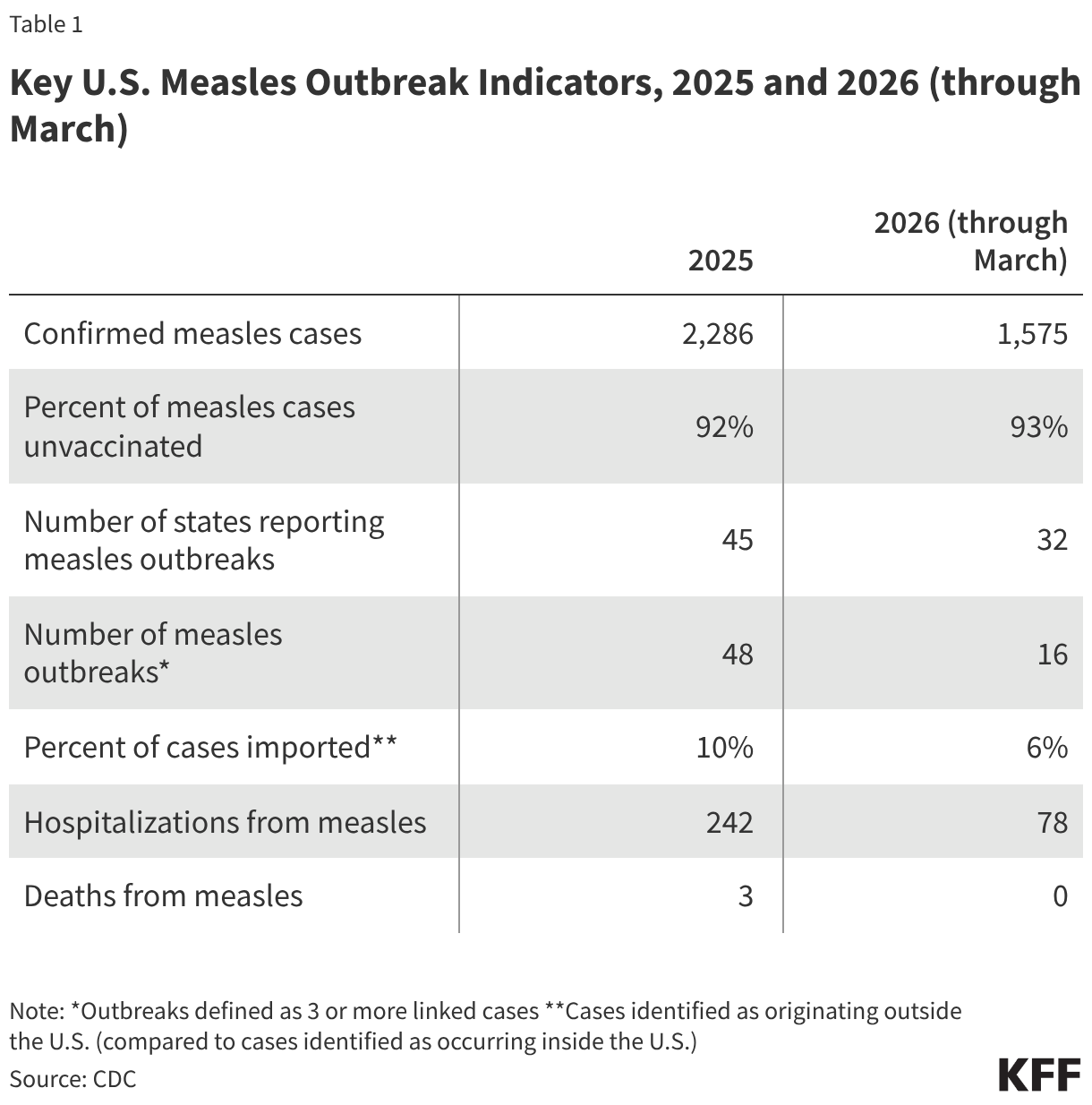
Key U.S. Measles Outbreak Indicators, 2025 and 2026 (through March) (Table)

Compared to the elimination period of 2001 to 2011 discussed above, these metrics are notably worse. There were 64 measles outbreaks in total over ten years (2001 -2011) but in 2025 there were 48 outbreaks, and there have been 16 new outbreaks in 2026 through March. While 40% of measles cases were imported in the 2001-2011 period, in 2025 just 10% of cases were imported and just 6% in 2026 (meaning more local transmission chains). There was one measles death over ten years during the elimination period, while there three in 2025 (none have been reported in 2026 to date). Many of these 2025 and 2026 data points are also worse than those from 2019, when U.S. measles elimination status was last threatened. For example, from January to October 1, 2019 (by which time the large outbreaks centered in New York had been contained), there had been 1,249 total measles cases, and 22 total outbreaks across 17 states; 2025 far surpassed those numbers. 

Primary responsibility for public health responses to measles sits with state and local health departments. At the moment, metrics on state and local capacities and response times for measles are not available, so gauging whether U.S. surveillance remains “high-quality” is challenging. However, in 2025 and 2026, state and local public health departments have faced cuts in funding and support from the federal government compared to previous years, which may impact their ability to track and respond to measles outbreaks. In recent years, the federal government has provided over half of state and local health public health departments’ budgets. There is little evidence that states most affected by measles in 2025, such as Texas, New Mexico, and South Carolina, have taken the kinds of measures that New York officials implemented to contain outbreaks in 2019: vaccination mandates, school restrictions and fines. While federal agencies such as CDC have been providing technical assistance and funding to affected areas, HHS Secretary Robert F. Kennedy, Jr. has downplayed the risks of measles and has provided mixed messages about the importance of vaccination compared to alternative treatments for measles, and CDC has been without a permanent Director since late August 2025. In January 2026, then Deputy Director of CDC Ralph Abraham stated that the measles outbreaks experienced by the U.S. were “just the cost of doing business…we have these communities that choose to be unvaccinated. That’s their personal freedom.” More recently, acting CDC Director Jay Bhattacharya has made stronger statements of support for measles vaccinations, saying in March 2026 that "measles is preventable and vaccination remains the most effective way to protect yourself and those around you.”

Data also show that national measles vaccination levels declined over the past five years, with kindergarten and childhood measles coverage rates dipping well below the 95% goal. Measles vaccination rates for kindergarteners at the national level declined from 95.2% in 2019-2020 to 92.5% in 2024-2025 (the latest available data), and over three-quarters of states had MMR vaccination rates below the target rate of 95% in the latest data. Additional studies have found that 78% of U.S. counties reported a decline in two-dose measles vaccine coverage in children, with the average county-level measles vaccination rate falling from 93.9% in 2019 to 91.3% in 2024. In 2025, 8% of U.S. measles cases had history of MMR vaccination while 92% of cases were unvaccinated or had unknown vaccination status; in 2026 so far 93% of cases were in unvaccinated individuals. Lower MMR vaccination rates have occurred in the context of broad declines in people’s trust in health authorities and in vaccinations in general. For example, KFF polling has found that parents are frequently exposed to misinformation about measles and the MMR vaccine, and in 2025 almost 20% of adults report they believed the false claim that “getting the measles vaccine is more dangerous than become infected with measles” is probably or definitely true.

Therefore, if current trends hold through the rest of the year there would appear to be grounds for the U.S. to lose measles elimination status, using prior definitions and benchmarks.

U.S. Measles Outbreaks in a Regional and Global Context

The U.S. is not alone in facing higher numbers of measles cases since 2025. There have also been large outbreaks in Mexico (6,213 reported cases in 2025) and Canada (5,463 reported cases in 2025). In fact, in November 2025 PAHO declared that Canada no longer holds measles elimination status due to having over 12 months of continual measles transmission. Like in the U,S., these outbreaks have been concentrated in communities with low vaccination rates. According to PAHO, in the region of the Americas, a total of 14,975 cases of measles were reported in 2025 across 13 countries, with almost all of these cases coming from North America. WHO reports that through June of this year, there were a total of 276,240 measles cases globally with large outbreaks occurring in the European and Eastern Mediterranean regions, in addition to the Americas. Outside of North America, the countries with the highest numbers of measles cases between August 2025 and January 2026 were India (12,135 cases), Angola (11,941), and Indonesia (8,892). As indicated in a standing travel warning from CDC, more circulation of measles regionally and globally means a higher risk that U.S. residents traveling internationally can be exposed, which raises the risk of importing measles and sparking new domestic outbreaks.

Looking Ahead

The next steps in determining U.S. measles elimination status include an internal federal-led review of state and CDC epidemiological data. A key outstanding question is whether transmission over the past year derived from the outbreak that began in January 2025 in West Texas, or whether outbreaks have been due to unconnected importation events. If cases over the past year across different states are epidemiologically linked to those from the Texas outbreak it would indicate continual chains of transmission extending more than 12 months, jeopardizing measles elimination status. Using genetic testing of measles virus isolated from patients, scientists can determine transmission patterns. CDC is currently working with partners to perform such sequences and publish the findings. These, along with other data, will be reviewed by the external expert PAHO committee (the Measles, Rubella, and Congenital Rubella Syndrome Elimination Regional Verification Commission, MRE-RVC), which is responsible for a determination of U.S. elimination status. After initially announcing a review meeting would take place in April 2026, PAHO changed the date for the U.S. measles elimination review to November 2026, which coincides with the regularly scheduled annual MRE-RVC meeting.

The elimination of measles in the U.S. was a notable public health achievement made possible by sustained investments in prevention and response capacities, support of vaccination, and commitment to the goal of elimination. However, this status is currently at risk, as demonstrated by the many factors discussed above. Losing measles elimination status would signify that the same commitment to measles prevention and control may no longer be present in the U.S. It could signify a future where measles is endemic and continuously circulating, especially if vaccination rates continue to decline. That would bring more hospitalizations and more deaths, particularly among vulnerable children, from a very preventable disease. There could be broader implications for communities across the country, which may have to contend with more frequent decisions about whether and when to close day cares and schools in the face of transmission risks. The societal costs of measles outbreaks are high, so continuous outbreaks would place an additional burden on already weakened and depleted public health systems, and would raise questions about what the appropriate level of support and funding should be from the federal government for outbreak response at the state and local levels.
Constrained Budgets Lead States to Restrict HIV Drug Access Through Ryan White

Published: Mar 2, 2026

States are facing constrained budgets, putting pressure on HIV care and prevention programs, including the Ryan White HIV/AIDS Program. Ryan White, the nation’s HIV safety-net, is funded each year through discretionary federal appropriations, state dollars, and other sources. However, funding does not necessarily match the number of people who need support or the cost of services.

The largest component of Ryan White provides grants to states, including for their AIDS Drug Assistance Programs (ADAPs), which provide HIV treatment and insurance assistance for people with HIV. In the past, ADAPs have used waiting lists and other cost-containment measures when programs could not meet the needs of all those eligible, and in the early 2000s, waiting lists were common. Significant waiting lists were last cleared with an influx of emergency federal funding in 2013 and then were used occasionally for a few years. They have not been used for over a decade and, to date, have not returned. However, several states facing budget pressures have recently moved to institute other cost-containment measures, including restricting eligibility and scope of services, and some are considering waiting lists for the future.  This represents the first time such broad cost-containment measures have been taken since the waitlist era.

Ultimately, such changes could result in people with HIV losing access to care and treatment, which could worsen health outcomes (increasing morbidity and mortality) and leading to new HIV infections (four in ten new HIV transmissions are associated with someone who is aware of their HIV status but not in care).

State ADAPs Respond to Strain by Limiting Enrollment and Services Offered

Florida recently announced changes to its ADAP, which would dramatically limit eligibility and scope of assistance. Specifically, the state plans to reduce income1 eligibility for the program from 400% of the federal poverty level (FPL) to 130% FPL (for an individual, which is the equivalent of eligibility decreasing from a maximum income of $63,840 to $20,748 annually).

Additionally, the state plans to remove Biktarvy from its formulary. Biktarvy is the most widely prescribed antiretroviral (ARV) medication nationally (accounting for 52% of the U.S. ARV market) and the only single tablet regimen (STR) included among the national HIV treatment guidelines list of recommended initial treatment regimens. Some studies have shown that STRs improve adherence by reducing pill burden.

The state also plans to roll back its insurance assistance program. ADAPs can help cover insurance costs in addition to directly purchasing medications. Ending insurance assistance poses unique challenges, as insurance coverage allows individuals to meet both HIV-related and other health care needs and helps protect clients in the face of unexpected medical costs (e.g. through out-of-pocket maximums).2 With expiration of enhanced Affordable Care Act premium tax credits, out-of-pocket premiums for people in ACA plans are increasing substantially this year.

The changes in Florida have received significant push back from advocates, patients, and providers, and the state was sued for proceeding with these changes without formal rule making. (The state then issued a proposed rule which it followed with emergency rulemaking. Litigation continues seeking to block implementation).

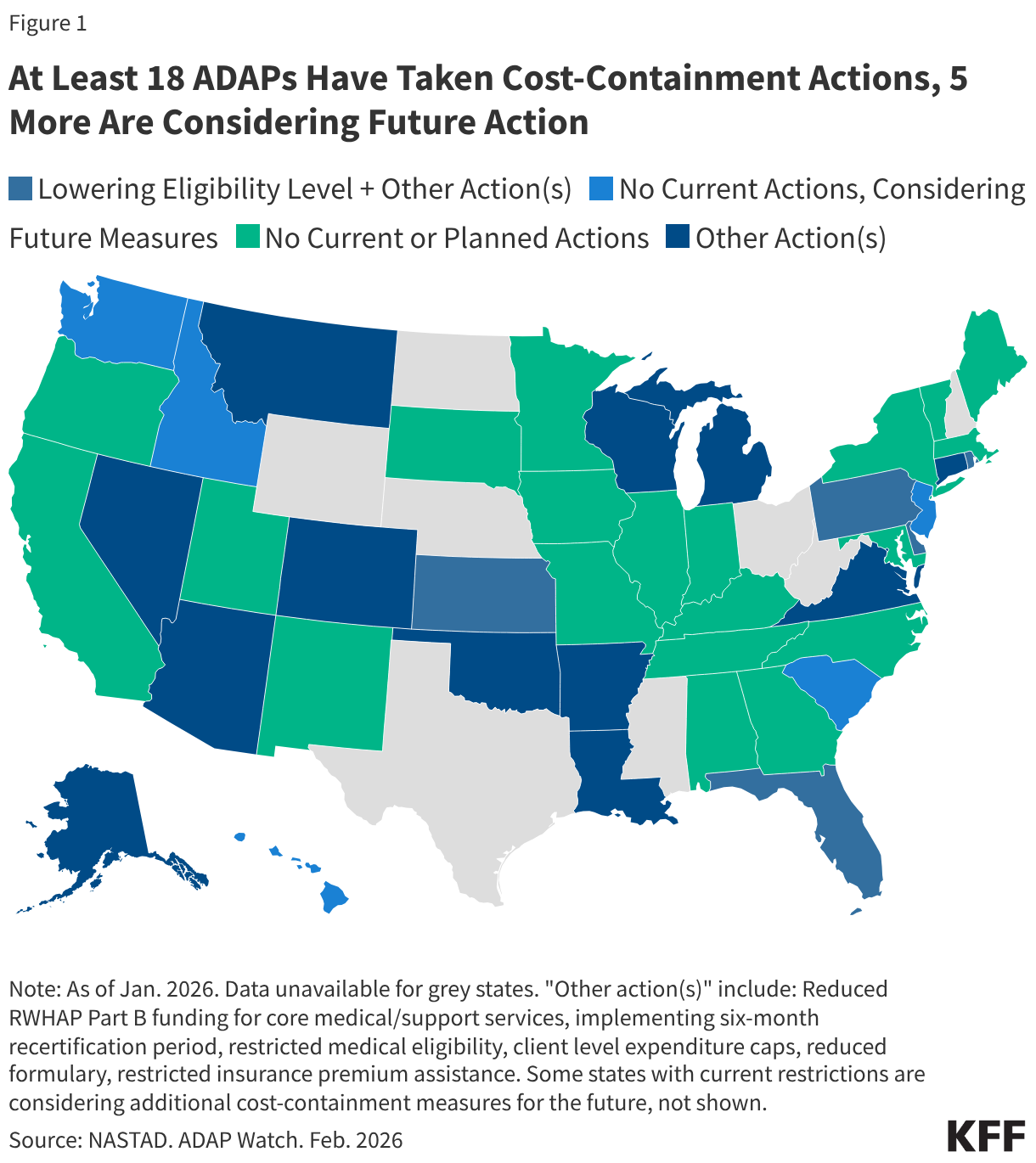
Florida, however, is not alone. New data from the National Association of State and Territorial AIDS Directors (NASTAD) indicate that 23 states (including Washinton, D.C.) have implemented or are considering ADAP cost-containment measures.3 Eighteen (18) ADAPs, including Florida‘s, have already made or are making changes and five additional states report that they are considering introducing such measures in the future. Further, 12 of the 18 states already implementing cost-containment measures are considering additional changes for the future.

For example, in addition to Florida, Pennsylvania, Kansas, Delaware, and Rhode Island have also reduced income eligibility for their programs (though to a lesser degree). Other changes states are exploring or implementing include reducing formularies (though, so far, none as consequential as removing Biktarvy), reducing funding for medical and support services, making recertification more stringent (which can create churn and lead to program disenrollment), implementing annual client spending caps, and restricting or ending health insurance assistance.

At Least 18 ADAPs Have Taken Cost-Containment Actions, 5 More Are Considering Future Action (Choropleth map)

To date, no state has implemented a waiting list, a measure widely seen as a last resort. However, Arkansas, Louisiana, and New Jersey report considering implementing one as a future cost-containment measure.

Multiple Factors Are Exerting Budget Pressures on ADAP

There are a range of factors affecting ADAP budgets. These include, but are not limited to, the following:

Federal ADAP Funding Not Keeping Pace With Inflation

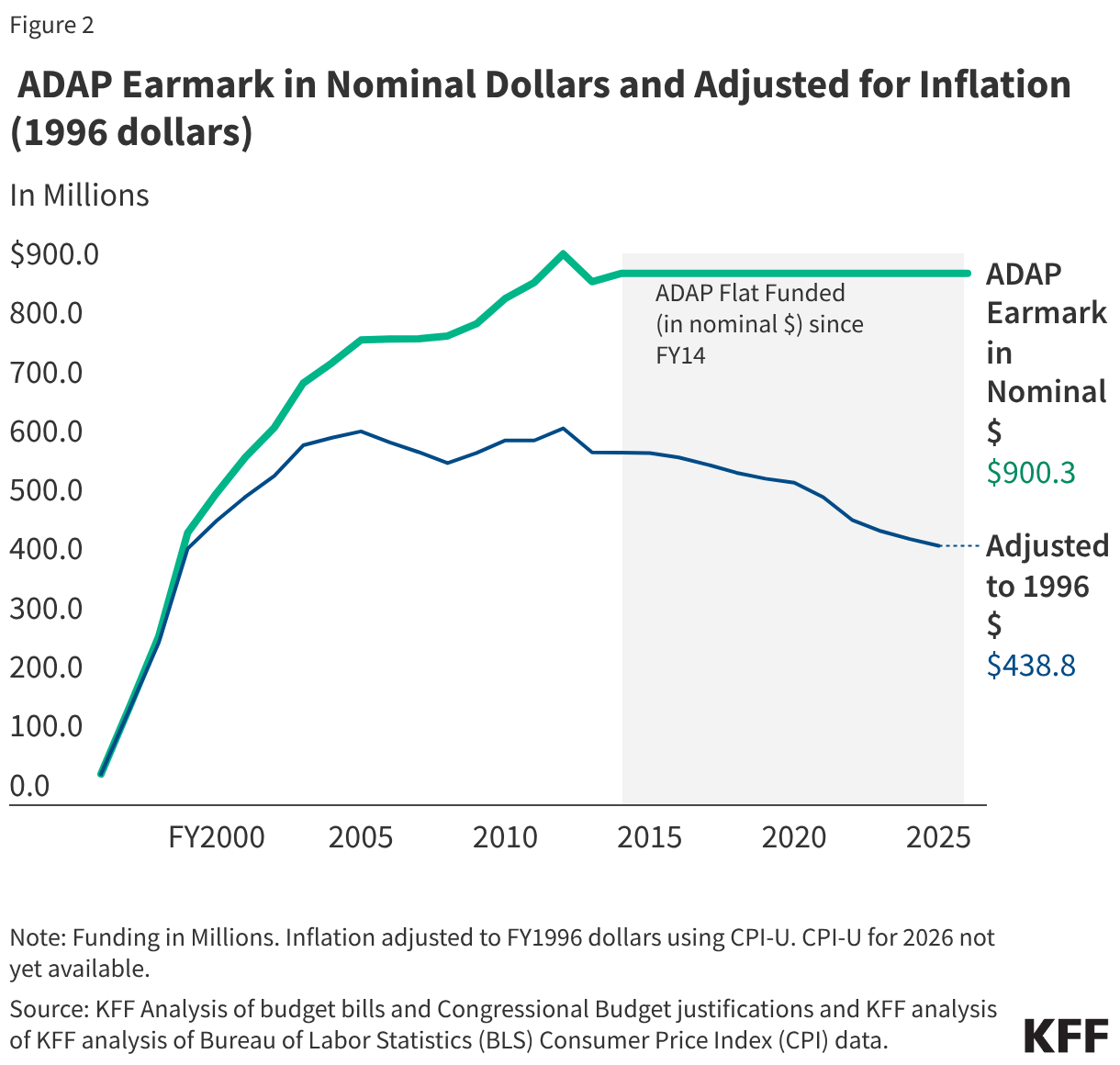
Since 1996, Congress has allocated (or “earmarked”) a set amount of funding for ADAPs during the annual appropriations process. After modest funding levels in the late 1990s, followed by significant growth in the early 2000s, ADAP inflation-adjusted appropriations have declined by 31% since 2005.4 The decline is largely attributable to more than a decade of flat funding in nominal dollars. When adjusted to 1996 dollars, the FY25 appropriation ($438.8 million) has similar purchasing power as the program’s FY1999 funding level ($434.0 million).5 In other words, in the last 20 years, ADAP funding has not kept pace with inflation, even before accounting for enrollment growth and increased costs (discussed below).

ADAP Earmark in Nominal Dollars and Adjusted for Inflation (1996 dollars) (Line chart)

In the NASTAD report ADAPs identified growing client enrollment, growing drug costs, and rising insurance costs as the top three drivers of budget concerns. These concerns are explored further below:

Increased Client Enrollment

While modern era federal ADAP funding has not kept pace with inflation, the number of ADAP clients served has increased significantly. The number of clients served increased by 56% from 2007 (the first year with available data for the full year) to 2024 (the most recent year with available data), rising from 165,3826 to 257,644 clients served. Adjusted for inflation, appropriations per client served dropped from about $3,600 in 2007 to approximately $1,700 in 2024. Additionally, the national HIV treatment guidelines have evolved to recommend HIV treatment at the time of diagnosis -as opposed to starting at signs of disease progression- which has led to more people with HIV having an indication for treatment.

Rising HIV Drug Costs

Another factor impeding the reach of ADAP dollars is the increasing cost of drugs for HIV treatment. A recent analysis found that the average wholesale price (AWP) of recommended initial antiretroviral regimes in 2012 ranged from an AWP of $24,970 to $35,160, increasing to $36,080 to $48,000 in 2018. Costs have generally increased since then. Data in the treatment guidelines show that the AWP for Biktarvy (again the number one treatment regimen for people with HIV and only STR recommended by the treatment guidelines start list) was $61,000 in 2025. The 2025 AWP for other recommended (two-pill) regimens ranged from $34,320 to $65,196. While ADAPs do not pay the full AWP because they have access to price discounts through the 340B drug pricing program and supplemental manufacturer rebates, increasing drug prices may still affect them; it is a main concern cited by ADAPs regarding cost challenges. Additionally, ADAPs ability to generate rebates (which make up a growing share of their budgets) through Medicare have diminished due to programmatic changes, including adoption of the out-of-pocket cap in Part D – by introducing the cap, ADAPs and other 340B entities, have less opportunity to generate rebates on claims because they make fewer cost-sharing payments.

Increased Insurance Premium Costs and Expiration of Enhanced Tax Credits

As mentioned above, ADAPs can also purchase health insurance for eligible clients. However, the cost of individual market coverage is on the rise, with the expiration of the enhanced premium tax credits being a particular driver and premium increases also playing a role.

ACA premium tax credits help make marketplace plans more affordable for people with low to moderate incomes. They were first enhanced as part of the American Rescue Plan Act in 2021 and extended by Congress through 2025, but have since expired due to the lack of a bipartisan Congressional agreement to continue them. The enhanced tax credits had improved insurance affordability for ADAPs purchasing coverage on behalf of clients, including for those previously eligible for the less generous ACA subsidies and, newly, for those with incomes over 400% FPL, a group for whom premium costs were limited to 8.5% of income. Without the enhanced credit those 100-400% FPL revert to the original, less generous, ACA tax credits and those over 400% FPL have lost financial assistance altogether. For enrollees keeping the same plan, expiration of the enhanced premium tax credits is estimated to more than double what subsidized enrollees previously paid annually for premiums—a 114% increase from an average of $888 in 2025 to $1,904 in 2026.

Additionally, after holding relatively steady since 2020, premiums increased steeply between 2025 and 2026, with the average premium cost for benchmark plans increasing by 26%7, with significant variation across states. Some southern states with high HIV prevalence saw especially large average increases (e.g. 33% in Florida and 35% in Texas). These premium increases occurred for a range of reasons including, but not limited to, higher health care costs, use of expensive GLP-1 drugs, the threat of tariffs, and the expiration of the enhanced premium tax credits. While the vast-majority of ADAP clients have modest incomes, these costs will be borne out most acutely for the 7% of clients served by insurance purchasing who have incomes over 400% FPL, a group who lost the enhanced tax credits that previously capped premium costs as a share of their income. ADAPs covering individuals in this higher income group face a two-fold setback – loss of enhanced tax credits and no protections against rising premiums. 

Additionally, individuals who lose ADAP insurance coverage due to cost-containment measures may find financing coverage independently more challenging due to reduced tax credit generosity and increases in premiums.

Looking Ahead

While ADAPs have sought to leverage additional state funds, drug rebates, and capture limited emergency and supplemental funding, these efforts have not remedied budget shortfalls, leading many to institute cost-containment measures. ADAPs may increasingly face budget pressures that could lead to additional such measures in the future. This could leave growing numbers of people with HIV ineligible for safety-net services, particularly if states further lower income eligibility limits or institute waiting lists. The expiration of enhanced tax credits amplifies these challenges, both increasing costs for programs and leaving those who are ineligible for ADAPs with fewer affordable alternatives. Limiting access to Ryan White services will in turn affect the ability of people with HIV to stay engaged in HIV treatment, a cornerstone of national efforts to address the HIV epidemic.

Endnotes

  1. Except for cost-sharing assistance which will remain available for those up to 400% FPL. ↩︎
  2. It is a federal requirement that insurance purchased through Ryan White be cost-effective compared to direct drug purchasing and  allows programs to generate 340B revenue.  ↩︎
  3. 44 states, including DC, responded to the survey. In addition, information on FL was publicly available. It is possible, but unknown if, the remaining states are implementing or considering cost-containment measures. ↩︎
  4. Adjusted using annualized CPI-U. ↩︎
  5. Full year CPI-U data for 2026 not yet available. ↩︎
  6. KFF and NASTAD. National ADAP Monitoring Project. 2009. https://www.kff.org/wp-content/uploads/2013/01/7861_es.pdf ↩︎
  7. The second-lowest-cost silver (benchmark) premium for a 40-year-old in each county and weighted by county plan selections. ↩︎

Filling in the Gap in Federal Medicaid Funding to Planned Parenthood: State Responses

Published: Feb 25, 2026

Editorial Note

This brief was updated on February 25, 2026, to reflect additional state commitments to entities effected by Section 71113. 

In a major victory long sought after by abortion opponents, the federal government now has codified a ban on Medicaid funds that support care provided at Planned Parenthood clinics and other locations. Section 71113 of the 2025 Federal Budget Reconciliation Law, prevents Medicaid payments to certain reproductive health care entities that provide abortion care for one year from the date of enactment. This ban includes all services including contraceptive care, preventive care, and other services, not only abortion. Based on the criteria in the law, three entities, Planned Parenthood affiliates, Maine Family Planning and Health Imperatives—providers in 39 states—have been blocked from receiving federal Medicaid revenue. A handful of states, however, have announced they will fill in current gaps created by losses in federal funding to support access to care for their residents. These funds will enable providers to keep serving enrollees they care for in these states to differing degrees, but in the remaining states, the loss of Medicaid revenues will greatly limit their ability to continue to see Medicaid patients. This brief reviews the status of state commitments to funding reproductive health care providers affected by Section 71113 to date.  

While there is ongoing litigation challenging Section 71113, the provision is currently in effect but a final decision on the merits of these cases might come after July 2026, when the one-year funding ban is no longer in effect. After the enforcement of Section 71113 became effective for Planned Parenthood in September 2025, some Planned Parenthood affiliates offered services to Medicaid beneficiaries on a free or reduced-fee basis, allowing patients to continue receiving care regardless of their ability to pay. However, federal Medicaid funds are not flowing into the clinics, and only a handful of states have stepped in to provide funding to support care. In September 2025, Planned Parenthood said they covered the costs of care provided to most of their patients who use Medicaid — an estimated $45 million in care. However, the organization stated that these efforts are unsustainable over the long run. 

Planned Parenthood’s Role in Providing Family Planning Services to Medicaid Enrollees 

Planned Parenthood is a large provider of family planning services nationwide. Planned Parenthood affiliates maintain health centers in 46 states and the District of Columbia and provide services to over 2 million patients per year. Over half of Planned Parenthood’s patients rely on Medicaid for their health coverage, and a KFF analysis finds that nearly one in five (18%) Medicaid enrollees got their contraceptive care from a Planned Parenthood clinic in 2023 (Figure 1). This share is greater in states like California, and Wisconsin where nearly half and one third of female Medicaid enrollees who got contraceptive care went to a Planned Parenthood health clinic, respectively. Planned Parenthood health clinics are primarily located in rural or medically underserved communities, and sometimes are the only clinic in a community offering sexual and reproductive health care services including contraception. Due to the unique role Planned Parenthood plays in offering sexual and reproductive health care, research shows that Medicaid enrollees would be harmed if they were excluded from Medicaid reimbursement because they would face increased difficulties in accessing contraceptive methods, primary care, and other sexual and reproductive health care.  

Place of Service for Last Contraceptive Care Encounter for Female Medicaid Enrollees Ages 15 to 49, 2023 (Stacked Bars)

State Efforts to Limit Harm to Medicaid Enrollees Who Receive Care at Planned Parenthood Health Centers 

Due to Planned Parenthood’s large role in providing family planning services to Medicaid enrollees, some states have committed to filling in gaps created by losses in federal revenues. In response to proposed budget cuts facing Planned Parenthood, eleven states (CA, CO, CT, IL, MA, ME, NJ, NM, NY, OR, WA) have allocated millions in funding to Planned Parenthoods to maintain access to care for their enrollees. All eleven of these states are also plaintiffs in a lawsuit challenging Section 71113. State responses have ranged from agreeing to cover the full cost of Medicaid services to allocating a specific amount of money for the year.  

California

On October 23, 2025, California Governor Newsom announced a plan to allocate over $140 million in state funds to assist Planned Parenthood health centers due to losses in federal funding caused by Section 71113. California has over 7 Planned Parenthood affiliates who maintain over 100 health centers. At California Planned Parenthoods, over 80% of patients rely on public health insurance such as Medi-Cal and the Family Planning, Access, Care and Treatment Program (FPACT). KFF estimates that in 2023, 47% of California female Medicaid recipients who received their last contraceptive visit of 2023 went to a Planned Parenthood clinic for that care. On February 11, 2026, Governor Newsom signed legislation that allocates $90 million in the form of an emergency one-time grant to Planned Parenthood and other clinics providing reproductive health care services.   

Colorado 

In August 2025, Colorado Governor Polis signed legislation (Senate Bill 25B-2) which does not appropriate a specified dollar amount to Planned Parenthood but instead asserts that Colorado will reimburse an organization designated as a “prohibited entity” under the 2025 Federal Budget Reconciliation Law using state funds. This guarantees state funding for Planned Parenthood clinics in Colorado providing care to Medicaid enrollees without placing a specific dollar amount on the allocation. 

Connecticut  

On December 18, 2025, Governor Lamont announced an allocation of $8.5 million to Planned Parenthood of Southern New England to make up for lost federal reimbursement for the period that Section 71113 is in effect.  

Illinois

On December 23, 2025, the Illinois Department of Healthcare and Family Services announced a $4 million investment in Medicaid family planning services to offset the loss of federal Medicaid reimbursement for Planned Parenthood due to Section 71113. The Department estimates that Planned Parenthood received $4 million in federal Medicaid reimbursement in 2024 for services like contraception, sexual transmitted infection testing and treatment, cancer screenings, and other family planning services Illinoisans rely on.  

Massachusetts

 On July 24, 2025, Governor Healey announced a plan to provide $2 million in state funds to Planned Parenthood League of Massachusetts to support continued access to sexual and reproductive health including cancer screenings, contraception, and STI testing and treatment. These state funds are not sufficient to completely make up for the loss of federal funds. In 2023, Planned Parenthood League of Massachusetts received approximately $4.7 million in Medicaid payments in 2023, and the federal match in Massachusetts varies between 50% and 90% with a 90% match for family planning services. Massachusetts has not allocated any funds to Health Imperatives, another family planning provider in Massachusetts currently blocked from receiving federal Medicaid reimbursements. 

Maine

The Maine Legislature passed two bills ( LD 143, LD210), shortly before Section 71113 became effective, allocating over $6 million to family planning providers, including Planned Parenthood of Northern New England and Maine Family Planning. This funding was allocated to fill financial gaps these organizations face due to their ongoing provision of free and discounted reproductive health care. On January 27, 2026, Governor Mills proposed providing an additional $2.25 million in state supplemental funding to offset the impact of Section 71113 on Maine Family Planning and Planned Parenthood. The legislature will review the Governor’s proposed biennial budget, which requires approval in both the House and Senate.      

New Jersey 

In fiscal year 2023, the two Planned Parenthood affiliates in New Jersey collectively billed $6.9 million to New Jersey’s Medicaid program. The state paid $1.4 million of these claims and the federal government paid the remaining $5.4 million. On December 24, 2025, Governor Murphy announced an allocation of $8 million to reproductive health care providers who have been blocked from receiving federal Medicaid funds. The allocation will cover both the state and federal Medicaid reimbursements that the Planned Parenthood affiliates would have received if not for Section 71113.  

New Mexico

On October 3, 2035, New Mexico, Governor Grisham, signed emergency legislation that allocates $3 million to contract with Planned Parenthood for health services provided to Medicaid patients. Any unexpended balance remaining at the end of fiscal year 2026 will revert to the general fund.  

New York

On October 24, 2025, New York Governor Hochul announced that the state will cover any funding gap Planned Parenthood experiences due to Section 711113. The state has instructed Medicaid providers who would be considered “Prohibited Entities,” to continue to submit claims, and they will be paid with state only dollars. Planned Parenthood has five affiliates that operate 48 clinics in the state. 

Oregon 

In Oregon, Planned Parenthood of Columbia Willamette received over $15 million of state and federal Medicaid dollars in 2024. In November 2025, their legislature allocated $7.5 million to Planned Parenthood affiliates in an emergency session for this coming fiscal year while Section 71113 is in effect. 

Washington

Washington estimated that they paid over $23.8 million to Planned Parenthood in 2023 for services to Medicaid enrollees with $11.8 million of those funds coming from the federal government. On July 9, 2025, Governor Ferguson announced that the state would cover any gap in Medicaid funds Planned Parenthood experienced because they would no longer be eligible to receive funding from the federal government.  

What Newly Released Medicaid Data Do and Don’t Tell Us

Published: Feb 20, 2026

The Centers for Medicare and Medicaid Services (CMS) is focused on addressing “fraud, waste and abuse” in health programs including Medicaid. Efforts span across different types of health coverage and across all provider and service types. In November 2025, CMS issued a letter to states describing opportunities for federal and state governments to work collaboratively. Efforts to address fraud, waste and abuse are not new. The Center for Program Integrity (CPI), within CMS, was established in 2010 to coordinate program integrity efforts and move from a “pay and chase” model to higher reliance on data analytics to detect and prevent fraud. CPI has worked with states to provide training through the Medicaid Integrity Institute and access to broad sets of complete data to help promote program integrity efforts.

On February 14, 2026, CMS released a dataset with provider-level spending data that the agency suggests could be used to identify unusual billing patterns for specific services, states, or providers. This policy watch describes what the data include, what they exclude, and how they could potentially lead to mistaken conclusions given the limitations of the data.

What do the data include and exclude?

The new dataset includes seven types of data:

  •  The national provider identifier (NPI) for the billing provider,
  • The NPI of the servicing provider (which may be an individual or an organizational entity),
  • The procedure code (also known as the healthcare common procedure coding system or HCPCS code),
  • The month and year,
  • The number of beneficiaries seen,
  • The number of procedures delivered (the count of claims), and
  • The total amount paid for the services.

The totals include records of outpatient services paid for by Medicaid directly (“fee-for-service”) and those paid for by Medicaid managed care organizations on behalf of enrollees between 2018 and 2024.

The data exclude all institutional records and all information about prescription drugs, which are significant shares of Medicaid spending, with hospital care accounting for 37% and being the single largest source of Medicaid spending. Beyond excluding entire categories of services, the data omit several types of information that are important in evaluating the reasonableness of service volume and spending:

  • Enrollment. The amounts of services used depend on how many people are eligible to receive the services, which varies based on state policies, the economy, and people’s demographics. Differences in service use over time or between geographic locations may not be comparable without accounting for the number of Medicaid enrollees and their age and health status.
  • Benefits and Coverage. The volume of services used also depends on what services states elect to offer and how they determine who is eligible to use those services, features that may change over time.
  • Payment rates. Spending on services depends on how much states are paying for each service, which could depend on the local cost of living as well as state decisions about how much payment rates should be to ensure reasonable access to care.
  • Diagnoses. The data do not include any information to indicate what condition the procedures are used to treat.
  • Place of service and other modifiers. The data exclude information about where the services were performed (including whether they were provided in-person or remotely) and other modifiers that are used to identify characteristics of the services.

How might the data lead to mistaken conclusions?

Although data analytics can be a powerful tool to identify potentially problematic patterns, they could lead to mistaken conclusions if used in isolation. A few specific shortcomings of the new Medicaid data stand out.

  • The reported procedures are not always comparable to each other. The data provide counts of patients, services, and Medicaid spending for each procedure, but the procedures are not in all cases comparable to each other. Some are very narrowly defined whereas others encompass a wide array of procedures. In CMS’ example of how the data could be used, spending on personal care appears to be a significant outlier and the single largest source of Medicaid spending. However, the “procedure” for personal care includes a range of possible services lasting from 15 minutes up to an entire day. In contrast, there are multiple separate procedures for psychotherapy that each correspond to visit length (30 minutes, 45 minutes, 60 minutes, etc.). Similarly, there are multiple procedures for emergency department visits and office visits that correspond to the complexity of the case on a scale from one to five. Personal care would not be the largest category of spending if institutional spending were also included.
  • Providers are not always comparable to each other. The data provide counts of patients, services, and Medicaid spending for each provider, but some of the providers are individuals whereas others are group practices, clinics, or even entire county and state health departments. In CMS’ example of how the data could be used to look at spending by provider, 10 of the 20 largest “providers” are state or local government agencies that both administer and deliver Medicaid benefits rather than health care providers. States’ approaches to delivering Medicaid benefits vary broadly, but in most cases, state or local health departments contribute by paying providers to deliver services and by providing services directly (particularly in the case of services for people with behavioral health needs and developmental disabilities).
  • There is limited information about the methods used to create the dataset or the underlying data quality. The data do not indicate how underlying Medicaid data were aggregated to create the summary file. They also do not address issues related to the quality of the underlying data, which come from the Transformed Medicaid Statistical Information System or T-MSIS. T-MSIS is a rich source of data, but sometimes there are issues with the data in specific states for specific topics. CMS maintains a rigorous “data quality atlas” that supports “insightful, methodologically sound analysis” of the data. The atlas provides a wealth of information about potential data problems. It’s unclear how CMS handled those issues when generating the recently-released data. For example, CMS reports that in the 2024 data, there were six states with unusable information about total spending for the services included in the data; and an additional 16 states where the data were of high concern. It is unknown whether CMS included the unusable data in the public file or whether the public data reflect a different version of T-MSIS.

Beyond those data issues, the data are missing context about how Medicaid spending and use of care changed between 2018 and 2024. The COVID-19 pandemic, which began in 2020, resulted in major changes to Medicaid spending that resulted from increased enrollment during the continuous enrollment period and increased awareness of unmet needs for behavioral health and long-term care. As states increased access to those services, use of those services and associated spending grew due to changes in states’ policies regarding coverage, eligibility, and provider payment rates.