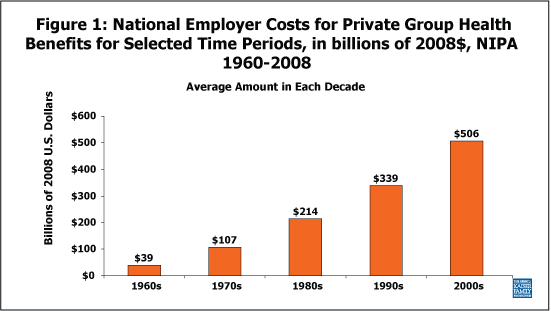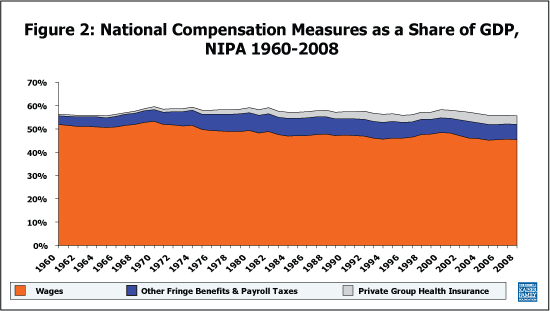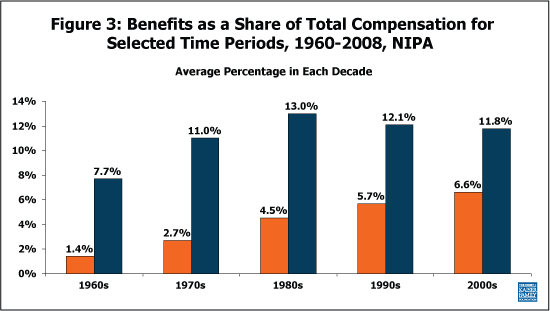
  Wages and Benefits: A Long-Term View February 2008 Recent polls show that a substantial portion of families worry about whether their incomes will keep pace with rising prices generally and whether they will have to pay more for health care or health insurance.1 This concern about the cost of health insurance may result in part from the rapid increases in the costs of work-based health insurance in recent years: between 2001 and 2007, health insurance premiums rose 78%, a much faster rate of increase than general inflation (17%) or workers' earnings (19%).2 While recent increases have been particularly acute, health benefit costs have risen quite rapidly over many years, measured absolutely and as a percentage of total economic activity, or gross domestic product (GDP). Using the same data used by the government to track changes in the U.S. economy over time, the analysis below shows the growth in employer costs for private group health benefits over a relatively long time span and shows the size of these expenses compared with wages and other benefits.3 Figure 1 shows, in billions of 2006 dollars 4, the total amount spent by employers on group health insurance policies from 1960 to 2006. The amount grew over twenty-fold from $23 billion in 1960 to $537 billion in 2006. Except for a short period between 1995 through 1998, this growth has been constant.  | Source: U.S. Department of Commerce, Bureau of Economic Analysis, National Income and Product Accounts, 1960-2006, Tables 6.11B, 6.11C, & 6.11D. Note: Amounts shown are averages of annual figures for each time period. | Figure 2 shows total employer costs for three forms of employee compensation as a share of GDP. The three compensation types we consider are: private group health benefits (the upper-most shaded region), wages/salaries (the bottom-most region), and other (non-private group health) benefits and payroll tax contributions (the middle region).5 Total compensation as a share of GDP is denoted by the topmost line and is a fairly stable over the period, ranging from about 56 percent to 59 percent. Although wages are consistently the largest component of worker compensation, the shares paid to employees for health benefits and other fringe benefits/payroll taxes have increased as a share of GDP, while the amount paid as wages has fallen. Health benefit costs have increased from 0.6 percent of GDP in 1960 to 4.1 percent in 2006. Fringe benefits other than health care and payroll taxes have also increased over this period, ranging from 3.8 percent of GDP in 1960 to 6.7 percent in 2006. Wages, meanwhile, have fallen from 51.8 percent of GDP in 1960 to 45.6 percent in 2006.  | Source: U.S. Department of Commerce, Bureau of Economic Analysis, National Income and Product Accounts, 1960-2006, Tables 1.1.5, 2.1, 6.11B, 6.11C, & 6.11D. | Figure 3 focuses on employer costs for private group health benefits and for non-health benefits as percentages of total compensation (i.e., benefits plus wages) to show more clearly the changes over time. Non-health benefits increased as a share of total compensation from the 1960s to the 1980s, but have fallen modestly since. On the other hand, employer payments for health benefits have increased as a share of total compensation in every decade, reaching 7.2 percent of compensation in 2006.  Source: U.S. Department of Commerce, Bureau of Economic Analysis, National Income and Product Accounts, 1960-2006, Tables 1.1.5, 2.1, 6.11B, 6.11C, & 6.11D. Note: Percentages shown are averages of annual shares for each time period. | Conclusion Many people feel the burden of health care costs directly when they use medical goods and services. However, another way these expenses may affect families’ well-being is by slowing the increase in their paychecks each year. These figures show that the share of employee compensation going to health benefits has risen substantially over time, while the share going to wages has fallen. While policy makers and others bemoan the rapid growth in the already high cost of health care, policy options that would have a significant impact on cost growth have not emerged. Absent fundamental change in cost growth, or a retreat from our country’s reliance on employer-provided health insurance, these trends seem likely to continue. The snapshot was prepared by Paul Jacobs, Kaiser Family Foundation, 2008. Figure 2 largely reproduces an exhibit presented at several briefings and meetings by Len Nichols, Ph.D., of the New America Foundation. We thank Dr. Nichols for permitting us to reuse and expound upon his work. 1. Kaiser Family Foundation, Health Security Watch, June 2007. Available online at: http://www.kff.org/healthsecuritywatch.cfm. 2. Kaiser/HRET Survey of Employer-Sponsored Health Benefits, September 2007. Available online at: http://www.kff.org/insurance/7672/index.cfm. 3. The data were obtained in August of 2007 from the U.S. Department of Commerce, Bureau of Economic Analysis, National Income and Product Accounts (NIPA) for the years 1960 to 2006. Note that the Bureau of Economic Analysis periodically updates published values, which may explain differences for data obtained after August of 2007. The data are available online at: http://www.bea.gov/national/nipaweb/SelectTable.asp. 4. In Figure 1, employer contributions towards private group health insurance are converted to 2006 dollars using the consumer price index for urban consumers. U.S. Department of Labor, Bureau of Labor Statistics, Consumer Price Index, All Urban Consumers (Current Series). Available online at: http://www.bls.gov/cpi/. For Figures 2 and 3, the data are shown as a percentage of nominal GDP, so they have not been adjusted. 5. Other benefits include employer contributions for: private pension and profit-sharing plans, publicly administered government employee retirement plans, private group life insurance plans, privately administered workers’ compensation plans, and supplemental unemployment benefit plans (denoted as “Employer contributions for employee pension and insurance funds” in the NIPA), as well as old age, survivors, and disability insurance (social security), hospital insurance (Medicare), unemployment insurance, railroad retirement, pension benefit guaranty, veterans life insurance, publicly administered workers’ compensation, military medical insurance, and temporary disability insurance (denoted as “Employer contributions for government social insurance” in the NIPA). For more information, see, U.S. Department of Commerce, Bureau of Economic Analysis, “A Guide to the National Income and Product Accounts of the United States,” September 2006. Available online at: http://www.bea.gov/methodologies/index.htm. 1. Centers for Medicare and Medicaid Services, Office of the Actuary, National Health Statistics Group, http://www.cms.hhs.gov/NationalHealthExpendData/ (see Historical, NHE summary including share of GDP, CY 1960-2005, file nhegdp05.zip; and Historical, Projected, NHE Historical and projections, 1965-2015, file nhe65-15.zip). 2. George B. Moseley III, Changing Conditions for Medical Technology in the Health Care Industry (presented before the OGI School of Science and Engineering, Oregon Health and Science University, October 18, 2005), http://cpd.ogi.edu/Seminars05/MoseleySeminarIndex.htm. 3. AdvaMed, The Value of Investment in Health Care: Better Care, Better Lives (January 2004): 14-21, at http://www.advamed.org/newsroom/medtap/medtapreport.pdf. 4. David M. Cutler and Mark McClellan, “Is Technological Change in Medicine Worth It?” Health Affairs 20(5) (September/October 2001): 11-29. 5. Richard A. Rettig, “Medical Innovation Duels Cost Containment,” Health Affairs (Summer 1994): 15. 6. Several approaches have been used to study and quantify the impact of technology on health care costs, including: - The residual approach, where the impact of changes in other factors (such as prices, income, population growth and demographic changes, and utilization) is quantified, and the residual not accounted for is attributed to changes in technology. The most widely-used approach, it circumvents the need to specify a direct measure of technology and captures the impact of general technologies applied in the health sector, such as information technology. However, it is only a rough, indirect estimate (and perhaps an overestimate) of the impact of technology on health spending because other factors that cannot be quantified (such as lifestyle, environment, education) will also be included along with technology. Examples of residual studies include (1) Newhouse (1992), described in the text of this report; and (2) Edgar A. Peden and Mark S. Freeland, “Insurance Effects on US Medical Spending (1960-1993),” Health Economics 7 (1998): 671-687, which found that nearly half (47%) of the 1960-1993 growth in real per capita U.S. medical spending and almost two-thirds (64%) of its 1983-1993 growth were due to increasing levels of insurance coverage (i.e., a decline in coinsurance levels paid by consumers). Because lower coinsurance levels and higher research spending are considered inducers of technology, the authors concluded that these results imply that about two-thirds (70%) of the 1960-1993 medical spending growth and about three-fourths (76%) of the 1983-1993 medical spending growth came from cost-increasing advances in medical technology.
- The proxy approach, where a proxy (such as research and development spending, or time) is used to measure the impact of technology. The usefulness of these studies depends on how good a substitute the proxy is for technology and how measurable it is. Examples include: (1) Albert A. Okunade and Vasudeva N.R. Murthy, “Technology as a “Major Driver” of Health Care Costs: a Cointegration Analysis of the Newhouse Conjecture,” Journal of Health Economics 21 (2002): 147-159, which found that technological change, proxied by total research and development (R&D) spending and health R&D spending, is a statistically significant long-run driver of 1960-1997 rising real health care expenditures per capita; and (2) Livio Di Matteo, “The Macro Determinants of Health Expenditure in the United State and Canada: Assessing the Impact of Income, Age Distribution and Time,” Health Policy 71(1) (January 2005): 23-42, which found that time, used as a proxy for technological change, accounted for about two-thirds of the 1975-2000 increases in real per capita health expenditures in the U.S. and Canada.
- Case studies of specific technologies, to determine their effects on the cost of treating a particular condition. While case studies can explain the impact of certain medical advances on health care costs, it is difficult to generalize from them to an aggregate or national level: (1) In an analysis of technological change at the disease level for 5 medical conditions, David M. Cutler and Mark McClellan, “Is Technological Change In Medicine Worth It?” Health Affairs 20(5) (September/October 2001): 11-29, found that the benefits of 4 of the 5 conditions studied (heart attacks, low-birthweight infants, depression, and cataracts) were greater than the costs; costs and benefits were about equal for the fifth condition (breast cancer). For example, in 1984 nearly 90% of heart attack patients were managed medically; by 1998, more than half of patients received surgical treatment. Spending by Medicare on heart attack patients increased from $3 billion to $4.8 billion (a 3.4% annual change), despite a 0.8% annual decline in the number of heart attacks. From 1984-1998, the use of new technology helped to increase the average heart attack patient’s life expectancy by one year (valued at $70,000 per case), while treatment costs increased $10,000 per case (4.2% per year), for a net benefit of $60,000 per case; and (2) Laurence Baker et al., “The Relationship Between Technology Availability And Health Care Spending,” Health Affairs, Web Exclusive (November 5, 2003): W3-537-W3-551, studied the relationship between the supply of new technologies and health care utilization and spending at 3 levels (a particular technology, “category” spending on substitutable or complimentary technologies, and total health spending), using 10 diagnostic imaging, cardiac, cancer, and newborn care technologies. They found that more availability of the technologies was frequently associated with higher use and spending on the services. For example, a one unit increase in the number of freestanding MRI units per million people was associated with an increase of about $32,900 per million beneficiaries (commercial and Medicare) per month, or approximately $395,000 per year. Looking at “category” spending, they found an individual technology can increase or decrease spending on other technologies in the same category depending on whether they complement those technologies (e.g., an increase of one unit per million in availability of MRI equipment was associated with an increase of 0.33% in total diagnostic imaging spending) or substitute for those technologies (e.g., increases in the availability of cardiac services were typically associated with reductions in total spending on patients with cardiac diagnoses). For total health care spending, they found that greater availability of technologies was associated with higher total spending in the commercial population in all but 2 technologies studied, and these effects were larger than the technology-specific relationships.
This endnote borrows heavily from (1) Mark S. Freeland, Stephen K. Heffler, and Sheila D. Smith, The Impact of Technological Change on Health Care Cost Increases: A Brief Synthesis of the Literature, June 1998, Office of the Actuary, Health Care Financing Administration; (2) Fabio Pammolli et al., Medical Devices: Competitiveness and Impact on Public Health Expenditure (July 2005), Center for the Economic Analysis of Competitiveness, Markets and Regulation (CERM), Rome, Italy; prepared for the Directorate Enterprise of the European Commission, http://ec.europa.eu/enterprise/medical_devices/c_f_f/md_final_report.pdf; and (3) Productivity Commission, Australian Government, Impacts of Advances in Medical Technology in Australia, August 31, 2005, Melbourne, Australia, http://www.pc.gov.au/study/medicaltechnology/finalreport/index.html. 7. Joseph P. Newhouse, “Medical Care Costs: How Much Welfare Loss?” Journal of Economic Perspectives 6(3) (Summer 1992): 3-21. For a thorough discussion of the components of health care spending growth and medical technology's significant role, see the report of the Technical Review Panel on the Medicare Trustees Reports, Review of Assumptions and Methods of the Medicare Trustees' Financial Projections (December 2000), http://www.cms.hhs.gov/ReportsTrustFunds/02_TechnicalPanelReports.asp#TopOfPage. The Panel concluded that estimates from the literature suggest that about half of real health care expenditure growth has been attributable to medical technology (p. 35). 8. Research!America, 2005 Investment in U.S. Health Research, September 2006, http://www.researchamerica.org/publications/appropriations/healthdollar2005.pdf. Data for the medical technology industry, universities, state and local government, and philanthropic foundations is for 2004. 9. AdvaMed, The Medical Technology Industry at a Glance (Sept. 7, 2004): 14, Chart 3.2, http://www.advamed.org/newsroom/chartbook.pdf. 10. Kaiser Family Foundation, Health Care Spending in the United States and OECD Countries, January 2007, http://www.kff.org/insurance/snapshot/chcm010307oth.cfm. 11. Gerard F. Anderson, Bianca K. Frogner, Roger A. Johns, and Uwe E. Reinhardt, “Health Care Spending And Use Of Information Technology In OECD Countries,” Health Affairs 25(3) (May/June 2006): 819-831. 12. Cathy Schoen, Karen Davis, Sabrina K.H. How, and Stephen C. Schoenbaum, “U.S. Health System Performance: A National Scorecard,” Health Affairs, Web Exclusive (September 20, 2006): w459. 13. David M. Cutler, Allison B. Rosen, and Sandeep Vijan, “The Value of Medical Spending in the United States, 1960-2000,” The New England Journal of Medicine, 355(9) (August 31, 2006): 920-927. See also Jonathan S. Skinner, Douglas O. Staiger, and Elliott S. Fisher, “Is Technological Change In Medicine Always Worth It? The Case Of Acute Myocardial Infarction,” Health Affairs, Web Exclusive (February 7, 2006): W34-W47, and Cutler and McClellan (2001). 14. Mark. V. Pauly, “Competition And New Technology,” Health Affairs 24(6) (November/December 2005): 1523-1535. 15. Gail R. Wilensky, “Developing A Center For Comparative Effectiveness Information,” Health Affairs, Web Exclusive (November 7, 2006): w572-w585; Molly Joel Coye and Jason Kell, “How Hospitals Confront New Technology,” Health Affairs 25(1) (Januaryl/February 2006): 163-173; and the NICE website: http://www.nice.org.uk/page.aspx?o=home.  |
|
|